2027 Fastest Accredited Online Neurodiagnostic Technology Programs: Accelerated Degrees and Completion Times

Co-Founder and Chief Data Scientist
Choosing the fastest accredited online Neurodiagnostic Technology program is really a timing question: how quickly can you finish without losing eligibility for clinical training, certification, or employer recognition? The U.S. Bureau of Labor Statistics' May 2024 wage data places the broad "Health Technologists and Technicians, All Other" category, which includes many neurodiagnostic roles, near $49,000 in median annual pay.
This guide is for students comparing online, hybrid, and accelerated options, including how transfer credits, prerequisites, course load, fieldwork, and accreditation can change the advertised completion time.
Key Things You Should Know
- The shortest realistic accredited online Neurodiagnostic Technology path is usually about 12 months for students entering a CAAHEP-accredited certificate or degree-completion-style sequence with prerequisites and a clinical site already arranged.
- Most associate-level Neurodiagnostic Technology degrees take 18 to 24 months from start to finish, while accelerated 8-week terms can reduce calendar time only if students can handle heavier weekly workloads and clinical scheduling.
- Transfer credit can be a major speed factor: many associate programs may accept prior general education credits, while bachelor's-completion pathways in related health fields may accept 60 to 90 transfer credits, depending on school policy.
Which Colleges Offer the Fastest Accredited Online Neurodiagnostic Technology Programs?
The fastest accredited online Neurodiagnostic Technology programs are not always the shortest advertised programs. The key distinction is whether the didactic coursework is online, whether the program is institutionally accredited, whether the neurodiagnostic program itself is CAAHEP-accredited, and whether the student can complete required clinical experiences without delay.
The table below compares commonly considered U.S. online or hybrid Neurodiagnostic Technology options with publicly advertised timelines. Use it as a starting point, then verify current accreditation status, clinical-site rules, transfer policies, and start dates directly with each school before applying:
| School or provider | Credential type | Online format | Advertised or typical completion time | Best fit |
| Institute of Health Sciences | Neurodiagnostic Technology program | Online didactic coursework with required clinical experience | Often positioned as an approximately 12-month pathway | Students who already have the time, prerequisites, and clinical access needed for an intensive route |
| Labouré College of Healthcare | Associate-level Neurodiagnostic Technology pathway | Online coursework with required clinical components | May be completed faster by students with transfer credits; starting from scratch can take longer | Students seeking a college credential with online flexibility and prior college credit |
| Catawba Valley Community College | Associate of Applied Science in Electroneurodiagnostic Technology | Online or hybrid elements with clinical requirements | Commonly structured across multiple semesters | Students who want a community-college route and can meet clinical placement requirements |
| Lansing Community College | Associate degree pathway in Neurodiagnostic Technology | Online or hybrid coursework depending on sequence and location | Typically closer to a traditional associate-degree timeline | Students who prioritize affordability and a structured semester-based plan |
| Alvin Community College | Neurodiagnostic Technology associate pathway | Hybrid or partially online format with clinical education | Typically closer to 2 academic years | Students who can attend required labs or clinical placements and prefer a traditional pacing model |
A program may be "online" for lectures but still require in-person labs, hospital-based clinical rotations, EEG practice, or competency checkoffs. That is why the fastest option for one student may not be the fastest option for another.
How Long Does It Take to Complete an Accredited Online Neurodiagnostic Technology Degree?
In this field, "fastest" usually means the shortest calendar time from enrollment to completion of all required coursework and clinical competencies. "Accelerated" means the program compresses coursework through shorter terms, year-round enrollment, heavier course loads, transfer credit, or a tightly sequenced clinical plan.
"Completion time" should include prerequisites, general education courses, clinical hours, and any required capstone or competency assessment.
The table below summarizes realistic timelines by pathway. These estimates are most useful when you compare them against your own starting point: no college credit, some general education credit, previous healthcare training, or an existing degree:
| Pathway | Common credential | Fast realistic timeline | Typical timeline | Main reason it may take longer |
| Accelerated neurodiagnostic sequence | Certificate or program completion credential | About 12 months | 12 to 18 months | Clinical-site availability, prerequisites, and weekly workload |
| Associate degree in Neurodiagnostic Technology | AS, AAS, or similar associate degree | 18 months with transfer credit or year-round study | 2 years | General education courses and semester sequencing |
| Associate degree starting with no credits | AS or AAS | Usually not less than 2 years | 2 to 3 years if part time | Math, anatomy, physiology, and clinical requirements |
| Bachelor's completion in a related health field | BS or BAS completion pathway | 12 to 24 months after transfer | 2 years or more | Upper-division requirements and transfer-credit limits |
A student with prior anatomy, physiology, English, math, and psychology credits may move much faster than a student starting with no college coursework. However, clinical hours usually cannot be skipped simply because a program is online.
How Do Accelerated and Competency-Based Online Neurodiagnostic Technology Programs Work?
Accelerated online Neurodiagnostic Technology programs usually work by shortening the academic calendar rather than reducing the amount students must learn. An 8-week course can finish faster than a 16-week course, but it often requires nearly twice the weekly study pace.
The most common accelerated formats affect time to graduation in different ways. Students should compare the format with their work schedule, clinical availability, and comfort with science-heavy coursework:
- Short-course terms: Courses may run in 5-, 7-, or 8-week blocks, allowing students to complete more courses in a year if they can manage the pace.
- Year-round enrollment: Summer terms and multiple annual starts can reduce waiting time between course sequences.
- Lockstep cohorts: Students move through the program together, which can keep the schedule efficient but may make it harder to pause without delaying graduation.
- Transfer-heavy plans: Students complete general education elsewhere or transfer prior credits so the remaining program focuses on neurodiagnostic coursework and clinical skills.
- Competency-based elements: Students progress by proving mastery of specific skills, although true self-paced competency-based Neurodiagnostic Technology degrees are less common because clinical competencies must be supervised.
Students comparing accelerated healthcare degrees may notice similar pacing models in fields such as healthcare administration, but Neurodiagnostic Technology is different because hands-on clinical skill development is central to program completion.
What Accreditation Should an Online Neurodiagnostic Technology Program Have?
Accreditation is the main safeguard when choosing a fast online Neurodiagnostic Technology program. At minimum, the college should hold institutional accreditation recognized by the U.S. Department of Education or the Council for Higher Education Accreditation.
For neurodiagnostic-specific quality, look for programmatic accreditation through the Commission on Accreditation of Allied Health Education Programs, commonly called CAAHEP, based on review by the appropriate neurodiagnostic education committee.
CAAHEP accreditation matters because it signals that the program has been evaluated for curriculum, faculty, clinical education, outcomes, and professional preparation. Employers and credentialing bodies may look more favorably on graduates from appropriately accredited programs, although exact requirements can vary by employer, state, and certification pathway.
Before enrolling, students should verify accreditation in this order because each layer answers a different risk question:
- Confirm the institution is accredited, because federal financial aid and transfer credit often depend on institutional accreditation.
- Confirm the Neurodiagnostic Technology program is currently CAAHEP-accredited or ask whether it is in another recognized status.
- Ask whether the program's accreditation covers the specific location, delivery format, and credential you plan to complete.
- Ask how the program prepares students for relevant registry or certification exams, such as EEG-related credentials.
A red flag is a program that advertises speed but avoids clear answers about institutional accreditation, programmatic accreditation, clinical placements, or certification eligibility.
How Can Transfer Credits and Prior Learning Shorten an Online Neurodiagnostic Technology Degree?
Transfer credit can shorten an online Neurodiagnostic Technology degree more than almost any other factor. It is especially helpful for students who have already completed general education courses or have prior healthcare education, but every school sets its own rules for credit age, minimum grades, residency requirements, and maximum transfer limits.
The table below shows common credit sources and how they may affect completion time. The exact savings depends on whether the credits match degree requirements, not just whether they appear on a transcript:
| Credit source | Potential time impact | Important limitation |
| Prior college general education courses | May remove one or more terms from an associate-degree plan | Science courses may expire or require recent completion |
| Previous anatomy, physiology, or medical terminology | Can help students enter the technical sequence sooner | Minimum grades and lab requirements may apply |
| Military or healthcare training | May qualify for evaluated credit at some schools | Credit is not automatic and may count only as elective credit |
| Standardized exams or prior learning assessment | May reduce general education requirements | Usually cannot replace supervised clinical competencies |
| Existing associate degree | Can support faster bachelor's-completion options in related health fields | Neurodiagnostic major courses may still be required |
To use transfer credit strategically, follow a sequence that prevents wasted time and repeated coursework:
- Request unofficial transfer reviews from multiple accredited programs before applying.
- Ask which courses count toward the major, not only toward electives.
- Confirm whether anatomy, physiology, math, or science credits have expiration rules.
- Ask how many credits must be completed at the school to meet residency requirements.
- Get the final degree plan in writing before assuming an accelerated graduation date.
What Are the Admission Requirements and Start Dates for Accelerated Online Neurodiagnostic Technology Programs?
Accelerated Neurodiagnostic Technology programs usually admit students who are academically ready for science coursework and logistically ready for clinical training. Requirements vary, but schools commonly ask for a high school diploma or equivalent, transcripts, placement testing or college-level math and English, immunizations, background checks, drug screening, CPR certification, and proof that the student can complete clinical assignments.
Start dates matter because a "12-month" program may not actually take 12 months if the next cohort begins months after acceptance. Students comparing healthcare programs with frequent starts, such as a 9 month LPN program, should be especially careful: Neurodiagnostic Technology cohorts may be less frequent because clinical capacity is more specialized.
Ask admissions advisors these timing questions before you choose a program. The answers will show whether the advertised completion time is realistic for your situation:
- When is the next available start date for the technical Neurodiagnostic Technology sequence?
- Can I begin general education courses before the clinical sequence starts?
- Are there prerequisite courses that must be completed before admission rather than during the program?
- Does the school place students in clinical sites, or must I secure my own site?
- What happens if a clinical site is delayed, full, or too far from my home?
- Is the program lockstep, or can I accelerate by taking additional courses each term?
The fastest route is usually available to students who apply early, submit complete documents, finish prerequisites before the cohort begins, and have a workable clinical plan before the first term starts.
How Much Does a Fast Online Neurodiagnostic Technology Degree Cost, and Is Financial Aid Available?
The cost of a fast online Neurodiagnostic Technology degree depends on tuition, fees, textbooks, technology, uniforms, background checks, immunizations, travel to clinical sites, and certification exam preparation. Faster completion can reduce some living or opportunity costs, but it does not automatically make a program cheaper if tuition is higher or transfer credits are limited.
One useful benchmark is the College Board's 2024 published tuition data: the average public two-year in-district tuition and fees figure was about $4,000 for an academic year.
That benchmark helps explain why community-college Neurodiagnostic Technology pathways may look more affordable than private or specialized routes, although total program cost can change when clinical travel, fees, and repeated coursework are included.
The table below breaks down cost categories that can affect the total price and the timeline. Use it to ask schools for a full cost estimate, not just a per-credit tuition quote:
| Cost category | Why it matters for accelerated students | What to verify |
| Tuition and mandatory fees | Shorter programs may charge higher per-term or program fees | Total cost for the full credential |
| Transfer-credit acceptance | Accepted credits can reduce courses and tuition | Which credits apply to degree requirements |
| Clinical expenses | Travel, parking, uniforms, and health requirements can add costs | Whether local clinical placement is available |
| Books, software, and equipment | Compressed terms may require buying materials quickly | Estimated cost by term |
| Certification preparation | Exam fees and review materials may be separate from tuition | Which exams the program is designed to support |
Financial aid may be available if the institution and program meet eligibility rules. Federal Pell Grant eligibility can be significant for qualifying students; the maximum Pell Grant for the 2025-26 award year is $7,395, but individual awards depend on financial need, enrollment intensity, and federal aid rules.
Students comparing healthcare education costs at different levels may also want to review how tuition structures change in longer clinical fields, such as an online pharmacy degree, because the same headline tuition rate can mean very different total costs depending on credential length.
Can You Work Full Time While Completing an Accelerated Online Neurodiagnostic Technology Degree?
It may be possible to work full time while completing an accelerated online Neurodiagnostic Technology degree, but it is not always realistic. Online lectures can be flexible, yet clinical rotations, labs, exams, and competency checkoffs often occur on fixed schedules, including weekday daytime hours in hospitals or sleep and neurology labs.
The table below compares workload expectations by enrollment pace. It is not a promise of exact weekly hours, but it shows why "online" and "accelerated" do not necessarily mean easy to fit around a full-time job:
| Enrollment pace | Best for | Timeline effect | Main trade-off |
| Full-time accelerated | Students with flexible work hours or strong outside support | Fastest route, often 12 to 18 months for eligible students | High weekly workload and less room for schedule disruptions |
| Full-time traditional | Students who can study steadily but need standard terms | Often about 2 years for an associate pathway | Longer calendar time but more predictable pacing |
| Part-time | Students working full time or managing caregiving responsibilities | May extend completion beyond 2 years | Slower graduation but lower burnout risk |
| Transfer-heavy plan | Students with completed general education credits | Can shorten the remaining degree sequence | Still depends on clinical and major-course availability |
A useful rule is to protect clinical availability first. If your job cannot accommodate daytime clinical assignments, an accelerated plan may become slower than a traditional plan because missed clinical experiences can delay graduation.
Students who are already medical assistants or allied health workers sometimes compare Neurodiagnostic Technology with bridge routes such as a CCMA to LPN bridge program; the better fit depends on whether they want neurology-focused diagnostics or a broader nursing pathway.
Are Accelerated Online Neurodiagnostic Technology Degrees Respected by Employers and Graduate Schools?
Employers and graduate schools generally evaluate the substance of the credential, not just the delivery format. An online Neurodiagnostic Technology degree is more likely to be respected when it comes from an institutionally accredited school, includes appropriate clinical training, aligns with CAAHEP standards when available, and prepares students for relevant professional credentials.
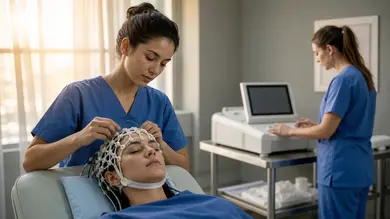
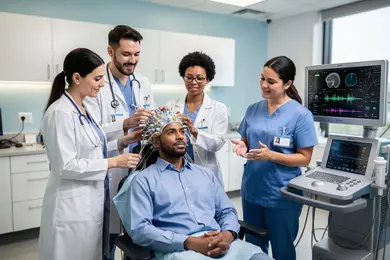
Neurodiagnostic technologists may perform or assist with EEG testing, long-term monitoring, nerve conduction-related procedures, intraoperative monitoring support, sleep studies, patient preparation, electrode placement, equipment troubleshooting, and documentation. Because patient safety and data quality matter, employers often care about verified hands-on competencies as much as classroom grades.
Online coursework can be a strength when it allows working adults to complete theory courses without relocating. The risk comes from programs that treat clinical training as an afterthought. Ask employers in your target area whether they prefer CAAHEP-accredited program graduates, registered EEG technologists, associate-degree holders, or applicants with prior patient-care experience.
Students planning long-term advancement may later consider nursing, management, physician assistant preparation, or graduate certificates. For example, nurses comparing advanced-practice timelines may research the shortest post master's FNP program online, but that is a different credential path with separate licensure and clinical requirements.
How Should You Compare the Fastest Accredited Online Neurodiagnostic Technology Programs?
The best fast accredited online Neurodiagnostic Technology program is the one that lets you finish quickly while preserving accreditation, clinical readiness, certification alignment, affordability, and schedule fit. Do not rank programs only by the shortest advertised timeline.
Use the following steps to compare programs in a practical order. This approach helps you avoid choosing a fast-looking program that becomes slower once transfer reviews, prerequisites, or clinical placements are finalized:
- Verify institutional accreditation and current Neurodiagnostic Technology programmatic accreditation status.
- Ask for the exact degree plan based on your transcripts, not a generic catalog sequence.
- Confirm whether the advertised timeline includes prerequisites, general education courses, clinical hours, and breaks between terms.
- Compare term length, weekly workload, and maximum course load before assuming shorter terms are easier.
- Ask who is responsible for securing clinical placement and what happens if placement is delayed.
- Request total cost, including fees, books, clinical expenses, and certification-related costs.
- Ask which registry or certification exams the curriculum is designed to support.
- Choose the fastest plan you can complete consistently, not the fastest plan on paper.
The table below highlights common mistakes that can delay graduation or reduce the value of the credential. Use it as a final checklist before submitting an application or deposit:
| Common mistake | Why it is risky | Better approach |
| Assuming "accelerated" means every student finishes in the same time | Transfer credits, prerequisites, and clinical placement can change the timeline | Request an individualized completion plan |
| Ignoring programmatic accreditation | Employer and certification expectations may be affected | Verify CAAHEP status and institutional accreditation |
| Confusing shorter terms with lighter coursework | Compressed courses usually increase weekly study demands | Compare weekly workload, not just calendar length |
| Overlooking clinical requirements | Clinical delays can extend even the fastest online program | Confirm clinical-site availability before enrolling |
| Assuming all old credits will transfer | Science credits may expire or transfer only as electives | Get a written transfer evaluation |
| Choosing speed over career fit | The fastest credential may not support your target role | Match the program to employer expectations in your area |
If two programs look equally fast, choose the one with clearer accreditation, stronger clinical placement support, transparent costs, and a written transfer-credit evaluation.
Other Things You Should Know About Neurodiagnostic Technology
EEG technology is one major area within Neurodiagnostic Technology, but the broader field can also include long-term monitoring, intraoperative monitoring support, nerve conduction-related testing, and sleep or evoked-potential procedures depending on training and employer needs.
Yes, accredited programs generally require supervised hands-on clinical experiences. Online coursework can cover theory, anatomy, instrumentation, and procedure concepts, but students still need practical training with patients, equipment, and competency evaluation.
Completion of a program may help prepare you for certification, but eligibility depends on the credentialing organization's rules, your education, clinical experience, and exam pathway. Always confirm certification requirements before enrolling.
Fully self-paced options are uncommon because clinical competencies must be supervised and scheduled. Some courses may be asynchronous, but clinical rotations, labs, exams, and skill checkoffs usually follow fixed deadlines.
References
- Admission Requirements - Neurodiagnostic Technology Institute https://neurodiagnostictechnologyinstitute.com/nti-requirements/
- Guide to Neurodiagnostic Tech Certifications - AAET, ABRET https://www.medicaltechnologyschools.com/neurodiagnostic-technologist/neurodiagnostic-certification
- Electroencephalogram (EEG) or Neurodiagnostic Technologists https://missourihealthcareers.com/careers/electroencephalogram-eeg-or-neurodiagnostic-technologists/
- Neurodiagnostic Technology Training Program https://www.vumc.org/allied-health-education/neurodiagnostic-technology-training
- Career Growth in Neurodiagnostics: How to Advance, Specialize, and Lead in the Field - Neuro Pathway https://myneuropathway.com/blog/career-development-in-neurodiagnostics/
- Neurodiagnostic Tech Certification & Licensure Guide â Trusted Health https://www.trustedhealth.com/allied-career-guide/neurodiagnostic-tech/certification-guide
- Neurodiagnostic Technology https://www.caahep.org/committees-on-accreditation/neurodiagnostic-technology
- Neurodiagnostic Technology Requirements https://www.southeasttech.edu/_showcase/test-pages/neurodiagnostic-technology/requirements.php