2027 Accredited Online Neurodiagnostic Technology Degree Programs With No GRE or GMAT Requirements

Co-Founder and Chief Data Scientist
Choosing an online neurodiagnostic technology degree is often less about test scores and more about accreditation, clinical placement, cost, and career fit. The U.S. Bureau of Labor Statistics' 2024 wage data places broader health technologists and technicians roles above $50,000 in median annual pay, making allied health training a practical path for students who want patient-facing diagnostic work.
This guide is for applicants comparing accredited online or hybrid programs that do not require the GRE or GMAT and want to understand admissions, affordability, quality, and outcomes before applying.
Key Things You Should Know
- Most online neurodiagnostic technology degree programs are undergraduate associate or bachelor's programs, so the GRE and GMAT are usually not part of admissions; applicants are evaluated through GPA, prerequisites, transcripts, healthcare readiness, and clinical eligibility.
- Specialized accreditation matters more than test policy: students should prioritize programs accredited by or aligned with CAAHEP standards because this can affect eligibility for professional credentials such as ABRET's R. EEG T. pathway.
- Cost comparisons should include tuition, clinical travel, background checks, immunizations, uniforms, exam fees, and transfer-credit policies; College Board's 2024-25 data shows average published tuition and fees of $4,050 at public two-year colleges and $11,610 for in-state public four-year colleges.
Which Accredited Online Neurodiagnostic Technology Degree Programs Do Not Require the GRE or GMAT?
Accredited online neurodiagnostic technology programs with no GRE or GMAT requirements are usually not graduate business or research degrees. They are typically associate degrees, bachelor's completion pathways, or online/hybrid allied health programs that combine didactic coursework with supervised clinical training. That means the real question is not whether a GRE or GMAT score is waived, but whether the program is properly accredited, offers clinical placement support, and prepares students for credentialing.
The table below summarizes how students should interpret no-GRE or no-GMAT policies in this field. Program availability, distance format, and accreditation status can change, so applicants should confirm details directly with the school and the CAAHEP program directory before applying.
| Program type | Typical online format | GRE or GMAT status | Accreditation factor to verify | Best fit |
| Associate degree in neurodiagnostic technology | Online lecture courses with in-person clinical rotations | Generally not required because it is an undergraduate program | Institutional accreditation and CAAHEP neurodiagnostic program accreditation | New students seeking entry-level EEG or neurodiagnostic roles |
| Bachelor's degree or completion pathway in neurodiagnostics, neurodiagnostic and sleep science, or clinical neurophysiology | Online or hybrid upper-division coursework with clinical requirements | Generally not required; transfer GPA and prerequisites are more important | Institutional accreditation, programmatic accreditation where available, and clinical-site approval | Transfer students, credentialed technologists, or students seeking broader advancement options |
| Certificate-to-degree pathway | Online general education or completion courses plus prior clinical training | Generally not required | Whether the certificate or prior coursework transfers into an accredited degree | Working technologists who want an academic credential beyond a certificate |
Examples of online or hybrid neurodiagnostic degree options students often investigate include programs such as Labouré College of Healthcare's associate pathway, Rochester Community and Technical College's neurodiagnostic technology pathway, and bachelor-level neurodiagnostics or neurodiagnostic and sleep science options offered through institutions with distance-learning components. However, because clinical-site availability and accreditation status are program-specific, students should treat any list as a starting point rather than a final enrollment decision.
When reviewing a school's admissions page, look for the phrase "GRE not required," "standardized tests not required," or simply an undergraduate admissions checklist that omits graduate entrance exams. If a page does not mention the GRE or GMAT, ask admissions whether the program is test-free, test-optional, or only test-waived for certain applicants.
Why Have Accredited Online Neurodiagnostic Technology Degree Programs Eliminated GRE and GMAT Requirements?
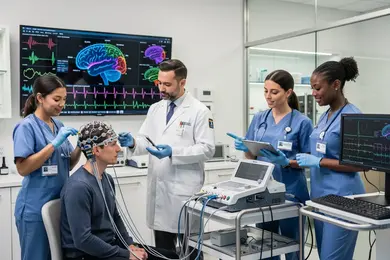
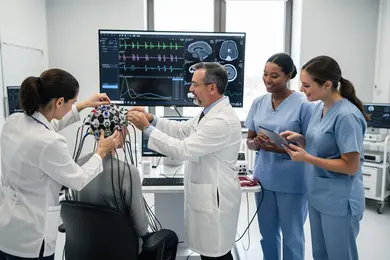
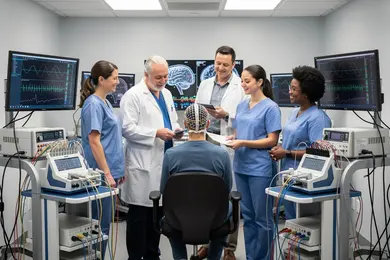
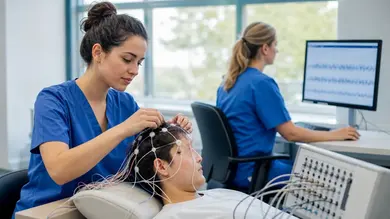
Neurodiagnostic technology programs have moved away from graduate-style standardized testing largely because the field depends on applied technical readiness, patient-care judgment, and supervised clinical competence. A GRE quantitative score does not show whether a student can prepare a patient for EEG monitoring, maintain electrode placement quality, recognize artifacts, document seizure activity, or follow safety protocols in a clinical environment.
Online allied health programs have also become more focused on access for working adults. Many applicants are medical assistants, LPNs, sleep technologists, patient care technicians, or transfer students who can show readiness through healthcare experience rather than standardized test performance. This mirrors a broader healthcare education trend: schools are trying to evaluate persistence, prerequisite mastery, and clinical professionalism instead of relying on exams that may add cost and delay.
For students comparing healthcare pathways, this shift is similar to what is happening in other practical clinical programs, including accelerated nursing and allied health options such as a 9 month LPN program, where admissions often emphasize prerequisites, clinical eligibility, and fit for patient care over graduate entrance testing.
The strongest reason for no-GRE admissions is alignment: neurodiagnostic technology is a competency-based allied health field. Programs still need to be selective, but they can be selective using criteria that better predict success in coursework, labs, and clinical rotations.

What Admissions Criteria Matter Most Without GRE or GMAT Scores?
Without GRE or GMAT scores, admissions committees usually place more weight on academic history and clinical readiness. This can help students who are strong hands-on learners, but it also means weak transcripts or missing prerequisites become harder to offset.
The following criteria typically matter most because they help schools determine whether applicants can handle neuroanatomy, EEG concepts, patient care, and the logistics of clinical training.
- College GPA and science grades: Programs may review cumulative GPA, prerequisite GPA, or grades in anatomy, physiology, biology, psychology, algebra, and medical terminology.
- Completed prerequisites: Missing prerequisite courses can delay admission even when no standardized test is required.
- Healthcare or patient-care experience: Experience as a medical assistant, CNA, LPN, sleep tech, EMT, or hospital volunteer can strengthen an application because it shows comfort in clinical settings.
- Personal statement or interview: Programs may use these to assess professionalism, communication, motivation, and understanding of neurodiagnostic work.
- Clinical eligibility: Background checks, drug screening, immunizations, CPR certification, and ability to travel to clinical sites can affect whether an admitted student can actually continue in the program.
- Transfer-credit fit: Students with prior college coursework should confirm which credits apply to the degree plan before assuming they will graduate faster.
A useful way to think about admissions is that no-GRE does not mean no evidence. It means the evidence shifts from a national exam to your transcript, healthcare readiness, and ability to complete clinical requirements.
Applicants coming from allied health backgrounds should also compare bridge-style options. For example, students currently working as medical assistants may want to compare neurodiagnostic technology with a CCMA to LPN bridge program if their long-term goal is nursing rather than diagnostic testing.
Are No-GRE or No-GMAT Online Neurodiagnostic Technology Degree Programs Easier to Get Into?
No-GRE or no-GMAT online neurodiagnostic technology programs are not automatically easier to get into. They may be easier to apply to because students avoid test registration, preparation time, and exam fees, but admissions can still be competitive when seats are limited by clinical-site capacity.
The distinction between test-free, test-optional, and test-waiver admissions is important. Students should not assume these terms mean the same thing.
| Admissions policy | What it means | How it affects applicants | When submitting scores may help |
| Test-free | The program does not accept or consider GRE or GMAT scores | Your transcript, prerequisites, experience, and application materials carry the decision | It does not help because scores are not reviewed |
| Test-optional | Scores are not required, but the school may review them if submitted | Applicants decide whether scores strengthen the file | Potentially useful if scores are strong and GPA is borderline |
| Test-waiver | The school normally uses a test but waives it for applicants who meet certain conditions | Eligibility may depend on GPA, prior degree, work experience, or recent coursework | Useful only if the program specifically allows score submission after waiver review |
In neurodiagnostic technology, the most common situation is effectively test-free undergraduate admission. However, programs can still deny applicants who lack prerequisites, have low science grades, cannot meet clinical requirements, or apply after seats are filled.
If a program says test scores are optional, submit them only when they add something positive that the rest of your application does not show. A high score may help a borderline academic file, but a rushed or average score rarely compensates for missing prerequisites or weak clinical readiness.
Does Skipping the GRE or GMAT Affect Academic Quality or Accreditation?
Skipping the GRE or GMAT does not reduce academic quality by itself. Accreditation, curriculum standards, faculty qualifications, clinical supervision, and student outcomes are much stronger quality signals than whether a school asks for a graduate entrance exam.
For neurodiagnostic technology, students should pay close attention to programmatic accreditation. CAAHEP-accredited neurodiagnostic programs are reviewed against standards that address curriculum, resources, clinical experiences, and outcomes. Institutional accreditation is also essential because it affects federal financial aid eligibility and transfer-credit recognition.
Quality should be evaluated through evidence that connects training to professional practice. Important indicators include whether the program prepares students for ABRET credentialing pathways, how clinical sites are arranged, whether faculty have neurodiagnostic credentials, and whether students receive enough supervised experience with EEG procedures and related technologies.
Students interested in longer healthcare education pathways should use the same accreditation-first mindset when comparing other regulated healthcare degrees, including an online pharmacy degree, where program approval and licensure alignment matter far more than admissions convenience.
The bottom line is straightforward: employers and credentialing bodies care more about whether you completed legitimate, relevant training than whether you submitted GRE or GMAT scores for an undergraduate allied health program.
Which Students Benefit Most From Online Neurodiagnostic Technology Degree Programs Without GRE or GMAT Requirements?
No-GRE online neurodiagnostic technology programs can be especially useful for students who are ready for healthcare training but do not want standardized testing to slow down enrollment. The best fit is usually someone who can manage science coursework, online learning, and in-person clinical expectations at the same time.
These student profiles tend to benefit most from a no-GRE or no-GMAT format because the admissions model matches their background and goals.
- Working healthcare support staff: Medical assistants, CNAs, EEG aides, sleep lab assistants, and patient care technicians can use work experience to show readiness.
- Adult learners returning to college: Applicants who have been out of school for several years may prefer transcript-based review over standardized testing.
- Transfer students: Students with general education credits can potentially shorten the timeline if the program accepts prior coursework.
- Students seeking a focused diagnostic career: Neurodiagnostic technology can appeal to people who want patient contact and technical work but do not want a broad nursing curriculum.
- Rural or place-bound students: Online didactic coursework can reduce relocation needs, although clinical placement still requires local or regional attendance.
This path may not be ideal for students who want a fully remote degree with no clinical hours, those uncomfortable with neurological conditions or seizure monitoring, or applicants who cannot travel to approved clinical sites. It may also be too narrow for students who want broad administrative leadership roles; those learners may be better served by a program in healthcare administration.
How Do Tuition and Financial Aid Compare for No-GRE Online Neurodiagnostic Technology Degree Programs?
No-GRE admissions can reduce application costs, but it does not automatically make a program affordable. Students should compare total cost of attendance, not just tuition per credit. Online neurodiagnostic technology students may also have clinical-related expenses that are not obvious on a tuition page.
College Board's 2024-25 tuition data gives students a useful benchmark: average published tuition and fees were $4,050 for public two-year in-district students and $11,610 for public four-year in-state students. If an online neurodiagnostic program costs far above those benchmarks, the program may still be worth it, but students should expect clearer evidence of clinical support, credential preparation, and graduation value.
The table below shows the main cost categories to compare before enrolling. This helps students avoid choosing a program only because it has flexible admissions.
| Cost category | Why it matters | Questions to ask |
| Tuition and mandatory fees | This is the largest visible cost, but rates vary by residency, institution type, and course load | Is tuition charged per credit, per term, or by program? Are online students charged extra fees? |
| Clinical placement expenses | Students may need to travel, park, buy uniforms, or complete clinical requirements at their own expense | Does the school arrange clinical sites, or must students find their own? |
| Books, software, and lab supplies | Neurodiagnostic coursework may require specialized learning materials | Are estimated program supply costs published before enrollment? |
| Background checks and health documentation | Clinical sites often require screening, immunization records, CPR certification, and drug testing | Which requirements are due before clinical placement, and who pays for them? |
| Credentialing exam preparation | Graduates may pursue professional credentials after meeting eligibility requirements | Does tuition include exam prep, practice tests, or review materials? |
Students should complete the FAFSA when eligible, ask whether the program qualifies for federal aid, and compare scholarships from the institution, state workforce agencies, hospitals, and allied health foundations. Working students should also ask employers about tuition reimbursement, especially if the employer operates neurology, epilepsy monitoring, sleep, or intraoperative monitoring services.
What Career Outcomes Can Graduates Expect From No-GRE Online Neurodiagnostic Technology Degree Programs?
Graduates of accredited neurodiagnostic technology programs may pursue roles involving EEG testing, long-term epilepsy monitoring, evoked potentials, nerve conduction support, sleep-related diagnostics, or intraoperative neurophysiological monitoring, depending on training and employer requirements. The exact title and scope of practice vary by facility and credential.
The U.S. Bureau of Labor Statistics' 2024 occupational wage data for the broader "health technologists and technicians, all other" category places median pay above $50,000, but students should interpret this carefully. Neurodiagnostic roles can vary by region, shift schedule, credential status, hospital setting, and whether the position involves specialized monitoring such as epilepsy monitoring or operating-room support.
Students should evaluate career value through likely credential pathways rather than assuming the degree alone determines salary. Common professional signals include eligibility for ABRET examinations, supervised clinical experience, familiarity with EEG equipment, patient-safety procedures, documentation accuracy, and the ability to work with neurologists and epilepsy teams.
A neurodiagnostic degree is usually best for students who want a technical clinical career. Students who already hold advanced nursing credentials and want primary care practice authority would be comparing a very different pathway, such as the shortest post master's FNP program online, which leads toward nurse practitioner preparation rather than diagnostic technology.
Career outcomes are strongest when students choose a program that aligns with local employer demand, offers meaningful clinical exposure, and supports credentialing. Before enrolling, applicants should search job postings in their region and note which credentials, shift expectations, and experience levels employers request.
What Common Application Mistakes Reduce Admission Chances to No-GRE Online Neurodiagnostic Technology Degree Programs?
Many applicants overfocus on the phrase "no GRE required" and underinvest in the parts of the application that actually matter. In a clinical allied health program, admissions teams want evidence that you can succeed academically and behave professionally around patients.
The mistakes below commonly weaken applications to no-GRE online neurodiagnostic technology programs. Avoiding them can make the application clearer, stronger, and more realistic.
- Ignoring accreditation: Do not apply until you verify institutional accreditation and, when relevant, CAAHEP neurodiagnostic accreditation or the program's relationship to credentialing eligibility.
- Assuming online means no campus or clinical attendance: Most programs require in-person clinical rotations, lab intensives, or approved healthcare-site participation.
- Submitting a generic personal statement: Explain why neurodiagnostic technology fits your goals, not just why you want a healthcare career.
- Leaving prerequisites unfinished: Missing anatomy, physiology, math, or medical terminology requirements can delay admission even if the program has open seats.
- Underestimating clinical compliance deadlines: Background checks, immunizations, CPR certification, and drug screening can take time and may be required before clinical placement.
- Comparing only tuition: Include fees, travel, equipment, supplies, and lost work hours when estimating affordability.
- Failing to ask about clinical placement responsibility: A program that expects students to secure their own clinical site may be difficult for applicants in areas with few neurology or EEG labs.
A strong application is specific, organized, and evidence-based. It should show that you understand the field, have planned for the clinical component, and are prepared for the academic workload.
How Should Students Compare Accredited Online Neurodiagnostic Technology Degree Programs Without GRE or GMAT Requirements?
The best no-GRE online neurodiagnostic technology program is not simply the fastest or easiest one to enter. It is the program that offers the strongest combination of accreditation, clinical access, affordability, transfer-credit fit, student support, and career alignment.
Use the following step-by-step approach before applying. This sequence helps narrow your options without relying only on rankings or marketing language.
- Verify accreditation first: Confirm institutional accreditation and check whether the neurodiagnostic program has CAAHEP accreditation or a clear credentialing pathway.
- Map the clinical requirement: Ask where clinical rotations occur, who arranges them, how many hours are required, and whether your location is eligible.
- Compare admissions barriers beyond testing: Review GPA minimums, prerequisite courses, healthcare experience expectations, interview requirements, and application deadlines.
- Calculate total cost: Add tuition, fees, supplies, travel, compliance costs, and credentialing preparation expenses.
- Ask about student outcomes: Request available data on retention, graduation, credential exam preparation, job placement support, and employer partnerships.
- Review course delivery: Determine whether classes are asynchronous, synchronous, hybrid, full-time, part-time, or cohort-based.
- Check transfer and prior-learning policies: Ask how previous college credits, healthcare certifications, military medical training, or prior clinical experience are evaluated.
Applicants should also ask admissions counselors direct questions before committing: "Is the GRE or GMAT ever required for this program?" "Can students in my state enroll?" "What happens if a clinical site is unavailable?" "Which credentials are graduates prepared to pursue?" and "What costs are not included in tuition?"
If two programs are similar, choose the one with stronger clinical support and clearer credential alignment rather than the one with the simplest application. Admissions flexibility is valuable, but long-term value comes from completing a respected program that helps you enter the field with confidence.
Other Things You Should Know About Neurodiagnostic Technology
EEG technology is a major part of neurodiagnostic technology, but the broader field can also include long-term monitoring, evoked potentials, nerve conduction support, sleep studies, and intraoperative neurophysiological monitoring depending on training and workplace scope.
Yes. Many work in hospitals, epilepsy monitoring units, neurology clinics, sleep centers, and surgical monitoring environments. Job duties depend on credentials, employer needs, and state or facility policies.
Yes. Even when lectures are online, students normally need supervised clinical experience because neurodiagnostic testing requires patient interaction, equipment setup, safety procedures, and real-time recording skills.
Successful students are detail-oriented, calm with patients, comfortable using technology, able to follow protocols, and willing to work with people who may be anxious, ill, or experiencing neurological symptoms.
References
- Neurodiagnostic Technologist - Salary, How to Become, Job Description & Best Schools https://www.onlinedegree.com/careers/medical-healthcare/neurodiagnostic-technologist/
- Program Information https://orangecoastcollege.edu/academics/consumer-health/allied-health/neurodiagnostic-technology/program-information.html
- Neurodiagnostic Technology, Associate in Science Degree https://catalog.cccd.edu/orange-coast/pathways/careers-healthcare/neurodiagnostic-technology/neurodiagnostic-technology-associate-science-degree/
- Tuition & Fees https://medicaleducation.ascension.org/indiana/st-vincent-neurodiagnostic-program/tuition-and-fees
- Neurodiagnostic Technologist, AAS http://catalog.kellogg.edu/preview_program.php
- Neurodiagnostic Tech Certification & Licensure Guide â Trusted Health https://www.trustedhealth.com/allied-career-guide/neurodiagnostic-tech/certification-guide
- Admission Requirements - Neurodiagnostic Technology Institute https://neurodiagnostictechnologyinstitute.com/nti-requirements/