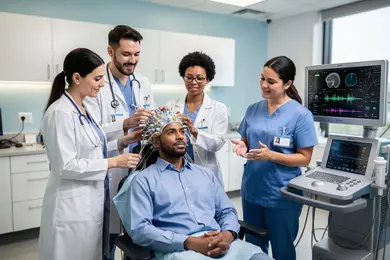
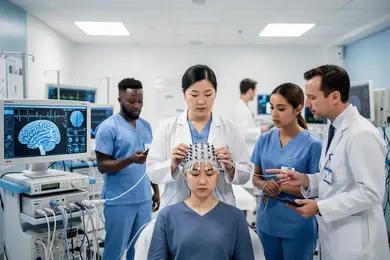
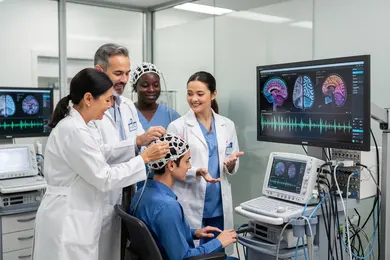
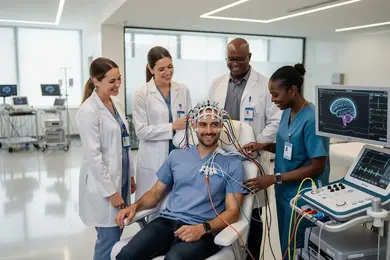
2027 Accredited Online Neurodiagnostic Technology Degree Programs That Accept the Most Transfer Credits

Co-Founder and Chief Data Scientist
If you already have college credits, the right online neurodiagnostic technology degree can save you semesters of coursework and thousands in tuition. This matters because neurodiagnostic technologists support EEG, sleep, epilepsy monitoring, and intraoperative monitoring teams, and BLS May 2024 wage data places the broader health technologists and technicians group that captures many of these roles near the $50,000 median range.
This guide is for students comparing accredited online or hybrid NDT programs, especially those with an associate degree, healthcare coursework, military training, or unfinished college credits.
Key Things You Should Know
- The most transfer-friendly online neurodiagnostic technology pathways are usually bachelor's degree-completion programs, where a 120-credit degree with a 30-credit residency rule may allow up to about 90 transfer credits, although community-college transfer caps often reduce the practical total.
- For associate-level NDT programs, transfer credits usually help most with general education, anatomy and physiology, medical terminology, psychology, math, and English; major clinical NDT courses are less likely to transfer unless they come from a closely aligned accredited program.
- College Board's 2024 pricing data lists average published tuition and fees at $4,050 for public two-year colleges and $11,610 for in-state public four-year colleges, so every accepted three-credit course can materially reduce cost, but only if it applies to degree requirements rather than unused electives.
Which Accredited Online Neurodiagnostic Technology Degree Programs Accept the Most Transfer Credits?
The short answer is that bachelor's degree-completion programs usually accept the most transfer credits, while associate-level neurodiagnostic technology programs tend to be more restrictive because they must protect clinical competency, lab sequencing, and eligibility for registry preparation. Students should compare both the advertised maximum and the number of transferred credits that will actually satisfy the degree plan.
Neurodiagnostic technology is a small specialized field, so the list of accredited online or mostly online options is much shorter than in nursing, healthcare administration, or public health. The table below summarizes transfer-friendly program types and the transfer-credit issues that matter most; students should confirm current CAAHEP accreditation status, online availability, clinical-site requirements, and official transfer limits directly with each school before enrolling.
| Program or pathway type | Typical degree structure | Transfer-credit potential | Best fit | Main caution |
| Online or hybrid bachelor's degree-completion program in neurodiagnostics, neurodiagnostics and sleep science, or allied health with an NDT focus | Usually around 120 credits total with upper-division major, general education, and residency requirements | Often the highest potential, commonly strongest for students bringing an associate degree or 60+ prior credits | Registered or registry-seeking technologists, associate-degree graduates, and students with substantial healthcare coursework | A high maximum transfer limit does not mean all credits apply to the major; some may count only as electives |
| CAAHEP-accredited online or hybrid associate degree in neurodiagnostic technology | Usually a two-year AAS or AS with online didactic courses and in-person clinical experiences | Moderate; strongest for general education and prerequisite courses | Career changers, students without a prior allied health degree, and those seeking entry-level NDT preparation | Core EEG, polysomnography, evoked potential, and clinical practicum courses are often school-specific |
| Community college transfer pathway into a university neurodiagnostic bachelor's completion program | Associate degree first, then upper-division online completion coursework | High if the associate degree aligns with a formal transfer plan or articulation agreement | Students who want lower-division tuition savings before finishing a bachelor's degree | Some universities cap community-college transfer credits, often around the lower-division portion of the degree |
| Allied health bachelor's completion program that accepts NDT registry, healthcare experience, or professional coursework | Broad healthcare degree with possible specialization, electives, or credit for credentials | Variable; can be useful when a dedicated NDT bachelor's option is unavailable | Working technologists who need a bachelor's for advancement, management, education, or graduate study | May not provide the same NDT-specific curriculum depth as a dedicated neurodiagnostic technology degree |
In practice, the "most transfer credits" choice is not always the best choice. A program accepting 90 credits but requiring 45 new credits because many previous courses land as electives may be less efficient than a program accepting 70 credits that applies nearly all of them to general education, prerequisites, and major-support requirements.
How Do Online Neurodiagnostic Technology Degree Programs Evaluate Transfer Credits?
Online neurodiagnostic technology programs usually evaluate transfer credits in two layers: the registrar determines whether courses are institutionally transferable, and the academic department decides whether they satisfy NDT-specific degree requirements. This distinction matters because a course can transfer to the college without shortening the NDT major.
Most schools use a structured review process. Students can improve the result by preparing documents before they apply or immediately after admission.
- Submit official transcripts from every college, university, military program, or approved testing agency attended.
- Request a degree-specific transfer evaluation rather than a general credit estimate, because only the degree audit shows which credits reduce remaining requirements.
- Provide syllabi, course descriptions, lab-hour details, and clinical documentation for science, health, and NDT-related courses.
- Ask whether transferred credits satisfy general education, prerequisites, major requirements, clinical requirements, or electives.
- Confirm minimum grades, course-age limits, accreditation requirements, and whether repeated or pass/fail courses are eligible.
The most common mistake is assuming that "credits accepted" and "credits applied" mean the same thing. For a transfer student, the applied-credit number is the one that determines graduation timeline, tuition savings, and whether the degree plan remains practical.
How Can Transfer Credits Shorten an Online Neurodiagnostic Technology Degree?
Transfer credits shorten an online neurodiagnostic technology degree only when they replace required courses in the curriculum. The biggest time savings usually come from completed general education blocks, prerequisite sciences, prior allied health coursework, and an associate degree that aligns with a bachelor's completion plan.
The table below shows how different transfer-credit levels can affect a typical 120-credit bachelor's completion pathway. These examples are planning estimates, not promises, because course sequencing, clinical placement availability, term length, and part-time enrollment can change the actual timeline.
| Credits applied to degree | Credits remaining in a 120-credit bachelor's plan | Likely time impact | Who this commonly fits |
| 30 applied credits | 90 remaining credits | May reduce about one academic year compared with starting from zero | Students with one year of prior college or a partially completed healthcare program |
| 60 applied credits | 60 remaining credits | Often supports a two-year completion plan if courses are offered in sequence | Associate-degree holders or students with completed lower-division requirements |
| 75 applied credits | 45 remaining credits | Can make completion faster, but only if upper-division major courses are available frequently | Students with an allied health associate degree plus transferable general education |
| 90 applied credits | 30 remaining credits | Usually the practical lower limit for completion because many bachelor's programs require at least 30 institutional credits | Highly prepared transfer students entering a degree-completion format |
Associate-level NDT programs work differently. Even with many prior credits, students may still need to complete a fixed sequence of neuroanatomy, EEG instrumentation, recording techniques, abnormal pattern recognition, patient care, and supervised clinical practice. This is why a transfer-friendly associate program may reduce cost more than it reduces calendar time.
How Much Can Transfer Credits Reduce the Cost of an Online Neurodiagnostic Technology Degree?
Transfer credits can reduce cost by eliminating tuition for courses you do not need to retake, but the savings depend on the school's per-credit tuition, fees, residency requirement, and how many credits apply to required categories. College Board's 2024 data shows average published tuition and fees of $4,050 at public two-year colleges and $11,610 for in-state public four-year colleges, which helps explain why completing transferable lower-division credits before a bachelor's program can be financially powerful.
Use a simple calculation before choosing a program: multiply the number of credits that apply to the degree by the school's tuition per credit, then subtract any extra transfer, technology, lab, clinical, or transcript-evaluation fees. This is also a useful comparison method for students weighing NDT against other transfer-friendly healthcare degrees such as healthcare administration, where more coursework may be available fully online and clinical-site costs may be lower.
The table below illustrates how tuition savings can vary by the number of applied transfer credits. Replace the sample tuition figures with the actual per-credit rate from each school's tuition page before making a decision.
| Applied transfer credits | Estimated savings at $300 per credit | Estimated savings at $500 per credit | Decision point |
| 15 credits | $4,500 | $7,500 | Meaningful if the credits replace prerequisites or general education requirements |
| 30 credits | $9,000 | $15,000 | Can change the affordability of an associate-to-bachelor pathway |
| 60 credits | $18,000 | $30,000 | Often the point where a bachelor's completion program becomes more attractive |
| 90 credits | $27,000 | $45,000 | Potentially high value, but only if the remaining 30 credits meet residency and major requirements |
Do not compare programs by tuition alone. A higher-cost program that accepts and applies more of your credits may cost less overall than a cheaper program that requires you to repeat coursework or take extra electives.
Can Military, Professional, or Prior Learning Credits Transfer to an Online Neurodiagnostic Technology Degree?
Some online neurodiagnostic technology and allied health programs consider military training, professional credentials, standardized exams, employer training, or prior learning assessment, but policies vary widely. These credits are most useful when they replace general education, health science foundations, computer literacy, medical terminology, or lower-division electives.
Students with military or professional backgrounds should ask specific questions because broad transfer language can hide important limits. The following items are especially important for NDT students because clinical competencies and patient-safety requirements are harder to waive than classroom electives.
- Whether the school accepts Joint Services Transcript credit, ACE-recommended coursework, CLEP, DSST, AP, IB, or portfolio-based prior learning.
- Whether professional credentials such as EEG, sleep technology, medical assisting, EMT, respiratory care, or nursing-related coursework can reduce required credits.
- Whether credential-based credit applies to the major, health science core, electives, or only the total credit count.
- Whether the program requires institutional clinical hours even for experienced healthcare workers.
- Whether transferred experiential credit affects eligibility for financial aid, full-time status, or graduation honors.
Students comparing advanced healthcare pathways should also recognize that professional programs differ sharply in how they treat prior coursework. For example, an online pharmacy degree may have strict prerequisite and accreditation rules that are not interchangeable with NDT transfer policies.
Which Types of Previous College Credits Transfer Best to Online Neurodiagnostic Technology Degrees?
The best-transfering credits are usually recent, graded, regionally accredited courses that match the receiving school's curriculum. In NDT programs, general education and supporting science courses transfer more predictably than specialized neurodiagnostic courses because schools must verify lab skills, equipment training, patient interaction, and clinical performance.
The table below ranks common prior credits by how likely they are to help an online NDT student shorten the degree. "High" does not mean automatic acceptance; it means these credits commonly map more easily to standard degree requirements.
| Previous credit type | Transfer usefulness | Why it helps | What to verify |
| English composition, college algebra, statistics, psychology, humanities, and social sciences | High | These courses often satisfy general education blocks | Minimum grade and whether the school requires a complete gen-ed package |
| Anatomy and physiology, biology, medical terminology, and pathophysiology | High to moderate | These support NDT coursework and patient-care preparation | Course age limits, lab requirements, and credit-hour equivalency |
| Prior allied health coursework | Moderate | May satisfy healthcare foundations, patient care, safety, or electives | Whether credits apply beyond electives |
| Neurodiagnostic, sleep, EEG, or electroneurodiagnostic courses from another program | Moderate to low | May be considered if content, lab hours, and clinical outcomes align | Programmatic accreditation, syllabi, competencies, and clinical documentation |
| Developmental, remedial, very old, or ungraded coursework | Low | Often excluded from college-level degree requirements | Institutional exclusions and expiration rules |
Students entering from practical nursing, medical assisting, or other patient-care routes should not assume all healthcare credits will transfer into NDT. A short workforce pathway such as a 9 month LPN program may build useful clinical confidence, but the receiving NDT school still decides whether the coursework fits its degree requirements.
How Do Transfer Agreements Affect Online Neurodiagnostic Technology Degree Completion?
Transfer agreements can make degree completion more predictable by identifying which courses move from one school to another and how they apply to the receiving degree. For NDT students, the most valuable agreements are associate-to-bachelor pathways that preserve lower-division credits and reduce the risk of excess electives.
There are several agreement types students may encounter. Understanding the difference can prevent delays after admission.
- Articulation agreements: These specify how courses from one institution transfer into a particular degree at another institution.
- Block-transfer agreements: These allow a completed associate degree or general education package to satisfy a set of lower-division requirements.
- Reverse-transfer agreements: These let students apply university credits back to a community college to complete an associate degree after transfer.
- Statewide transfer pathways: These standardize parts of transfer for public institutions, although major-specific requirements can still vary.
The main benefit is planning certainty. The main limitation is that agreements often cover general education better than specialized NDT clinical coursework, so students should still request a degree audit before assuming they can finish quickly.
What Transfer Policies Should Students Compare Before Choosing an Online Neurodiagnostic Technology Degree?
Students should compare transfer policies the same way they compare tuition, accreditation, clinical support, and graduate outcomes. A generous transfer maximum is useful only when the school's residency rules, course-matching process, and clinical sequence allow those credits to reduce the real path to graduation.
Before applying, review the following policy details with admissions, the registrar, and the NDT program director. Ask for answers in writing when possible.
- Maximum transferable credits: Find out the total cap and whether separate caps apply to two-year colleges, four-year colleges, testing credit, military credit, or prior learning.
- Residency requirement: Confirm the minimum number of credits that must be completed at the school granting the degree.
- Major-course transfer rules: Ask whether EEG, sleep, neuroanatomy, instrumentation, and clinical practicum courses can transfer.
- Minimum grade requirement: Many schools require a minimum grade for transfer, and some require higher grades for science or major courses.
- Course-age limits: Science, technology, and healthcare courses may expire sooner than humanities or social science courses.
- Accreditation requirements: Credits from regionally accredited institutions usually transfer more smoothly, while programmatic accreditation may matter for NDT-specific coursework.
- Elective-credit treatment: Ask how many elective credits the degree has; excess elective credit may not shorten the degree.
- Clinical placement rules: Verify whether clinical hours must be completed through the program even if you have prior healthcare experience.
Red flags include schools that give only a verbal estimate, refuse to show how credits apply to the degree plan, advertise a high transfer limit without explaining residency requirements, or lack clear information about accreditation and clinical training.
Which Students Benefit Most From Transfer-Friendly Online Neurodiagnostic Technology Degree Programs?
Transfer-friendly online NDT programs are most valuable for students who already have college-level work that maps cleanly to the degree. They are less valuable for students whose credits are outdated, unrelated, remedial, unaccredited, or unlikely to satisfy science and major requirements.
The best candidates usually fall into a few groups. These students should prioritize official transfer evaluation before comparing final cost.
- Students with an associate degree in neurodiagnostic technology, electroneurodiagnostics, sleep technology, respiratory care, nursing, medical assisting, or another allied health field.
- Students who completed general education and prerequisite science courses but did not finish a degree.
- Working healthcare professionals who need a bachelor's degree for advancement, supervision, education, or preparation for graduate study.
- Military-trained healthcare personnel with documented coursework, clinical training, and ACE-recommended credits.
- Students who live near an approved clinical site and need online didactic coursework for flexibility.
Students should avoid choosing a program primarily because it accepts many transfer credits if they are new to healthcare, need extensive hands-on support, cannot secure clinical placement, or want a campus-based lab environment. Someone considering a different clinical ladder, such as a CCMA to LPN bridge program, should compare scope of practice, licensure, clinical hours, and employer demand rather than focusing only on credit transfer.
How Should Students Choose an Online Neurodiagnostic Technology Degree Based on Transfer Efficiency?
The best program is the one that converts your existing education into the fewest remaining required credits while still providing accredited, career-relevant NDT preparation. Transfer efficiency is not just a credit count; it is the relationship between accepted credits, applied credits, remaining tuition, clinical access, accreditation, registry preparation, and career goals.
Use the following decision process before committing to a program. It will help you compare schools on the result that matters: the degree plan you would actually complete.
- Verify institutional accreditation and current programmatic accreditation or employer-recognized status for the NDT pathway.
- Request an official or pre-admission transfer evaluation using all transcripts, syllabi, military documents, test scores, and credential records.
- Ask for a remaining-course plan that separates general education, major requirements, clinical requirements, electives, and residency credits.
- Calculate total remaining tuition and fees, not just tuition per credit.
- Check whether courses are offered every term or only once per year, because sequencing can delay graduation even when many credits transfer.
- Confirm clinical placement expectations, supervision requirements, background checks, immunizations, and any travel costs.
- Compare career alignment, including preparation for EEG or related registry exams, employer recognition, and whether a bachelor's degree supports your advancement goals.
- Choose the program with the strongest combination of applied transfer credits, realistic completion time, manageable cost, clinical feasibility, and career value.
Transfer efficiency matters across healthcare education, but it works differently by credential level. A student comparing NDT with an advanced nursing option such as the shortest post master's FNP program online should remember that graduate certificates, licensure-linked programs, and undergraduate allied health degrees have very different transfer and clinical rules.
Other Things You Should Know About Neurodiagnostic Technology
Usually not. Many programs deliver lectures online, but neurodiagnostic technology requires hands-on clinical practice with patients, equipment, electrodes, recording protocols, and supervised skill checks. Students should expect in-person clinical hours at an approved site.
Not automatically. Accreditation can support eligibility for registry pathways, but certification rules depend on the credentialing organization, exam requirements, clinical documentation, and current eligibility standards. Students should verify requirements for credentials such as EEG or related neurodiagnostic registries before enrolling.
They can be, but career changers should look for strong advising, clinical-placement support, patient-care preparation, and clear lab expectations. Students without healthcare experience may need more structure than working technologists who already understand clinical environments.
Ask whether the school finds clinical sites or expects students to locate them, whether placements are guaranteed, what happens if no site is available nearby, and which costs are outside tuition. Clinical access can determine whether an online program is actually feasible.
References
- Unlocking the Mind: EEG Tech Training and Career Guide - Neuro Pathway https://myneuropathway.com/blog/unlocking-the-mind-eeg-tech-training-and-career-guide/
- Transfer of Credit Policy https://catalog.southuniversity.edu/transfer-of-credit-policy
- Program Information https://orangecoastcollege.edu/academics/consumer-health/allied-health/neurodiagnostic-technology/program-information.html
- Neurodiagnostic Technology https://www.baptistu.edu/neurodiagnostic-technology
- Neurodiagnostic Tech Certification & Licensure Guide â Trusted Health https://www.trustedhealth.com/allied-career-guide/neurodiagnostic-tech/certification-guide
- Neurodiagnostic Technology https://www.caahep.org/committees-on-accreditation/neurodiagnostic-technology