2027 Choosing Public Health BS Coursework for Agricultural Safety Outreach Programs

Co-Founder and Chief Data Scientist
A public health BS can prepare you to help agricultural communities prevent injuries and illness, but the course titles alone do not show whether a program teaches useful outreach skills. Farm safety work combines occupational hazards, communication, community relationships, and evidence-based evaluation. This guide is for students choosing a major, electives, and field experience with that work in mind. It explains what to prioritize, what a bachelor's degree cannot qualify you to do, and how to compare programs before committing time and money.
Key Things You Should Know
- Prioritize environmental and occupational health, community health communication, and program evaluation; seek supervised experience with an agricultural partner.
- A typical US bachelor's degree requires about 120 semester credits, but transfer decisions, course sequencing, and field placements can change the time and cost to finish.
- A public health BS can support entry-level outreach work; it does not by itself qualify you to perform regulated pesticide training, clinical care, or advanced exposure assessment.
What Is a Public Health BS for Agricultural Safety Outreach?
A public health Bachelor of Science (BS) prepares students to address health risks across populations rather than provide individual clinical care. Applied to agriculture, that means helping a farmworker organization, cooperative extension office, health department, or safety program identify concerns and communicate practical prevention measures.
Depending on the setting, those concerns may include heat, machinery, respiratory exposures, pesticide contact, or injuries during animal handling.
Few students need a degree formally named "agricultural safety." A stronger test is whether a public health BS lets you combine occupational and environmental health coursework with community engagement and an approved field project.
An agricultural science or occupational safety degree may be more direct if you want to design technical controls or specialize in farm operations. For a broader view of undergraduate options, compare public health degree choices for undergraduate students against the specific courses and placements you need.
Which Public Health Courses Support Agricultural Safety Outreach Programs?
Build your coursework around the tasks you expect to perform: understand a hazard, work with the people affected, develop a useful message, and check whether outreach reached its audience.
The table distinguishes courses that directly support those tasks from electives whose value depends on your intended role.
| Course area | Contribution to agricultural safety outreach | What to check in the syllabus |
| Environmental and occupational health | Introduces exposure pathways, injury prevention, and the distinction between recognizing hazards and conducting technical assessments. | Coverage of worker health, agricultural settings, and prevention approaches. |
| Community health and health communication | Supports respectful, accessible messages developed with workers and agricultural partners. | Audience research, language access, message testing, and community feedback. |
| Epidemiology and biostatistics | Helps interpret injury or illness patterns without treating a small dataset as proof of causation. | Denominators, bias, uncertainty, and responsible data interpretation. |
| Program planning and evaluation | Connects a stated need to activities, reach measures, and feasible improvements. | Logic models, process measures, qualitative feedback, and reporting. |
| Agricultural science or extension elective | Adds context about farm tasks, seasons, equipment, and local service networks. | Actual agricultural content and opportunities to work across disciplines. |
A workable sequence is introductory public health and statistics first, occupational health and communication next, then an evaluation course alongside a supervised project. If you later want to lead complex exposure studies or statistical analyses, undergraduate data literacy is a foundation - not a substitute for advanced methods training. At that point, comparing professional-friendly biostatistics master's programs may be more useful than adding another general elective.
How Does CEPH Accreditation Affect Public Health BS Program Quality?
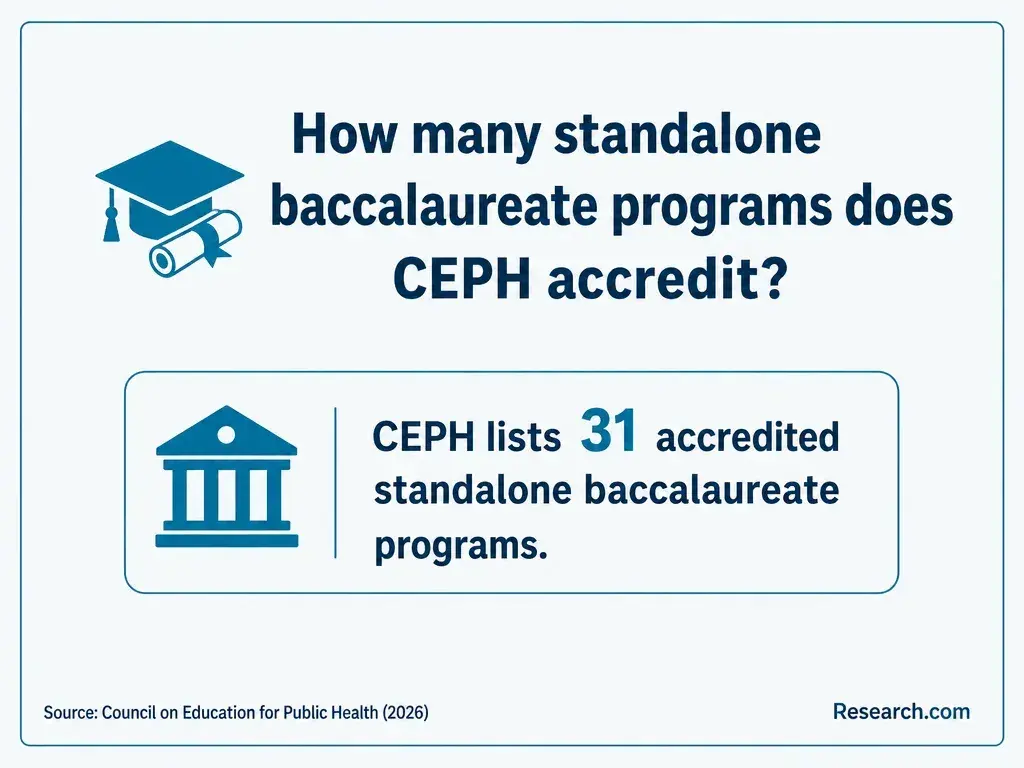
The Council on Education for Public Health (CEPH) accredits eligible public health schools and programs against public health education standards. It is a useful quality signal, but it is not a farm safety specialization or a promise that an undergraduate student can take a particular elective. Institutional accreditation is a separate consideration.
Check the CEPH directory for the exact school or program, its accreditation status, and whether the BS you are considering falls within the accredited unit's scope. Then request the current degree plan and ask whether occupational health, agricultural electives, and relevant placements are available to undergraduates.
If graduate study becomes relevant later, CEPH-accredited online MPH programs require their own review; an institution's graduate accreditation should not be assumed to cover a separate bachelor's program.
The most direct path is supervised outreach or program-support work. A graduate might help an extension educator organize workshops, assist a nonprofit with multilingual materials, or track participation for a farmworker health initiative. Progression toward program leadership usually depends on demonstrated partnership, budgeting, evaluation, and supervisory experience - not the BS alone.
If your goal is research leadership or advanced policy work, decide what that role actually requires before choosing another degree. An MPH may strengthen program and population-health practice; research-oriented graduate training may fit advanced analysis. A doctorate is rarely the immediate next step for someone seeking an entry-level outreach position. Compare public health doctorate costs and career outcomes only if your long-term responsibilities call for doctoral study.
Choose the format that lets you complete both the coursework and credible agricultural field experience. An online program may suit a student who already works near farms or can arrange a local placement. A campus-based program may offer easier access to extension faculty, agricultural laboratories, student groups, or nearby partners. Neither format guarantees a placement.
Ask each program which courses are asynchronous, whether group meetings have fixed times, who arranges field sites, and whether travel or campus visits are required. Confirm how supervisors are approved and how student safety is handled at agricultural sites. Online delivery does not remove seasonal scheduling pressures: an outreach activity tied to planting or harvest may not fit an ordinary class timetable.
If you expect to pursue graduate study after building experience, keep that separate from the BS format decision. Guidance on building a realistic online MPH application list can help later, but it cannot replace checking undergraduate fieldwork access now.
First-year applicants generally apply to the institution, while some schools require a later application to the public health major. Requirements may include prerequisite courses, a minimum GPA, or available space; others admit students directly. Ask admissions which rules apply to your entry term and ask the department when you can begin upper-level occupational health and evaluation courses.
If you are transferring, request a written degree audit. Credits accepted by the university do not necessarily satisfy statistics, science, general education, major, or residency requirements. Bring course descriptions and syllabi for potentially equivalent classes, and confirm when required courses are offered before estimating your graduation date.
Graduate admissions are a separate decision. If an eventual MPH is part of your plan, public health master's conditional admission options may be worth investigating when you are ready; they do not change a BS program's entrance or transfer rules.
A US bachelor's degree commonly totals about 120 semester credits and takes four years of full-time study from first entry. Your remaining time depends on applicable transfer credits, prerequisites, course availability, enrollment pace, and any approved field experience. Ask for a term-by-term plan rather than relying on an advertised completion time.
There is no dependable universal price for a public health BS. Compare the net cost of each feasible route: tuition after confirmed aid, mandatory fees, books, travel to field sites, and income you might forgo during unpaid hours.
Published per-credit rates alone can conceal a costly extra term if a required course is offered infrequently. Use affordable online public health degrees as a starting list, then obtain each school's current charges and an individual degree audit before comparing totals.
Search by duties as well as titles; agricultural outreach positions may sit inside extension, community health, worker protection, or nonprofit programs. The following distinctions help you judge whether a posting is a realistic bachelor's-entry opportunity.
| Role type | Possible responsibilities | Qualification to verify |
| Outreach or program assistant | Coordinate events, prepare materials, maintain partner contacts, and document participation. | Local travel, language skills, and experience working with the intended community. |
| Community health worker | Connect workers with services and share prevention information within an assigned scope. | Employer training and any applicable state certification rules. |
| Health education specialist | Plan, deliver, and assess health education activities. | Required degree field, experience, and any preferred credential. |
| Occupational safety technician | Support workplace inspections, training, and hazard documentation under appropriate supervision. | Technical training and the employer's equipment or site requirements. |
Do not infer eligibility for a role labeled epidemiologist, industrial hygienist, or program director from a few relevant electives; those jobs may require graduate methods training, specialized experience, or other qualifications. Students interested in research-intensive work can investigate affordable epidemiology doctoral study with aid later, after establishing whether research is the career goal.
No national wage figure describes "agricultural safety outreach graduates" as a group. US Bureau of Labor Statistics occupation data for health education specialists, community health workers, and occupational health and safety technicians can provide separate benchmarks, but each category includes employers and duties outside agriculture. Its occupation-wide median is not an entry-level offer or the earnings outcome of a particular BS.
For a useful estimate, identify the occupation that matches the job's actual duties, check the latest BLS Occupational Outlook Handbook wage reference year and projection period, then compare current local postings with similar experience requirements.
Weigh projected growth against the number and location of relevant openings: a favorable national outlook does not guarantee agricultural outreach vacancies near you.
Graduate education should be evaluated against a specific role requirement and its full cost, not an occupation-wide wage alone. If you are considering an MPH after working in outreach, comparing tuition with public health graduate outcomes can frame that later financial decision without treating a published salary as a promised return.
Which Certifications Support Agricultural Safety Outreach Careers?
A certification is useful when it matches a job's duties and eligibility rules. The Certified Health Education Specialist (CHES) credential may be relevant to health education roles, but candidates must meet the National Commission for Health Education Credentialing's current academic eligibility rules and pass its examination.
The Certified in Public Health (CPH) credential has different eligibility pathways set by the National Board of Public Health Examiners. A public health BS does not automatically award either credential.
For farm-specific work, employer-approved safety training may matter more immediately than a general credential. Pesticide safety instruction, for example, can carry requirements under the Environmental Protection Agency's Worker Protection Standard; do not assume that taking a pesticide elective authorizes you to train workers. Check the applicable rule and employer responsibilities before accepting that task.
If a position instead requires graduate public health preparation, a short certification may not close the gap. Compare the actual degree requirement and financing options, including public health graduate tuition after institutional funding, before enrolling.
Other Things You Should Know About Public Health
No. Learn local agricultural tasks and seasons, work with experienced partners, and avoid assuming that one farm community represents another.
Work with qualified language professionals and community reviewers. Do not rely on an unreviewed translation for safety-critical instructions.
Only with the data owner's permission and your program's required oversight. Remove identifiers where appropriate, follow any data-use agreement, and do not publish restricted details in a portfolio.
Agree on a modest deliverable the partner wants, such as a reviewed resource guide or event plan. Set a feasible timeline and allow the partner to check accuracy before the material is shared.
- Safety Management - A safe workplace is sound business | Occupational Safety and Health Administration http://www.osha.gov/safety-management
- Overcoming language and literacy barriers in safety... - PubMed https://pubmed.ncbi.nlm.nih.gov/20665309/
- Student Participation in Community-Based Participatory... - PMC https://pmc.ncbi.nlm.nih.gov/articles/PMC6774665/
- Health Communication with Refugee, Immigrant, and Migrant Communities | CDC Yellow Book™ https://www.cdc.gov/yellow-book/hcp/refugees-immigrants-migrants/health-communication-with-refugee-immigrant-and-migrant-communities.html
- Agricultural and Farm Safety | usda.gov https://www.nifa.usda.gov/topics/agricultural-farm-safety
- Bachelor of Science in Environmental & Occupational Health Science | Western Kentucky University https://www.wku.edu/school-of-health-and-social-services/programs/undergraduate/environmental-occupational-health-science/index.php
- EPA Worker Protection Standard for Agricultural Pesticides | Early Learning Professionals (Better Kid Care) https://extension.psu.edu/epa-worker-protection-standard-for-agricultural-pesticides/
- Occupational and Environmental Health Sciences Major | purdue.edu https://hhs.purdue.edu/undergraduate-majors/occupational-and-environmental-health-sciences/
- Section 11. Participatory Evaluation - Community Tool Box https://ctb.ku.edu/en/table-of-contents/overview/model-for-community-change-and-improvement/participatory-evaluation/main