2027 Choosing an Online Ed.D. in Leadership and Learning in Organizations Around Working in a Different Time Zone from Live Classes
Audited and Verified:
Our Editorial and Data Verification Process
Research.com uses government datasets, official education statistics and primary institutional information to support its career and degree guides. Our review process checks factual accuracy, occupational definitions, source dates and the requirements associated with the credentials discussed.
How This Article Was Fact-Checked
Our editorial team verifies salary estimates, employment projections, education requirements and program information against original data providers and official organizations. Salary figures are checked against the relevant occupational definitions and reporting periods. Information about licensure, accreditation and required in-person training is reviewed separately.
Fact-checked and verified on:

Co-Founder and Chief Data Scientist
An online Ed.D. may let you study from another time zone without letting you choose when class meets. For a working professional, a required live session can collide with a shift, a commute, or the hours reserved for family.
This guide shows you how to test whether an Ed.D. in Leadership and Learning in Organizations fits your schedule - not just your career goals. You'll learn which commitments to verify, how to plan for conflicts, and when a more flexible program or a shorter development route is the better choice.
Key Things You Should Know
- Online does not mean self-paced: verify the time zone, frequency, and attendance rules for every required live class before enrolling.
- A hypothetical 7 p.m. Eastern class starts at 4 p.m. Pacific - a material difference if your workday has not ended.
- Compare class meetings with group work, project milestones, and any campus convenings; a workable weekly slot alone does not establish that the degree is feasible.
What is an online Ed.D. in Leadership and Learning in Organizations?
An Ed.D. is a professional doctorate that generally emphasizes applying research and leadership concepts to problems in practice. A program focused on leadership and learning in organizations may examine how adults learn at work, how leaders implement change, and how organizations evaluate development efforts. Its exact degree name and requirements depend on the university.
"Online" describes where much of the instruction occurs, not necessarily when it occurs. Some programs combine independent coursework with scheduled video classes, cohort discussions, team projects, or campus convenings. Before comparing convenience claims, establish which of those activities are required in the specific program. A broadly focused organizational Ed.D. also should not be mistaken for preparation for school-administrator licensure.
How do live online classes work across different time zones?
Programs may publish meeting times in the institution's local time zone or another designated zone. You are responsible for converting them to your location and checking whether the schedule changes by term. A recording, when offered, may support review without replacing participation required for attendance or assessment.
The following comparison shows why the published class time is only the starting point for a scheduling decision. The times are illustrative, not a particular university's schedule.
| Program activity | Illustrative scheduling issue | What to verify |
| Weekly live class | A 7 p.m. Eastern start is 4 p.m. Pacific. | Required attendance, meeting length, and term-by-term schedule |
| Small-group work | Members may need another shared meeting window. | Whether meetings are required and how teams set times |
| Faculty or project meetings | Availability may differ from class hours. | Appointment windows and any required real-time checkpoints |
| Campus convening | Travel can require time away from work. | Dates, location, attendance rules, and travel responsibility |
Convert actual meeting dates rather than relying on a standing time-zone difference, particularly if you live somewhere that changes clocks on different dates from the institution. Ask for the academic calendar and a recent course schedule; neither an advertised "evening" format nor a sample week establishes your entry term's commitments.
How can working professionals manage time-zone conflicts in an online Ed.D. program?
Start with your least flexible obligations: shifts, caregiving, and recurring work meetings. Then assess the whole term, not just a typical class night. Group assignments and applied research can create additional meetings, while deadlines may cluster near the end of a course.
Use these steps to test a program against your actual calendar before making a commitment:
- Obtain required live-session days, start times, meeting lengths, and attendance policies in writing, then convert dates to your local time.
- Block a sample term that includes classes, independent work, team meetings, and any required travel; flag conflicts you cannot routinely move.
- Ask your employer about a specific schedule adjustment, and ask the program which accommodations or alternative sections, if any, it actually permits.
- Plan for a changed shift, employer, or project partner; confirm leave, deferral, and reentry rules before relying on them.
An employer's willingness to release you early is separate from a university's attendance policy. Likewise, a recording is not an approved absence unless the program says so. If you are returning to doctoral study after all-but-dissertation status, planning an online Ed.D. return after ABD status calls for a separate check of reentry and remaining research requirements; a convenient class schedule does not settle those issues.
What accreditation should an online Ed.D. in organizational leadership have?
Confirm that the university holds institutional accreditation recognized by the U.S. Department of Education or the Council for Higher Education Accreditation. Check the accreditor's official directory and the university's current status, then confirm that the Ed.D. is an awarded degree at that institution. Accreditation applies at a defined scope; a university's status alone does not establish that a particular program leads to a license or certification.
If your goal is a regulated education role, ask the program for its licensure disclosure and check the relevant state authority's requirements. If your goal is organizational learning or leadership outside a licensed role, place greater weight on curriculum, faculty guidance, project structure, and whether you can meet the live schedule.
What coursework does an online Ed.D. in Leadership and Learning include?
Relevant study may cover adult learning, leadership and organizational change, research methods, needs assessment, and program evaluation. Look beyond course titles: a working learning-and-development professional may need stronger evaluation skills, while an experienced manager may need more preparation in learning design. Confirm which courses are required, which are electives, and when each is offered.
The culminating requirement matters to your calendar. A dissertation in practice, capstone, or other applied project can involve faculty meetings, organizational access, and deadlines that are less predictable than weekly classes. These formats are not interchangeable. If project format affects your choice, review choosing an Ed.D. with an applied capstone option, then verify the prospective program's actual deliverable and approval process. Permission to study workplace data must be addressed separately from permission to attend class during work hours.
What are the admission requirements for an online Ed.D. program?
Requirements vary by institution. Programs may ask for a completed graduate degree, transcripts, evidence of professional experience, recommendations, a statement of purpose, and an interview. Ask admissions whether your academic background qualifies and what preparation is recommended for doctoral research; do not assume an education master's or a particular job title is universally required.
If you have an Ed.S. or other prior graduate study, distinguish credits considered for admission from credits actually applied to the doctorate. Advanced study options after an Ed.S. can help frame that comparison, but only the institution can evaluate your transcript and confirm any effect on required coursework. Applicants studying from outside the United States should also confirm overseas enrollment eligibility and any credential-evaluation requirements directly with admissions.
How long does an online Ed.D. take, and how much does it cost?
Completion time depends on required credits, course sequencing, enrollment pace, and progress on the culminating project. The price depends on the school's tuition structure and fees; online study may still bring travel, technology, and time-away-from-work costs. Request a term-by-term plan and a written cost breakdown rather than calculating either from the advertised course schedule alone.
When planning a budget for doctoral study in education, include the financial consequence of a schedule conflict: reducing work hours, taking leave for a convening, or extending enrollment can change the total substantially. Confirm employer reimbursement limits and continued-employment conditions before counting that assistance as funding.
What careers can an online Ed.D. in Leadership and Learning prepare you for?
The degree may support experienced professionals pursuing broader responsibility in learning and development, organizational development, workforce training, consulting, or education-adjacent administration. The work differs: a training manager directs development programs and staff, while an organizational consultant may diagnose processes and recommend changes. Employers will assess relevant leadership, implementation, and evaluation experience alongside the credential.
For someone seeking a specific promotion, compare the role's actual requirements with the program's applied opportunities. If the missing qualification is supervised management experience or a focused technical skill, an employer leadership assignment or targeted training may be more direct - and easier to schedule - than a doctorate.
What salary and job outlook can Ed.D. graduates expect?
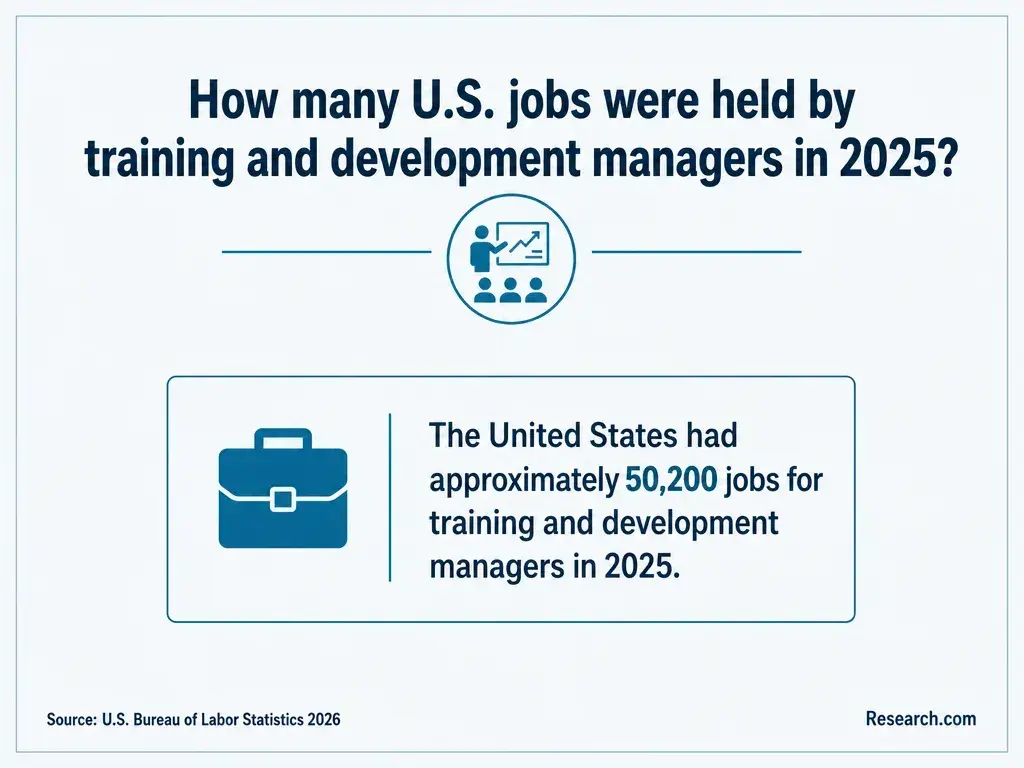
The U.S. Bureau of Labor Statistics lists a $133,000 median annual salary for training and development managers in May 2025 and projects 6.4% employment growth for that occupation from 2025 to 2035. Those are occupation-wide figures, not salaries or placement outcomes for Ed.D. graduates. They are most useful if you already have - or can realistically build - the management experience the role requires.
Salary prospects also depend on sector, location, responsibilities, and employer. Before using earnings to justify tuition or a recurring work-schedule change, compare openings you would actually pursue with your present experience and compensation.
What is an online Ed.D. in Leadership and Learning in Organizations?
An Ed.D. is a professional doctorate that generally emphasizes applying research and leadership concepts to problems in practice. A program focused on leadership and learning in organizations may examine how adults learn at work, how leaders implement change, and how organizations evaluate development efforts. Its exact degree name and requirements depend on the university.
"Online" describes where much of the instruction occurs, not necessarily when it occurs. Some programs combine independent coursework with scheduled video classes, cohort discussions, team projects, or campus convenings. Before comparing convenience claims, establish which of those activities are required in the specific program. A broadly focused organizational Ed.D. also should not be mistaken for preparation for school-administrator licensure.
How do live online classes work across different time zones?
Programs may publish meeting times in the institution's local time zone or another designated zone. You are responsible for converting them to your location and checking whether the schedule changes by term. A recording, when offered, may support review without replacing participation required for attendance or assessment.
The following comparison shows why the published class time is only the starting point for a scheduling decision. The times are illustrative, not a particular university's schedule.
| Program activity | Illustrative scheduling issue | What to verify |
| Weekly live class | A 7 p.m. Eastern start is 4 p.m. Pacific. | Required attendance, meeting length, and term-by-term schedule |
| Small-group work | Members may need another shared meeting window. | Whether meetings are required and how teams set times |
| Faculty or project meetings | Availability may differ from class hours. | Appointment windows and any required real-time checkpoints |
| Campus convening | Travel can require time away from work. | Dates, location, attendance rules, and travel responsibility |
Convert actual meeting dates rather than relying on a standing time-zone difference, particularly if you live somewhere that changes clocks on different dates from the institution. Ask for the academic calendar and a recent course schedule; neither an advertised "evening" format nor a sample week establishes your entry term's commitments.
How can working professionals manage time-zone conflicts in an online Ed.D. program?
Start with your least flexible obligations: shifts, caregiving, and recurring work meetings. Then assess the whole term, not just a typical class night. Group assignments and applied research can create additional meetings, while deadlines may cluster near the end of a course.
Use these steps to test a program against your actual calendar before making a commitment:
- Obtain required live-session days, start times, meeting lengths, and attendance policies in writing, then convert dates to your local time.
- Block a sample term that includes classes, independent work, team meetings, and any required travel; flag conflicts you cannot routinely move.
- Ask your employer about a specific schedule adjustment, and ask the program which accommodations or alternative sections, if any, it actually permits.
- Plan for a changed shift, employer, or project partner; confirm leave, deferral, and reentry rules before relying on them.
An employer's willingness to release you early is separate from a university's attendance policy. Likewise, a recording is not an approved absence unless the program says so. If you are returning to doctoral study after all-but-dissertation status, planning an online Ed.D. return after ABD status calls for a separate check of reentry and remaining research requirements; a convenient class schedule does not settle those issues.
Confirm that the university holds institutional accreditation recognized by the U.S. Department of Education or the Council for Higher Education Accreditation. Check the accreditor's official directory and the university's current status, then confirm that the Ed.D. is an awarded degree at that institution. Accreditation applies at a defined scope; a university's status alone does not establish that a particular program leads to a license or certification.
If your goal is a regulated education role, ask the program for its licensure disclosure and check the relevant state authority's requirements. If your goal is organizational learning or leadership outside a licensed role, place greater weight on curriculum, faculty guidance, project structure, and whether you can meet the live schedule.
Relevant study may cover adult learning, leadership and organizational change, research methods, needs assessment, and program evaluation. Look beyond course titles: a working learning-and-development professional may need stronger evaluation skills, while an experienced manager may need more preparation in learning design. Confirm which courses are required, which are electives, and when each is offered.
The culminating requirement matters to your calendar. A dissertation in practice, capstone, or other applied project can involve faculty meetings, organizational access, and deadlines that are less predictable than weekly classes.
These formats are not interchangeable. If project format affects your choice, review choosing an Ed.D. with an applied capstone option, then verify the prospective program's actual deliverable and approval process. Permission to study workplace data must be addressed separately from permission to attend class during work hours.
Requirements vary by institution. Programs may ask for a completed graduate degree, transcripts, evidence of professional experience, recommendations, a statement of purpose, and an interview. Ask admissions whether your academic background qualifies and what preparation is recommended for doctoral research; do not assume an education master's or a particular job title is universally required.
If you have an Ed.S. or other prior graduate study, distinguish credits considered for admission from credits actually applied to the doctorate. Advanced study options after an Ed.S. can help frame that comparison, but only the institution can evaluate your transcript and confirm any effect on required coursework. Applicants studying from outside the United States should also confirm overseas enrollment eligibility and any credential-evaluation requirements directly with admissions.
Completion time depends on required credits, course sequencing, enrollment pace, and progress on the culminating project. The price depends on the school's tuition structure and fees; online study may still bring travel, technology, and time-away-from-work costs. Request a term-by-term plan and a written cost breakdown rather than calculating either from the advertised course schedule alone.
When planning a budget for doctoral study in education, include the financial consequence of a schedule conflict: reducing work hours, taking leave for a convening, or extending enrollment can change the total substantially. Confirm employer reimbursement limits and continued-employment conditions before counting that assistance as funding.
The degree may support experienced professionals pursuing broader responsibility in learning and development, organizational development, workforce training, consulting, or education-adjacent administration. The work differs: a training manager directs development programs and staff, while an organizational consultant may diagnose processes and recommend changes. Employers will assess relevant leadership, implementation, and evaluation experience alongside the credential.
For someone seeking a specific promotion, compare the role's actual requirements with the program's applied opportunities. If the missing qualification is supervised management experience or a focused technical skill, an employer leadership assignment or targeted training may be more direct - and easier to schedule - than a doctorate.
The U.S. Bureau of Labor Statistics lists a $133,000 median annual salary for training and development managers in May 2025 and projects 6.4% employment growth for that occupation from 2025 to 2035. Those are occupation-wide figures, not salaries or placement outcomes for Ed.D. graduates. They are most useful if you already have - or can realistically build - the management experience the role requires.
Salary prospects also depend on sector, location, responsibilities, and employer. Before using earnings to justify tuition or a recurring work-schedule change, compare openings you would actually pursue with your present experience and compensation.
How should you choose a reputable online Ed.D. program?
Shortlist programs only after establishing both academic fit and schedule fit. Ask each program for the same entry-term information: a course sequence, live-meeting schedule, attendance policy, group-work expectations, convening dates, culminating-project rules, and a complete cost breakdown. Confirm important answers with the program office rather than relying on general descriptions of online learning.
Use cost-focused selection of a Doctor of Education program to identify options worth examining, but do not let a lower advertised price outweigh a live schedule you cannot sustain. Favor a program when its required meetings fit your ordinary week and you have a credible plan for project-stage peaks and changes at work. If neither condition holds, defer enrollment or choose a more flexible development pathway.
Other Things You Should Know About EdD Leadership
It can, especially if your location and the university change clocks on different dates. Convert the published meeting time for each actual class date and confirm the time zone the program uses.
Possibly, but confirm the university permits enrollment from your location and that you can access required services and attend scheduled activities. Online enrollment does not itself provide U.S. immigration or work authorization.
Contact the university's accessibility office early to discuss your needs and its process. Do not assume a recording or transcript will automatically be provided or will substitute for required participation.
Use the time zone specified in the syllabus or learning platform, and ask the instructor if it is unclear. A deadline shown as midnight may fall on a different local date where you live.
- 9 FAM 402.5 (U) STUDENTS AND EXCHANGE VISITORS | state.gov https://fam.state.gov/fam/09FAM/09FAM040205.html
- Distance Learning Instruction Planning Guidance | ca.gov https://www.cde.ca.gov/ls/he/hn/guidanceplanning.asp
- Online group projects in higher education - PMC https://pmc.ncbi.nlm.nih.gov/articles/PMC10038701/
- Classroom and Event Recording Policy | Georgetown Law https://www.law.georgetown.edu/your-life-career/campus-services/information-systems-technology/policies-and-initiatives/recording-policy/
- Class Attendance - Undergrad Inside https://undergrad-inside.wharton.upenn.edu/attendance/
- Class Attendance Policy - Seton Hall Law School https://law.shu.edu/policies/class-attendance.html
- Doctor of Education in Educational Leadership - USC Online https://online.usc.edu/programs/educational-leadership/
- What's the Difference Between Asynchronous and Synchronous Learning? | Ohio State Online https://online.osu.edu/content-hub/blogs/whats-the-difference-between-asynchronous-and-synchronous-learning/
- Strategies for Teaching Students in Different Time Zones | Carnegie Mellon University https://www.cmu.edu/teaching/online/designteach/strategies/timezones.html
- Academic Residencies, Labs, and Intensives Requirements | Academics at Walden University https://academics.waldenu.edu/handbook/learning-modalities/residency-lab-intensive-requirements