2027 Choosing an Online Ed.D. in Leadership and Learning in Organizations for Leadership in Distributed Global Companies
Audited and Verified:
Our Editorial and Data Verification Process
Research.com uses government datasets, official education statistics and primary institutional information to support its career and degree guides. Our review process checks factual accuracy, occupational definitions, source dates and the requirements associated with the credentials discussed.
How This Article Was Fact-Checked
Our editorial team verifies salary estimates, employment projections, education requirements and program information against original data providers and official organizations. Salary figures are checked against the relevant occupational definitions and reporting periods. Information about licensure, accreditation and required in-person training is reviewed separately.
Fact-checked and verified on:

Co-Founder and Chief Data Scientist
Leading learning across a distributed company involves more than delivering training online. Teams work across time zones, local expectations differ, and a program that succeeds in one region may not transfer to another.
For experienced leaders and learning professionals, an online Ed.D. in Leadership and Learning in Organizations may offer a way to study those challenges while working. This guide explains what to look for in a program, what doctoral study can - and cannot - add to your leadership practice, and how to decide whether the commitment fits your role and organization.
Key Things You Should Know
- Choose for evidence of cross-region organizational learning, applied evaluation, and workable live-session times - not the word "online" alone.
- Confirm that you can obtain an approved, ethical project setting and appropriate organizational data before relying on a workplace capstone.
- The U.S. median pay for training and development managers was $133,000 in May 2025, but that occupational figure is not an Ed.D. graduate salary or a promised return.
What is an online Ed.D. in Leadership and Learning in Organizations?
An online Doctor of Education, or Ed.D., in this area is a practice-oriented doctorate concerned with how people learn and how organizations lead change. Depending on the university, "Leadership and Learning in Organizations" may be an exact program name, a concentration, or simply a description of the curriculum. Check what the institution actually awards rather than assuming these labels are interchangeable.
For a leader in a distributed company, the relevant distinction is between studying organizational problems and acquiring a general leadership credential. A suitable Ed.D. should help you frame a consequential workplace problem, examine evidence, test or evaluate a response, and communicate limitations to decision-makers. It does not substitute for managing people across regions, understanding local operations, or having authority to implement change.
If your principal goal is original scholarship and an academic research career, compare research-focused PhD programs. A DBA may fit a business-research question more closely; an MBA or focused executive education may be more direct if you chiefly need finance, operations, or management preparation.
Applicants who have already completed doctoral coursework should investigate doctoral completion options for ABD education students rather than assume they must start a new Ed.D. Neither an ABD designation nor previous credits guarantees an accelerated path.
How does an online Ed.D. prepare leaders for distributed global companies?
The strongest fit is a program that treats distance as an organizational design problem, not merely a video-meeting problem. Distributed leaders must build shared practices while allowing for different time zones, languages, employment arrangements, and local decision rights. Doctoral study can strengthen their ability to distinguish a learning gap from a problem caused by incentives, unclear authority, or a poorly designed workflow.
Consider a hypothetical company whose regional teams adopt a new process at different rates. An applied inquiry might compare how teams receive guidance, gather interviews about implementation barriers, and examine appropriately authorized, aggregated process measures. It could inform a revised support plan. It could not, without a suitable design, prove that training caused a performance change. Differences in staffing, systems, and local conditions matter.
Look for faculty guidance on cross-cultural inquiry, adult learning, organizational change, and evaluation across sites. A useful program should also make its project rules clear: Can a student work with multiple offices or an external partner? Who approves the site, methods, and data access? Employer permission, academic approval, privacy review, and permission to share findings are separate questions.
A global company's access to employee records does not automatically authorize a doctoral student to use them.
How do you choose an accredited online Ed.D. program?
Start by confirming the university's institutional accreditation through the accreditor and the U.S. Department of Education's recognized-accreditor information. Then verify the exact degree, its home school, and its curriculum with the institution. Institutional accreditation is important, but it does not establish that a particular doctorate teaches global organizational leadership or qualifies graduates for a regulated role.
Compare programs using questions tied to the work you expect to do. Request answers for your intended entry term, since schedules and requirements can change:
- Learning fit: Which required courses address adult learning, organizational diagnosis, change implementation, and evaluation? Which relevant electives actually run?
- Applied work: Is the final requirement an individual dissertation in practice, team capstone, or another project? Can an approved project span company regions?
- Access and support: Who advises students on research design, data permissions, and projects involving multiple jurisdictions?
- Participation: When are live classes and group meetings held, what attendance is required, and are there campus convenings?
- Outcomes: Are completion and career claims based on defined cohorts and observation periods, or only on selected graduate stories?
Ask for written policies or a current handbook, not just an admissions summary. If your intended setting is a college or university rather than a company, compare Ed.D. options for organizational improvement in colleges; their governance and stakeholder demands may call for a different emphasis.
Relevant study typically connects leadership theory with adult learning, organizational development, and applied research. For a distributed company, course titles matter less than whether students learn to diagnose uneven performance, design learning that transfers into work, and evaluate implementation without overstating results. Required courses and elective depth vary by program.
A particularly useful sequence moves from needs assessment to intervention design and then to evaluation. For example, a leader might examine why managers in different regions interpret a shared process differently before proposing training. Qualitative interviews could uncover workflow barriers; quantitative measures could show where variation occurs. Neither method alone identifies a cause automatically, and employee data require appropriate access and safeguards.
Examine the final doctoral requirement as carefully as the courses. Professional education doctorates with applied projects can differ substantially in faculty oversight, team arrangements, deliverables, and research review. A capstone is not necessarily easier than a dissertation, and a consulting assignment for your employer does not automatically meet academic requirements.
Requirements vary by university. Programs may request a completed master's degree or other specified graduate preparation, professional experience, transcripts, recommendations, a statement of purpose, and an interview. Some ask applicants to describe a problem of practice. Confirm whether tests, minimum grades, or particular experience thresholds apply to the program you are considering; none is universal across online Ed.D. degrees.
An applicant from business, technology, healthcare, government, or learning and development can make a strong case by documenting actual responsibility: decisions made, people or functions coordinated, and an organizational problem they are prepared to examine. Avoid presenting an unapproved employer project as if access were secured. Explain the question, your relevant experience, and what permissions you would still need.
Prior graduate study may help establish admission eligibility without transferring into the doctorate. Applicants with an education specialist degree should consider reviewing Ed.S.-to-Ed.D. transition requirements and seek a written, program-specific credit evaluation. The same caution applies to credits from unfinished programs: admission review, course substitution, and reduced time to completion are different decisions.
There is no reliable universal duration or price for this degree. A program's published schedule may depend on cohort sequencing, enrollment intensity, course availability, and how long the final project takes. Request the current course sequence and completion rules, including what happens if your employer changes or your project site becomes unavailable.
Build a total-cost estimate from the institution's stated tuition basis - per credit, term, or program - plus mandatory fees, required credits, possible tuition increases, travel and lodging for convenings, and any costs associated with extending enrollment. For a leader working across regions, missed work time and the scheduling demands of a project can matter as much as travel. Do not treat a posted tuition figure as the full cost.
Before enrolling, obtain your employer's education-benefit policy in writing. Check annual limits, eligibility of doctoral study, payment timing, grade or continued-employment conditions, and any repayment obligation after departure. Resources on employer tuition support for higher education leadership study can help frame the questions, but your company's policy - not another employer's example - controls your reimbursement.
Compare the remaining cost with a smaller development investment if your goal does not require a doctorate.
Online delivery can remove a regular commute, but it does not necessarily remove scheduled attendance. The comparison below separates where learning happens from the obligations that determine whether you can participate while leading a distributed team.
| Feature | Online Ed.D. | Campus-based Ed.D. |
| Class participation | May combine live sessions, asynchronous work, and scheduled group meetings | Usually centers on scheduled in-person classes and meetings |
| Travel | May still require campus convenings or project travel | Requires regular campus access; project travel may also apply |
| Peer collaboration | Relies heavily on planned remote coordination | Offers more routine in-person contact |
| Project access | Can support inquiry near a student's workplace, subject to approval | Can also support workplace inquiry, subject to approval |
For someone coordinating colleagues across U.S. and overseas offices, the deciding issue may be the fixed class time rather than the delivery label. Ask for a sample term schedule showing live classes, group work, and convenings.
Check attendance and leave policies before assuming a recording will replace a missed meeting. Campus study may be preferable if local faculty access and in-person research collaboration outweigh the commute; online study may fit better when its actual schedule works with your job.
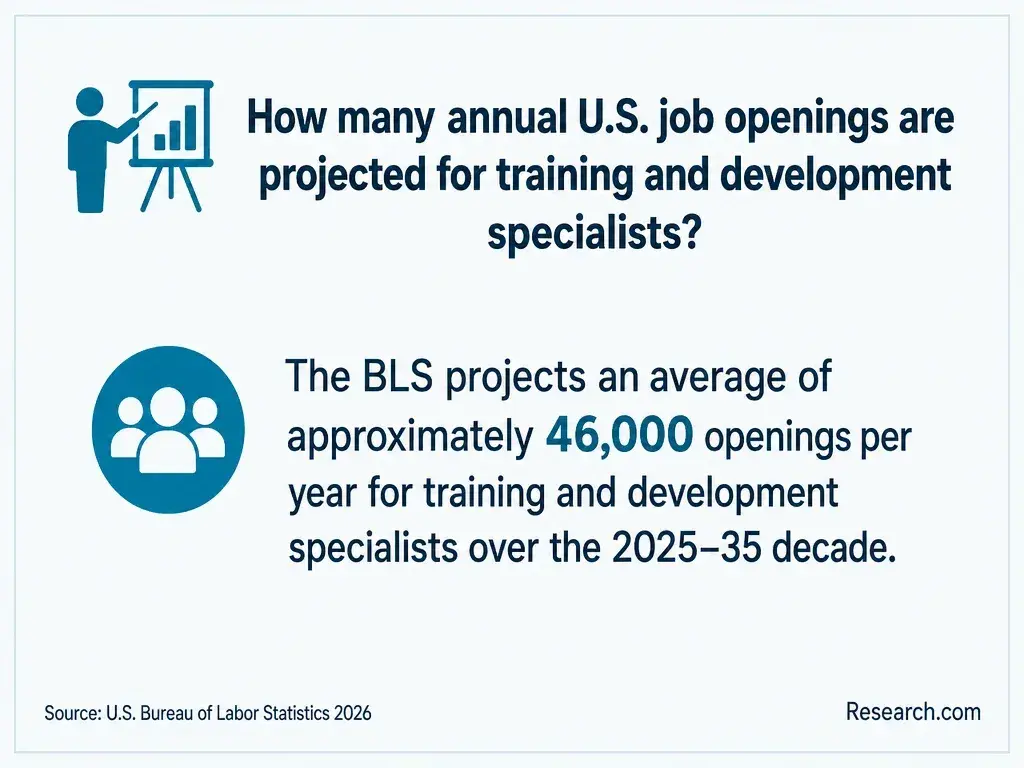
For an experienced professional, plausible paths include leading learning and development, organizational development, talent development, or change initiatives; advising organizations on workforce learning; and moving into broader leadership roles when existing experience supports that move. These jobs differ. A training manager oversees programs and staff, while an organizational consultant may diagnose a client problem and recommend changes without owning implementation.
The Ed.D. is most useful when a target role values applied inquiry alongside demonstrated leadership. Keep evidence of cross-functional projects, evaluation decisions, stakeholder engagement, and changes you helped implement - subject to confidentiality rules.
If you have not yet managed a learning function or major change effort, seeking that responsibility may be more valuable for your next move than immediately pursuing a doctorate. Employers set their own experience requirements, and senior appointments are not automatic degree outcomes.
There is no single defensible salary for graduates of this doctorate. U.S. Bureau of Labor Statistics occupational medians describe everyone in an occupation, across education levels and experience, rather than the earnings of Ed.D. holders. These May 2025 figures offer context for three distinct career targets:
| U.S. occupation | Median annual pay, May 2025 | Relevance to the degree decision |
| Training and development managers | $133,000 | Leadership of a learning function generally requires substantial relevant experience |
| Management analysts | $101,860 | Consulting work depends on problem-solving and client-relevant expertise |
Use the occupation that matches your intended responsibilities, not the highest figure, when weighing cost. Industry, location, employer, scope of authority, and prior experience affect an individual offer. A doctorate does not establish that either salary - or a promotion - will follow.
Does an Ed.D. require licensure or professional certification?
Organizational leadership and learning roles in companies generally do not require a license simply because the professional holds an Ed.D. The degree itself does not award a change-management certification, an HR credential, or authority to practice another regulated profession. Employers may prefer particular certifications or technical experience for specific jobs.
Licensure becomes a separate issue if you plan to use the doctorate for a regulated education position, such as school administration. A broadly focused organizational leadership Ed.D. should not be assumed to meet a state's principal or superintendent preparation rules. Obtain the program's licensure disclosure and check the relevant licensing authority's requirements before enrolling for that purpose.
Other Things You Should Know About EdD Leadership
Potentially, if the program approves the design and each organization authorizes the work. Data access, privacy obligations, translation, and research oversight may differ by location; do not assume one office's approval covers every site.
Not automatically. Confirm the university's submission requirements and your employer's confidentiality and intellectual-property rules before choosing a topic. Discuss whether an appropriately redacted academic deliverable is possible.
No. The degree does not confer employment authorization or override local employment rules. Your employer determines role qualifications, and applicable laws govern where and how you may work.
Review actual job descriptions and speak with leaders who make hiring or promotion decisions. Ask which responsibilities require doctoral-level inquiry and whether the organization would support an approved project. Compare those answers with the value of gaining equivalent experience through a smaller initiative.
- Maximizing the Impact and ROI of Leadership Development | nih.gov https://pmc.ncbi.nlm.nih.gov/articles/PMC11505461/
- Accreditation in the U.S. | ed.gov http://www.ed.gov/laws-and-policy/higher-education-laws-and-policy/college-accreditation/accreditation-in-the-us
- Chapter 3 - Courses and Enrollment, Full Course of Study, and Reduced Course Load | USCIS https://www.uscis.gov/policy-manual/volume-2-part-f-chapter-3
- Cost of Attendance (Budget) | 2025-2026 Federal Student Aid Handbook https://fsapartners.ed.gov/knowledge-center/fsa-handbook/2025-2026/vol3/ch2-cost-attendance-budget
- Doctoral dissertation or capstone: how to choose the right program | PhD/Doctorate | Capella University Blog https://www.capella.edu/blog/phd-doctorate/the-difference-between-a-dissertation-and-doctoral-capstone/
- Estimate Costs and Aid | WVU Hub | West Virginia University https://hub.wvu.edu/planning-and-resources/estimate-costs-and-aid
- Application Steps and Required Materials | The Graduate School https://gs.howard.edu/admissions/application-steps-and-required-materials
- Choosing a learning format that works for you | Gary W. Rollins College of Business https://blog.utc.edu/business/2025/06/09/choosing-a-learning-format-that-works-for-you/
- 2026 UNC Online EdD in Organizational Learning & Leadership https://online.unc.edu/online-doctoral-programs/online-edd-organizational-learning-and-leadership/
- What Is a Problem of Practice? | spalding.edu https://online.spalding.edu/blog/what-is-problem-practice