2027 Online Ed.D. in Leadership and Learning in Organizations: Comparing Coursework in Research Design
Audited and Verified:
Our Editorial and Data Verification Process
Research.com uses government datasets, official education statistics and primary institutional information to support its career and degree guides. Our review process checks factual accuracy, occupational definitions, source dates and the requirements associated with the credentials discussed.
How This Article Was Fact-Checked
Our editorial team verifies salary estimates, employment projections, education requirements and program information against original data providers and official organizations. Salary figures are checked against the relevant occupational definitions and reporting periods. Information about licensure, accreditation and required in-person training is reviewed separately.
Fact-checked and verified on:

Co-Founder and Chief Data Scientist
Two online Ed.D. programs can both promise applied research preparation yet teach very different ways to investigate an organizational problem. For learning and development professionals and emerging leaders, that difference matters: coursework must prepare you to choose credible evidence, work within data-access limits, and explain findings to decision-makers.
This guide compares research design sequences and methods, then shows how to check whether a program's project requirements, schedule, and cost fit the work you want to do.
Key Things You Should Know
- Compare the full sequence - not just a course titled "Research Design" - from problem definition and methods through analysis, ethics, and the final project.
- A strong fit lets you practice the methods your organizational question requires; a survey course alone does not establish readiness to evaluate whether an intervention caused an outcome.
- Check three practical constraints before enrolling: access to usable data, approval and privacy requirements, and the faculty support available when your design changes.
What is an online Ed.D. in Leadership and Learning in Organizations?
It is a practice-oriented doctorate focused on how people learn, lead, and improve organizations. Students may examine adult learning, leadership development, organizational change, and evidence-informed decisions in workplaces or education settings. "Online" describes where much instruction occurs; it does not establish that classes are self-paced or that campus visits are unnecessary.
Research design is the bridge between identifying a problem and making a defensible recommendation. A learning and development leader, for example, might need to determine whether a training program reaches the intended staff, whether participants use new skills, and what other factors could explain a performance change. Programs differ in whether students pursue a dissertation in practice, another dissertation format, a capstone, or a different approved project. Confirm the actual degree and requirements rather than inferring them from the program name.
If your goal is broader organizational change rather than research-intensive inquiry, compare the curriculum with shorter development options. Guidance on selecting a professional focus for an Ed.D. can help distinguish a named concentration from electives or a general leadership curriculum.
How does research design coursework compare across online Ed.D. programs?
Compare programs by what students must do with a research question, not by course titles alone. The patterns below are comparison categories, not claims that every school offers each sequence.
| Coursework emphasis | What to look for in the required sequence | Best fit and limitation |
| Foundational methods | Question development, literature appraisal, sampling, measurement, and introductory qualitative and quantitative analysis | Builds breadth for students with limited methods preparation; may leave advanced analysis or project planning to later study |
| Program evaluation and improvement | Needs assessment, implementation measures, outcome indicators, and feedback to stakeholders | Fits workplace learning decisions; improvement observed over time does not, by itself, prove causation |
| Dissertation or capstone-linked design | Proposal development, design review, data collection planning, analysis, and interpretation tied to the required final project | Can support a coherent project; usefulness depends on faculty guidance and whether the approved project fits your setting |
| Specialized analytics or inquiry | Deeper study of statistics, interviewing, case studies, mixed methods, or learning analytics | Useful when matched to your question; confirm whether courses are required, available electives, or merely examples in a catalog |
Read the catalog and sample syllabi together. Trace one possible question - such as whether a leadership-development initiative changes managers' coaching practices - from the first methods course to the final deliverable. Ask where students learn to select measures, account for missing information, obtain approvals, analyze results, and state limitations. A course list that covers each topic separately is less useful if students never integrate them in an approved design.
What research methods do Leadership and Learning Ed.D. programs teach?
Methods offerings vary. Quantitative work may include surveys, organizational records, descriptive statistics, and comparisons across groups or time. Qualitative work may involve interviews, observations, documents, and systematic coding. Mixed methods combines forms of evidence to answer a question neither addresses adequately alone. Evaluation examines a program's implementation or results; it is not automatically a causal study.
Consider an illustrative workplace question: Did a new manager-training initiative improve coaching practice? Attendance and satisfaction surveys describe participation and reactions, not behavior change. A follow-up observation protocol could document coaching practices, while interviews could explore barriers. A before-and-after comparison would still need to consider staff turnover, other initiatives, and who participated. The appropriate design depends on the decision to be made and what evidence can legitimately be collected.
For learning analytics, ask whether the program teaches measurement quality and responsible interpretation, not just dashboard use. Employee records, identifiable learner information, and interview responses raise different access and confidentiality issues. Students should check organizational permission, applicable privacy rules, and their institution's process for determining whether a proposed activity needs research review. Neither "workplace evaluation" nor "deidentified data" automatically settles those questions.
Verify that the degree-awarding institution holds institutional accreditation recognized by the U.S. Department of Education or the Council for Higher Education Accreditation, and confirm that the accreditation covers the institution awarding the online degree. Then review the program's own degree and licensure disclosures. Institutional accreditation establishes an important baseline; it does not certify that a particular methods sequence is strong or that the degree qualifies graduates for a regulated role.
For a cost-conscious comparison, screen accreditation and project support before comparing advertised tuition. An inexpensive option is a poor value if its research sequence cannot support your intended project or its attendance requirements are unworkable. The same screening applies when considering organizational leadership doctoral study on a budget.
Requirements are program-specific. Schools may evaluate prior degrees, academic transcripts, professional experience, recommendations, a statement of purpose, and evidence that an applicant can undertake doctoral work. An education master's, publication, GRE score, or particular statistics course should not be treated as universal. Credits considered when determining admission eligibility are also not necessarily credits that transfer into the doctorate.
For a methods-focused application, describe a real organizational learning problem, the decisions it affects, and what evidence you could reasonably seek. Do not promise access to confidential records or claim an employer has approved a project unless that is documented. Ask admissions whether bridging methods coursework is available and ask the program - not just an admissions representative - when students select a project site and obtain faculty guidance.
If higher education leadership is your intended field, investigate aid as carefully as eligibility. Scholarship planning for higher education leadership doctoral study should account for award conditions and employer reimbursement rules; neither admission nor employment guarantees funding.
Completion time depends on required credits, course sequencing, enrollment pace, and the final project. Methods courses can be consequential prerequisites: a delayed design proposal or loss of project-site access may affect progress even after classroom coursework is complete. Request the published plan of study and ask which courses run each term, when project approval occurs, and what happens if a proposed design needs revision.
Compare any advertised accelerated schedule with the actual time needed for live meetings, team work, data collection, analysis, and faculty feedback. Intensive online education doctoral pathways are most plausible when their fixed schedule and project expectations fit your work and access arrangements - not simply because instruction is online.
There is no reliable single price for this degree category. Obtain the program's required credits and charge basis, then include mandatory fees, possible campus travel, materials, and any costs associated with an approved project. Check whether tuition can change during enrollment and whether additional terms are charged if the project takes longer than planned.
For a working professional, time is also a cost. Compare the schedule with paid leave, caregiving, and employer reimbursement conditions before committing. A cheaper program may cost more overall if it requires travel or offers too little flexibility during data collection. A guide to planning tuition for an online Ed.D. can support that comparison, but request a written, program-specific estimate before making a financial decision.
The methods sequence is especially relevant to professionals who must diagnose learning needs, evaluate initiatives, and communicate evidence to leaders. Possible paths include learning and development management, organizational development, workforce program evaluation, consulting, and education administration. The fit depends on your existing responsibility and sector expertise: analyzing a training initiative in class is not the same as having managed its budget, staff, or implementation.
Use the final project as evidence of judgment rather than as a credential substitute. A strong, shareable portfolio account can explain the question, authorized data sources, design choices, limitations, and recommendation without exposing confidential information. If you mainly need survey design or evaluation skills for your current role, a focused course plus supervised workplace practice may be more direct than a doctorate.
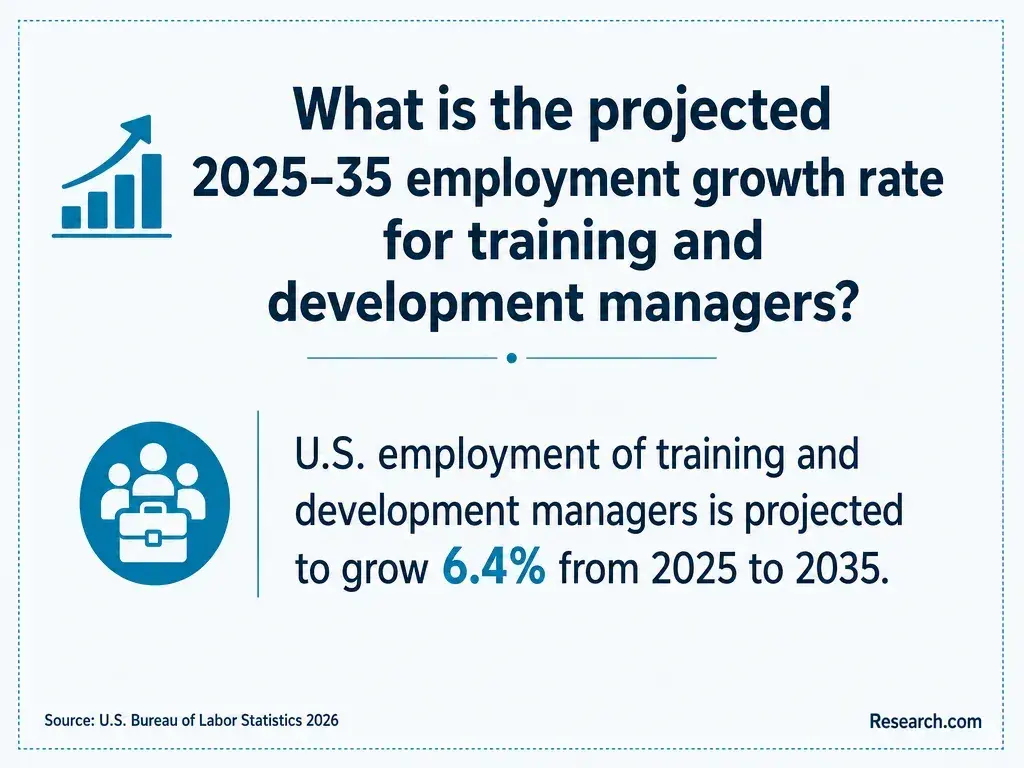
There is no dependable salary figure for graduates of this degree as a group. Pay follows the occupation, employer, location, and level of responsibility, not the degree title alone. The U.S. Bureau of Labor Statistics reports a May 2025 median annual salary of $133,000 for training and development managers, with 6.4% projected employment growth from 2025 to 2035. That occupational median describes workers in the role - not new Ed.D. graduates or the financial return from enrolling.
When assessing career value, compare the jobs you can realistically pursue now with those requiring additional management or sector experience. Research coursework may strengthen your case for evaluation and strategy responsibilities, but it does not establish eligibility for a management position or predict a raise.
Do Ed.D. graduates need licenses or certifications for leadership careers?
Many organizational learning, training, and consulting roles do not have a state license tied to an Ed.D. Employers may nevertheless prefer particular experience or voluntary certifications. Regulated education roles are different: principal or superintendent eligibility, for example, depends on applicable state rules and approved preparation, not simply possession of a leadership doctorate.
If licensure is part of your goal, ask the program for its disclosure for your state and confirm the requirements with the relevant licensing authority before enrolling. If your goal is to lead applied research in an organization, prioritize demonstrated methods competence, ethical data practice, and relevant professional experience over an unrelated certification.
Other Things You Should Know About EdD Leadership
Not universally. Check the program's prerequisites and syllabi. Being able to interpret results and explain design limitations matters more than assuming every school uses the same software.
Sometimes, if the approved question and final-project rules permit it. Public data may not measure the learning process or decision you originally wanted to study.
Review faculty research interests and ask who advises projects using your intended approach, how design feedback works, and whether advising assignments can change.
Possibly, but approval procedures vary. Ask what changes require renewed faculty, organizational, or institutional review before collecting or using different data.
- The Growing Importance of Mixed-Methods Research in Health | nih.gov https://pmc.ncbi.nlm.nih.gov/articles/PMC9057171/
- Academic Program and Course Development | umdearborn.edu https://umdearborn.edu/academic-program-and-course-development
- Doctoral Learning and Resources - Section 7. Learning Modalities and Resources - Academics at Walden University https://academics.waldenu.edu/handbook/learning-modalities/doctoral-research-resources
- 2026 UNC Online EdD in Organizational Learning & Leadership https://online.unc.edu/online-doctoral-programs/online-edd-organizational-learning-and-leadership/
- Doctoral dissertation or capstone: how to choose the right program | PhD/Doctorate | Capella University Blog https://www.capella.edu/blog/phd-doctorate/the-difference-between-a-dissertation-and-doctoral-capstone/
- Faculty Guide to Advising Research Degree Students | cornell.edu https://gradschool.cornell.edu/resources/faculty-guide-to-advising-research-degree-students/
- Mixed Methods Research | harvard.edu https://catalyst.harvard.edu/community-engagement/mmr/
- Full article: How to maximize the impact of workplace training | tandfonline.com https://www.tandfonline.com/doi/full/10.1080/1359432X.2024.2319082
- Bichronous Online Learning: Blending Asynchronous and Synchronous Online Learning | educause.edu https://er.educause.edu/articles/2020/9/bichronous-online-learning-blending-asynchronous-and-synchronous-online-learning
- Curriculum: Fall 2022 and Beyond - The ILR School https://www.ilr.cornell.edu/current-students/undergraduate-student-resources/curriculum-requirements/new-curriculum-requirements