2027 Online Ed.D. in Leadership and Learning in Organizations: Designing a Project About Team Collaboration
Audited and Verified:
Our Editorial and Data Verification Process
Research.com uses government datasets, official education statistics and primary institutional information to support its career and degree guides. Our review process checks factual accuracy, occupational definitions, source dates and the requirements associated with the credentials discussed.
How This Article Was Fact-Checked
Our editorial team verifies salary estimates, employment projections, education requirements and program information against original data providers and official organizations. Salary figures are checked against the relevant occupational definitions and reporting periods. Information about licensure, accreditation and required in-person training is reviewed separately.
Fact-checked and verified on:

Co-Founder and Chief Data Scientist
A team collaboration problem can make a strong applied doctoral project but only if the student can define the problem, obtain appropriate access, and evaluate a realistic change. This guide is for organizational leaders and learning professionals considering an online Ed.D. in leadership and learning in organizations.
It explains how to turn a broad concern such as "teams do not work well together" into a feasible project, then shows which program requirements, costs, and career considerations could change the decision to enroll.
Key Things You Should Know
- Start with a specific collaboration decision, such as whether a revised handoff process helps a defined team coordinate work; do not assume that training is the solution.
- Confirm the program's project rules, faculty oversight, organizational permission, and data access before committing to a workplace team or intervention.
- An Ed.D. can support deeper applied inquiry, but it is not necessary for every collaboration improvement project; an employer-sponsored initiative or focused evaluation training may be more direct.
What Is an Online Ed.D. in Leadership and Learning in Organizations?
An Ed.D. in leadership and learning in organizations is a practice-oriented doctorate that applies leadership, adult learning, organizational change, and research methods to problems in workplaces or other institutions. "Online" describes how much of the instruction is delivered remotely; it does not establish whether classes are self-paced or whether a project can be completed at any organization.
Program names and requirements differ. Some award a broadly focused Ed.D.; others offer a formally named concentration. A student interested in team collaboration should compare the actual curriculum and required doctoral deliverable, not just the degree title. Ed.D. concentration planning for doctoral applicants can help frame that comparison.
The degree is most useful when a leader wants sustained preparation to diagnose organizational problems, use evidence responsibly, and guide change. If the immediate goal is to improve one team's meetings or handoffs, a supervised workplace project or targeted development course may be faster and less costly.
How Does an Online Ed.D. Differ From a Campus-Based Program?
Online study changes where students participate, not necessarily how often they must participate. A cohort-based online Ed.D. may require live evening classes, group meetings, faculty consultations, and campus convenings. A campus-based program makes in-person attendance more routine but may offer easier informal access to peers and university resources.
For a team collaboration project, the decisive question is where the organizational work happens. Remote coursework can coexist with on-site observation, stakeholder meetings, or implementation at a partner organization. Ask each program which activities require attendance, whether projects may use an external site, and how students coordinate team assignments across schedules. Check accessibility and time-zone arrangements if either affects participation.
What Careers Can You Pursue With This Ed.D.?
Experienced learning and development professionals may use doctoral study to strengthen their work in training strategy, leadership development, or organizational change.
Leaders in nonprofits, healthcare, government, and higher education may apply the same methods to cross-functional coordination. Management consulting is another possible direction, but employers will still assess sector knowledge, project results, and client-facing experience.
A team collaboration project can provide portfolio evidence of problem definition, stakeholder engagement, implementation, and careful evaluation. It cannot, by itself, establish readiness for an executive role.
Readers targeting university administration can compare the distinct responsibilities involved in comparing Ed.D. organizational leadership study for higher education before choosing a program.
Relevant study may combine leadership and organizational theory with adult learning, change implementation, qualitative or quantitative inquiry, and program evaluation. For a collaboration project, the important skill is distinguishing a learning gap from a process or authority problem. People may understand how to collaborate yet lack shared priorities, clear handoffs, or time to coordinate.
Research-methods coursework can help students select credible evidence, interpret feedback without overstating it, and explain limitations. Check the course sequence and faculty expertise.
A course mentioning teamwork does not guarantee advanced instruction in team assessment, and a methods course does not automatically provide access to workplace data. An Ed.D. typically emphasizes inquiry for professional practice, whereas a research-focused PhD may better fit someone whose main goal is to produce generalizable scholarship.
Begin with a decision an organizational sponsor can act on. "Improve collaboration" is too broad; "determine whether a shared handoff checklist helps a defined service team identify unresolved requests before the next shift" identifies a process, setting, and observable outcome. This is an illustrative question, not a finding or a presumed diagnosis.
A workable proposal moves through the following decisions. The faculty advisor must also confirm whether the proposed work meets the program's capstone, dissertation-in-practice, or other doctoral requirements; those deliverables are not interchangeable.
- Define the boundary. Identify the team, workflow, project period, sponsor, and decision to be made. Exclude problems beyond the team's authority.
- Check plausible causes. Review available process documents and seek authorized stakeholder perspectives before choosing training, a meeting change, or a workflow intervention.
- Secure roles and access. Clarify what the student, organizational sponsor, team members, and faculty advisor may decide, observe, and review. Obtain site and data permissions separately from academic approval.
- Choose proportionate evidence. Consider an authorized baseline and follow-up measure, such as documented handoff completeness, alongside carefully gathered feedback about usability.
- Plan interpretation and delivery. Record how measures are defined, what changed during the project, whose views may be missing, and what recommendation the sponsor can realistically implement.
Before collecting employee information, ask the institution whether ethics or institutional review is required and ask the organization about consent, confidentiality, retention, and any data-use agreement.
Education records may raise FERPA obligations; employment records have their own restrictions. Even an apparent improvement after an intervention would not, on its own, prove that the intervention caused it.
A useful final deliverable might include the problem statement, an authorized account of the baseline, the change tested, findings with limitations, and a decision brief. Share only material approved for release; remove identifying details from any portfolio version.
When comparing programs, examine choosing an Ed.D. with an applied capstone option against the specific project and approval rules, not the word "capstone" alone.
Requirements vary by institution. Programs may assess prior graduate education, professional or leadership experience, academic performance, recommendations, a statement of purpose, and readiness for applied inquiry. An education degree or senior job title is not a universal prerequisite.
For this project interest, an application is stronger when it explains an organizational problem the applicant has encountered, the decisions they have actually helped make, and why further study is needed. Describe possible partner access honestly: an employer's interest is not academic project approval or permission to use employee data.
Applicants returning after earlier doctoral work should distinguish admission eligibility from credit that will apply to a new degree; Ed.D. pathways for students with prior doctoral study provide a starting point for questions to put to the institution.
Completion time depends on required credits, enrollment pace, course scheduling, and the time needed for project approval and execution. A workplace-based project can stall if access changes or a sponsor leaves, even after coursework is complete. Request the program's published sequence and completion rules rather than relying on an advertised minimum timeline.
Compare the full cost of attendance: tuition and fees, required technology, travel for any convenings, and time away from paid work. Ask whether employer assistance is paid upfront or reimbursed after a grade is earned, and what happens if employment ends.
For a structured cost comparison, use planning tuition for an online Ed.D., then verify charges and aid directly with each school. Without a specific program's credit requirements and rates, a reliable total-price estimate is not possible.
Confirm the institution's accreditation status and the scope of that accreditation through the accreditor and the US Department of Education's recognized-accreditor information. Then verify the exact Ed.D. degree and campus or online location with the institution. Institution-level accreditation does not establish that a particular leadership program has specialized accreditation or prepares students for a regulated occupation.
Accreditation is only one project-fit check. Ask the program coordinator for the current handbook or written requirements covering the doctoral deliverable, external sites, group work, faculty supervision, and ethics review. Those documents matter more to a proposed collaboration project than a general claim that a program supports applied learning.
Organizational learning, training, and many consulting roles generally do not require licensure simply because the practitioner holds an Ed.D. A general leadership and learning doctorate also does not automatically qualify its graduate for teacher, principal, or superintendent licensure.
If a target job is regulated, check the program's licensure disclosure and the relevant state authority's requirements before enrolling. Optional professional certifications may help demonstrate a particular skill, but they are separate from the doctorate and should be judged against the jobs the reader actually wants.
What Salary and Job Outlook Can Ed.D. Graduates Expect?
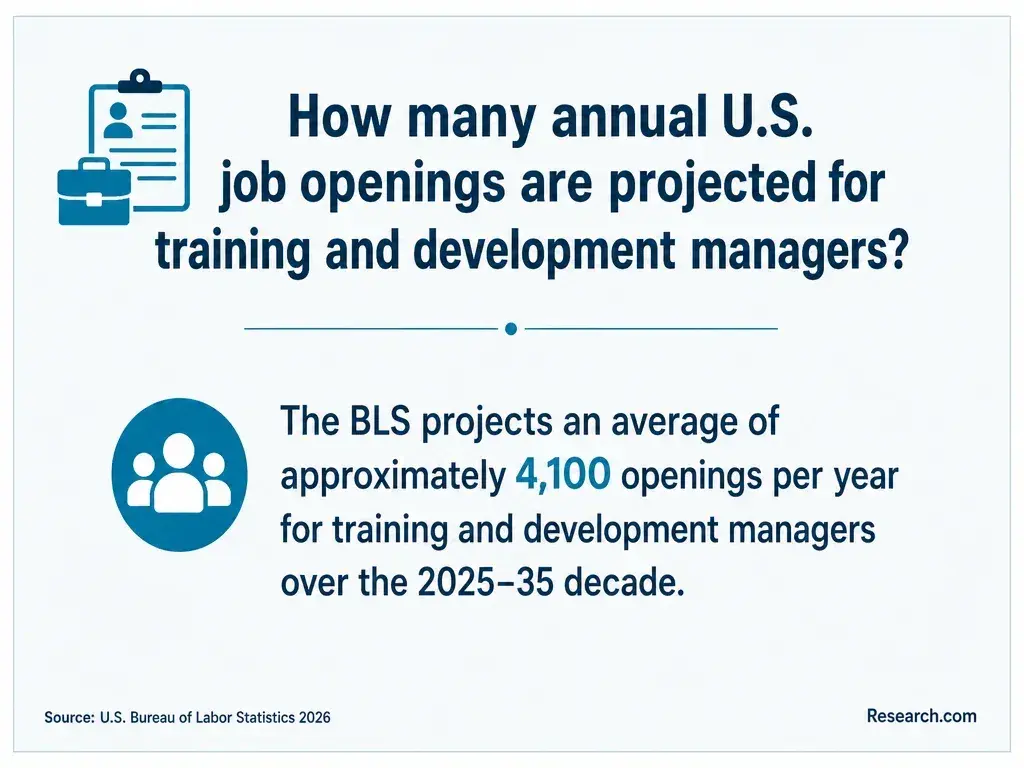
There is no single Ed.D. salary: pay follows the occupation, sector, location, and level of responsibility. The US Bureau of Labor Statistics reports a May 2025 median annual salary of $133,000 for training and development managers and projects 6.4% employment growth for that occupation from 2025 to 2035. Those figures describe an occupation, not graduates of a particular doctoral program or the effect of earning the degree.
Use a target job's duties and hiring requirements to judge return on investment. An established learning professional seeking broader management responsibility may value the applied project and credential differently from someone who mainly needs experience facilitating cross-functional work. In the latter case, leading a well-supported workplace initiative may be the more immediate career step.
Other Things You Should Know About EdD Leadership Programs
Possibly. Ask the program how it assigns individual credit, supervision, and deliverables within team work, and ask the organization who is authorized to coordinate the project.
That power relationship can affect participation and candor. Discuss recruitment, consent, and data handling with the faculty advisor and appropriate organizational reviewers before gathering feedback.
Only if institutional and organizational policies permit the tool and the proposed use of the data. Do not upload confidential recordings or transcripts to an unapproved service.
A carefully documented project can still identify implementation barriers, measure limitations, or an incorrect initial diagnosis. Report those findings accurately rather than presenting an unsupported success claim.
- Reactions towards organizational change: a systematic... - PMC https://pmc.ncbi.nlm.nih.gov/articles/PMC9006211/
- CDC Program Evaluation Framework, 2024 | MMWR https://www.cdc.gov/mmwr/volumes/73/rr/rr7306a1.htm
- Four practical tips for actionable and effective evaluation recommendations | who.int https://www.who.int/news/item/29-03-2025-four-practical-tips-for-actionable-and-effective-evaluation-recommendations
- Methodologies for data collection and analysis for monitoring and evaluation | M&E Guidelines https://mandeguidelines.iom.int/en/clone-methodologies-data-collection-and-analysis-monitoring-and-evaluation
- Leadership and Learning in Organizations Online Ed.D. | Peabody College of Education and Human Development https://peabody.vanderbilt.edu/academics/edd-programs/online-leadership-learning-organizations/
- Guidance: Data Security and Privacy | lehigh.edu https://research.lehigh.edu/policies-guidance-forms/guidance-data-security-and-privacy
- Identifying and Analyzing Stakeholders and Their Interests | ku.edu https://ctb.ku.edu/en/table-of-contents/participation/encouraging-involvement/identify-stakeholders/main
- Online Ed.D. in Leadership and Learning in Organizations | VU-EDU https://peabodyonline.vanderbilt.edu/edd-in-organizational-learning/
- Online Ed.D. in Organizational Learning & Leadership | UNC https://ed.unc.edu/academics/programs/organizational-learning-and-leadership/about-the-program/
- Data Security Guidelines | Research Ethics & Compliance https://research-compliance.umich.edu/data-security-guidelines%20