2027 Online Ed.D. in Leadership and Learning in Organizations Admissions: Applying with Research Experience but Limited Management Experience
Audited and Verified:
Our Editorial and Data Verification Process
Research.com uses government datasets, official education statistics and primary institutional information to support its career and degree guides. Our review process checks factual accuracy, occupational definitions, source dates and the requirements associated with the credentials discussed.
How This Article Was Fact-Checked
Our editorial team verifies salary estimates, employment projections, education requirements and program information against original data providers and official organizations. Salary figures are checked against the relevant occupational definitions and reporting periods. Information about licensure, accreditation and required in-person training is reviewed separately.
Fact-checked and verified on:

Co-Founder and Chief Data Scientist
Research experience can make you a strong candidate for an online Ed.D. in Leadership and Learning in Organizations, but it may not satisfy a program's professional-experience requirement. That distinction matters if you have designed studies, evaluated programs, or analyzed organizational problems without managing employees.
This guide explains how admissions committees may assess your background, what evidence to assemble, and which program rules to verify before applying. It also helps you decide whether an Ed.D. fits your next professional step - or whether gaining leadership responsibility first would serve you better.
Key Things You Should Know
- Research experience can demonstrate doctoral readiness, but it does not automatically meet a program's requirement for professional or leadership experience. Check how each admissions office defines qualifying work.
- Show decisions you influenced, people you coordinated, and how your research informed practice. Describe your actual authority rather than substituting a managerial-sounding title.
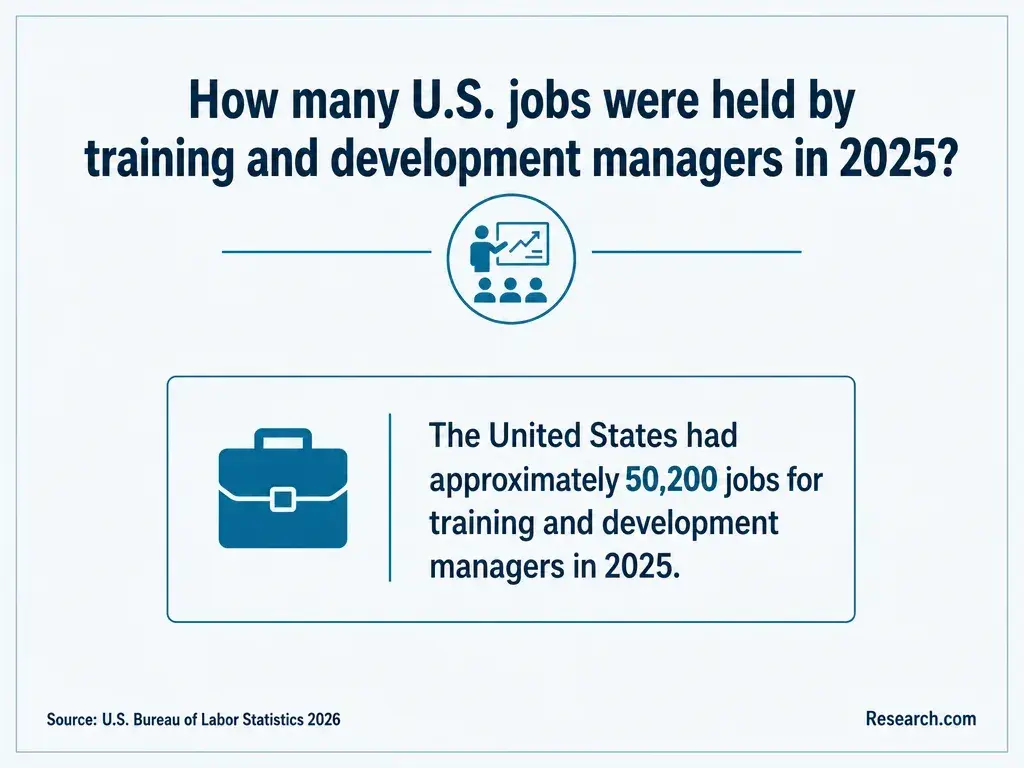
- The U.S. Bureau of Labor Statistics reports a $133,000 median annual salary for training and development managers in 2025; that occupation-wide figure is not an expected Ed.D. graduate salary or a substitute for management experience.
What is an online Ed.D. in Leadership and Learning in Organizations?
An Ed.D. in leadership and learning is a practice-oriented doctorate focused on how organizations develop people, use evidence, and implement change. Students may study adult learning, organizational systems, leadership, and applied inquiry while preparing to address a problem in a workplace or partner organization. "Online" describes where much of the instruction occurs; it does not establish whether attendance is self-paced, live, or partly on campus.
Leadership and Learning in Organizations is also the name of a Vanderbilt University online Ed.D. program. If that is your intended program, evaluate Vanderbilt's requirements for your proposed entry term rather than relying on descriptions of organizational leadership doctorates generally. An Ed.D. is usually a better fit for improving professional practice than for pursuing a primarily research-focused PhD. Neither degree, by itself, grants school-administrator licensure.
Can applicants with research experience but limited management experience get admitted?
Possibly. The decisive issue is whether a particular program requires defined years or types of professional experience, and whether your work meets that definition. Being an excellent researcher does not waive a stated eligibility condition. Conversely, limited direct-report supervision does not mean you lack leadership experience: coordinating a study team, securing stakeholder input, guiding an evaluation, or helping implement findings may demonstrate influence and responsibility.
Separate eligibility from competitiveness. First, send admissions staff a concise description of your roles, employment dates, responsibilities, and any decision-making authority; request clarification if the published requirement is ambiguous.
Then assess whether you can show a credible organizational problem you are positioned to investigate and address. An applicant who has only conducted academic research, with no opportunity to work alongside organizational decision-makers, may benefit more from supervised improvement work before applying.
If you previously began a doctorate and reached the dissertation stage, all-but-dissertation education doctorate admission options are a separate pathway worth investigating. Do not assume that unfinished doctoral work satisfies this Ed.D.'s experience rules or transfers into its curriculum.
What are the admission requirements for an online Ed.D. in organizational leadership?
Requirements differ by institution and entry term. The comparison below separates common application elements from conditions that need a program-specific answer; none should be treated as a universal Ed.D. rule.
| Application element | What may vary by program | Why it matters here |
| Prior education and transcripts | Required degree level, accepted fields, grades, and credential evaluation policies | Research preparation may be valuable even when the prior degree is outside education. |
| Professional experience | Minimum duration, qualifying roles, and whether project leadership counts | This is the principal eligibility question for an applicant without formal management duties. |
| Application materials | Recommendations, statement, résumé, writing sample, interview, and any test policy | These materials must substantiate both research ability and readiness for practice-focused study. |
| Academic or organizational project expectations | Required project setting, access, approvals, and culminating format | Research skill alone does not establish access to a feasible organizational problem. |
If you hold an education specialist credential, finding an online Ed.D. route after specialist study can help frame your search. Ask the institution separately whether that credential supports admission and whether any coursework applies to the doctorate; those are different decisions. Confirm deadlines, test policies, and any exception process directly with the admissions office before submitting materials.
The strongest application translates research tasks into evidence of judgment, collaboration, and improvement - not just technical proficiency. A publication, thesis, or software skill may support your case, but none is universally required. Build your statement and résumé around the following evidence, using only work you actually performed:
- Define your contribution: Identify the question, your role in the design or evaluation, and how you handled limitations or conflicting evidence.
- Show organizational relevance: Explain who needed the findings, what decision they faced, and whether you communicated results in a usable form.
- Document leadership without inflation: Describe stakeholders you convened, work you coordinated, recommendations you shaped, and the limits of your authority.
- Propose a feasible next question: Connect a real learning or change problem to potential evidence while acknowledging that employer permission, data access, and academic approval remain unresolved until confirmed.
For example, an applicant might accurately say they coordinated interviews and presented an evaluation to a program director. They should not claim to have managed the program or caused an improvement unless those responsibilities and outcomes can be documented. A research supervisor can attest to methodological rigor; a workplace collaborator may be better placed to describe influence across teams.
Verify the university's institutional accreditation through the accreditor and the U.S. Department of Education's recognized-accreditor information, and confirm that the accreditation covers the institution awarding the doctorate. Check the university catalog for the exact degree title and academic unit; an appealing leadership course is not proof of a formally awarded concentration.
Do not assume that institutional accreditation confers program-specific approval, professional certification, or eligibility for principal or superintendent licensure. If a regulated role is your goal, obtain the institution's licensure disclosure and check requirements with the relevant state authority. For applicants pursuing organizational learning rather than school administration, the program's curriculum and practical fit will often be more informative than a licensure claim.

Relevant study may connect adult learning and learning transfer with organizational diagnosis, change leadership, program evaluation, and qualitative or quantitative inquiry. The value for a research-experienced applicant lies partly in learning to move from finding evidence to making and implementing responsible organizational decisions. Course titles alone cannot establish how much supervised leadership practice a program provides.
Compare the required sequence with your gaps. If you already design strong studies but have rarely negotiated priorities with staff, budgets, or senior sponsors, look for applied work involving stakeholder engagement and implementation.
If your experience is mostly academic research, examine how the program teaches needs assessment, workplace ethics, and interpretation of imperfect operational data. Confirm electives, faculty guidance, and the actual culminating requirement in the current catalog.
Completion depends on the required credits, course sequence, enrollment pace, scheduled offerings, and time needed for the final project. An advertised program length may assume continuous enrollment and timely project approvals. Ask for the published degree plan and policies on pauses, missed courses, and maximum time to completion rather than treating an estimate as a guarantee.
Check live-class hours, group meetings, campus convenings, and periods when research or project work intensifies. These obligations matter if you must build leadership experience while studying. Programs also differ in their culminating work: reviewing Ed.D. culminating requirements beyond the traditional dissertation can clarify the terminology, but only a program's own rules establish what you must complete.
There is no defensible single price for this degree category. To compare programs, request the current tuition basis - per credit, term, or program - alongside required credits and mandatory fees. Add technology charges, any travel and lodging for convenings, and the cost of remaining enrolled if a project takes longer than planned. Education doctorate fees and total study costs provides a useful starting point, but obtain a written estimate for your entry term.
Employer reimbursement may depend on continued employment, grades, or repayment conditions. Ask whether doctoral study qualifies before counting it as funding. If the degree is primarily a way to acquire management experience, compare its full cost with a stretch assignment, employer leadership program, or targeted training that could provide that experience more directly.
Potential paths include learning and development, program evaluation, organizational consulting, and leadership-development work. Advancement depends on demonstrated responsibilities as well as education. A researcher moving toward a training manager position, for example, may need experience setting priorities, supervising staff, and working with budgets - not only stronger evaluation methods.
The U.S. Bureau of Labor Statistics reports a 2025 median annual salary of $69,280 for training and development specialists, with projected employment growth of 10.8% from 2025 to 2035. That occupation may be closer to an applicant's current experience than a manager role, but neither figure predicts an individual Ed.D. graduate's pay or prospects. Use job postings in your target sector to test whether employers prioritize a doctorate, functional experience, or both.
How should applicants compare reputable online Ed.D. programs?
Start with a shortlist that meets your formal eligibility and schedule constraints. Then compare programs on the question this applicant profile makes most important: whether they will help you turn research capability into credible organizational leadership practice. Request written answers when a published policy does not resolve your situation.
Use these questions in conversations with admissions and program staff:
- Does my specific research and project-coordination work meet the professional-experience requirement for this entry term?
- Which required activities develop influence, implementation, and organizational decision-making - not just additional research skills?
- What live attendance, convenings, team obligations, and final-project approvals are required?
- What is the estimated full cost under my enrollment plan, and what happens if the project extends beyond it?
When price is a constraint, use low-cost doctoral study in organizational leadership to identify candidates for closer review, not as proof that the least expensive option fits your goals. If no eligible program offers meaningful leadership practice, gaining responsibility for a cross-functional initiative before applying may produce a stronger application and a better-informed degree decision.
Other Things You Should Know About EdD Leadership
Follow the program's letter requirements. If you have a choice, seek recommenders who can provide complementary, firsthand evidence: one of research judgment and another of collaboration, influence, or organizational responsibility.
Not without appropriate permission. Ask about the organization's confidentiality rules, remove identifying information where permitted, and consider using work you are authorized to share.
Usually, an application can describe a focused area of interest rather than an approved project. Check the program's instructions, and avoid implying that an employer has granted access or that faculty have approved a design when they have not.
Ask admissions whether updates are accepted and by what deadline. A new role may strengthen your candidacy, but the program decides whether it changes eligibility for the entry term you selected.
- General Schedule Qualification Policies | U.S. Office of Personnel Management https://www.opm.gov/policy-data-oversight/classification-qualifications/general-schedule-qualification-policies/
- Qualitative Methods in Implementation Research - PMC - NIH https://pmc.ncbi.nlm.nih.gov/articles/PMC7023962/
- Document Analysis | sagepub.com https://methods.sagepub.com/ency/edvol/sage-encyclopedia-of-educational-research-measurement-evaluation/chpt/document-analysis
- UNC EdD Online: Organizational Learning and Leadership https://online.unc.edu/online-doctoral-programs/online-edd-organizational-learning-and-leadership/
- Ed.D. Admissions - Peabody | Vanderbilt University Online https://peabodyonline.vanderbilt.edu/edd-in-organizational-learning/admissions/
- Internal Admission Summary and Averages | UConn School of Business https://undergrad.business.uconn.edu/prospective/current-students/summary-and-averages/
- Online Doctorate of Education in Leadership Studies | LSU Online https://online.lsu.edu/online-degree-programs/graduate/doctorate-education-leadership-studies/
- What Admissions Committees Are Really Looking for in a PhD Application | Graduate School of Biomedical Sciences https://gsbs.tufts.edu/news-events/news/what-admissions-committees-are-really-looking-phd-application
- Advance Your Leadership With an Online Ed.D | SUNY Empire https://sunyempire.edu/academics/graduate-academics/doctorate/educational-leadership-change.html
- Ed.D., Leadership | Saint Mary's University of Minnesota https://www.smumn.edu/degree/doctorate/education-programs/leadership/