2027 Online Ed.D. in Leadership and Learning in Organizations: Comparing Coursework in Learning Governance
Audited and Verified:
Our Editorial and Data Verification Process
Research.com uses government datasets, official education statistics and primary institutional information to support its career and degree guides. Our review process checks factual accuracy, occupational definitions, source dates and the requirements associated with the credentials discussed.
How This Article Was Fact-Checked
Our editorial team verifies salary estimates, employment projections, education requirements and program information against original data providers and official organizations. Salary figures are checked against the relevant occupational definitions and reporting periods. Information about licensure, accreditation and required in-person training is reviewed separately.
Fact-checked and verified on:

Co-Founder and Chief Data Scientist
Two online Ed.D. programs can both promise leadership development yet prepare students for different decisions. One may emphasize designing professional learning; another may teach who approves it, who controls its data, and how leaders remain accountable for results.
For educators, learning and development professionals, and organizational leaders, that difference matters when choosing coursework for a governance-heavy role. This guide explains what learning governance covers, how to compare curricula and applied projects, and which program details to verify before committing to doctoral study.
Key Things You Should Know
- Compare decision-making, not course titles: Strong learning-governance preparation connects authority, stakeholder participation, resource allocation, evidence, and accountability to an applied organizational problem.
- Check the required sequence: A leadership elective alone may not provide sustained practice in governance; examine required courses, methods training, and the approved doctoral project together.
- Match coursework to the role: The U.S. Bureau of Labor Statistics reports a $133,000 median annual salary for training and development managers in May 2025, but that occupational median is not an expected Ed.D. graduate salary.
What Is an Online Ed.D. in Leadership and Learning in Organizations?
An online Ed.D. in leadership and learning is a practice-oriented doctorate for professionals studying how organizations develop people, make decisions, implement change, and evaluate improvement.
The exact degree title and curriculum vary by institution. "Online" describes where much of the instruction occurs; it does not establish that classes are self-paced or that campus visits are unnecessary.
For a reader interested in learning governance, the degree is useful when it combines adult learning and organizational change with the authority and accountability behind learning decisions. A school district might examine who approves professional development and how its effectiveness is assessed.
A healthcare employer might address who sets training standards across departments. Neither example means a general organizational leadership Ed.D. prepares graduates for school-administrator licensure.
The degree is less direct if the immediate goal is to master one training platform or earn a specific professional certification. Focused training or supervised experience may serve that goal without a doctorate.
How Does Coursework Compare Across Online Ed.D. Leadership Programs?
Compare programs by the decisions students practice making, not by how often "leadership" appears in a course catalog. The table shows common curricular emphases; these are comparison categories, not claims that every program offers a named track:
| Curricular emphasis | Likely governance preparation | Potential gap to check |
| Educational administration | Institutional policy, stakeholder accountability, and resource decisions | Whether adult workplace learning outside schools is addressed |
| Organizational learning and development | Learning strategy, change implementation, and cross-functional decisions | Whether formal authority, public accountability, or board oversight is studied |
| Instructional design and learning technology | Learning design, platform choices, and assessment | Whether students examine who authorizes, funds, and reviews those choices |
| Applied research and evaluation | Evidence quality, program assessment, and recommendations | Whether findings are connected to an actual decision process |
Ask for the required course sequence, recent syllabi, elective rotation, and doctoral-project handbook. Look for assignments that require students to map decision rights, evaluate competing stakeholder claims, assess data limitations, and recommend an implementable process.
A single course on governance does not establish a formal specialization or advanced competence. If you are comparing formally awarded options, review education doctorate specialization comparisons, then confirm the credential shown on each institution's transcript.
What Does Learning Governance Mean in Educational Organizations?
Learning governance is the set of decision rights, policies, oversight practices, and accountability arrangements that shape how an organization provides and evaluates learning. In an educational organization, it may determine who sets professional-learning priorities, whose needs inform them, who approves spending and technology, and what evidence prompts a change in direction.
Governance differs from managing an individual course: it establishes how such choices are made and reviewed across the organization.
Consider a district where schools select different staff-development tools. A governance question is not simply which tool is best. It is who can approve a tool, how accessibility and privacy are assessed, whether staff have a voice, and who checks whether the purchase supports agreed priorities.
An Ed.D. assignment could analyze that process without claiming that training alone will fix problems caused by staffing, incentives, or policy.
Data governance is part of the picture. Using learner records, employee evaluations, or platform analytics can involve access restrictions, confidentiality obligations, and institutional review requirements.
Students should establish what they are authorized to examine before proposing surveys, interviews, or a workplace project; they should not assume that removing names makes sensitive information unrestricted.
Course names differ, but governance-focused students should look for a sequence of complementary learning outcomes. Adult learning and instructional design explain how learning is developed; organizational leadership and change explain how priorities become action; evaluation and research methods explain how leaders judge evidence and revise decisions.
The most useful curriculum goes beyond exposure to those subjects. A student might first diagnose a professional-learning problem, then analyze who has authority over it, study the quality of available evidence, and finally propose a feasible change with clear responsibility for review.
Quantitative or qualitative methods courses support that work, but taking them does not by itself make a student an independent research expert.
Read course descriptions alongside the project requirements. If governance is central to your goal, ask whether assignments address budgets, policy, stakeholder representation, privacy, and implementation, not merely personal leadership style.
Confirm that relevant electives will run during your enrollment and that faculty can supervise the type of organizational inquiry you intend to pursue.
Online delivery can let working professionals study without relocating and apply coursework in their own organizations. Campus-based study may offer more in-person interaction and easier access to local partners.
Neither format is inherently stronger for learning governance; the decisive issue is whether students can examine real decision processes with useful faculty and peer feedback.
Check live-session attendance, group-work schedules, required campus convenings, and how students receive project supervision. A professional working across time zones or juggling a public-sector calendar may find a cohort with fixed evening meetings less flexible than the word "online" suggests.
Accelerated schedules can intensify those demands; readers evaluating fast-track education doctoral programs should inspect the workload and project milestones, not just the advertised completion time.
Requirements are program-specific. Schools may assess prior graduate study, professional responsibilities, academic performance, recommendations, a statement of purpose, and an applicant's readiness for applied inquiry.
A master's in education, a particular managerial title, or a published study should not be treated as a universal prerequisite.
For governance-focused study, the strongest application explains a decision problem the applicant has encountered and the limits of their authority. A learning and development professional, for example, can describe coordinating training across departments without claiming control over organizational policy.
Applicants with graduate education credentials can also examine pathways for education specialist graduates considering a doctorate; admission eligibility and transfer of credits into the Ed.D. are separate determinations.
Before applying, ask admissions which degrees and transcripts qualify, whether professional experience must meet a defined threshold, and who evaluates prior credits. Ask the program separately whether students need an employer-approved project site at entry. Get any unusual eligibility or credit decision in writing.
Time and total cost depend on required credits, course availability, enrollment pace, tuition structure, fees, and the length of the doctoral project. A published minimum completion schedule is not a promise that every working student will finish on that schedule. Team coordination, organizational permissions, and research review can affect progress.
Request a term-by-term cost estimate rather than comparing tuition rates alone. Include required travel and lodging, technology charges, possible continuation fees, and the effect of reduced work hours.
Employer reimbursement is valuable only under its actual terms, including annual limits, grade rules, and any obligation to remain employed.
Students examining grant and scholarship options for higher education leadership research study should confirm eligibility and award availability with each school; professional doctorates are not necessarily funded like research PhDs.
Governance-focused coursework can support experienced professionals who help set learning strategy, evaluate development programs, coordinate change, or advise organizations. Relevant roles may include learning and development management, organizational development, consulting, and higher-education or public-sector administration.
The work differs: a training manager may control a development budget, while a consultant may recommend a governance process without having authority to adopt it.
Match the degree to responsibilities you can realistically seek. If you already lead cross-functional learning initiatives, an applied project can demonstrate how you analyze policy, evidence, and stakeholder trade-offs.
If you are trying to enter the field, employers may value direct training, evaluation, or management experience more immediately than a doctorate. School principal and superintendent roles can have separate state licensure requirements that a general leadership Ed.D. does not automatically meet.
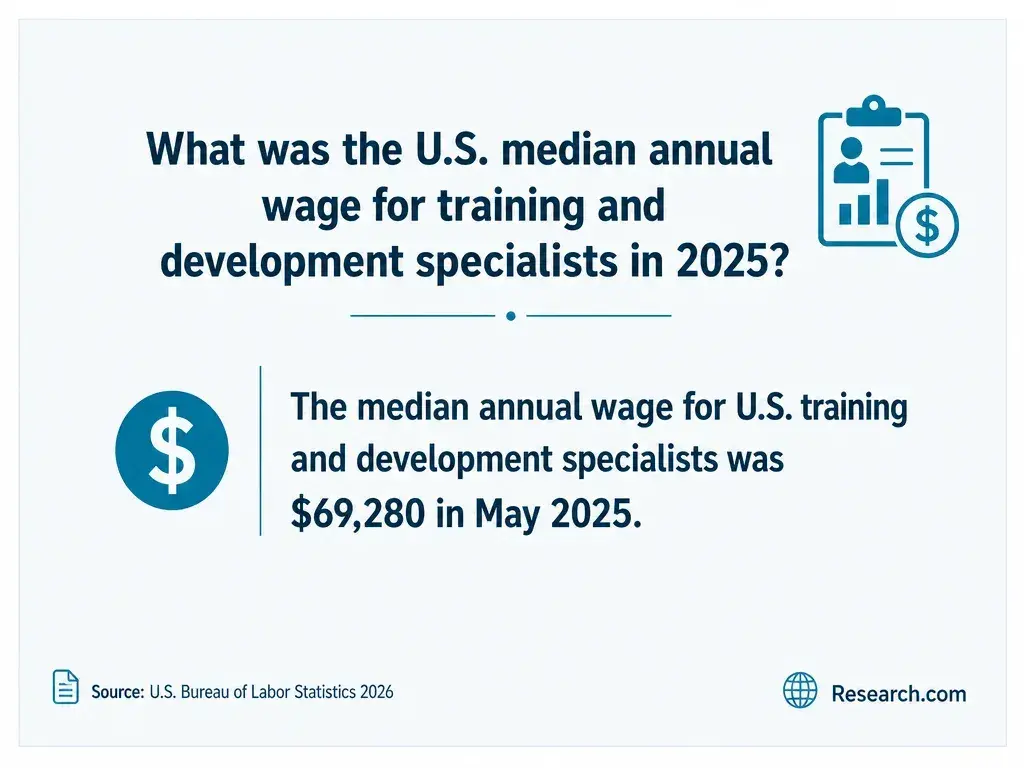
There is no single salary or job-growth rate for Ed.D. graduates. The U.S. Bureau of Labor Statistics reports a May 2025 median annual salary of $133,000 for training and development managers, with projected employment growth of 6.4% from 2025 to 2035.
That figure describes an occupation, not new doctorate holders; management experience and an employer's requirements still matter.
For a different pathway, BLS reports a $101,860 median for management analysts, a category that includes organizational consultants, and projects 10.1% growth over the same period.
Consulting roles may reward demonstrated diagnosis and implementation work, but neither occupational figure shows that an Ed.D. causes a salary increase. Compare actual job postings in your sector with your present qualifications before using salary data to justify tuition.
How Can You Choose an Accredited Online Ed.D. Program?
Start by confirming the institution's accreditation through the accreditor and the institution itself. Then verify the exact awarded degree, curriculum, delivery requirements, project format, and any licensure disclosures.
Institutional accreditation establishes something different from preparation for a regulated school leadership position - or from proof that the coursework fits your governance goal.
A focused comparison should follow the same process for every shortlisted program. These checks help expose differences that broad program descriptions can hide:
- Identify the learning-governance decisions you want to handle, such as policy approval, resource allocation, data oversight, or evaluation accountability.
- Map each goal to required courses and available assignments; ask for syllabi and confirm when relevant electives are offered.
- Check whether the doctoral project permits your proposed setting, what approvals and data access it requires, and how faculty supervision works.
- Confirm live attendance, campus visits, the term-by-term price, and the consequences if your employer or project site changes.
Use the written answers to compare educational fit against the full financial commitment. Resources on planning a budget for doctoral study in education can help organize cost questions, but obtain the final figures and policies directly from each institution.
If your principal gap is one governance skill rather than sustained doctoral-level inquiry, a targeted course, mentorship, or supervised improvement project may be the better choice.
Other Things You Should Know About EdD Leadership
No. School boards have legally defined oversight responsibilities. Learning governance also includes the decision processes used by administrators, departments, and other organizations. Studying those processes does not confer board membership or legal authority.
Potentially. The project must meet program requirements, employer permissions, and applicable privacy or research-review rules. Ask the faculty supervisor what can be analyzed and reported before collecting restricted information.
Yes, when its use affects learning decisions or handles sensitive data. A review should clarify who approves it, what information it can access, how outputs are checked, and who responds to errors or complaints.
Tell your faculty supervisor promptly. A change may alter your question, access, or timeline, and the program - not the employer alone - must approve any revised academic project.
- The Course Syllabus: Legal Contract or Operator's Manual? | nih.gov https://pmc.ncbi.nlm.nih.gov/articles/PMC5289733/
- Americans with Disabilities Act Title II Regulations | ADA.gov https://www.ada.gov/law-and-regs/regulations/title-ii-2010-regulations/
- Federal Role in Education | U.S. Department of Education http://www.ed.gov/about/ed-overview/federal-role-in-education
- Online Ed.D. in Leadership and Learning in Organizations | VU-EDU https://peabodyonline.vanderbilt.edu/edd-in-organizational-learning/
- Responsible artificial intelligence governance: A review and research framework - ScienceDirect https://www.sciencedirect.com/science/article/pii/S0963868724000672
- Educational Leadership, Higher Education, and Student Development Department | St. Cloud State University Catalog https://catalog.stcloudstate.edu/departments/A10005/courses
- UNC EdD Online: Organizational Learning and Leadership https://online.unc.edu/online-doctoral-programs/online-edd-organizational-learning-and-leadership/
- Catalog Navigator: Educational Administration, Supervision, and Adult Education (230) | rutgers.edu https://catalogs.rutgers.edu/generated/gse_1719/pg221.html
- Impact on student learning and organizational change | sagepub.com https://journals.sagepub.com/doi/10.1177/09504222211036584
- Education Policy, Organization & Leadership, EdD | University of Illinois Urbana-Champaign Course Catalog https://catalog.illinois.edu/graduate/education/education-policy-organization-leadership-edd/