2027 Online Ed.D. in Leadership and Learning in Organizations Admissions: Documenting Pass-Fail Graduate Credits
Audited and Verified:
Our Editorial and Data Verification Process
Research.com uses government datasets, official education statistics and primary institutional information to support its career and degree guides. Our review process checks factual accuracy, occupational definitions, source dates and the requirements associated with the credentials discussed.
How This Article Was Fact-Checked
Our editorial team verifies salary estimates, employment projections, education requirements and program information against original data providers and official organizations. Salary figures are checked against the relevant occupational definitions and reporting periods. Information about licensure, accreditation and required in-person training is reviewed separately.
Fact-checked and verified on:

Co-Founder and Chief Data Scientist
A pass on your graduate transcript may represent substantial academic work, but it does not tell an Ed.D. admissions committee what grade you would have earned. If you are applying to an online leadership and learning doctorate with pass-fail coursework from a completed master's degree, an unfinished program, or several institutions, that distinction matters.
This guide explains which records to collect, how schools may evaluate the credits, and what to ask before assuming they meet an admission requirement, or will shorten the doctorate.
Key Things You Should Know
- A transcript showing "Pass" is the starting point, not a grade conversion. Obtain the school's grading key and, when necessary, its written definition of a passing graduate grade.
- Ask for three separate decisions: whether the coursework supports admission eligibility, whether it satisfies a prerequisite, and whether any credits apply to Ed.D. degree requirements.
- No universal pass-fail credit minimum or GPA conversion applies across online Ed.D. programs. Request a written, term-specific evaluation before relying on a credit count.
What Are the Pass-Fail Credit Requirements for an Online Ed.D. in Leadership and Learning?
There is no single pass-fail rule for online Ed.D. programs. One school may require an awarded master's degree, another may specify a quantity of graduate-level coursework, and another may review applicants with unfinished graduate study individually.
A program may accept pass-fail courses toward an admissions credit threshold while declining to use them to establish a minimum graduate GPA.
First identify what the requirement measures. A completed master's degree is a credential awarded by an institution; a collection of graduate credits is not automatically equivalent.
Likewise, admission eligibility does not mean prior courses can replace doctoral courses. For applicants returning after an Ed.S., planning the transition from Ed.S. to Ed.D. starts with checking whether the prospective school evaluates the awarded degree, its individual courses, or both.
Before applying, ask admissions whether pass-fail graduate coursework counts toward its stated threshold, whether an awarded degree changes that assessment, and which office decides if any course can satisfy a doctoral requirement. Obtain answers for your intended entry term.
How Do You Document Pass-Fail Graduate Credits for Ed.D. Admission?
Submit evidence that establishes what the course was, how much graduate credit it carried, and what "Pass" meant when you earned it. The transcript alone may establish the first two points but leave the grading standard unclear. Build a separate record for each institution rather than combining credits into an unsupported total.
The following sequence gives admissions staff a clear basis for reviewing an unusual transcript:
- Request an official transcript from every institution where you took graduate courses, including unfinished programs and nondegree study.
- Save the catalog or registrar's grading policy for the term of enrollment, including the minimum performance required for "Pass" and whether the course counted toward a graduate degree.
- Collect course descriptions or syllabi if a prerequisite, methods course, or proposed transfer equivalent needs content review.
- Prepare a brief course inventory listing institution, term, graduate level, course title, credit unit, recorded result, and the requirement you believe it may satisfy.
- Ask admissions which supporting documents it accepts and request its eligibility determination in writing; seek a separate decision from the office responsible for doctoral transfer or substitution.
Do not assign a letter grade to yourself. If the former institution cannot document a grade equivalent, explain that limitation rather than presenting an estimate as an official conversion.
What Admission Requirements Apply to Online Leadership and Learning Ed.D. Programs?
Requirements vary by program and entry term. Schools may examine an awarded graduate degree or prior graduate credits, academic standing, professional experience, recommendations, a statement of purpose, an interview, and readiness for applied inquiry. A master's in education, a particular leadership title, a GRE score, and a publication record are not universal requirements.
For a pass-fail applicant, distinguish eligibility from evidence of readiness. Even if the courses count toward a formal threshold, the committee may have limited graded work from which to assess research preparation.
You can describe a genuine organizational learning or change problem you have worked on, identify your responsibility for decisions, and explain how you used evidence, without claiming results you cannot substantiate. A supervisor or academic recommender may speak to the quality of your work, but their letter does not replace an official grade policy.
If you have been away from school, ask whether recent methods coursework would strengthen your application or satisfy a stated prerequisite. Take an additional course only after confirming the program will recognize it for the purpose you intend.
Verify that the degree-granting institution holds recognized institutional accreditation and that the accreditation applies to the institution awarding the Ed.D.
This helps you assess the standing of the prospective school; it does not settle whether that school will recognize pass-fail credits earned elsewhere. Admissions and transfer policies remain the receiving institution's decisions.
Check the exact degree designation and program purpose as well. A broadly focused leadership and learning Ed.D. is not automatically a state-approved pathway to teacher, principal, or superintendent licensure.
If licensure is your objective, confirm the program's disclosures and the relevant state authority's requirements before applying. Specialized recognition, when applicable, should be verified for the actual program rather than inferred from the university's accreditation.
Evaluators may check the issuing institution, course level, credit units, date, academic standing, grading definition, and subject matter.
A "Pass" can mean different things under different institutions' policies, so a receiving school may accept the credit but decline to calculate a letter-grade equivalent. It may also require graded evidence to evaluate a prerequisite or minimum GPA.
These decisions answer different questions. Keeping them separate prevents the most costly misunderstanding in prior-credit planning:
| Decision | Question the school answers | Possible effect |
| Admissions credit review | Does prior graduate study meet an entry condition? | May establish eligibility without changing the Ed.D. curriculum. |
| Prerequisite or waiver review | Does a course demonstrate required preparation? | May satisfy a preparation requirement, subject to approval. |
| Transfer or degree audit | Can a course replace an Ed.D. requirement? | May reduce required coursework only if doctoral rules permit it. |
Quarter credits also need conversion under the receiving school's rules; course titles alone do not establish equivalence. Ask who makes each decision and whether a preliminary review can be completed before you commit to enrollment. An admissions offer should not be read as a transfer-credit award.
Follow the program's application instructions for official transcripts, including records from institutions where you did not earn a degree. An awarded degree should appear on the appropriate transcript.
If coursework was completed at several schools, provide each original record rather than assuming a later institution's transcript fully documents earlier study.
Other requested materials may include a résumé, recommendations, a statement of purpose, and a writing sample. For this admissions scenario, the most useful supplement is a concise note identifying pass-fail courses and attaching the issuing school's grading explanation where permitted.
Keep your statement of purpose focused on your leadership and learning goals, not a lengthy defense of the transcript.
If a document is missing, contact the registrar and prospective admissions office early. Ask whether an unofficial record can be used for initial review and when the official version must arrive; do not assume that a preliminary upload completes the application.
Completion time depends on the program's required coursework, enrollment pace, course sequence, and capstone or dissertation requirements.
Pass-fail graduate credits do not shorten the degree simply because they helped you qualify for admission. A school may limit transfer credit, require its own doctoral courses, or offer required courses only in a set sequence.
If speed matters, compare published requirements for faster routes through an education doctorate with your own written degree audit. Also confirm live-session attendance, team commitments, and any campus convenings. "Online" describes where much of the study occurs, not necessarily a self-paced schedule.
Calculate cost from the school's published charges for your entry term and a degree plan that reflects approved credit decisions. Include tuition, mandatory fees, materials, technology requirements, and any travel or lodging for required convenings. A preliminary statement that credits count for admission is not a basis for subtracting tuition.
Compare the full expected expense - not just an advertised per-credit rate - when reviewing tuition-focused choices for a leadership doctorate. Ask whether employer reimbursement applies to doctoral study, requires a minimum grade that pass-fail courses cannot demonstrate, or must be repaid if you leave your job.
If a targeted graduate methods course would resolve an admissions gap, compare its cost with applying elsewhere or pursuing a shorter professional-development route.
A practice-oriented Ed.D. may support experienced professionals who want to lead workplace learning, evaluate programs, or guide organizational change in business, government, nonprofits, healthcare, or education. It can complement, but does not replace, experience managing people, budgets, projects, and stakeholders.
A prospective training and development manager, for example, should assess whether the program builds relevant evaluation and leadership capabilities alongside opportunities to demonstrate them at work.
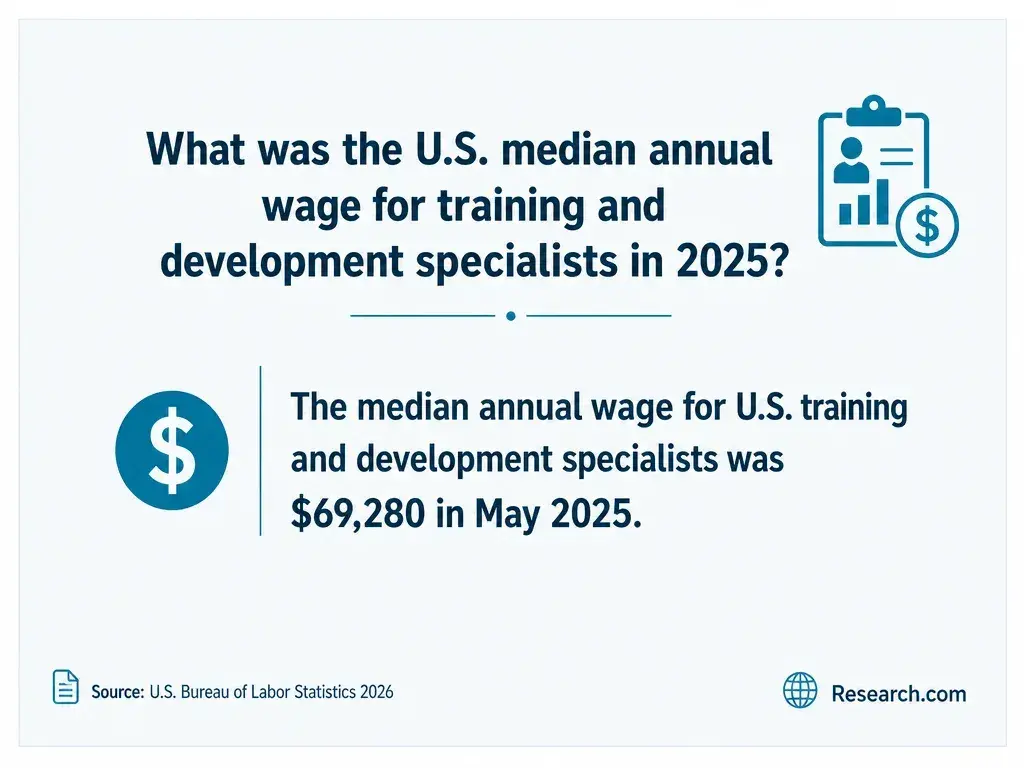
The US Bureau of Labor Statistics reports a May 2025 median annual salary of $133,000 for training and development managers. That occupation-wide figure is not an expected salary for Ed.D. graduates; experience, employer, location, and role responsibilities affect pay.
If your aim is higher education leadership, assess actual job requirements and employer support before taking on doctoral costs. Resources on higher education leadership doctoral scholarships can help frame funding questions, but availability and eligibility must be confirmed with each school.
If you primarily need a specific learning-design or management skill, a focused course or employer development program may be more direct than an Ed.D.
What Should You Look for in a Reputable Online Ed.D. Program?
Look for clear written policies on admission, pass-fail grades, graduate-credit eligibility, transfer limits, and who has final approval. The school should also explain its actual leadership and learning curriculum, online attendance obligations, faculty guidance, and required doctoral project.
Ambiguous promises that prior study will "count" are less useful than a decision specifying which requirement it meets.
Compare the resulting degree plan and total expense against low-cost education doctoral degree options only after confirming that each program fits your professional aim. A lower tuition figure offers little value if the curriculum targets a different field or the schedule is unworkable.
Before accepting an offer, request the admissions determination, any prerequisite decision, and the transfer or degree-audit result from their respective offices. If a decision remains pending, budget and schedule as though the credits will not reduce doctoral requirements. That conservative assumption protects you from committing to a program on an unapproved exception.
Other Things You Should Know About EdD Leadership
Usually not when a school requires an official academic record. A portfolio may demonstrate leadership or research readiness, but ask admissions how to obtain or replace records from the issuing institution.
Possibly, if the program accepts that type of sample and you have permission to share it. Remove confidential organizational information and follow the school's length and authorship rules.
Not before asking the prospective program whether a graded course is necessary and whether a repeat would meet its policy. A new grade does not erase the original transcript entry.
Ask the relevant state higher education agency or records custodian where its transcripts and catalogs are held. Tell the Ed.D. admissions office promptly if the historical pass-fail grading policy is difficult to retrieve.
- Rule 3337-12-40 - Ohio Administrative Code https://codes.ohio.gov/ohio-administrative-code/rule-3337-12-40
- Students with Disabilities Preparing for Postsecondary Education | U.S. Department of Education http://www.ed.gov/higher-education/students-disabilities-preparing-postsecondary-education
- Graduate School: Pass/Fail Grading Option | wisc.edu https://policy.wisc.edu/library/UW-1215
- Academic Rules and Regulations | American University https://www.american.edu/provost/undergrad/undergrad-rules-and-regulations.cfm
- Graduate Academic Processes | UWG https://www.westga.edu/academics/gradstudies/academic-policies.php
- Academic Policies | newhaven.edu https://catalog.newhaven.edu/content.php
- Academic Standards for Students | UC Irvine Graduate Division - https://grad.uci.edu/uc-irvine-graduate-policies-and-procedures/academic-standards-for-students/