2027 Online Ed.D. in Leadership and Learning in Organizations After a Master's in Library and Information Science: Admission and Credit Questions
Audited and Verified:
Our Editorial and Data Verification Process
Research.com uses government datasets, official education statistics and primary institutional information to support its career and degree guides. Our review process checks factual accuracy, occupational definitions, source dates and the requirements associated with the credentials discussed.
How This Article Was Fact-Checked
Our editorial team verifies salary estimates, employment projections, education requirements and program information against original data providers and official organizations. Salary figures are checked against the relevant occupational definitions and reporting periods. Information about licensure, accreditation and required in-person training is reviewed separately.
Fact-checked and verified on:

Co-Founder and Chief Data Scientist
A master's in library and information science (MLIS) can provide a foundation for doctoral study in organizational leadership and learning. It does not, however, settle whether a particular online Ed.D. will admit you - or count any MLIS courses toward the doctorate. Those decisions affect your application, budget, and graduation timeline.
This guide helps librarians, information professionals, and other MLIS graduates assess their preparation, distinguish admission from transfer credit, and get the written answers needed before committing to a program.
Key Things You Should Know
- An MLIS can satisfy an Ed.D. program's master's-degree requirement even if the degree is not in education; the specific program decides eligibility.
- MLIS credits used to establish admission eligibility are not automatically transferable into doctoral requirements. Ask for a separate course-by-course evaluation.
- Get two written determinations before planning your budget: an admissions decision and a degree audit showing any approved transfer credits or course substitutions.
What Is an Online Ed.D. in Leadership and Learning in Organizations?
An Ed.D. in leadership and learning in organizations is a practice-oriented doctorate focused on how people learn, lead, and implement change at work. Depending on the program, students may study adult learning, organizational development, leadership, and applied research. Graduates might use those skills in a library system, university, nonprofit, government agency, or company.
"Online" describes where much of the instruction takes place, not necessarily when it takes place. A program may require live classes, group work, campus convenings, and a faculty-supervised capstone or dissertation in practice. Compare those obligations with your work schedule; fast-paced online Ed.D. study formats are not automatically more flexible.
The exact degree name and final project vary by institution. An Ed.D. generally emphasizes using evidence to improve practice, while a research-focused PhD may be a better fit if your principal goal is to produce disciplinary research.
Can You Pursue This Ed.D. After a Master's in Library and Information Science?
An MLIS is a completed master's degree, and some leadership and learning Ed.D. programs welcome applicants from fields beyond education. Eligibility still depends on the program's accepted degrees, academic standards, and experience requirements. Neither an MLIS nor a library job guarantees admission.
Your strongest case connects information work to organizational problems you have actually addressed: improving staff training, evaluating a community program, managing knowledge across departments, or leading a service change. Describe your decisions and evidence honestly. A reference librarian with substantial project leadership may have a stronger practice-focused application than someone with a management title but little change or evaluation experience.
Check whether the program requires prior study in research methods, statistics, education, or leadership. An admissions office may accept your MLIS while recommending preparation in one of those areas. An MLIS is also different from the Ed.S. credential addressed by education specialist to education doctorate programs; do not assume an Ed.S.-to-Ed.D. credit pathway applies to your degree.
What Admission Requirements Apply to Online Leadership and Learning Ed.D. Programs?
Requirements differ by school and entry term. Programs may request transcripts, a résumé, recommendations, a statement of purpose, writing samples, an interview, or evidence of relevant professional experience. GPA thresholds, entrance-test policies, and definitions of qualifying leadership work are program-specific; confirm them in the current admissions instructions rather than relying on another school's checklist.
For an MLIS applicant, the statement of purpose should explain why a leadership and learning doctorate fits a specific professional challenge - not simply why library work is valuable. For example, you could describe a staff-development or cross-branch implementation problem, what you can currently assess, and what you need to learn about evaluation or change. Do not claim access to workplace data or approval for a doctoral project unless you have it.
Before applying, ask admissions whether your MLIS meets the degree requirement, whether your experience qualifies, and whether any prerequisite or bridging coursework applies. Ask the program office separately whether it expects students to have an approved organizational project site at entry.
Admission and transfer are separate decisions. A school can accept your MLIS as the required prior degree while applying none of its courses to Ed.D. completion. This distinction matters because assumed transfer credit can make an otherwise accurate tuition or graduation estimate misleading.
The following categories show what a school may evaluate and why each decision must be documented separately.
| Decision | What the MLIS may establish | What it does not establish |
| Admission eligibility | Completion of an acceptable master's degree | Admission or doctoral credit |
| Prerequisite or course substitution | Preparation comparable to a specified course | Fewer credits required for graduation |
| Transfer into the Ed.D. | Credit toward an approved degree requirement | A shorter timeline unless the degree audit confirms it |
Schools may consider course level, grade, recency, content, institutional recognition, and limits on credits earned outside the doctoral program. A course substitution can remove a requirement without reducing total credits. Cohort sequencing or required doctoral research courses can also limit the time saved by an approved transfer.
Use this sequence to obtain an answer you can plan around:
- Send official transcripts from every graduate institution and retain syllabi for potentially relevant MLIS courses, especially research methods, evaluation, management, and adult learning.
- Ask the registrar or designated transfer-credit office which courses are eligible, whether quarter credits need conversion, and whether previously used master's credits can count toward the Ed.D.
- Ask the program director which approved credits satisfy named doctoral requirements and whether any substitutions change the total credits or course sequence.
- Request a written degree audit showing remaining requirements, then check its effect on tuition and your expected timeline.
If you also have unfinished doctoral coursework, have it evaluated separately from your MLIS. Resources on online Ed.D. study for returning doctoral applicants address a different situation; prior doctoral study does not automatically transfer either.
Verify that the university holds recognized institutional accreditation and that it covers the institution awarding the Ed.D. Check the institution's current status with its accreditor or the U.S. Department of Education's accreditation database. Then confirm the exact doctorate, delivery format, and any program-specific approvals or disclosures with the university.
Do not confuse accreditation of an MLIS with accreditation of a leadership doctorate. Likewise, institutional accreditation does not mean an Ed.D. prepares graduates for a regulated school-administrator role. If licensure matters to you, seek written confirmation about the program and the state where you intend to work.
Coursework commonly addresses leadership, adult learning, organizational change, and research or evaluation methods, but required courses and depth vary. An MLIS graduate may already bring strengths in information access, knowledge organization, user research, or service assessment. The more important curriculum question is what the Ed.D. adds to that preparation.
Compare course descriptions and required projects against your goal. Someone aiming to improve learning across a library system may need adult-learning theory, implementation, and program evaluation. Someone aiming for organizational consulting may need stronger preparation in diagnosis, stakeholder engagement, and interpreting mixed forms of evidence. Check whether desired subjects are required courses or electives that will actually be offered during your enrollment.
Pay particular attention to methods preparation. Experience with library surveys or service metrics is useful, but it may not substitute for doctoral coursework in research design, ethical review, or evaluating whether an intervention worked.
There is no reliable universal timeline or price for this degree. Required credits, enrollment pace, cohort scheduling, and the final project determine how long you study. Approved transfer credit may reduce coursework, but it may not move a fixed-sequence cohort or shorten the time needed for an applied project.
For a usable cost estimate, request the program's required credits and tuition structure, mandatory fees, and any expected travel or lodging for campus convenings. Add the costs relevant to your situation, such as reduced work hours or employer reimbursement that depends on grades or continued employment. When comparing affordable organizational leadership doctorates, calculate the cost of completing your particular degree audit - not just the advertised price per credit.
Ask how often live classes meet, when group projects occur, and what happens if your employment or project site changes. Those answers may matter more to completion than a program's advertised minimum duration.
For an MLIS graduate, the most direct opportunities build on existing experience: library-system leadership, staff development, organizational learning, program evaluation, or knowledge-management initiatives. The doctorate may strengthen your ability to lead and assess change, but hiring committees will still look for relevant responsibility and results.
Moving into a university-wide leadership role, learning and development department, or consulting practice is a larger transition. Compare your experience with actual job descriptions and seek opportunities to lead cross-functional projects, manage resources, and present credible evaluation work. If college administration is your goal, online organizational leadership Ed.D. choices for college leaders can inform a more role-specific comparison.
If your immediate goal is to supervise a small team or improve one training program, employer development, mentorship, or a focused evaluation course may be more direct and less costly than a doctorate.
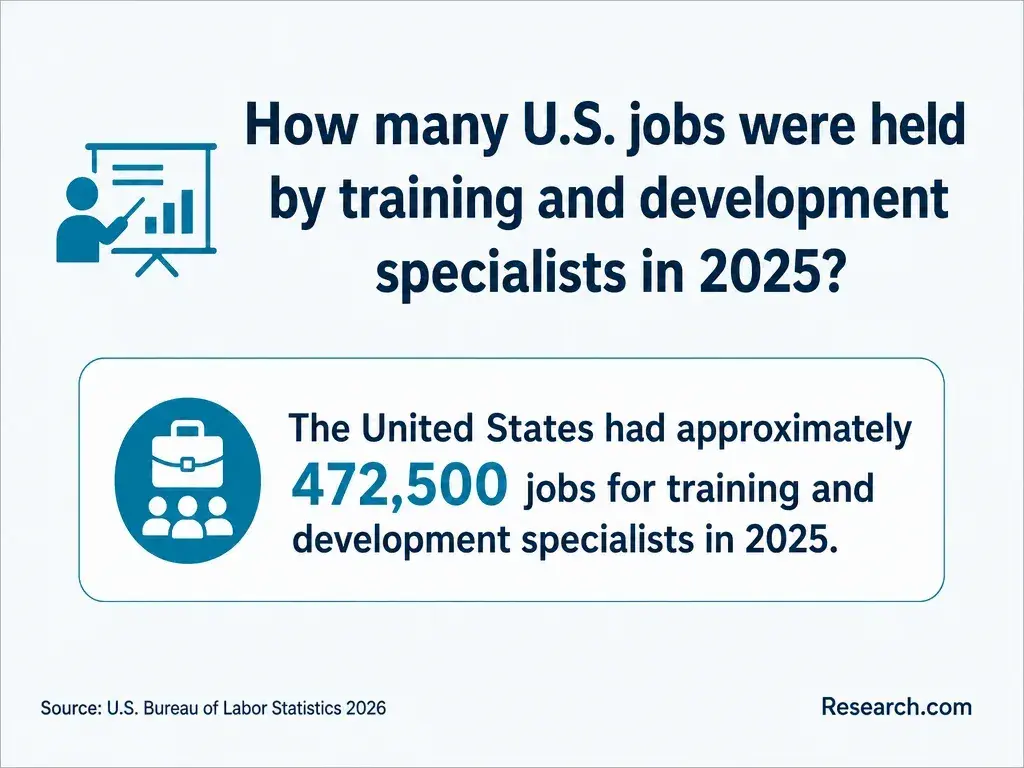
There is no single salary or employment projection for Ed.D. graduates. The U.S. Bureau of Labor Statistics reports a May 2025 median annual wage of $133,000 for training and development managers. That figure describes workers in an occupation, not the earnings of new Ed.D. graduates; management experience and the employer's role requirements remain important.
BLS projects 6.4% employment growth for that occupation from 2025 to 2035. Use occupational data to assess a target field, then compare it with openings you could realistically pursue given your library experience, location, and leadership record. Do not use the median as a promised return on doctoral tuition.
Do Ed.D. Graduates Need Licensure or Professional Certification?
Most general organizational learning and leadership roles do not have a universal Ed.D.-based license. An employer may prefer a certification for a particular training, human resources, or project-management role, but completing the doctorate does not automatically award one.
Regulated education positions are different. Principal or superintendent roles, for example, can have state-specific licensure requirements that a general leadership and learning Ed.D. may not satisfy. If you have a specific position in mind, confirm its requirements with the relevant state authority and ask the university whether its exact program is approved to meet them.
Other Things You Should Know About EdD Leadership
Possibly. Ask the program whether the proposed project meets academic requirements, then obtain the library's permission and clarify who can authorize any needed data access.
Tell your faculty advisor before settling on a project. A different question or approved source of evidence may be feasible; do not assume that removing names makes restricted data available for study.
The answer depends on program policy and the project's approvals. Ask in advance whether you could change sites, revise the scope, or continue with the original organization's written permission.
No. Information professionals who lead training, service improvement, or cross-functional initiatives may have a good fit. First identify the work you want to do and whether doctoral study offers something you cannot gain more directly through experience or shorter training.
- Colleges and College Coursework | New York State Education Department https://www.nysed.gov/teaching-initiatives/colleges-and-college-coursework
- Ed.D. in Curriculum & Instruction | La Sierra University https://lasierra.edu/instructional-leadership/
- How Long Does It Take to Get an EdD? Full Online Timeline Guide | Alverno College https://edd.alverno.edu/articles/how-many-years-is-a-doctorate-in-education/
- Admission Requirements https://graduate.appstate.edu/graduate-admissions/apply-graduate-school/application-requirements
- Doctor of Education (Ed.D.) Online - TXWes https://doctorofeducation.txwes.edu/
- Doctor of Education in Educational Leadership | tarleton.edu https://programs.tarleton.edu/program/doctor-of-education-in-educational-leadership/
- Tuition Breakdown | Florida Atlantic University https://www.fau.edu/administration/controller/student-services/tuition-breakdown/
- EdD vs. PhD in Education: What's the Difference? | Campus Insider https://insider.augusta.edu/edd-vs-phd-education/
- Program: Library and Information Science, MLIS | pitt.edu https://catalog.upp.pitt.edu/preview_program.php
- Online Doctorate in Education and Leadership (Ed.D.) | Rockhurst University https://onlinedegrees.rockhurst.edu/online-edd-programs