2027 Choosing an Online Ed.D. in Leadership and Learning in Organizations Around Peak Nonprofit Fundraising Periods
Audited and Verified:
Our Editorial and Data Verification Process
Research.com uses government datasets, official education statistics and primary institutional information to support its career and degree guides. Our review process checks factual accuracy, occupational definitions, source dates and the requirements associated with the credentials discussed.
How This Article Was Fact-Checked
Our editorial team verifies salary estimates, employment projections, education requirements and program information against original data providers and official organizations. Salary figures are checked against the relevant occupational definitions and reporting periods. Information about licensure, accreditation and required in-person training is reviewed separately.
Fact-checked and verified on:

Co-Founder and Chief Data Scientist
Year-end appeals, GivingTuesday, galas, and grant deadlines can turn a manageable doctoral schedule into an impossible one. For nonprofit professionals considering an online Ed.D. in Leadership and Learning in Organizations, the decisive issue is not whether classes are online; it is whether required meetings, group work, and applied research remain feasible during fundraising peaks.
This guide explains how to test a program against your development calendar, assess its academic and financial value, and decide whether a doctorate - or a shorter route - fits the work you want to do.
Key Things You Should Know
- Compare each program's required live sessions, group meetings, campus visits, and project milestones with your actual campaign calendar; online delivery does not guarantee schedule flexibility.
- A fundraising campaign can suggest an applied research topic, but donor-data access, organizational permission, faculty approval, and academic requirements must be resolved separately.
- The U.S. Bureau of Labor Statistics reports a 2025 median salary of $133,000 for training and development managers; that occupational figure is not a forecast of nonprofit fundraising pay or an Ed.D. graduate's earnings.
What is an online Ed.D. in Leadership and Learning in Organizations?
An Ed.D. is a practice-oriented doctorate. Programs focused on leadership and learning examine how people develop, how organizations change, and how leaders use evidence to improve practice.
For a nonprofit professional, that might mean evaluating volunteer onboarding, improving staff development, or studying how campaign teams share knowledge - not simply learning new fundraising tactics.
The exact degree title and curriculum vary by institution. An online Ed.D. may include scheduled video classes, cohort projects, campus convenings, and a dissertation in practice or another approved culminating project.
A prior education specialist degree can be relevant to some applicants, but online Ed.S.-to-Ed.D. study pathways have school-specific admission and credit rules; an Ed.S. does not automatically shorten this doctorate.
Best fit: a nonprofit leader who wants to investigate recurring organizational learning or change problems and can apply the work responsibly. If the immediate goal is to improve a single appeal or learn a fundraising platform, targeted training and supervised campaign experience are more direct.
Is an online Ed.D. in Leadership and Learning accredited?
Accreditation applies to the institution and, where relevant, to a particular program; the phrase "online Ed.D." does not establish either. Check the university's current institutional accreditation status with the accreditor and the U.S. Department of Education's accreditation records.
Then confirm that the advertised doctorate is awarded by that university and ask whether any claimed programmatic recognition actually covers it.
For nonprofit leadership, institutional accreditation is a basic quality and eligibility check, not proof that the curriculum teaches fundraising, qualifies graduates for a certification, or leads to educator licensure. A broadly focused organizational Ed.D. should not be mistaken for a state-approved school-administrator preparation program.
How does an online Ed.D. compare with campus-based doctoral programs?
Online study removes a routine commute, but it does not necessarily remove fixed attendance. For development staff, the relevant comparison is how each format handles the weeks surrounding major appeals, events, and reporting deadlines.
The table separates delivery features that matter during a fundraising peak. These are questions to verify for specific programs, not promises about all online or campus-based doctorates:
| Feature | Online Ed.D. | Campus-based doctorate |
| Attendance | May require live evening classes and scheduled cohort meetings | Requires travel to scheduled classes; timetable may be predictable |
| Travel | May include mandatory campus convenings | Usually involves recurring campus travel or relocation |
| Applied work | May permit workplace-based inquiry with required approvals | May offer local faculty and research access; project rules still vary |
| Peak-season risk | Remote group deadlines can collide with campaign deadlines | Class and commute commitments can be harder to rearrange |
Request a sample term calendar, not just a description of "flexible" delivery. Check whether attendance is mandatory during your busiest weeks, whether group meetings occur outside class, and whether an academic leave is possible without disrupting your cohort or funding.
A campus-based program with a compatible calendar can be more workable than an online program with inflexible live sessions.
Common subject areas include adult learning, leadership theory, organizational change, research methods, program evaluation, and applied inquiry. Their usefulness depends on your role.
A development director overseeing staff and volunteers may benefit most from learning transfer and change implementation; a program leader responsible for grant reporting may place greater weight on evaluation and measurement.
Read the required course sequence rather than relying on a list of appealing electives. Ask whether a course is offered when you can take it and whether major assignments fall during year-end giving.
Choosing an Ed.D. concentration is worthwhile only if its required work advances your intended responsibilities; a course mentioning nonprofits does not establish a formal nonprofit specialization.
Also examine the culminating project. Studying volunteer retention or campaign-team onboarding could be relevant, but a routine campaign report is not necessarily doctoral research. Faculty must approve the academic scope, and the organization must separately authorize any data access or staff participation.
Requirements vary by program. Schools may ask for graduate transcripts, a statement of purpose, recommendations, a résumé documenting professional responsibility, and evidence that the applicant can pursue doctoral-level inquiry.
Some require a completed master's degree or specified experience; others define preparation differently. Nonprofit leadership can be strong evidence when you describe decisions made, people led, and improvements pursued, not merely a job title or fundraising total.
If you previously began a doctorate, distinguish credits that support admission from credits that the new university will apply toward graduation. Ed.D. completion pathways after unfinished doctoral study are program-specific; request a written credit and requirements evaluation before assuming a shorter route.
In an application, connect a real organizational learning problem to the program's methods. For example, explain why volunteer preparation needs investigation without claiming that training caused a fundraising result you have not established. Ask admissions whether an external project site is allowed if you cannot obtain suitable access at your employer.
There is no reliable universal timeline or price. Required credits, course sequencing, enrollment pace, project approvals, and leave rules determine completion time. Compare each school's published tuition method, per credit, term, or program, with its required credits and expected enrollment pattern.
An online doctoral education program cost guide can help frame the comparison, but obtain a current, individualized estimate from each university.
For a nonprofit employee, the consequential costs may also include required travel, lodging, books, technology, reduced paid work, and an extra term if a campaign delays the project.
Ask whether employer assistance is reimbursement after a passing grade, whether continued employment is required, and whether the organization permits tuition to be charged to the proposed budget source. Never count unapproved employer support as funding.
Build the schedule around your busiest campaign, not an average week. Map the program's fixed classes, assignment due dates, and project checkpoints against year-end giving, recurring events, and grant reporting. If the same people must cover campaigns while you study, discuss that coverage before enrolling.
For an experienced nonprofit professional, the degree may support broader responsibilities in staff development, volunteer learning, program improvement, organizational development, or cross-functional leadership.
A fundraising leader might use applied evaluation to improve how campaign teams are trained and supported. That is different from assuming the doctorate itself qualifies someone to lead a development office.
Target roles still depend on sector knowledge, supervisory experience, budgeting, relationship-building, and evidence of implementation. If you want a fundraising promotion, leading a successful team initiative and developing major-gift or grant expertise may be more valuable than doctoral study.
If you want to design and evaluate organization-wide learning systems, an Ed.D. becomes more relevant. A research-intensive PhD is usually the clearer choice when the primary goal is a research career rather than practice-focused organizational change.
There is no single salary for this degree, and an occupational median is not a graduate earnings figure. The U.S. Bureau of Labor Statistics reports a 2025 median annual salary of $133,000 for training and development managers.
That figure describes workers in the occupation across educational backgrounds and employers; it should not be used as an expected salary for a nonprofit development director or a new Ed.D. graduate.
For a financial decision, compare salaries for the roles you could credibly pursue with your current experience against relevant openings in your region and sector.
Then weigh the possible benefit of new responsibilities against tuition, time, and any lost income. Do not assume that a nonprofit can create or fund a higher-level position because an employee earns a doctorate.
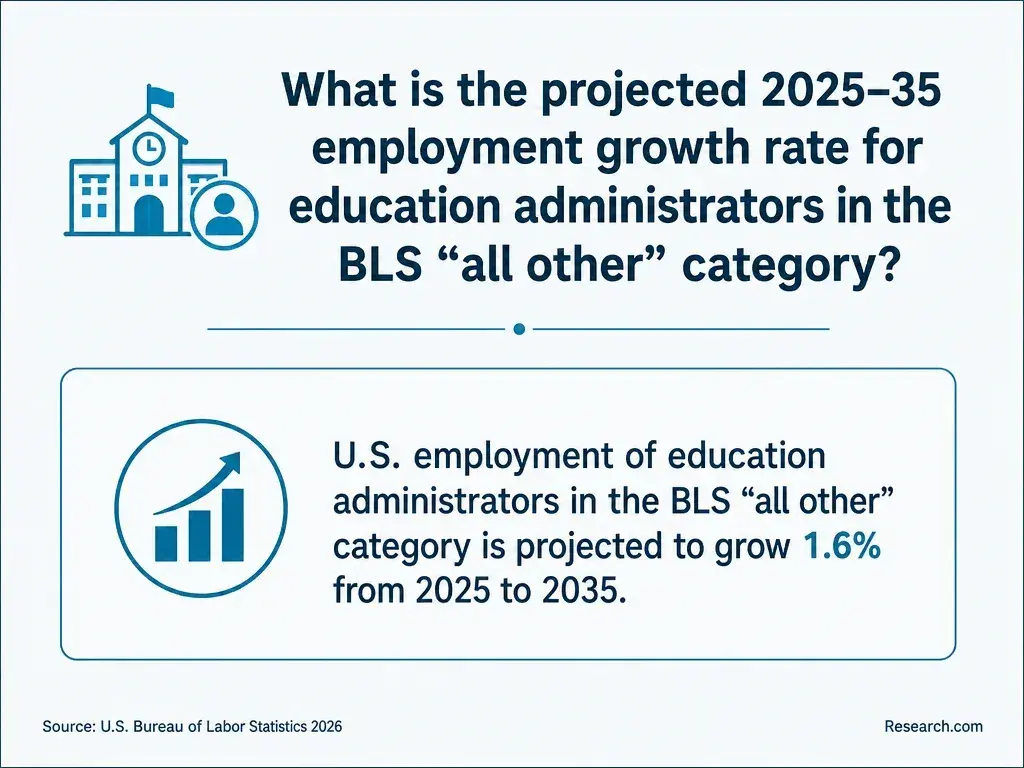
Outlook depends on the occupation, not the degree title. The U.S. Bureau of Labor Statistics projects 10.8% employment growth for training and development specialists from 2025 to 2035.
That indicates demand for a defined learning-and-development occupation, but it does not predict nonprofit fundraising openings or guarantee that specialist jobs require an Ed.D.
Nonprofit professionals should examine actual vacancies for the work they want: fundraising leadership, volunteer development, program evaluation, or organizational learning.
A move between those functions may require a portfolio of relevant projects and sector relationships. Broad education-administration projections are a poor substitute for checking the qualifications and budgets of prospective nonprofit employers.
How can you choose a reputable online Ed.D. program?
Start with a calendar test and a project test, then compare academic quality and price. Reviewing budget-conscious Ed.D. degree options can narrow a search, but a lower advertised tuition is not a bargain if required travel or an incompatible course sequence makes completion impractical.
Before applying, ask each program for answers you can compare:
- Which live classes, group meetings, campus visits, and project deadlines are mandatory, and when do they occur relative to my fundraising peaks?
- What are the approved culminating-project formats, and can I use an external partner if my employer cannot support the work?
- Who approves the project and access to staff, volunteers, or organizational records, and when must those approvals be obtained?
- What is the full estimated cost at my enrollment pace, including fees and required travel, and what happens if I need a leave?
- What completion support and outcome information can the school provide, including how its figures are defined?
Choose only after checking institutional accreditation, current program requirements, faculty guidance, and written answers to schedule and project questions.
Donor records and employee information demand particular care: organizational permission, university research review when applicable, confidentiality protections, and any relevant data-use agreement are distinct from academic approval.
If no program can accommodate the campaign cycle or an ethical project, postponing the doctorate while building leadership experience is a sound decision.
Other Things You Should Know About EdD Leadership
No. Your organization's busiest period may be a gala, fiscal-year close, capital campaign, or grant deadline. Use your own workload records and upcoming campaign plan when testing a doctoral schedule.
Only if the grant terms and the organization's financial policies permit that expense. Ask the grants and finance teams for a documented determination before including it in a funding plan.
Do not upload them without explicit organizational authorization and compliance with the university's rules. Use approved, appropriately deidentified or synthetic material when possible.
It may help demonstrate responsibility and initiative, but the program decides whether it meets any formal experience requirement. Describe your decisions and scope of work, and ask admissions how it evaluates volunteer roles.
- Academic Years, Academic Calendars, Payment Periods, and Disbursements | 2024-2025 Federal Student Aid Handbook https://fsapartners.ed.gov/knowledge-center/fsa-handbook/2024-2025/vol3/ch1-academic-years-academic-calendars-payment-periods-and-disbursements
- Master's Degree in Organizational Leadership | Mercer University https://professionaladvancement.mercer.edu/academic-programs/graduate-and-professional/organizational-leadership/
- UNC EdD Online: Organizational Learning and Leadership https://online.unc.edu/online-doctoral-programs/online-edd-organizational-learning-and-leadership/
- Criteria for Accreditation - Office of the Provost | University of Notre Dame https://provost.nd.edu/accreditation-and-state-authorization/criteria-for-accreditation/
- Online Ed.D. in Leadership and Learning in Organizations | VU-EDU https://peabodyonline.vanderbilt.edu/edd-in-organizational-learning/
- Careers in Nonprofit Organizations | Fordham Graduate School of Education https://www.fordham.edu/graduate-school-of-arts-and-sciences/student-resources/professional-development/gsas-futures/career-pathways/careers-for-training-in-the-humanities/nonprofit-organizations/
- Online Doctorate in Education and Leadership (Ed.D.) | Rockhurst University https://onlinedegrees.rockhurst.edu/online-edd-programs
- Employer Tuition Assistance Plans May Help Pay for College | Campus https://campus.edu/blog/financial-aid/employer-tuition-assistance-programs-can-help-pay-for-college
- Requests for Exceptions to Academic Policy | Academic Advising https://advising.stanford.edu/current-students/academic-policy/exceptions
- Academics: Section 3: Student Expectations and Responsibilities: Student Guidelines for the Classroom https://academics.waldenu.edu/handbook/student-expectations/classroom-guidelines