2027 Is an Online Ed.D. in Leadership and Learning in Organizations a Good Fit for Franchise Training Directors?
Audited and Verified:
Our Editorial and Data Verification Process
Research.com uses government datasets, official education statistics and primary institutional information to support its career and degree guides. Our review process checks factual accuracy, occupational definitions, source dates and the requirements associated with the credentials discussed.
How This Article Was Fact-Checked
Our editorial team verifies salary estimates, employment projections, education requirements and program information against original data providers and official organizations. Salary figures are checked against the relevant occupational definitions and reporting periods. Information about licensure, accreditation and required in-person training is reviewed separately.
Fact-checked and verified on:

Co-Founder and Chief Data Scientist
Franchise training directors must help people learn across locations they do not all manage directly. An online Ed.D. in leadership and learning in organizations could strengthen that work, but it is a substantial commitment, not a required next credential.
This guide is for directors considering broader responsibility for franchise learning, organizational change, or consulting. It explains where doctoral study could add value, where experience or shorter training may serve better, and what to verify before applying.
Key Things You Should Know
- An Ed.D. is most useful when your next role involves leading systemwide learning and evaluating change, not simply delivering more training.
- Franchisee independence, access to training data, and authority to change operating practices can limit the value of an applied doctoral project.
- The U.S. Bureau of Labor Statistics reports a $133,000 median annual salary for training and development managers in May 2025; that occupational figure is not an Ed.D. graduate salary or a promised raise.
Is an Online Ed.D. in Leadership and Learning a Good Fit for Franchise Training Directors?
Yes, potentially, if you already lead franchise learning and want to solve larger organizational problems through evidence, collaboration, and change leadership. The fit is weaker if your immediate goal is a promotion that depends mainly on operations results, stronger instructional design skills, or experience managing a larger team.
A franchise training director may oversee onboarding, field-trainer development, learning platforms, and training for new products or procedures. Yet completion rates alone cannot show whether training improves performance.
Location ownership, staffing, incentives, and the franchisor's authority also shape what people can put into practice. Doctoral study is more valuable when you can investigate those interacting factors and influence decisions beyond the training department.
The comparison below separates goals that may justify an Ed.D. from goals with a more direct route:
| Primary goal | Likely fit | Why |
| Lead systemwide learning and change | Potentially strong Ed.D. fit | Applied inquiry and organizational leadership can support decisions across functions and locations. |
| Improve course design or learning-platform use | Targeted development may fit better | Instructional design training and supervised projects address a narrower skills gap. |
| Move into franchise operations leadership | Experience may matter more | Operational accountability, budgets, and franchisee relationships are not conferred by a doctorate. |
| Conduct primarily academic research | Consider a research-focused PhD | A PhD may better match a career centered on producing scholarly research. |
A practical test is whether you can name a consequential learning problem, identify who has authority to act on the findings, and explain why structured doctoral inquiry would improve the decision. If not, seek a cross-functional assignment or targeted training first.
What Does an Ed.D. in Leadership and Learning in Organizations Cover?
An Ed.D. in leadership and learning in organizations is a practice-oriented doctorate focused on how people learn, how organizations change, and how leaders use evidence to improve practice. It is not necessarily a degree in school administration.
Program names and required courses vary, so the title alone does not establish a formal concentration or particular research requirement.
For franchise directors, the strongest connection is between learning transfer, whether people use what they learned on the job, and the conditions at individual locations. A director might study why a new service standard is adopted unevenly, while remaining open to explanations other than inadequate training.
Coursework in adult learning, organizational culture, change, and evaluation could help distinguish a knowledge gap from a workflow or incentive problem.
Programs may end in a dissertation in practice, capstone, or another approved project. Before treating your franchise network as a project site, confirm the academic deliverable and whether you could obtain organizational sponsorship and appropriate data access.
How Can an Ed.D. Advance a Franchise Training Director's Career?
An Ed.D. can help an established director make a stronger case for responsibility over enterprise learning strategy, leadership development, or organizational improvement.
Its professional value comes from applying what you learn: diagnosing a problem, working with franchise and corporate stakeholders, testing a feasible response, and communicating limitations honestly.
It does not replace a record of managing people, budgets, vendors, or change across independently operated locations. For an internal promotion, ask your employer which responsibilities the next role actually holds and whether a doctoral credential would affect selection.
For a move into higher education, doctoral leadership study for higher education organizations is a separate comparison: franchise experience may transfer, but institutional governance and hiring expectations differ.
If your aim is franchise growth, financial strategy, or general management rather than learning and organizational change, an MBA or relevant operating assignment may be more direct. If you want to improve one training process, a focused certificate, mentoring, and a documented workplace project may be sufficient.
Relevant study may combine leadership theory, adult learning, organizational diagnosis, research methods, and evaluation. For a franchise director, the useful distinction is between designing training and determining whether training is the right response.
A methods course, for example, may help you interpret surveys and performance measures without mistaking an association for proof that training caused an improvement.
Online delivery can let you study from where you work, but it does not mean self-paced study. Programs may require live sessions, group work, faculty meetings, or campus convenings.
Look at the actual course sequence and project rules, not just a catalog of topics: exposure to analytics or change management does not by itself establish advanced technical expertise.
A plausible applied question would be why newly onboarded locations differ in adoption of an approved procedure. Answering it responsibly would require agreement on the decision to be made, suitable measures, permission to use records, and attention to differences among locations. Those conditions matter as much as the research method taught in class.
Requirements are program-specific. Schools commonly review prior degrees and transcripts, professional experience, recommendations, a statement of purpose, and evidence that an applicant is prepared for doctoral work; particular tests, grades, or graduate-credit thresholds must be checked with the program.
A franchise director should describe actual decision-making responsibility rather than rely on the word "director" in a job title.
A persuasive application can connect a real franchise learning challenge to the applicant's authority, collaborators, and potential evidence, without claiming access to confidential data or promising an outcome.
Applicants with an education specialist credential can investigate education specialist to education doctorate programs, but should obtain a written evaluation: credits considered for admission are not necessarily credits applied toward the doctorate.
Completion time depends on the program's required credits, course availability, enrollment pace, and final-project structure. An online format does not remove deadlines, cohort schedules, or the time needed to secure project approval and complete an analysis.
A franchise director whose busiest periods coincide with openings, seasonal launches, or systemwide rollouts should compare those dates with required classes and project milestones.
Published shorter Ed.D. course sequences can help identify programs to investigate, but an advertised timeline is not an individual completion guarantee. Request the term-by-term schedule, live attendance rules, campus-visit requirements, leave policy, and typical progression through the final project before deciding that a pace is workable.
There is no reliable single price for this degree: schools charge under different credit, term, and fee structures. Compare the published tuition for your entry term with required credits, mandatory fees, travel for any convenings, and the cost of continuing enrollment if the final project takes longer than planned.
Time away from work and any reduction in hours belong in the decision even though they are not billed by the university.
Employer assistance can change the calculation, but a verbal offer is not funding. Ask for written rules covering eligible tuition, annual limits, required grades, continued-employment conditions, and repayment after departure.
Use online Doctor of Education tuition planning to organize comparisons, then confirm charges and aid directly with each school. Do not base the investment on an assumed promotion or salary increase.
Online delivery does not determine accreditation. Check the institution's current accreditation with the accreditor or the U.S. Department of Education's recognized accreditation information, then verify the exact Ed.D. award with the university.
If a school advertises additional programmatic recognition, confirm what it covers rather than assuming it applies to every doctorate.
For a franchise training director, employer recognition is a separate question: ask whether decision-makers value the degree, its applied work, or particular operating experience.
A broadly focused organizational leadership Ed.D. does not automatically award a professional certification or qualify someone for a regulated school-administrator position.
The most direct next steps are senior training and development leadership, enterprise learning roles, or broader organizational development responsibilities.
A director with substantial diagnosis and client-facing experience might also pursue organizational consulting. These roles are not interchangeable: consulting requires credible recommendations across client settings, while senior internal leadership generally adds budget, staffing, and cross-functional accountability.
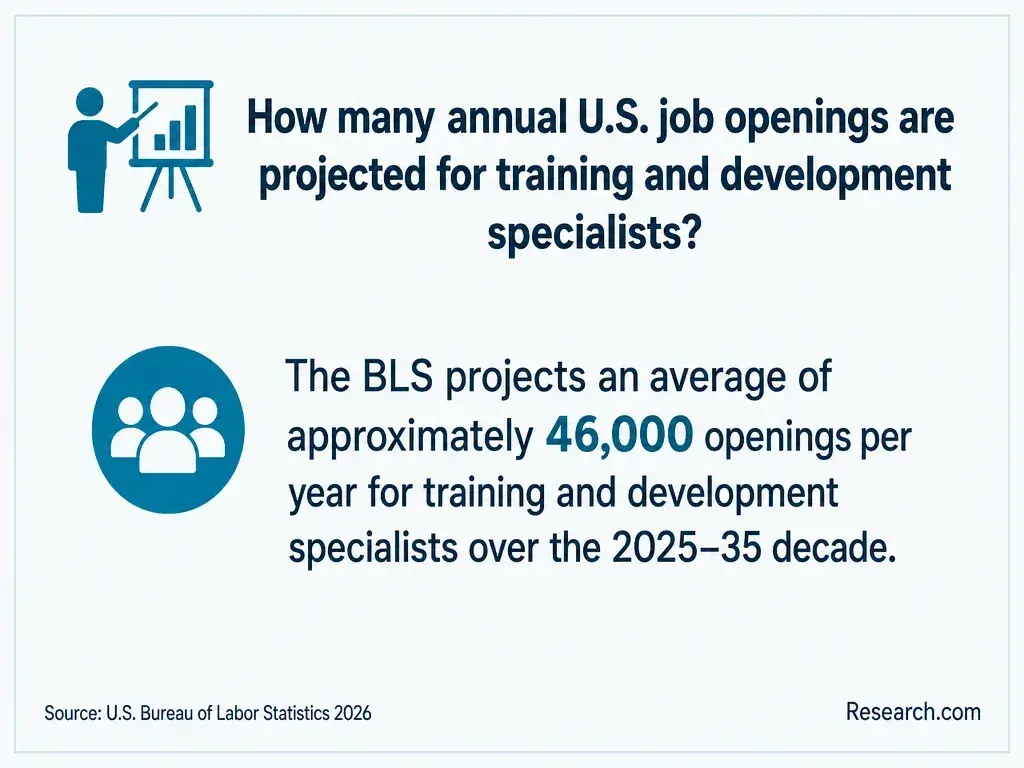
The U.S. Bureau of Labor Statistics reports a $133,000 median annual salary for training and development managers in May 2025 and projects 6.4% employment growth from 2025 to 2035.
These figures describe the occupation across industries, not franchise training directors or Ed.D. graduates. Location, employer size, scope of responsibility, and prior results will affect an individual offer more than the degree title alone.
To assess readiness, compare target job postings with evidence you can show: initiatives led across locations, decisions influenced, resources managed, and improvements evaluated with appropriate caution. Build the missing experience alongside any academic study.
How Should Franchise Training Directors Choose an Online Ed.D. Program?
Choose around the work you want to do, not the broad appeal of "leadership" in a program name. The following checks connect a school's published requirements to the realities of franchise training.
- Match the curriculum: Identify required adult-learning, organizational-change, and evaluation work; verify whether relevant electives are actually available.
- Test project feasibility: Ask whether a franchisor, franchisee group, or external partner can serve as the project setting and what approvals, data permissions, and faculty oversight are required.
- Check the schedule: Obtain live-session times, group-work expectations, campus-convening dates, and options if your role or employer changes.
- Compare total commitment: Request an entry-term cost estimate and written funding terms, then weigh them against a smaller credential or a stretch assignment.
For a second view of the financial comparison, use planning the cost of an organizational leadership doctorate alongside each institution's published charges. The best fit is a program whose requirements you can complete and whose applied work addresses decisions you are positioned to influence.
Other Things You Should Know About EdD Leadership
Yes. Corporate support does not necessarily give a student authority over franchisees' participation or records. Confirm the relevant agreements, obtain appropriate permissions, and design a feasible alternative if locations opt out.
Only within the permissions granted by the organization and program. Ask what can be published or presented, and prepare a version that removes protected data, proprietary procedures, and identifying details where required.
Do not upload restricted records to a tool without authorization. Check employer data-security rules, the university's research and AI policies, and any applicable consent or data-use terms first.
Access and sponsorship may end when employment does. Before starting, ask the program how project-site changes are approved and what evidence you may retain or transfer under your employer's rules.
- The Role of Continuing Professional Training or Development in Maintaining Current Employment: A Systematic Review https://pmc.ncbi.nlm.nih.gov/articles/PMC10647344/
- Cost of Attendance (Budget) | 2026-2027 Federal Student Aid Handbook https://fsapartners.ed.gov/knowledge-center/fsa-handbook/2026-2027/vol3/ch2-cost-attendance-budget
- Types of Financial Aid: Grants, Work-Study, and Loans | studentaid.gov https://studentaid.gov/understand-aid/types
- Online EdD in Organizational Leadership | Pepperdine University https://gsep.pepperdine.edu/doctorate-organizational-leadership/
- Instructional Time for Hybrid and Online Courses | DePaul University, Chicago https://resources.depaul.edu/teaching-commons/teaching-guides/course-design/Pages/instructional-time.aspx
- Doctor of Education in Organizational Leadership, Culture and Change | Thomas Edison State University https://www.tesu.edu/degrees-programs/doctoral/edd.php
- Online Doctorate in Education and Leadership (Ed.D.) | Rockhurst University https://onlinedegrees.rockhurst.edu/online-edd-programs
- Leadership and Learning in Organizations Online Ed.D. | Peabody College of Education and Human Development https://peabody.vanderbilt.edu/academics/edd-programs/online-leadership-learning-organizations/
- Time-on-Task Calculator | LSU Faculty Resources & Support https://facultysupport.lsu.edu/resources/time-on-task-calculator/
- Group Work | The Derek Bok Center for Teaching and Learning https://bokcenter.harvard.edu/group-work