2027 Is an Online Ed.D. in Leadership and Learning in Organizations a Good Fit for Internal Communications Directors?
Audited and Verified:
Our Editorial and Data Verification Process
Research.com uses government datasets, official education statistics and primary institutional information to support its career and degree guides. Our review process checks factual accuracy, occupational definitions, source dates and the requirements associated with the credentials discussed.
How This Article Was Fact-Checked
Our editorial team verifies salary estimates, employment projections, education requirements and program information against original data providers and official organizations. Salary figures are checked against the relevant occupational definitions and reporting periods. Information about licensure, accreditation and required in-person training is reviewed separately.
Fact-checked and verified on:

Co-Founder and Chief Data Scientist
Internal communications directors already know how to reach employees. The harder challenge is helping an organization learn, change, and determine whether its messages lead to better decisions. An online Ed.D. in Leadership and Learning in Organizations may strengthen that work - but it is a substantial investment, not a prerequisite for promotion. This guide helps experienced communications leaders judge whether doctoral study fits their next role, which program features matter, and when a more targeted route would serve them better.
Key Things You Should Know
- Best fit: An Ed.D. can make sense if you want to lead organizational learning, change, or evidence-based leadership initiatives - not simply become a more senior communications practitioner.
- Career reality: The Bureau of Labor Statistics reports a $133,000 median annual salary for training and development managers in 2025, but that occupation is not a salary forecast for Ed.D. graduates or communications directors.
- Before enrolling: Confirm the program's applied-project rules, live attendance, total cost, and whether your employer will permit access to the organizational problem and data you hope to study.
Is an online Ed.D. in Leadership and Learning in Organizations right for internal communications directors?
It may be a good fit if your next job extends beyond producing communications to shaping how people learn and adapt at work. A director who advises executives on change, partners with learning and development, and evaluates whether employees can act on new information has a relevant foundation. The Ed.D. adds the most value when that director also wants to diagnose organizational problems, design interventions, and test whether they work.
The choice depends on the responsibility you want to hold, not the prestige of the credential. These routes address different gaps for an experienced communications leader:
| Next objective | Likely better starting point | Why |
| Lead organization-wide learning and change | Practice-oriented Ed.D. | Connects leadership, adult learning, and applied inquiry over a sustained course of study. |
| Improve employee messaging, channels, or executive writing | Targeted training and larger communications assignments | Builds directly relevant skills without a doctoral commitment. |
| Move into business operations or general management | MBA or employer leadership program | May better address finance, operations, and commercial decision-making. |
| Become an academic researcher | Research-focused PhD | Typically places greater emphasis on producing original scholarship. |
An Ed.D. is a weaker fit if your main goal is a communications vice presidency that employers award primarily for crisis judgment, executive counsel, and a record of leading teams. Ask prospective employers which capabilities they actually value. If doctoral study is appropriate but cost is the obstacle, compare inexpensive Ed.D. pathways to consider against the curriculum and support you need; the lowest advertised tuition is not necessarily the lowest total cost.
What does an Ed.D. in Leadership and Learning in Organizations prepare graduates to do?
A practice-oriented Ed.D. prepares professionals to use research and leadership frameworks to address organizational problems. For an internal communications director, that might mean investigating why managers cannot explain a new policy consistently, then working with stakeholders to improve manager preparation and evaluate the results. The degree does not itself establish that communications caused a change in employee behavior.
The distinction between message reach and learning transfer matters. Email opens show possible exposure; they do not show that a supervisor understands a procedure or can use it. Doctoral study can help a director define more meaningful measures, consider competing explanations, and communicate limitations to executives. Applied projects require faculty oversight and, where applicable, employer permission, appropriate data access, and ethical review. They are not automatically authorized because the student works for the organization.
How can this Ed.D. advance an internal communications director's career?
The strongest advancement case is a broader scope of work: advising on culture and change, helping develop managers, or leading cross-functional efforts that combine communications, learning, and organizational development. A director can demonstrate readiness through projects that identify a performance problem, bring stakeholders together, implement a response, and assess it honestly.
For example, leading communications for a new operating model is different from helping managers learn their new decision rights and determining where implementation stalls. An Ed.D. can strengthen the second kind of work. Promotion still depends on leadership experience, organizational authority, results, and the employer's hiring criteria. Before applying, compare target job descriptions with your current portfolio: if the missing qualification is budget ownership or direct management experience, seek that responsibility rather than assuming a doctorate will substitute for it.
Relevant programs commonly connect leadership and organizational change with adult learning, research methods, and evaluation. A communications director should look beyond course titles to see whether assignments address how employees learn at work, how changes are implemented, and how evidence is interpreted. Some curricula emphasize educational institutions; others are designed for leadership across sectors.
Examine required courses, available electives, and the final project separately. A course on change management does not establish a formal concentration or ensure extensive preparation in analytics. Comparing types of Ed.D. programs and concentrations can help you distinguish an organization-wide learning focus from a school-administration pathway. Ask for recent course descriptions and examples of permissible project topics before deciding that a program matches internal communications work.
Online delivery removes a regular commute; it does not necessarily make a doctorate self-paced. Live classes, cohort meetings, group assignments, and campus convenings may still require fixed hours or travel. Campus-based study can offer regular in-person contact, but its schedule may be harder to reconcile with executive meetings, launches, or crises.
Request the actual class timetable, attendance policy, convening dates, and expectations during the final project. Then compare those commitments with your busiest communications cycles, not an average week. If speed matters, review faster routes through an education doctorate cautiously: a shorter schedule may concentrate coursework and leave less room for an unpredictable leadership role.
Requirements vary by institution. Programs may request graduate transcripts, a statement of purpose, recommendations, a résumé, and evidence of relevant professional experience; some also use interviews or specify prior degrees or grades. A communications background is not inherently disqualifying, and a master's in education is not a universal requirement. Check the rules for the exact degree and entry term.
A strong application should describe a leadership problem you have actually encountered, your decision-making responsibility, and what you still need to learn. Do not present a proposed workplace study as an approved project. If you have education specialist coursework, ask admissions whether it supports eligibility and ask the program separately whether any credits can apply to the doctorate. Ed.D. pathways building on education specialist study may have different credit rules; prior study does not automatically shorten completion.
There is no reliable universal timeline or price. Required credits, enrollment pace, course availability, and the time needed for a dissertation or other approved final project all affect completion. Tuition may be charged per credit or term, so an advertised rate alone cannot establish the total bill.
For a usable estimate, obtain the program's required credits and fee schedule, then account for convening travel, books or technology, and possible extra terms if a project takes longer than planned. Ask whether employer reimbursement covers doctoral tuition, whether it is paid upfront or after grades post, and whether leaving the company triggers repayment. A comparison of organizational leadership doctoral fees and total costs can frame the questions, but use each institution's written figures for your entry term to make the decision.
Confirm that the degree-granting institution holds institutional accreditation from an accreditor recognized by the U.S. Department of Education or the Council for Higher Education Accreditation. Verify the institution and accreditor in their official directories, and confirm that the award is an Ed.D., not a certificate or a differently designated doctorate.
Institutional accreditation speaks to the institution's recognized quality-assurance process; it does not prove that a particular curriculum fits communications leadership, that credits will transfer, or that graduates qualify for a license. Evaluate faculty guidance, project requirements, and student support on their own merits.
An experienced director might pursue broader internal communications leadership, change or organizational development leadership, learning and development management, or consulting. These are different jobs: a training and development manager oversees learning programs, while a management analyst typically advises organizations on improving operations. Neither role follows automatically from earning an Ed.D.
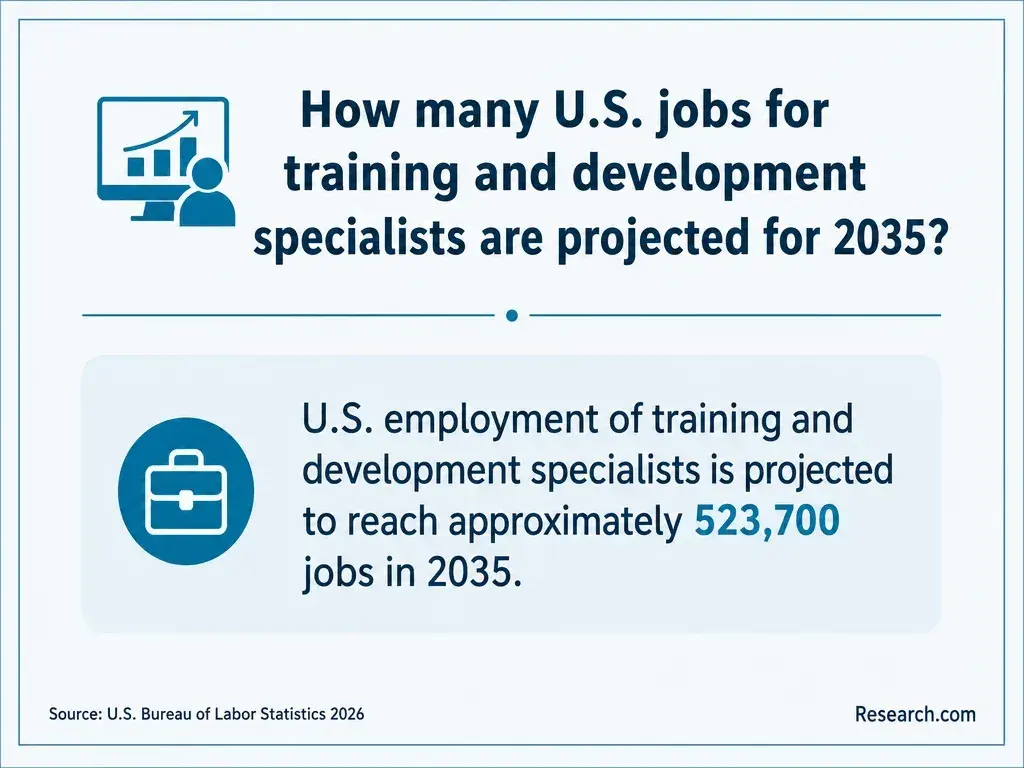
For context, the U.S. Bureau of Labor Statistics reports a 2025 median annual salary of $133,000 for training and development managers and projects 6.4% employment growth for that occupation from 2025 to 2035. Those figures describe an occupation, not what communications directors or Ed.D. graduates will earn. Use them only if you are seriously targeting learning-management work; for a communications promotion, examine the specific employer's responsibilities and compensation range instead.
Do internal communications directors need a license or professional certification?
Internal communications director roles generally do not require a state professional license. Employers may value communications, change-management, or talent-development certifications for particular responsibilities, but these are distinct from an Ed.D. and should be assessed against the jobs you want. A leadership doctorate does not automatically confer a professional certification.
If your intended move is into a regulated education role, ask the program and the relevant state authority whether that specific degree meets its requirements. A broadly focused organizational leadership Ed.D. should not be mistaken for a state-approved school-administrator licensure program.
Other Things You Should Know About EdD Leadership
Possibly. A program may permit their use if the question, measures, permissions, and oversight meet its requirements. Opens and clicks alone rarely establish employee understanding or behavior change.
Coursework may continue, but an employer-based project could lose its sponsor or data access. Ask the program how project-site changes are approved before you depend on one workplace.
It may support some teaching applications, but institutions set their own qualifications. Relevant professional experience and evidence of teaching ability also matter; research-intensive faculty roles may favor a PhD.
Only within your institution's academic-integrity rules and your organization's data-security requirements. Do not upload confidential employee responses to an unapproved tool, and verify any AI-assisted coding or summary against the underlying evidence.
- Cost of Attendance (Budget) | 2025-2026 Federal Student Aid Handbook https://fsapartners.ed.gov/knowledge-center/fsa-handbook/2025-2026/vol3/ch2-cost-attendance-budget
- Understanding College Costs | studentaid.gov https://studentaid.gov/resources/prepare-for-college/students/choosing-schools/consider-costs
- Online EdD - Higher Education | American International College https://online.aic.edu/programs/online-edd/higher-education
- Doctor of Education in Organizational Leadership, Culture and Change | Thomas Edison State University https://www.tesu.edu/degrees-programs/doctoral/edd.php
- Online Doctorate in Education and Leadership (Ed.D.) | Rockhurst University https://onlinedegrees.rockhurst.edu/online-edd-programs
- The Types of Courses We Offer - Harvard Extension School https://extension.harvard.edu/student-experience/course-formats/
- What's the Difference Between Asynchronous and Synchronous Learning? | Ohio State Online https://online.osu.edu/content-hub/blogs/whats-the-difference-between-asynchronous-and-synchronous-learning/
- Learning and Organizational Change - Academic Catalog https://catalogs.northwestern.edu/undergraduate/education-social-policy/learning-organizational-change/
- EdD vs. PhD in Education: Choosing the Right Program | Goodwin College of Professional Studies https://drexel.edu/soe/resources/career-path/edd-vs-phd/
- Why communication is essential to effective leadership | upenn.edu https://lpsonline.sas.upenn.edu/features/why-communication-essential-effective-leadership