2027 Is an Online Ed.D. in Leadership and Learning in Organizations a Good Fit for Training Curriculum Development Directors?
Audited and Verified:
Our Editorial and Data Verification Process
Research.com uses government datasets, official education statistics and primary institutional information to support its career and degree guides. Our review process checks factual accuracy, occupational definitions, source dates and the requirements associated with the credentials discussed.
How This Article Was Fact-Checked
Our editorial team verifies salary estimates, employment projections, education requirements and program information against original data providers and official organizations. Salary figures are checked against the relevant occupational definitions and reporting periods. Information about licensure, accreditation and required in-person training is reviewed separately.
Fact-checked and verified on:

Co-Founder and Chief Data Scientist
A training curriculum development director may already know how to build effective courses but want greater influence over workforce strategy, leadership development, and learning outcomes. An online Ed.D. in Leadership and Learning in Organizations could support that move - but it is a substantial investment, not a prerequisite for every director role.
This article examines what the degree adds to established curriculum expertise, where its limits lie, and how to compare it with more targeted development. The goal is to help you decide whether doctoral study addresses the work you actually want to do.
Key Things You Should Know
- Best fit: An Ed.D. is most useful when a curriculum director wants to lead organization-wide learning strategy, change, and evaluation - not simply improve course production.
- Career reality: The U.S. Bureau of Labor Statistics reports a $133,000 median annual salary for training and development managers in May 2025; that occupation-wide figure is not an expected salary for Ed.D. graduates.
- Decision test: Compare the program's applied research, leadership coursework, total cost, and scheduling demands against the responsibilities you can realistically gain at work.
Is an online Ed.D. in Leadership and Learning in Organizations a good fit for curriculum development directors?
Yes, conditionally. A practice-oriented Ed.D. can fit a director who already oversees training curricula and wants to diagnose performance problems, align learning with organizational priorities, lead cross-functional change, and evaluate whether programs work. It is less compelling if the immediate goal is to master a new authoring tool, update individual courses, or qualify for a promotion that primarily depends on management experience.
The distinction is scope of responsibility. A curriculum director may own learning objectives, design standards, vendor work, and production schedules. A broader learning leader must also negotiate priorities with executives and operations teams, make resource decisions, and determine whether training is even the right response to a performance gap. Doctoral study can strengthen that judgment, but it cannot replace the authority and experience needed to implement decisions.
The following comparison ties common goals to the preparation most likely to help. It is a decision guide, not a claim that every employer requires the same credential.
| Primary goal | Potentially useful pathway | Key limitation |
| Lead organization-wide learning, change, and evaluation | Practice-oriented leadership and learning Ed.D. plus progressively broader work responsibility | Coursework alone does not establish executive readiness |
| Improve instructional design, technology, or curriculum production | Focused graduate study, a certificate, or supervised technical projects | May not develop enterprise-level leadership or research skills |
| Advance through a specific management vacancy | Check the job requirements; seek budget, staff, and stakeholder leadership experience | A doctorate may add cost without changing eligibility |
Before applying, identify a decision you want to own that you do not own now - for example, deciding whether a training initiative should expand based on credible evidence. Then ask whether the Ed.D.'s required work develops that capability more directly than a stretch assignment, mentorship, or targeted study.
What career opportunities can an online Ed.D. in Leadership and Learning prepare you for?
For an established curriculum director, the most plausible next steps are broader learning and development leadership, talent or leadership development, organizational development, and consulting. These roles differ: a training and development manager directs programs and staff; an organizational development practitioner addresses processes and change; a consultant diagnoses client problems and recommends action.
A doctorate can support those tasks, but hiring decisions also turn on results, sector knowledge, budgets managed, and people led.
Internal advancement may be more realistic than an immediate sector switch because colleagues can evaluate your work firsthand. To build a credible case, document how you identified a performance need, gained stakeholder agreement, implemented a response, and assessed results without overstating what the evidence proves.
If you aim to move into university administration, explore higher education leadership through an organizational leadership Ed.D. while checking each employer's expectations for higher education experience.
A research-focused PhD may be a better match if the principal goal is to conduct original scholarship or compete for research-intensive faculty positions. An Ed.D. may suit a director whose central aim is to improve practice in an organization; neither degree by itself secures a faculty, consulting, or executive appointment.
What does an online Ed.D. in Leadership and Learning in Organizations teach?
Relevant programs commonly bring together adult learning, organizational leadership, change, and applied inquiry. For a curriculum director, the value lies in connecting these subjects: learning theory helps explain why a course may not transfer to work, while organizational diagnosis tests whether the obstacle is instruction, incentives, processes, or something else.
Research and evaluation courses can help a director choose meaningful measures rather than rely only on completion rates or favorable surveys.
Look closely at the actual course sequence. A program emphasizing leadership theory but offering little opportunity to study learning evaluation may not meet your goal; one focused on school administration may be a poor substitute for cross-sector workforce learning. Also distinguish a required course from an elective that may not run during your enrollment.
An applied project could let you investigate a real learning problem, but its form varies by institution. A course assignment, team capstone, dissertation in practice, and research dissertation are not interchangeable. If you hope to use employee or learner information, confirm organizational permission, confidentiality requirements, and the program's ethics-review process before assuming the project is feasible.
Online delivery changes where you study, not necessarily what the doctorate demands. Some programs have scheduled live classes, group work, or campus convenings; others offer more asynchronous coursework. A campus-based program may make in-person collaboration easier, while an online program may let a working director remain employed and investigate a problem in their own organization. Neither format is inherently more flexible at the project stage.
Compare actual attendance rules, faculty access, project supervision, and travel obligations rather than labels. If price is driving the format decision, compare the full cost of attendance alongside organizational leadership doctoral study on a budget; an apparently cheaper online option can still involve fees, travel, and substantial time away from work.
Requirements vary by school. Programs may assess prior graduate education, academic performance, professional experience, recommendations, a statement of purpose, and evidence that an applicant can undertake doctoral work. A curriculum director can make a stronger case by describing decisions made, stakeholders led, and a genuine organizational learning problem - not just listing courses produced or citing a senior title.
Check the specific program's rules for acceptable prior degrees, minimum graduate credits, tests, and any employer or project-site expectations. Credits accepted as evidence of admission eligibility are not automatically transferable into the Ed.D. Ask admissions staff for a written evaluation if your graduate study is incomplete, spread across institutions, or outside education.
Plan for a multi-year commitment, but use the school's published course sequence rather than a generic completion estimate. Timing depends on required credits, cohort scheduling, enrollment intensity, and the time needed to gain approval for and complete the final project. A curriculum director should also account for predictable work peaks, such as major launches or annual planning.
Investigate shorter Ed.D. course sequences if time is the main constraint, but verify what makes a sequence shorter. A faster advertised schedule may demand heavier terms or leave little room for an employer change or delayed project access. Ask how often required courses run and what happens if you pause enrollment.
There is no reliable single price for this degree category. Obtain a program-specific estimate that includes required credits, tuition, mandatory fees, any campus travel and lodging, and likely costs if completion extends beyond the planned schedule. Add the personal cost of reduced work hours if the program would require them.
Employer education assistance can change the calculation, but confirm reimbursement limits, grade and continued-employment conditions, and whether doctoral study qualifies. Compare your net commitment with inexpensive education doctoral study options using the same cost categories. Do not justify borrowing with an assumed promotion or salary increase; first establish which new responsibilities the degree would help you pursue and whether your employer values it.
A broadly focused organizational leadership and learning Ed.D. should not be assumed to require a teaching license, and earning one should not be assumed to grant licensure or a professional certification. A corporate or nonprofit curriculum director may need neither. Requirements can differ for programs designed specifically for licensed school leadership and for jobs governed by state rules.
If your intended role is in a public school system or another regulated setting, ask the university whether the exact degree is an approved licensure pathway and confirm eligibility with the relevant state authority. Treat employer-preferred certifications separately from the academic degree.
"Curriculum development director" is not a single Bureau of Labor Statistics occupation, so a national median for that exact title would be misleading. For directors whose duties align with training and development managers, the BLS reports a $133,000 median annual salary for that occupation in May 2025. The figure covers workers with varied education and experience; it does not measure the effect of an Ed.D.
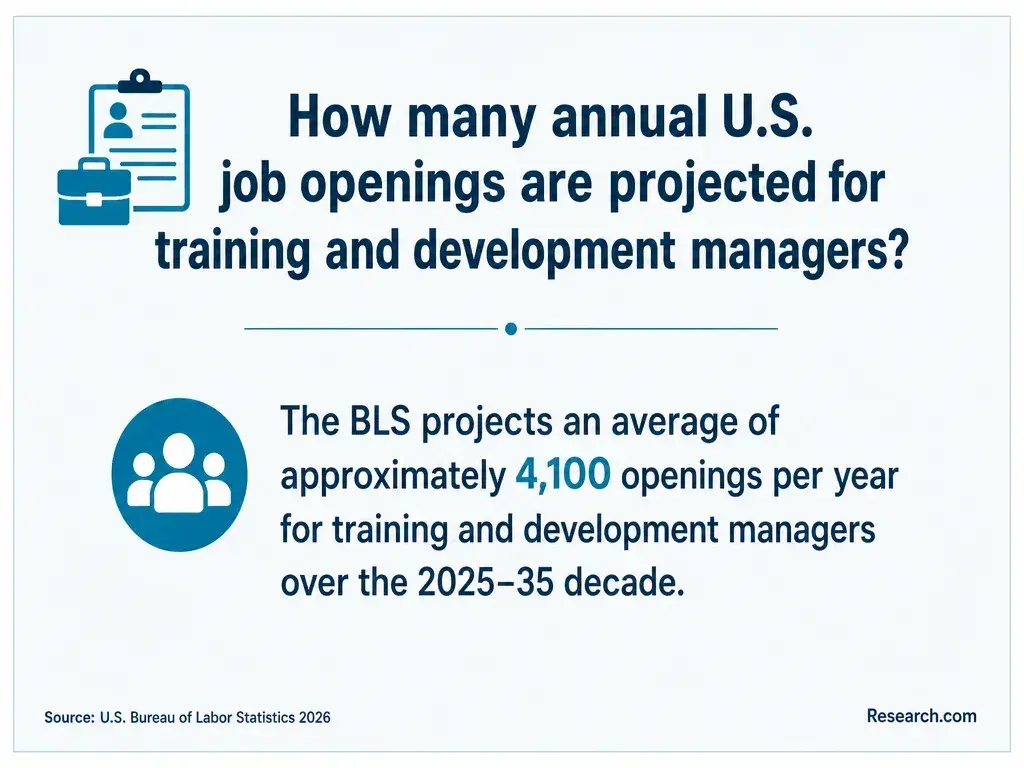
The BLS projects 6.4% employment growth for training and development managers from 2025 to 2035. That signals demand for the occupation, not a forecast for doctorate holders. Evaluate likely pay using actual openings in your sector and location, your existing compensation, and whether the roles you want call for enterprise-level leadership rather than curriculum production alone.
How can you choose an accredited online Ed.D. program in leadership and learning?
Start with the work you want to do after graduation, then compare programs against it. Confirm the institution's recognized accreditation and the exact awarded degree; institution-level accreditation does not establish licensure eligibility or prove that a program specializes in workforce learning. Review the published curriculum, delivery schedule, final-project requirements, faculty guidance, and total cost for your intended entry term.
Use matching an Ed.D. focus to leadership goals to separate a formal concentration from a handful of related electives. For a curriculum director, the decisive questions are whether you can study organizational learning and evaluation at sufficient depth, complete an approved project with feasible data access, and continue meeting your leadership obligations while enrolled. Request written clarification on any requirement that could change your decision.
Other Things You Should Know About EdD Leadership
Only with the appropriate organizational authorization and program review. Ask what data can be accessed, deidentified, analyzed, and reported before proposing the project.
Ask the program about project-site changes before enrolling. Continued access to the original site is not automatic, and a new project or approval process may affect your timeline.
Possibly, but academic approval does not necessarily give you publication rights. Check employer intellectual-property, confidentiality, and program rules before sharing materials or findings.
Yes. Discuss the responsibilities you hope to gain and the evidence your employer would expect. That conversation can reveal whether doctoral study, a stretch assignment, or another form of development is the more direct next step.
- How Instructional Design Is Operationalized in Various... - PMC https://pmc.ncbi.nlm.nih.gov/articles/PMC8320718/
- Curriculum Developer/Trainer, Bureau of Workforce Development and Training | City of New York Jobs https://cityjobs.nyc.gov/job/curriculum-developer-trainer-bureau-of-workforce-development-and-training-in-queens-jid-31346
- Cost of Attendance (Budget) | 2025-2026 Federal Student Aid Handbook https://fsapartners.ed.gov/knowledge-center/fsa-handbook/2025-2026/vol3/ch2-cost-attendance-budget
- Directors of Learning and Development: How to Become One | Franklin University https://www.franklin.edu/career-guide/training-and-development-managers/how-to-become-directors-of-learning-and-development
- What Is an Online EdD in Curriculum and Instruction Program | ULM Online https://online.ulm.edu/degrees/education/edd-curriculum-and-instruction/what-is-an-edd-in-curriculum-and-instruction/
- What is an instructional designer and what do they do? | Penn State World Campus https://www.worldcampus.psu.edu/about-us/news-and-features/what-is-an-instructional-designer-and-what-do-they-do
- Balancing Work, Life, and an EdD: What to Expect in an Educational Leadership Doctorate | Fairfield University https://www.fairfield.edu/news/insights/education-human-development/what-to-expect-in-an-educational-leadership-doctorate.html
- EdD vs. PhD in Education: Choosing the Right Program | Goodwin College of Professional Studies https://drexel.edu/soe/resources/career-path/edd-vs-phd/
- UNC EdD Online: Organizational Learning and Leadership https://online.unc.edu/online-doctoral-programs/online-edd-organizational-learning-and-leadership/