2027 Is an Online Ed.D. in Leadership and Learning in Organizations a Good Fit for Hospital Department Managers?
Audited and Verified:
Our Editorial and Data Verification Process
Research.com uses government datasets, official education statistics and primary institutional information to support its career and degree guides. Our review process checks factual accuracy, occupational definitions, source dates and the requirements associated with the credentials discussed.
How This Article Was Fact-Checked
Our editorial team verifies salary estimates, employment projections, education requirements and program information against original data providers and official organizations. Salary figures are checked against the relevant occupational definitions and reporting periods. Information about licensure, accreditation and required in-person training is reviewed separately.
Fact-checked and verified on:

Co-Founder and Chief Data Scientist
Hospital department managers already lead teams, but improving staff learning across a complex health system can require different skills. An online Ed.D. in leadership and learning may help you study organizational change and evaluate whether an intervention works. It may also demand years of study without advancing the career you want.
This guide helps clinical and nonclinical managers assess that trade-off, compare alternatives, and identify the program details and employer support to confirm before applying.
Key Things You Should Know
- Best fit: Managers aiming to lead workforce learning, cross-department change, or evidence-based improvement - not those seeking a clinical credential or a promotion based on the degree alone.
- Career context: The U.S. Bureau of Labor Statistics reports a $133,000 median annual salary for training and development managers in 2025; that is an occupational median, not a salary forecast for hospital managers with an Ed.D.
- Before enrolling: Confirm the actual online schedule, full cost, applied-project rules, access to authorized hospital data, and whether a shorter qualification would meet your goal.
Is an Online Ed.D. in Leadership and Learning a Good Fit for Hospital Managers?
It can be a good fit if you want to improve how people learn, lead, and implement change across a hospital - not simply add a doctorate to your résumé. A practice-oriented Ed.D. typically combines leadership study with inquiry into real organizational problems.
For a department manager, a useful question might be how to improve the adoption of a new handoff process or evaluate a supervisor-development initiative. A poor fit would be expecting coursework alone to fix staffing levels, unsafe workflows, or incentives beyond your authority.
Match the education to the responsibility you want next. These distinctions matter more than the prestige of the credential:
| Primary goal | Likely better starting point | Why |
| Lead learning or change across departments | Leadership and learning Ed.D., if substantial applied study is useful | Connects adult learning, organizational systems, and evaluation to managerial practice. |
| Move into hospital operations or financial leadership | MHA, MBA, or employer leadership program | May address healthcare finance, strategy, and operations more directly. |
| Improve a specific training or quality process | Targeted training plus a supervised improvement project | May produce relevant experience faster and at lower cost. |
| Become an independent academic researcher | Research-focused PhD | Usually offers a more direct route into sustained scholarly research. |
A useful test is whether you can name both a future responsibility and a recurring learning or change problem you have authority to address. If neither is clear, seek a cross-functional assignment or mentorship before committing to a doctorate.
What Careers Can an Ed.D. in Leadership and Learning Prepare Hospital Managers For?
For an experienced hospital manager, the strongest path is usually advancement into broader responsibilities, not entry into an unrelated profession.
Possible roles include healthcare workforce-development leader, organizational development director, clinical or nonclinical education administrator, and leader of a system-wide change initiative. Each still requires relevant experience, relationships, and an employer with a suitable position.
For example, a manager who has designed onboarding, coordinated educators, and evaluated training may have credible evidence for a workforce-learning role. A manager whose experience is primarily unit scheduling may first need exposure to instructional design, budgets, and cross-department implementation.
Document decisions you owned, stakeholders you coordinated, and outcomes you can substantiate without disclosing confidential information.
Moving into higher education administration is a separate transition with different hiring expectations. Managers considering that route can examine online Ed.D. pathways for college organizational leadership, while checking whether their experience matches the specific jobs they seek.
What Does an Online Ed.D. in Leadership and Learning Program Teach?
Relevant programs may cover adult learning, organizational culture, change leadership, research methods, and program evaluation. For a hospital manager, the value lies in connecting those subjects: identifying whether a performance problem calls for training, a workflow change, clearer supervision, or a combination, and then assessing the response with appropriate evidence.
Applied work varies by school. A dissertation in practice, capstone, and conventional dissertation are not interchangeable requirements. If workplace inquiry is central to your decision, review the program's actual deliverable and guidance on choosing an Ed.D. with an applied capstone option. Ask whether your proposed hospital setting is eligible, who supervises the project, and what happens if your job changes.
Hospital data creates particular constraints. Employee records, patient information, and internal quality reports are not automatically available for doctoral work.
The hospital and university may require separate permissions, privacy safeguards, data-use terms, and research or ethics review. A worthwhile project must be feasible within those rules; access to a problem does not equal permission to study it.
Online study reduces routine travel but does not necessarily make doctoral work self-paced. Programs may require live evening classes, cohort projects, scheduled advising, or campus visits. Those commitments can conflict with rotating shifts, on-call duties, and the busiest stages of an applied project.
Campus-based study may offer more in-person interaction but impose a commute or relocation. Neither format is inherently stronger for hospital leadership: compare faculty access, research support, collaboration requirements, and whether the schedule is sustainable alongside your job. A broader guide to understanding different Ed.D. degree formats and focuses can help you distinguish delivery mode from academic focus.
Before applying, obtain the actual class timetable and attendance policy. Then test a typical week against your shift schedule, protected study time, and the possibility of a required campus convening.
Requirements vary by institution. Programs may request a completed master's degree, transcripts, recommendations, a statement of purpose, a résumé, and evidence of professional leadership. Some also use interviews or specify academic preparation.
A nursing, healthcare administration, business, or other non-education background does not by itself rule out a leadership and learning Ed.D.
Use your application to show what you actually manage: decisions, staff-development responsibilities, cross-functional work, and a problem you could investigate ethically. Do not assume a managerial title proves doctoral readiness or that an employer's endorsement guarantees access to a project site.
Applicants with an education specialist degree can also review Ed.S.-to-Ed.D. admission and study options; the admitting school must determine whether prior credits satisfy eligibility rules or apply to the doctorate.
There is no dependable single duration or price for an online leadership and learning Ed.D. Required credits, enrollment pace, project approvals, and continuation rules differ. Compare each school's published requirements and a written estimate for your intended entry term rather than relying on an advertised minimum completion time.
The amount to budget extends beyond tuition. Request an itemized estimate covering required fees, travel for any campus visits, books or technology, and charges if the project takes longer than planned.
Check whether your hospital reimburses doctoral study, which courses qualify, when payment occurs, and whether leaving the employer triggers repayment. Reimbursement is not the same as guaranteed funding.
If you have unfinished doctoral work, investigate unfinished education doctorate study and completion choices before starting over. Only the prospective institution can confirm whether previous work reduces its requirements, time, or cost.
No general leadership and learning Ed.D. should be assumed to confer a healthcare license or professional certification. Clinical practice remains subject to the applicable licensing authority, and an academic doctorate does not replace occupation-specific qualifications.
The same caution applies to educator or school-administrator licensure: an organizational leadership degree is not necessarily an approved licensure program.
If a target job names a credential, compare its exact requirements with the university's published licensure disclosures and confirm eligibility with the relevant board or certifying organization. Treat the Ed.D. as education in leadership and inquiry unless a specific program and authority establish otherwise.
There is no reliable salary figure that applies specifically to hospital department managers after an Ed.D. Pay depends on the role, location, employer, scope of responsibility, and prior experience. An earned doctorate does not establish a new pay grade on its own.
For context, the U.S. Bureau of Labor Statistics reports a $133,000 median annual salary for training and development managers in 2025. That occupation can include roles outside hospitals and does not describe the earnings of Ed.D. graduates.
For a useful financial decision, compare actual postings and your hospital's pay bands for the jobs you could credibly pursue against your full education cost and any employer assistance.
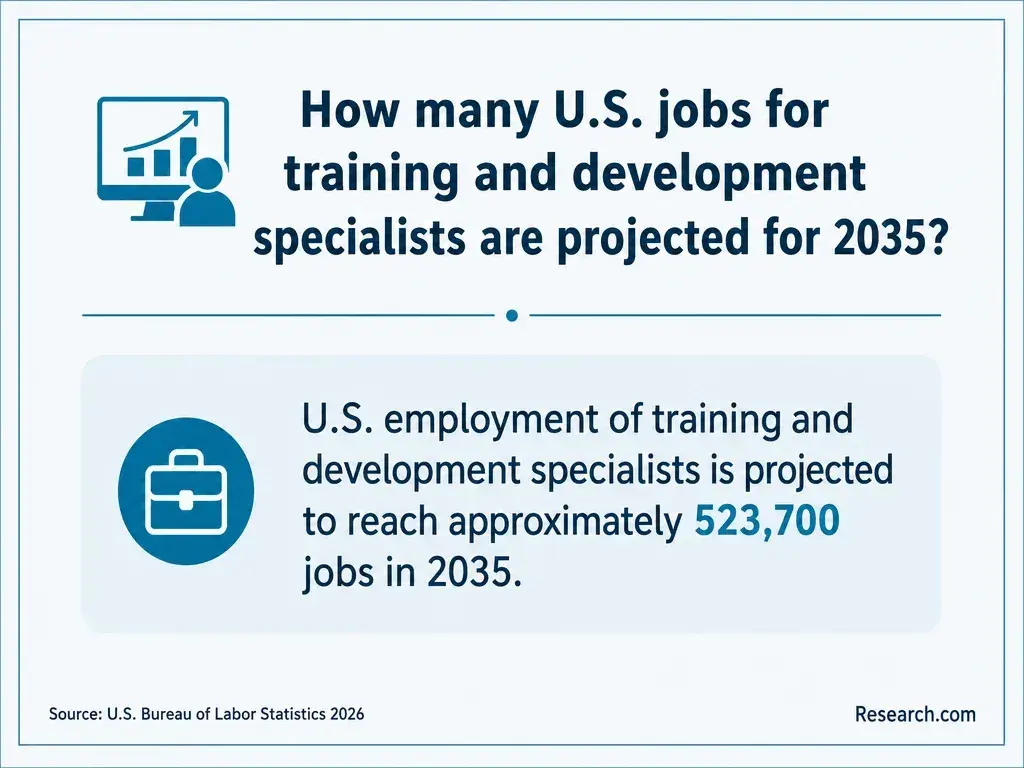
Outlook depends on the job you intend to hold; a projection for a broad training occupation is not a hospital department-manager forecast. The Bureau of Labor Statistics projects 6.4% employment growth for training and development managers from 2025 to 2035.
This suggests opportunities in workforce learning, but it does not establish demand for Ed.D. holders or predict openings at your hospital.
Assess your local market more directly: review health-system postings, note whether they require healthcare operations experience or learning expertise, and ask leaders how system-wide roles are filled. If your target role rarely calls for a doctorate, a documented improvement project and broader management experience may strengthen your candidacy more immediately.
How Can You Choose an Accredited Online Ed.D. Program?
Start by confirming the exact degree and institution, then compare programs against your intended hospital leadership role. Institutional accreditation matters, but it does not establish clinical licensure eligibility, a particular concentration, or the quality of an applied-project arrangement.
Use these checks to turn a promising program description into a decision you can defend:
- Confirm the institution's accreditation with its accreditor and identify the exact degree, curriculum, and any formally awarded concentration.
- Ask for the current schedule, live-attendance rules, campus requirements, and full written cost estimate.
- Review the required final project, faculty support, site-approval process, and options if hospital access or employment changes.
- Compare graduates' reported outcomes, if available, with the responsibilities and qualifications in your target job postings.
Choose the program only if its learning outcomes address a real gap in your practice and its obligations remain workable without assuming a promotion, salary increase, or access to restricted hospital data.
Other Things You Should Know About EdD Leadership
Do not assume so. Ask the licensing or certifying body whether particular courses or activities qualify before counting on them for renewal.
That depends on employer policy and context. Clearly identify your degree and clinical credentials so patients and colleagues do not mistake an academic doctorate for a clinical qualification.
Not automatically. Teaching requirements vary by school, assignment, and state; clinical instruction may require an active nursing license and relevant clinical expertise.
Possibly, but academic completion is not permission to disclose hospital information. Confirm publication rights, required organizational review, privacy protections, and any university research-oversight conditions before sharing results.
- Standards and Evaluation of Healthcare Quality, Safety... - NCBI https://www.ncbi.nlm.nih.gov/books/NBK576432/
- Patient safety | who.int https://www.who.int/news-room/fact-sheets/detail/patient-safety
- Improving Patient Outcomes Through Effective Hospital... - PMC https://pmc.ncbi.nlm.nih.gov/articles/PMC10676194/
- Leadership Role in Improving Safety | PSNet https://psnet.ahrq.gov/primer/leadership-role-improving-safety
- Employer-offered educational assistance programs can help pay for college | Internal Revenue Service https://www.irs.gov/newsroom/employer-offered-educational-assistance-programs-can-help-pay-for-college
- Programmatic Accrediting Agencies | ed.gov http://www.ed.gov/laws-and-policy/higher-education-laws-and-policy/college-accreditation/programmatic-accrediting-agencies
- Synchronous vs. Asynchronous Online Classes | American National University https://an.edu/synchronous-vs-asynchronous-classes/
- What's the Difference Between Asynchronous and Synchronous Learning? | Ohio State Online https://online.osu.edu/content-hub/blogs/whats-the-difference-between-asynchronous-and-synchronous-learning/
- Learning and Organizational Change | Northwestern University https://sesp.northwestern.edu/graduate-professional/learning-and-organizational-change/