2027 Online Ed.D. in Leadership and Learning in Organizations: Choosing a Partner Outside Your Current Industry
Audited and Verified:
Our Editorial and Data Verification Process
Research.com uses government datasets, official education statistics and primary institutional information to support its career and degree guides. Our review process checks factual accuracy, occupational definitions, source dates and the requirements associated with the credentials discussed.
How This Article Was Fact-Checked
Our editorial team verifies salary estimates, employment projections, education requirements and program information against original data providers and official organizations. Salary figures are checked against the relevant occupational definitions and reporting periods. Information about licensure, accreditation and required in-person training is reviewed separately.
Fact-checked and verified on:

Co-Founder and Chief Data Scientist
An outside-industry partner can give your Ed.D. project a new setting for studying leadership and organizational learning. It can also create problems if the organization cannot provide a sponsor, appropriate data access, or time for the work. For working leaders considering an online Ed.D., the decision is not simply whether another industry sounds interesting. This guide explains how to assess a potential partner, confirm that its project meets doctoral requirements, and decide whether the relationship advances your professional goals without making the degree harder to finish.
Key Things You Should Know
- Choose an outside-industry partner for a defined organizational problem and dependable sponsorship - not solely for access to a new professional network.
- Before committing, obtain separate confirmation of academic fit, organizational permission, feasible data access, and any required ethical review.
- The U.S. Bureau of Labor Statistics projects 10.1% growth for management analysts from 2025 to 2035, but that occupational outlook does not predict an Ed.D. graduate's job prospects.
What Is an Online Ed.D. in Leadership and Learning in Organizations?
An Ed.D. in leadership and learning in organizations is a practice-oriented doctorate concerned with how people learn, lead change, and improve performance in organizational settings. Coursework may address adult learning, organizational development, leadership, and applied research. An online delivery format changes where students participate; it does not necessarily remove live classes, group work, campus visits, or a substantial final project.
For someone seeking a partner outside their current industry, the critical detail is the program's actual applied-project requirement. A school may require a dissertation in practice, a team capstone, another research project, or a different culminating assessment. Some permit external sites; others impose conditions or expect work in a particular setting. An organization's willingness to collaborate does not, by itself, make its project eligible for doctoral credit.
Why Choose an Ed.D. Outside Your Current Industry?
An external partner can help an experienced leader test whether their skills transfer to a target sector. For example, a corporate learning manager interested in healthcare workforce development might investigate how a healthcare organization supports supervisor learning. The project could produce evidence of needs assessment and stakeholder collaboration - but it would not substitute for healthcare-specific experience or hiring requirements.
These settings offer different benefits and risks. Compare them against the work you want to do after graduation, not just the appeal of an unfamiliar industry.
| Project setting | Potential advantage | Main limitation to check |
| Current employer | Established relationships and familiarity with operations | Conflicts of interest or restrictions on sharing findings |
| Partner outside your industry | Cross-sector experience and exposure to new stakeholders | Less authority, slower approvals, and unfamiliar rules |
| Program-arranged partner | A potentially clearer route to an eligible project, if offered | Limited choice of problem, sector, or project timing |
An outside partner makes the most sense when it has a genuine learning or leadership problem, an accountable sponsor, and a project scope the program accepts. If your goal is primarily to meet people in another industry, targeted volunteering, a supervised consulting engagement, or professional networking may be more direct and less expensive than choosing a doctoral project around that aim.
How Do You Choose an Accredited Online Ed.D. Program?
Start by confirming the institution's accreditation through the institution and its recognized accreditor. Then examine the specific Ed.D.'s curriculum and project rules: institutional accreditation does not establish that an outside-industry project is allowed or that the degree leads to licensure.
Ask the program coordinator and a prospective faculty advisor how external sites are approved, whether students may propose their own partners, who supervises partner relationships, and what happens if access ends. Request the current handbook and a written explanation of requirements for your intended entry term. If cost is a deciding factor, compare total requirements alongside lower-tuition pathways to an education doctorate; a lower tuition rate is less useful if the program cannot support your proposed project.
Look for faculty whose applied-research expertise fits the problem, not merely the partner's industry. A leader studying training transfer at a nonprofit, for instance, needs guidance on learning evaluation and organizational inquiry more than a program that simply lists nonprofits among possible workplaces.
Relevant study can include adult learning, organizational diagnosis, change implementation, stakeholder engagement, and qualitative or quantitative evaluation. These skills help a student distinguish a training need from an underlying problem with processes, incentives, or management. Course titles alone do not establish the depth of methods training or the availability of an external-partner project.
Before selecting a partner, turn its broad concern into a feasible proposal. These questions help separate an interesting industry from a workable doctoral inquiry:
- What decision does the organization need to make, and who has authority to act on the findings?
- What evidence could answer that question within the academic timeline?
- Who can authorize access, and what confidentiality, consent, or review rules apply?
- What deliverable will satisfy both the organization's needs and the program's assessment requirements?
A proposed workplace evaluation is not automatically exempt from institutional review, and access to employee or learner information requires appropriate authorization. If a conventional dissertation does not suit the problem, examine education doctorates using alternative research projects - then verify each program's exact deliverable rather than assuming "no dissertation" means no rigorous inquiry.
Online study can make it possible to work with an external partner without relocating, but location flexibility is not the same as schedule flexibility. Live seminars, team meetings, partner interviews, and campus convenings may compete for the same evenings or workdays. Campus-based programs may make informal faculty collaboration easier, while requiring more travel or proximity to the institution.
Ask for a sample term schedule and the attendance policy, then compare it with the partner's availability. A partner whose staff can meet only during your busiest work hours may be impractical regardless of delivery format. Include required travel, lodging, technology, and time away from work when considering online Ed.D. affordability and degree planning.
Requirements vary by program. Schools may ask for a qualifying prior degree, transcripts, professional experience, recommendations, a statement of purpose, and evidence that applicants are ready for doctoral-level work. An education degree or a particular leadership title should not be assumed necessary unless the program says so.
If you already know the outside-industry organization, describe an authentic problem and your relationship to its sponsor without claiming approvals or results you do not have. Ask admissions whether an external partner is expected at application or selected later. Also distinguish prior graduate study used to establish admission eligibility from credits formally accepted toward the Ed.D.; only the institution can determine whether either applies to you.
Time and total cost depend on required credits, enrollment pace, tuition and fees, residency or convening travel, and the final project's progression rules. An external partnership adds a further scheduling variable: approvals, access agreements, staff turnover, and data collection may not follow the academic calendar.
Request a term-by-term degree plan and a full cost estimate from each school. For a proposed outside-industry project, ask which milestones require partner participation and whether delays trigger additional enrollment charges. When evaluating fast-track education doctoral programs, check whether the advertised timeline leaves enough time to establish the relationship and complete approved inquiry. Employer reimbursement, if available, should be assessed against its eligibility and continued-employment conditions - not treated as guaranteed funding.
The strongest career case connects your existing responsibilities, the partner project, and a specific next role. A learning and development professional might use a cross-sector project to demonstrate evaluation and change skills for a training-management role. A manager moving toward consulting might document how they scoped a problem and communicated recommendations to stakeholders. Neither example means the degree alone qualifies someone for the role.
A substantial transition may require sector knowledge, a professional network, and relevant work experience beyond the Ed.D. University employees considering an internal move can use organizational leadership Ed.D. program selection for university staff to compare that setting with broader organizational programs. If your target is a narrowly specialized function, a focused credential and supervised experience may offer a more direct route.
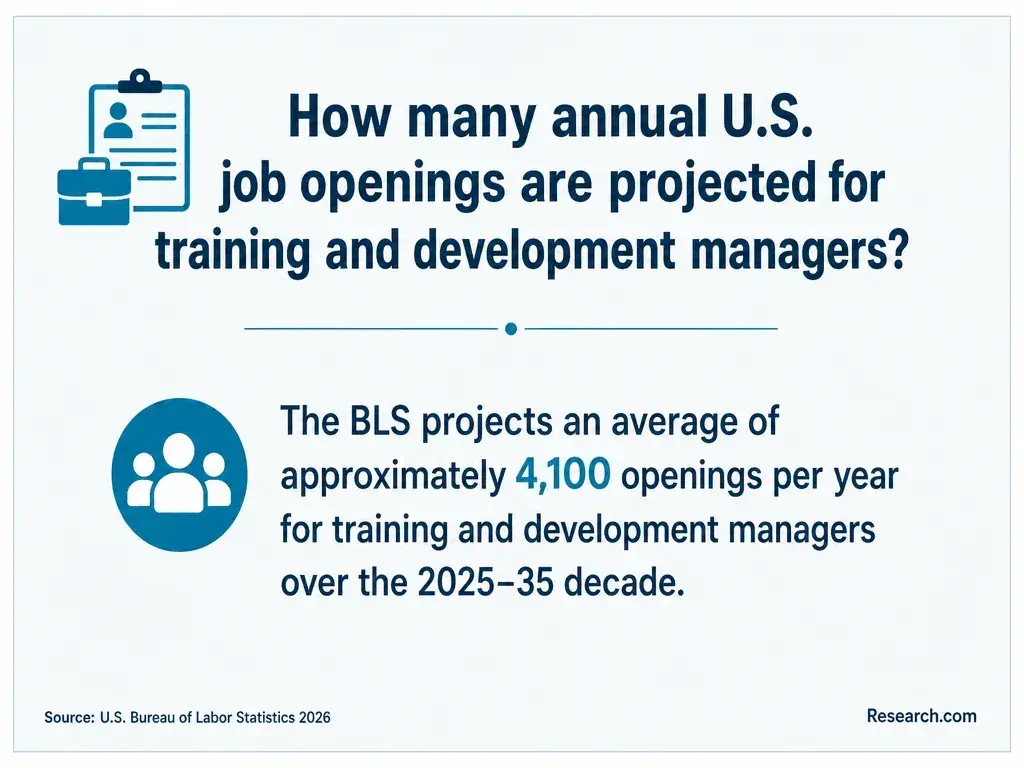
There is no single salary or growth rate for graduates of this degree. The U.S. Bureau of Labor Statistics reports a May 2025 median annual salary of $133,000 for training and development managers and projects 6.4% employment growth for that occupation from 2025 to 2035. Those figures describe an occupation, not new Ed.D. graduates or people changing industries.
Use occupational data only after identifying a realistic target job. Compare postings for that role with your experience, the degree's curriculum, and what your partner project could credibly demonstrate. Seniority, sector, location, and employer requirements can matter more to an individual offer than the doctorate's title.
Do Ed.D. Graduates Need Licensure or Professional Certification?
Organizational learning, training, and consulting roles do not generally have a single license conferred by an Ed.D. Employers may value particular professional certifications, but those have separate requirements. If your outside-industry goal is a regulated position - such as school principal - check the applicable state licensing authority and the program's licensure disclosures before enrolling.
A broadly focused leadership and learning doctorate should not be mistaken for a state-approved administrator-preparation program. Similarly, an external project in healthcare, government, or education does not itself grant authority to practice a regulated profession in that sector.
Other Things You Should Know About EdD Leadership
Yes, if the application permits it, but describe the relationship accurately. Identify the organization as prospective and distinguish an initial conversation from formal permission.
Ownership depends on university policies and any agreement with the organization. Clarify rights to reports, instruments, and other work before the project begins.
Usually you can describe your responsibilities and methods, but check confidentiality and publication terms before sharing the organization's identity, data, or findings. Prepare a redacted account if needed.
Possibly, if the program permits team work and the partner has capacity. Confirm each student's academic responsibilities and the organization's expectations before proposing a shared project.
- General Schedule Qualification Policies | U.S. Office of Personnel Management https://www.opm.gov/policy-data-oversight/classification-qualifications/general-schedule-qualification-policies/
- Cost of Attendance (Budget) | 2026-2027 Federal Student Aid Handbook https://fsapartners.ed.gov/knowledge-center/fsa-handbook/2026-2027/vol3/ch2-cost-attendance-budget
- Accreditation in the U.S. | ed.gov http://www.ed.gov/laws-and-policy/higher-education-laws-and-policy/college-accreditation/accreditation-in-the-us
- Types of Financial Aid: Grants, Work-Study, and Loans | studentaid.gov https://studentaid.gov/understand-aid/types
- 10 Experiential Learning Examples for Graduate Students | Northeastern University Graduate Programs https://graduate.northeastern.edu/knowledge-hub/experiential-learning-examples/
- Online EdD in Education Policy and Leadership | American University https://www.american.edu/baker/graduate/edd/
- 2026 UNC Online EdD in Organizational Learning & Leadership https://online.unc.edu/online-doctoral-programs/online-edd-organizational-learning-and-leadership/
- After Everything: Projections of Jobs, Education, and Training Requirements through 2031 - CEW Georgetown https://cew.georgetown.edu/cew-reports/projections2031/
- 5 Critical Steps in the Change Management Process | Harvard Business School https://online.hbs.edu/blog/post/change-management-process
- How a DBA Supports Career Growth Through Applied Research | Concordia University Chicago https://career.cuchicago.edu/how-a-dba-supports-career-growth/