2027 Online Ed.D. in Leadership and Learning in Organizations: Degree Fit for Leaders Tackling A Centralized Learning Team Needing Better Local Relevance
Audited and Verified:
Our Editorial and Data Verification Process
Research.com uses government datasets, official education statistics and primary institutional information to support its career and degree guides. Our review process checks factual accuracy, occupational definitions, source dates and the requirements associated with the credentials discussed.
How This Article Was Fact-Checked
Our editorial team verifies salary estimates, employment projections, education requirements and program information against original data providers and official organizations. Salary figures are checked against the relevant occupational definitions and reporting periods. Information about licensure, accreditation and required in-person training is reviewed separately.
Fact-checked and verified on:

Co-Founder and Chief Data Scientist
A centralized learning team can deliver consistent training while missing the realities of individual sites, regions, or communities. If you lead that team, an online Ed.D. in leadership and learning may help you investigate the gap and redesign how local knowledge informs organization-wide decisions.
It is not necessarily the fastest solution. This guide explains what the degree could add, what the organization must be willing to change, and how to decide whether doctoral study - or a smaller improvement effort - better fits your authority, resources, and career goals.
Key Things You Should Know
- An Ed.D. is most useful if you can lead a sustained, evidence-based change in how central and local teams share decisions - not merely update a course.
- Diagnose the gap before prescribing training: local conditions, incentives, technology, and approval rules may matter more than instructional design.
- Training and development managers had a $133,000 US median annual salary in May 2025, according to the Bureau of Labor Statistics; that occupational figure is not an Ed.D. graduate salary or a projected return on tuition.
What Is an Online Ed.D. in Leadership and Learning in Organizations?
An online Ed.D. in leadership and learning in organizations is a practice-oriented doctorate concerned with how people learn and how leaders improve organizational systems. Program names and requirements vary. Relevant study may combine adult learning, organizational change, leadership, and applied research; "online" describes delivery, not necessarily self-paced study or the absence of campus visits.
For a centralized learning team, local relevance means that shared learning goals remain useful under different sites' workflows, populations, regulations, and resources. The goal is not to make every course different. It is to determine which elements require consistency and which decisions local teams should shape.
The distinction matters because similar complaints can call for different remedies:
| Observed problem | Possible underlying issue | What an Ed.D. could help investigate |
| Sites say examples do not fit their work | Central designers lack reliable local input | How local expertise enters design and revision decisions |
| Employees complete training but struggle to apply it | Workflows or manager support may block transfer | Whether conditions for using the learning differ by site |
| Local teams create unofficial versions | Adaptation rules may be too restrictive or unclear | Which content must remain standard and where adaptation is appropriate |
These are hypotheses, not a diagnosis of any particular organization. An Ed.D. can build the leader's ability to investigate and evaluate them; it cannot supply decision authority that the employer has not granted.
Who Is an Online Ed.D. in Leadership and Learning Best Suited For?
The strongest fit is an experienced learning and development or organizational leader who can influence central policy, work with local managers, and pursue a substantial improvement question over time. Prior responsibility for budgets, design standards, implementation, or evaluation matters more to this decision than a senior-sounding title.
A degree becomes more compelling when the challenge spans governance and learning: for example, central leaders own mandatory content, local teams understand implementation, and neither has a dependable way to test whether adaptations improve use on the job. Doctoral study may provide structured inquiry, faculty critique, and time to evaluate a change. If you need a better feedback channel or a few revised modules now, a pilot, mentorship, or targeted organizational-development training is likely more direct.
Existing preparation also changes the choice. A leader planning the transition from Ed.S. to Ed.D. should ask how prior study supports readiness, while confirming separately whether any credits apply to the doctorate. Neither a prior credential nor leadership experience alone ensures admission or a shorter program.
How Does an Online Ed.D. Compare With Campus-Based Doctoral Programs?
An online Ed.D. may let a working leader remain close to the sites and decisions being studied. A campus-based program may offer more in-person collaboration, but it does not inherently offer better access to your organization. Compare the actual program's methods training, faculty guidance, project rules, and schedule rather than treating delivery mode as a proxy for quality.
Online cohorts can still require live classes, team meetings, and campus convenings. Those obligations matter if regional visits, evening calls, or operational emergencies already compete for your time. Ask for a sample term schedule and the rules for attendance, group work, and project milestones. If speed is the deciding constraint, compare verified shorter online Ed.D. degree pathways without assuming a faster timetable leaves enough room for organizational approval and meaningful evaluation.
A research-oriented PhD may fit someone whose primary aim is scholarly research. For a leader seeking to improve a specific learning system, the more important comparison is whether an Ed.D. program permits a feasible, supervised practice-focused project.
Course titles vary, but this problem calls for more than general leadership theory. Look for connected preparation in adult learning and learning transfer; organizational diagnosis and change; stakeholder engagement; qualitative and quantitative methods; and program evaluation. Courses in instructional design can help with local examples, while systems and governance work can address who is allowed to adapt them.
Check the sequence as well as the catalog. Methods should arrive early enough to help you distinguish employee complaints from representative evidence and to choose measures before a pilot begins. Useful measures might include whether staff can perform a relevant task, whether managers support its use, and whether local adaptations preserve required content. Completion rates alone cannot establish that learning transfers to work.
A course mentioning analytics is not proof of advanced measurement training. Ask to see syllabi, available electives, and examples of approved project formats before assuming the curriculum supports your intended inquiry.
Programs set their own requirements for prior degrees, professional experience, grades, recommendations, statements, and any tests. For this challenge, a persuasive application would document decisions you have actually influenced: how you gathered local input, handled competing priorities, or evaluated a learning initiative. Describe the centralized-versus-local tension as a question to investigate, not as a proven failure with a predetermined solution.
Ask admissions whether your academic background qualifies and ask the project director whether your proposed organizational setting is feasible. Admission is distinct from permission to use workplace data. Returning doctoral learners should also verify whether returning to Ed.D. study after reaching ABD status involves a separate pathway; prior doctoral work does not automatically transfer or replace a new program's completion requirements.
Time and total cost depend on required credits, enrollment pace, tuition and fees, convening travel, and the time needed to secure and complete an applied project. A locally relevant learning initiative can take longer than a course redesign if sites need separate approvals or implementation windows. Do not use a program's advertised minimum duration as your planning assumption without checking its project timeline and leave policies.
Compare the full cost of attendance, not tuition alone. Request a written estimate that includes mandatory fees and travel, then check employer reimbursement limits and whether support depends on continued employment. A comparison of Ed.D. program costs for prospective doctoral students can narrow your search, but confirm charges and funding with each school before committing. If the employer needs an immediate solution, price a smaller pilot or external evaluation separately rather than assigning its entire value to the degree.
Relevant paths include learning and development leadership, organizational development, workforce development, and organizational consulting. In a training manager role, the challenge might be setting shared standards and allocating resources across regions. An organizational development leader might instead redesign decision rights and feedback processes. A consultant may help multiple clients diagnose similar problems but must establish credibility through prior work and demonstrable results.
The doctorate can strengthen your approach to these responsibilities; it does not substitute for managing people, budgets, or implementation. For internal advancement, seek an authorized cross-site initiative and document the decisions you led, the evidence considered, and the limits of any findings. A broadly focused Ed.D. also does not automatically confer school-administrator licensure.
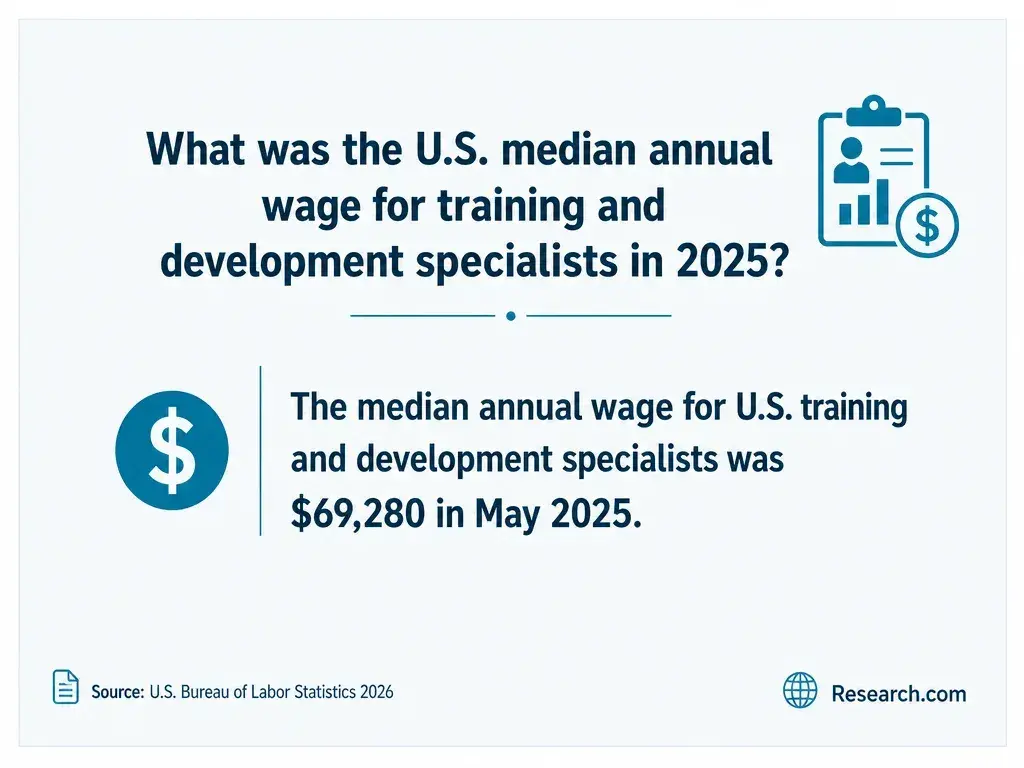
The US Bureau of Labor Statistics reports a May 2025 median annual salary of $133,000 for training and development managers. That describes workers in an occupation, not Ed.D. graduates specifically. Pay depends on role scope, sector, location, and experience; a doctorate does not guarantee a managerial appointment or raise.
For this decision, use your employer's posted pay ranges and promotion requirements. Compare the likely responsibilities of your next role with your existing experience before treating a national occupational median as evidence that tuition will pay for itself.
The Bureau of Labor Statistics projects US employment of training and development managers to grow 6.4% from 2025 to 2035. That signals demand for the occupation, not for a particular doctorate or for leaders specializing in central-local learning systems. Opportunities will still depend on an employer's structure and hiring criteria.
If your goal is to lead this work at your current organization, investigate the internal outlook as carefully as the national one: who owns the learning strategy, whether local leaders have seats in design decisions, and whether a position exists with authority to change the process. External job postings can then show whether your experience and project evidence match the roles you want.
How Can You Choose an Accredited and Reputable Online Ed.D. Program?
First, confirm the institution's accreditation, the exact degree awarded, and any applicable licensure disclosures through the institution and its recognized accreditor. Then evaluate fit for this specific organizational problem. A reputable program need not promise a particular intervention; it should explain how faculty support diagnosis, ethical inquiry, implementation, and interpretation of imperfect workplace evidence.
Before applying, ask the program director whether students may study a current employer, what project deliverable is required, how advisors are assigned, and what happens if employment or data access changes. Ask your employer separately who can authorize site participation, what records may be used, and whether findings may be shared. Faculty approval, employer permission, privacy review, and permission to publish are different decisions. If your target is an education-sector role, evaluating aid eligibility for higher education leadership doctorates may also help you compare funding, but confirm that those programs address organizational learning rather than a different administrative goal.
Bottom line: choose an Ed.D. if you want sustained preparation to lead and evaluate a complex central-local change - and can obtain the authority, time, and access to do it responsibly. Choose a smaller pilot or targeted development if the immediate need is a practical fix rather than doctoral-level inquiry.
Other Things You Should Know About EdD Leadership
Possibly, but separate nonnegotiable legal or policy content from examples, practice activities, and delivery choices. Have the relevant compliance owner approve adaptation rules before sites publish local versions.
Keep a version record that identifies the local need, the change made, its owner, and any review required. Share adaptations for consideration rather than assuming that a solution from one site fits every other site.
Usually, process improvement needs themes rather than named performance records. Limit access, avoid collecting unnecessary identifiers, and follow organizational privacy rules before gathering or sharing feedback.
Agree on a small set of shared outcomes while allowing sites to explain local conditions and add relevant measures. Record disagreements before interpreting results so central leaders do not mistake inconsistent definitions for performance differences.
- The Role of Continuing Professional Training or Development in Maintaining Current Employment: A Systematic Review https://pmc.ncbi.nlm.nih.gov/articles/PMC10647344/
- Accreditation in the U.S. | ed.gov http://www.ed.gov/laws-and-policy/higher-education-laws-and-policy/college-accreditation/accreditation-in-the-us
- Cost of Attendance (Budget) | 2025-2026 Federal Student Aid Handbook https://fsapartners.ed.gov/knowledge-center/fsa-handbook/2025-2026/vol3/ch2-cost-attendance-budget
- An Approach to Creating an Intentional Stakeholder Engagement Process | IES https://ies.ed.gov/learn/blog/approach-creating-intentional-stakeholder-engagement-process
- Types of Financial Aid: Grants, Work-Study, and Loans | studentaid.gov https://studentaid.gov/understand-aid/types
- EdD vs. PhD in Education: Choosing the Right Program | Goodwin College of Professional Studies https://drexel.edu/soe/resources/career-path/edd-vs-phd/
- Learning Analytics - an overview https://www.sciencedirect.com/topics/computer-science/learning-analytics
- What Is a Problem of Practice? | spalding.edu https://online.spalding.edu/blog/what-is-problem-practice
- Online Ed.D. in Leadership and Learning in Organizations | VU-EDU https://peabodyonline.vanderbilt.edu/edd-in-organizational-learning/