2027 Paying for an Online Ed.D. in Leadership and Learning in Organizations: Employer Reimbursement Paid After Each Term
Audited and Verified:
Our Editorial and Data Verification Process
Research.com uses government datasets, official education statistics and primary institutional information to support its career and degree guides. Our review process checks factual accuracy, occupational definitions, source dates and the requirements associated with the credentials discussed.
How This Article Was Fact-Checked
Our editorial team verifies salary estimates, employment projections, education requirements and program information against original data providers and official organizations. Salary figures are checked against the relevant occupational definitions and reporting periods. Information about licensure, accreditation and required in-person training is reviewed separately.
Fact-checked and verified on:

Co-Founder and Chief Data Scientist
Employer tuition reimbursement can make an online Ed.D. affordable on paper while leaving you responsible for every bill before the reimbursement arrives. For working leaders and learning and development professionals, that timing matters as much as the benefit amount. This guide explains how post-term reimbursement works, how to estimate the cash you need between payments, and which program and employer rules could change the calculation. The goal is to help you decide whether to enroll now, negotiate different support, or choose a less costly route.
Key Things You Should Know
- Reimbursement paid after each term is not upfront funding: confirm when tuition is due, when your employer pays, and whether you can cover the next term before the previous payment arrives.
- Get written approval for the specific Ed.D. program, annual benefit limit, eligible charges, grade rules, employment conditions, and any repayment obligation before enrolling.
- Qualifying employer educational assistance may be excluded from taxable income up to a generally applicable $5,250 annual limit under federal rules; verify the current tax year and your employer's plan before treating that amount as tax-free.
What is an online Ed.D. in Leadership and Learning in Organizations?
An Ed.D. in Leadership and Learning in Organizations is a practice-oriented education doctorate focused on how organizations develop people, use evidence, and lead change. Depending on the university, students may study adult learning, leadership, organizational improvement, and applied research. "Online" describes where much of the instruction occurs; it does not establish that classes are self-paced or that campus visits are unnecessary.
The degree may fit an experienced training manager, organizational development practitioner, or public-service leader who can apply doctoral study to a substantial workplace challenge. It is not automatically the most economical way to gain a new skill. If you already hold an education specialist degree, compare online doctoral program choices after an Ed.S., but ask each university separately whether prior credits apply to the doctorate; admission eligibility and transferable credit are different decisions.
How does employer reimbursement paid after each term work for an online Ed.D.?
Under a typical post-term arrangement, you pay the university or arrange financing, finish the term, submit the required records, and wait for your employer to reimburse approved expenses. The employer - not the university - decides whether the course, grade, expense, and employment status meet its benefit policy. A manager's verbal encouragement is not the same as written benefit approval.
The distinction between payment arrangements determines who must supply cash when tuition comes due. Compare the arrangements before assuming an advertised employer benefit will cover your bill.
| Arrangement | Who pays the university first? | Principal risk to the student |
| Post-term reimbursement | Student or lender | Payment may arrive after the next term's bill. |
| Employer direct billing | Employer, if the school and employer have an agreement | Ineligible charges may still become the student's responsibility. |
| Employer sponsorship agreement | As specified in the written agreement | Funding may depend on continued employment or service commitments. |
For a post-term benefit, map your university's billing dates against your employer's submission deadline and payroll schedule. If the next term begins before reimbursement clears, you may need enough liquidity to carry two overlapping term bills. A university payment plan can spread a bill without reducing it; borrowing can bridge the gap but may add interest and fees. Ask payroll or benefits whether reimbursement is processed as taxable pay, whether payments follow a calendar-year or academic-year cap, and how a term crossing year-end is assigned.
Before committing, obtain the written policy and ask benefits staff to confirm the degree's eligibility, covered fees, required grade, proof of payment, documentation deadline, payment date, and what happens if you change jobs. For a higher-education employee, information on employer-sponsored higher education leadership doctoral education may suggest alternatives to compare, but only your employer can approve your individual benefit.
How much does an online Ed.D. in Leadership and Learning cost?
There is no reliable universal price: universities charge by credit, term, or program, and an employer may reimburse only some charges. Request a written cost estimate for your intended start term and compare the amount due before reimbursement as well as the eventual net expense. Published tuition alone will not show whether the plan is workable.
These cost categories belong in a funding worksheet because they can have different payment dates and reimbursement treatment.
| Cost category | What to verify |
| Tuition and mandatory fees | Required credits, rate increases, term charges, and which fees the employer covers |
| Online and campus costs | Technology charges, required travel, lodging, and accessibility-related expenses |
| Financing and household costs | Loan interest, payment-plan fees, childcare, and any unpaid leave |
| Completion costs | Additional enrollment or project-related charges if study extends beyond the planned schedule |
Calculate your expected net cost as all program and participation expenses minus reimbursement you are actually eligible to receive and other confirmed aid. Calculate your cash-flow need separately using each bill's due date and each expected reimbursement date. Do not subtract the full advertised employer benefit if annual caps, ineligible fees, grade conditions, or required continued employment could prevent payment. Compare lower-tuition online leadership doctorate options using total required costs and program fit, not a headline per-credit rate.
Confirm that the university holds recognized institutional accreditation and that it covers the institution awarding the doctorate. Check the accreditor and institutional status through the university and the U.S. Department of Education's accreditation records. Also verify the exact degree name and whether the online offering is included in the university's approved operations.
Accreditation supports confidence in the institution, but it does not require an employer to reimburse the degree. Ask benefits staff whether their policy restricts eligible institutions or programs. Nor does institutional accreditation make a general leadership Ed.D. a state-approved school-administrator licensure program; that is a separate question for the university and relevant state authority.
Relevant study may include adult learning, organizational change, leadership, program evaluation, and qualitative or quantitative inquiry. The financial question is whether the curriculum builds capabilities you will use in your present or intended role - especially if your employer requires the degree to be job-related. Compare required courses rather than assuming that a program title guarantees a particular specialization.
Ask what the final research or practice requirement entails and when its heaviest work occurs. A team capstone, dissertation in practice, and traditional dissertation can demand different schedules, supervision, and organizational access. Comparing education doctorate capstone and project pathways can help you frame questions, but obtain the actual requirements and any associated costs from the university. Employer willingness to fund tuition does not itself grant permission to use workplace data for a project.
Requirements vary by university. An application may call for a graduate degree or specified graduate study, transcripts, professional experience, recommendations, a statement of purpose, and evidence that you can investigate a leadership or learning problem. Do not assume that an education master's, a particular job title, or a test score is universally required.
For this funding scenario, coordinate two decisions before paying a deposit: ask admissions to confirm your eligibility and ask employer benefits to approve the exact program and degree. If you have prior graduate coursework, request a separate written transfer-credit evaluation. Credits that support admission do not necessarily reduce required Ed.D. credits or tuition.
Completion time depends on required credits, course sequencing, enrollment pace, and the final project. An online cohort may have fixed live meetings, group work, or campus convenings even when most coursework is remote. Slowing down can improve monthly cash flow but can also add terms of fees and postpone completion; accelerating may increase the amount you must pay before reimbursement catches up.
Compare the university's standard schedule with its part-time and leave policies, then model the employer benefit across calendar years as well as academic terms. When evaluating fast-track education doctoral programs, check whether your work schedule and available cash - not just the advertised completion time - support the proposed pace.
The degree may support advancement in learning and development, talent development, organizational change, consulting, or education administration when paired with relevant experience. For an established training professional, an applied evaluation project may demonstrate readiness to lead a larger initiative. For someone changing fields, employers may still expect direct experience with budgets, teams, instructional design, or sector-specific operations.
Use your target job postings and internal promotion criteria to test the degree's value before assuming reimbursement makes it a good investment. If the role calls mainly for a focused technical skill or more managerial responsibility, an employer leadership program, supervised project, or shorter credential may be the more direct route.
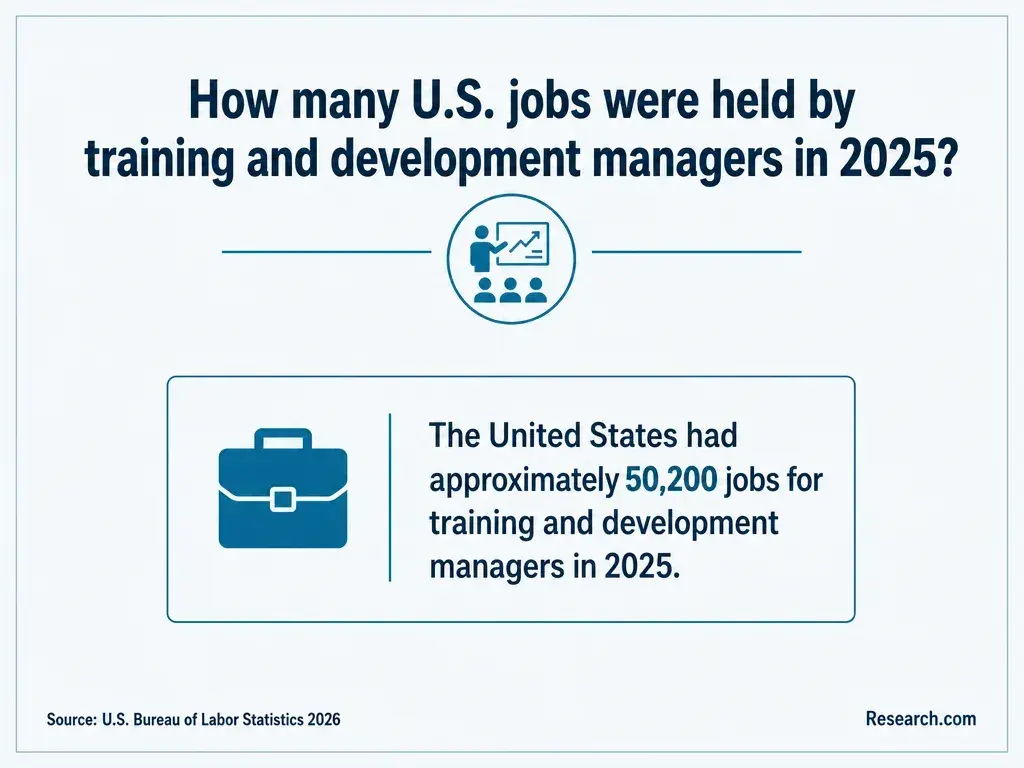
There is no defensible salary figure for all Ed.D. graduates. The U.S. Bureau of Labor Statistics reports a 2025 median annual salary of $133,000 for training and development managers and projects 6.4% employment growth for that occupation from 2025 to 2035. Those are occupation-wide figures, not earnings or placement outcomes for doctorate holders.
A reimbursement decision should therefore rest on a plausible role change, not an assumed salary increase. Ask your employer whether the doctorate affects eligibility for a specific position or pay band, and weigh any potential gain against your remaining cost, financing expense, and time commitment.
Does an online Ed.D. require licensure or professional certification?
A broadly focused leadership and learning Ed.D. does not, by itself, grant teacher, principal, superintendent, counseling, or other regulated licensure. Many organizational learning and consulting roles have no single mandatory professional license, although employers may prefer particular experience or certifications.
If your objective is a regulated school position, ask the program whether it is explicitly approved for the license and verify eligibility with the state licensing authority. This matters financially: an employer may reimburse a doctorate that advances organizational leadership while the degree still fails to meet the credential requirement for the job you want.
Other Things You Should Know About EdD Leadership
Only if that employer's written benefit expressly covers spouses and the proposed degree. Employee-only educational assistance policies should not be assumed to extend to dependents.
Ask the university and employer how they coordinate awards. Their rules may reduce reimbursement for expenses already covered by a scholarship; retain an itemized account showing who paid each charge.
Ask benefits staff before taking leave. Eligibility may depend on active employment when you enroll, finish the term, submit documentation, or receive payment.
Keep the written approval, itemized university bills, payment receipts, grades, reimbursement submissions, and payroll records. These help resolve benefit disputes and support questions about tax treatment.
- Accepting Financial Aid | studentaid.gov https://studentaid.gov/complete-aid-process/accept-aid
- Qualified Ed expenses | Internal Revenue Service https://www.irs.gov/credits-deductions/individuals/qualified-ed-expenses
- Payment Due Dates | CSU Northridge | California State University, Northridge https://www.csun.edu/stufin/tuition/payment-due-dates
- What Is Tuition Reimbursement? How It Works for Grad School | University of Kansas https://admissions.ku.edu/blog/what-is-tuition-reimbursement
- Paying Tuition and Fees | Undergraduate Admission https://admission.ucla.edu/admitted-students/pay-tuition-fees
- Tuition Reimbursement 101: Five Things to Know | Online https://cps.unh.edu/blog/2022/01/tuition-reimbursement-101-five-things-know
- Employer Tuition Assistance: How to Use Your Workplace Education Benefits | American College of Healthcare Sciences https://achs.edu/blog/employer-tuition-assistance-workplace-benefits/
- Tuition Payment Policy - McGeorge | University of the Pacific https://www.pacific.edu/law/tuition-payment-policy
- Employer Tuition Reimbursement: How It Works and How to Pay for College | Winston-Salem State University https://ramsonline.wssu.edu/blog/employer-education-benefits/
- Employer Reimbursement - USC Student Financial Services https://sfs.usc.edu/payment/employer-reimbursement/