2027 Online Ed.D. in Leadership and Learning in Organizations: Evaluating Research Preparation for Using Multiple Sources of Evidence
Audited and Verified:
Our Editorial and Data Verification Process
Research.com uses government datasets, official education statistics and primary institutional information to support its career and degree guides. Our review process checks factual accuracy, occupational definitions, source dates and the requirements associated with the credentials discussed.
How This Article Was Fact-Checked
Our editorial team verifies salary estimates, employment projections, education requirements and program information against original data providers and official organizations. Salary figures are checked against the relevant occupational definitions and reporting periods. Information about licensure, accreditation and required in-person training is reviewed separately.
Fact-checked and verified on:

Co-Founder and Chief Data Scientist
A leadership decision rarely rests on one clean dataset. Training records may suggest progress while employees describe barriers to using what they learned. For working leaders and learning professionals considering an online Ed.D., the important question is whether the program will teach them to investigate such disagreements - not merely collect more data.
This guide explains what strong preparation in multiple sources of evidence looks like, how to assess a program's methods and applied project, and when a shorter research or evaluation course may meet your needs instead.
Key Things You Should Know
- Strong preparation goes beyond surveys: students should learn to connect organizational records, stakeholder accounts, and relevant research to a clearly defined decision.
- Look for supervised practice in measurement, qualitative inquiry, quantitative analysis, interpretation, and data ethics - not just course titles that mention "evidence."
- An Ed.D. may be worthwhile for sustained leadership and applied inquiry, but a targeted evaluation course can be a better choice if you need one method for one project.
What Is an Online Ed.D. in Leadership and Learning in Organizations?
An online Doctor of Education in leadership and learning in organizations is a practice-oriented doctorate concerned with how people learn, how organizations change, and how leaders use evidence to improve decisions. Program names and requirements vary. Some emphasize workplace learning and organizational development; others focus more heavily on education systems or leadership theory.
For this article, multiple sources of evidence means information produced in different ways - for example, participation records, interviews, performance indicators, and published research. Using them well means asking what each source can establish, where it may be biased, and how the sources relate. It does not mean treating every source as equally reliable or counting how many support a preferred conclusion.
An Ed.D. is most relevant if you expect to lead recurring improvement efforts and need to judge evidence while navigating stakeholders and implementation. If your goal is primarily to produce generalizable scholarship, compare research-focused PhD programs. If you need only a specific analytic technique, a methods course or supervised evaluation project is less of a commitment. Even among low-cost education doctoral degree options, the decisive question is whether the curriculum provides enough guided practice for your intended work.
How Does an Online Ed.D. Prepare Students to Use Multiple Sources of Evidence?
Good preparation begins with an organizational decision, not a list of available files. Consider an illustrative question: After a new supervisor-development program, should an organization revise the training, change workplace support, or wait for more evidence? The population, intended behavior, baseline, follow-up period, and decision-maker all need defining before anyone selects measures.
The following comparison shows how distinct sources could inform that hypothetical decision. None would establish the program's impact by itself.
| Possible source | What it can help establish | Important limitation |
| Enrollment and completion records | Who participated and whether they finished | Completion does not demonstrate learning or changed practice. |
| Observation or work-product review | Whether targeted supervisory practices appear in work | Ratings need consistent criteria; observers may see an unrepresentative sample. |
| Interviews with supervisors and employees | How participants experienced training and workplace barriers | Accounts are contextual and may be affected by power relationships or recall. |
| Operational indicators over time | Whether outcomes moved in a direction worth investigating | Staffing, policy, demand, or other changes may explain the movement. |
Students should learn to integrate these sources. If completion is high but observed practices do not change, interviews might reveal that supervisors lack time or authority to apply the training. That is a hypothesis to investigate, not a finding about a real organization. A pre/post change alone would not prove the training caused an outcome; a feasible comparison group, stronger measurement, and attention to other changes might improve the inference.
Preparation also includes deciding what not to collect. Employee interviews, learner records, and personnel data can carry confidentiality and power risks. Students need to check organizational permission, applicable privacy obligations, data-use terms, and their institution's review procedures before collecting or sharing information. An internal evaluation is not automatically exempt from institutional review, and not every internal evaluation is automatically human-subjects research.
What Careers Can You Pursue With an Ed.D. in Leadership and Learning?
Experienced learning and development professionals may use doctoral study to move toward responsibility for needs assessment, program evaluation, leadership development, or organizational change. Organizational development consultants and public- or nonprofit-sector leaders may likewise need to explain recommendations to people who value different kinds of evidence. In these roles, a defensible conclusion often matters more than mastery of any single survey or dashboard.
The doctorate does not replace functional experience. A learning and development specialist seeking a manager role still needs evidence of leading people, budgets, and implementation. A consultant needs credible project work and client skills; a higher-education administrator needs experience relevant to the institution and position. Readers pursuing that setting can compare college leadership development through organizational leadership doctoral study while checking whether programs address the governance and evidence demands of their target roles.
A useful professional outcome is an authorized, appropriately redacted portfolio showing how you framed a problem, assessed evidence quality, explained uncertainty, and recommended a feasible next step. A degree alone does not establish executive readiness or permission to disclose workplace findings.
For evidence integration, course sequence matters more than an impressive list of topics. A student needs to move from defining a learning or leadership problem to selecting measures, analyzing distinct forms of evidence, and defending a practical recommendation. Check which courses are required and whether relevant electives will actually be available during your enrollment.
Look for connected instruction in organizational diagnosis and adult learning; research design and measurement; qualitative approaches such as interviews and document analysis; quantitative analysis and program evaluation; and interpretation, ethics, and communication. Coursework should clarify, for instance, why an employee satisfaction survey cannot substitute for a valid measure of workplace performance.
The strongest test is a supervised assignment or doctoral project requiring students to reconcile evidence that does not neatly agree. Ask whether faculty review the research question, sampling, instruments, analysis, and final interpretation. Also verify the required culminating work: a dissertation in practice, team capstone, individual dissertation, and course project can offer substantially different opportunities to demonstrate independent methods competence.
Requirements are institution-specific. Programs may assess prior degrees, graduate work, professional experience, recommendations, a statement of purpose, and readiness for doctoral-level writing or inquiry. Do not assume that a master's in education, a publication, a particular statistics course, or a senior job title is universally required.
For this topic, a strong application connects a problem you have encountered to the evidence you could realistically examine. You might describe responsibility for a training initiative and explain why completion records alone could not answer whether learning transferred to work. State what access and authority you actually have; do not imply that an employer has approved a doctoral study when it has not.
Ask admissions staff to distinguish formal eligibility from recommended methods preparation. Prior graduate credits that satisfy an entry requirement do not necessarily transfer into the Ed.D. or shorten it. If your research background is limited, ask whether the program offers introductory methods support before advanced project work.
Length and price cannot be inferred from the degree name or the word "online." Required credits, course sequencing, cohort schedules, project approvals, and the time needed to obtain usable organizational evidence can all affect completion. Request the proposed entry term's curriculum map and ask what happens if a data source or project partner becomes unavailable.
To estimate your own cost, obtain the school's current tuition schedule and add required fees, technology expenses, books, any convening travel, and potential time away from paid work. Confirm whether employer assistance is guaranteed, reimbursed only after passing courses, or lost if you change jobs. When comparing low-cost Doctor of Education programs online, compare the cost of meeting all requirements, including any extension terms - not an advertised tuition figure alone.
If you chiefly need to learn how to combine interviews with existing performance data, a shorter supervised evaluation course may offer a more proportionate investment than a doctorate. The Ed.D. makes more sense when that capability is part of a broader, long-term leadership goal.
Accreditation applies to the institution and, where relevant, to particular programs or purposes; online delivery does not establish or negate it. Verify the institution's current accreditation, the precise degree being awarded, and any program-specific claims through the institution and responsible accreditor. Accreditation alone does not show that the methods curriculum is strong.
A broadly focused leadership and learning Ed.D. should not be assumed to qualify someone for teacher, principal, superintendent, counseling, or other regulated roles. If licensure matters to your goal, obtain the institution's disclosure for your state and confirm eligibility with the applicable state authority before enrolling. For a workplace research goal, also check the institution's policies on project oversight, access to research support, and use of organizational data.
Online and campus-based programs can both teach rigorous research. The meaningful difference for this decision is how reliably you can obtain feedback on study design and interpretation while meeting the program's attendance obligations. Online access may let a working leader investigate a local organizational problem without relocating, but it does not make live seminars, group analysis, or faculty meetings self-paced.
Request a typical term schedule, required live-session times, campus-convening dates, and expectations for collaborative projects. Ask how students obtain timely methods advice when an interview plan fails or a dataset proves incomplete. Readers comparing fast-paced online Ed.D. study formats should examine whether the compressed schedule leaves adequate time for permissions, data collection, analysis, and revision.
A campus-based program may offer more routine in-person contact; an online cohort may offer colleagues working across sectors. Neither format guarantees better evidence use. Compare actual supervision, access to research resources, and the feasibility of completing the required project alongside your job.
There is no single "Ed.D. salary": pay depends on occupation, responsibility, sector, location, and experience. The U.S. Bureau of Labor Statistics reports a May 2025 median annual wage of $133,000 for training and development managers. That is an occupational median, not a forecast for doctorate holders or a reason to expect promotion after graduation.
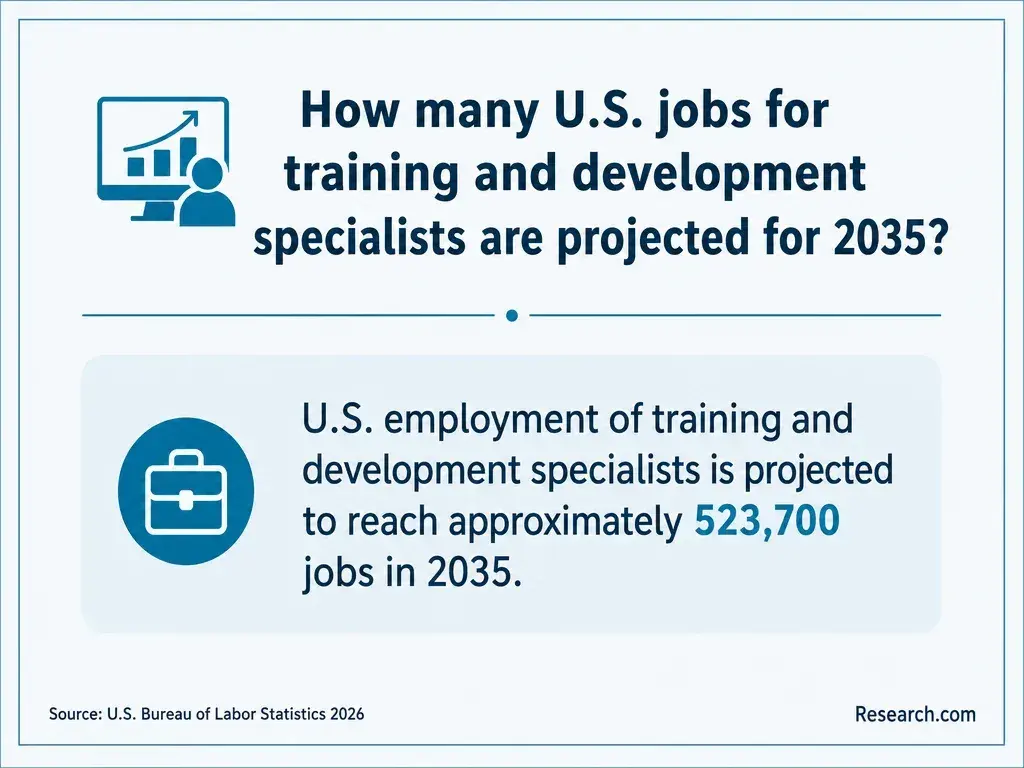
BLS projects 10.8% employment growth for training and development specialists from 2025 to 2035. Growth may support demand for learning-related work, but a specialist role differs from a management position in authority and required experience. Evaluate the degree against jobs you could plausibly pursue, your employer's advancement rules, and the cost of study - not a broad salary figure alone.
How Can You Choose a Reputable Online Ed.D. Program?
Compare programs using a real decision you expect to face - for example, whether to continue, redesign, or stop a leadership-development initiative when participation records and staff accounts conflict. Then ask each program for evidence that its students learn to reach defensible conclusions under those conditions.
Use these questions in conversations with faculty or program staff; published course descriptions alone may not answer them.
- Which required assignments make students integrate qualitative, quantitative, and organizational evidence, and what feedback do faculty provide?
- What methods support is available when measures are weak, sources disagree, or a comparison is not feasible?
- What are the actual culminating-project requirements, approval stages, supervision arrangements, and alternatives if workplace access changes?
- What permissions, privacy review, and restrictions on sharing organizational findings apply?
- What are the verified total charges and attendance commitments for my entry term?
Request a curriculum map, project handbook, and sample assignment criteria where available. Compare the same materials across schools rather than relying on claims that graduates become "data-driven leaders." If cost is a constraint, organizational leadership doctoral study on a budget can help frame the search, but affordability should be weighed against methods instruction and usable faculty guidance.
Choose the Ed.D. if its supervised inquiry, leadership curriculum, and required project align with decisions you expect to own. If the gap is narrower - such as interview design, evaluation planning, or quantitative analysis - seek targeted training and an opportunity to apply it before committing to doctoral study.
Other Things You Should Know About EdD Leadership
No. Disagreement may identify a measurement problem, a difference among groups, or an important implementation barrier. Explain the conflict, assess each source's limitations, and choose an action proportionate to the uncertainty.
No. A mixed-methods design intentionally connects qualitative and quantitative strands to answer a defined question. Merely placing interview quotations beside a chart does not establish that integration.
Usually not. A summary is a transformation of underlying material, not independent confirmation. Check it against authorized original sources and follow organizational rules before entering confidential information into an AI tool.
Yes, if it clearly identifies what the available evidence cannot establish and what a decision-maker should examine next. An honest limitation is more useful than claiming an effect the design cannot support.
- Read the Belmont Report | hhs.gov https://www.hhs.gov/ohrp/regulations-and-policy/belmont-report/read-the-belmont-report/index.html
- Duke Research Data Management Training Resources https://research.duke.edu/duke-research-data-management-training-resources/
- UNC EdD Online: Organizational Learning and Leadership https://online.unc.edu/online-doctoral-programs/online-edd-organizational-learning-and-leadership/
- Online Doctorate in Educational Leadership & Management (EdD) | Drexel University Online https://www.online.drexel.edu/online-degrees/education-degrees/oelm/index.aspx
- The importance of ethical considerations in research and clinical trials | Penn LPS Online https://lpsonline.sas.upenn.edu/features/importance-ethical-considerations-research-and-clinical-trials
- Doctoral Learning and Resources - Section 7. Learning Modalities and Resources - Academics at Walden University https://academics.waldenu.edu/handbook/learning-modalities/doctoral-research-resources
- EdD vs. PhD in Education: Choosing the Right Program | Goodwin College of Professional Studies https://drexel.edu/soe/resources/career-path/edd-vs-phd/
- Guide 3: Reliability, Validity, Causality, and Experiments | fsu.edu https://myweb.fsu.edu/slosh/MethodsGuide3.html
- Effective master's thesis supervision - A summative framework for research and practice - ScienceDirect https://www.sciencedirect.com/science/article/pii/S1747938X23000829
- Mixed Methods Research | harvard.edu https://catalyst.harvard.edu/community-engagement/mmr/