2027 Online Ed.D. in Leadership and Learning in Organizations: Moving from Instructional Design to Learning Function Leadership
Audited and Verified:
Our Editorial and Data Verification Process
Research.com uses government datasets, official education statistics and primary institutional information to support its career and degree guides. Our review process checks factual accuracy, occupational definitions, source dates and the requirements associated with the credentials discussed.
How This Article Was Fact-Checked
Our editorial team verifies salary estimates, employment projections, education requirements and program information against original data providers and official organizations. Salary figures are checked against the relevant occupational definitions and reporting periods. Information about licensure, accreditation and required in-person training is reviewed separately.
Fact-checked and verified on:

Co-Founder and Chief Data Scientist
Designing effective instruction and leading an organization's learning function are different jobs. A learning leader must decide which performance problems call for training, align development with organizational priorities, manage resources, and show whether an initiative worked. For instructional designers considering that move, an online Ed.D. in leadership and learning may build useful capabilities - but it cannot substitute for leadership experience. This guide explains what the degree can add, what employers are likely to expect, and how to decide whether doctoral study or a more direct route fits your next step.
Key Things You Should Know
- An Ed.D. can help an experienced instructional designer move from course-level decisions toward organizational diagnosis, learning strategy, evaluation, and change leadership; the degree alone does not qualify someone to direct a learning function.
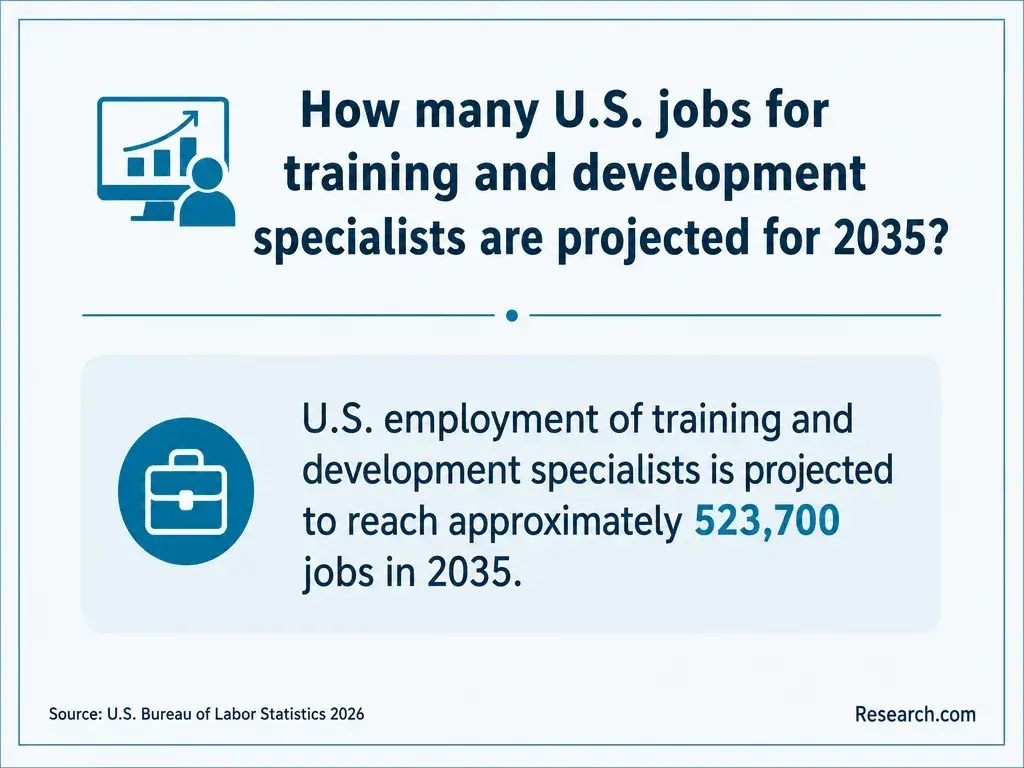
- The US Bureau of Labor Statistics reports a $133,000 median annual salary for training and development managers in May 2025, with 6.4% projected employment growth from 2025 to 2035.
- These are occupation-wide figures, not Ed.D. graduate outcomes. Before enrolling, compare a program's leadership practice, applied research, schedule, and full cost against a lower-cost route: leading a cross-functional learning initiative with mentoring and targeted study.
What Is an Online Ed.D. in Leadership and Learning in Organizations?
An online Doctor of Education in leadership and learning in organizations is a practice-oriented doctorate concerned with how people learn and how organizations improve. Depending on the program, students may study adult learning, organizational change, leadership, and applied research while investigating a problem in a workplace or another approved setting. "Online" describes where much of the instruction occurs; it does not necessarily mean self-paced study or no campus visits.
For an instructional designer, the important distinction is scope. Designing a learning experience is one part of the work. Leading a learning function also involves setting priorities, securing support, coordinating stakeholders, and deciding whether learning is the appropriate response to a performance problem. Programs with similar names can emphasize different sectors and methods, so use these Doctor of Education study areas to compare before assuming a degree matches corporate, nonprofit, government, or higher-education work.
An Ed.D. generally fits a practitioner who wants to lead and evaluate change. A research-oriented PhD may fit someone whose primary goal is producing academic research; a focused master's, certificate, or employer leadership program may be more direct when the immediate gap is a specific management skill.
How Does an Online Ed.D. Advance Instructional Designers Into Learning Leadership?
Instructional designers often bring needs-assessment, facilitation, technology, and evaluation skills. The move into leadership requires applying those skills across a portfolio of initiatives - not just improving one course. Doctoral study is most valuable when it gives a working designer opportunities to test decisions involving organizational systems, stakeholders, and evidence.
A useful progression is to take on responsibilities before, during, or instead of the degree. Each step should produce evidence an employer can assess:
- Diagnose beyond the training request: Work with a sponsor to identify the performance gap, affected groups, and nontraining causes such as incentives or workflow.
- Lead across functions: Coordinate managers, subject-matter experts, HR partners, and operations staff on a learning initiative with a defined decision owner.
- Evaluate a consequential decision: Agree on feasible measures before launch, assess implementation and limitations, and recommend whether to continue, revise, or stop the initiative.
- Document leadership responsibility: Show your role in priorities, trade-offs, resources, and stakeholder decisions without claiming sole credit for organizational results.
An Ed.D. can provide frameworks, faculty feedback, and disciplined applied inquiry for this progression. It is less likely to change your prospects if you cannot obtain meaningful project responsibility or if the roles you want primarily require experience managing people, vendors, or budgets.
What Careers Can an Online Ed.D. in Leadership and Learning Prepare You For?
The most plausible next role depends on what you have already led. The comparison below separates adjacent moves from transitions that usually demand substantial experience beyond instructional design.
| Target role | Typical work | Evidence to build beyond the degree |
| Senior learning strategist or L&D lead | Sets priorities across programs and advises business partners | Cross-functional planning, needs diagnosis, and evaluation decisions |
| Training and development manager | Oversees a learning function, staff, vendors, or resources | People or project management, budgeting, and accountable delivery |
| Organizational development consultant | Diagnoses organizational issues and supports change | Consulting, stakeholder engagement, and carefully interpreted evidence |
| Higher-education learning or development leader | Supports staff, faculty, or institutional development | Knowledge of campus governance, stakeholders, and relevant administration |
A designer with broad program ownership may be positioned for an internal learning-strategy role sooner than for an external director opening. Higher education introduces different governance and hiring expectations; readers considering that sector can examine Ed.D. learning and organizational improvement pathways in universities without assuming corporate L&D experience transfers unchanged.
Before choosing a doctorate for career advancement, review several actual job postings and discuss the target role with hiring managers. If they consistently prioritize team leadership or sector experience over doctoral preparation, pursue that experience first.
For a designer seeking function-level responsibility, the strongest curriculum fills gaps between building instruction and directing learning decisions. Look for adult learning and learning transfer; organizational diagnosis and change; leadership and resource decisions; and research methods that support credible evaluation. A course title alone does not establish how deeply a topic is taught.
Ask to see required courses and the actual applied-project requirements. Can students investigate a learning problem that matters to an organization? Are they taught to distinguish a satisfaction survey from evidence of changed practice? Does faculty guidance address sampling, alternative explanations, and responsible use of employee data? These questions matter more than a long list of electives that may not be offered during your enrollment.
A workplace project also needs more than an interesting topic. Before relying on it as a reason to enroll, confirm the program's deliverable and oversight rules, your organization's permission, and access to appropriate data. Employee records, learner information, and interview responses may require privacy safeguards, consent, agreements, or institutional review. A proposed evaluation is not an approved doctoral project or proof of impact.
Requirements vary by institution. Applicants may need a qualifying prior degree, transcripts, recommendations, a statement of purpose, and evidence of relevant professional experience; some programs add interviews or other conditions. An education major is not universally required, and designing instruction does not automatically satisfy a program's definition of leadership experience.
Show admissions committees the decisions you have made: the organizational problem, stakeholders, your authority, the evidence you used, and what you learned when an approach needed revision. If a program expects workplace-based inquiry, explain a feasible setting without promising access or approvals you do not yet have. Confirm entry-term requirements directly with admissions, particularly if you have unfinished doctoral work. Online Ed.D. options for all-but-dissertation applicants are worth reviewing in that situation, but prior doctoral credits, admission eligibility, and credits applied to a new degree are separate decisions.
There is no reliable universal timeline or price for an online leadership Ed.D. Completion depends on the required credits, course sequence, enrollment pace, and time needed for the dissertation or other approved doctoral project. Published tuition may be charged by credit or term and may exclude fees, books, travel, and lodging for required convenings.
Request a written estimate for your intended enrollment pattern, including likely continuation charges if the project takes longer than planned. Check employer reimbursement caps, grade conditions, and repayment obligations before subtracting assistance from the cost. Compare that commitment with the price and career value of a smaller credential or a supported leadership assignment; planning the cost of an organizational leadership doctorate can help frame the full-cost comparison. Do not budget around an assumed promotion or salary increase.
Online delivery can let working instructional designers remain employed and apply coursework locally. Campus-based study may offer more in-person interaction and access to local professional networks. Neither format determines academic quality or schedule flexibility: an online cohort may require live evening classes, group meetings, and travel, while a campus program may offer some flexible coursework.
Compare the calendar you would actually live with: attendance rules, time zones, residency dates, project milestones, faculty access, and accommodations. Ask how the program handles an employer change during an applied project. If your target is higher-education leadership, compare funding as well as format; scholarship planning for higher education leadership doctoral study may reveal questions to ask about aid eligibility and employer support. Confirm every award's terms with the institution rather than assuming that online or campus enrollment qualifies.
Verify that the institution is accredited by an accreditor recognized by the US Department of Education or the Council for Higher Education Accreditation, and confirm that the degree you are considering is actually awarded by that institution. Review the program's official catalog for its precise degree title, delivery requirements, and doctoral completion rules.
Institutional accreditation does not establish that a leadership and learning Ed.D. has a specialized accreditation, prepares graduates for school-administrator licensure, or satisfies an employer's hiring standard. If a particular role requires regulated credentials, check the program's disclosures and the relevant state authority before enrolling.
The US Bureau of Labor Statistics reports a May 2025 median annual salary of $133,000 for training and development managers, compared with $69,280 for training and development specialists. The difference reflects distinct occupations, not the pay increase an instructional designer should expect after earning an Ed.D. Management openings generally call for demonstrated responsibility in addition to education.
For a realistic salary decision, match job postings to your target title, location, sector, and existing experience. A public institution, nonprofit, or corporate employer may classify and compensate leadership work differently. Use the degree's total cost and the responsibilities you can credibly pursue - not the manager median alone - to judge its financial value.
What Certifications or Licenses Do Learning Leaders Need?
Most organizational learning leadership roles do not have a universal professional license. Employers may value relevant certifications in talent development, project management, change management, coaching, or learning technologies, but each credential has its own requirements and serves a narrower purpose than a doctorate.
Choose a certification only when it addresses a documented skill gap or appears regularly in your target job requirements. A general leadership and learning Ed.D. should not be mistaken for a state-approved teacher, principal, or superintendent preparation program. Those positions have jurisdiction-specific eligibility rules that must be checked separately.
Other Things You Should Know About EdD Leadership
Yes. Many roles combine hands-on design with strategy, especially in smaller teams. Clarify how much time the target job allocates to design versus prioritization, management, and evaluation.
Create a redacted case study describing the problem, your decisions, collaborators, methods, and limitations. Obtain permission before sharing internal materials, results, or identifiable information.
Seek a defined cross-functional initiative and document your decision authority, stakeholder coordination, and resource trade-offs. Be precise about what you led rather than presenting project participation as people management.
Access and approvals may change. Ask the program how it handles project-site changes, and establish an alternative scope with faculty before relying on data or participation from a former employer.
- How Instructional Design Is Operationalized in Various... - PMC https://pmc.ncbi.nlm.nih.gov/articles/PMC8320718/
- Workforce Development | eda.gov https://www.eda.gov/resources/comprehensive-economic-development-strategy/content/workforce-development
- Instructional Designer Jobs, Salary & Career Guide | Northwest Missouri State University https://online.nwmissouri.edu/programs/education/msed/curriculum-instruction-teaching-technology/how-to-become-designer/
- EdD in Organizational Change and Leadership | USC Rossier https://rossier.usc.edu/programs/doctoral/organizational-leadership/
- What is an instructional designer and what do they do? | Penn State World Campus https://www.worldcampus.psu.edu/about-us/news-and-features/what-is-an-instructional-designer-and-what-do-they-do
- Master of Education in Instructional Design and Learning Technologies | College of Health, Education, and Human Services https://health-education-human-services.wright.edu/leadership-studies-in-education-and-organizations/master-of-education-in-instructional-design-and-learning-technologies
- UNC EdD Online: Organizational Learning and Leadership https://online.unc.edu/online-doctoral-programs/online-edd-organizational-learning-and-leadership/
- What is an Ed. D. in Educational Leadership Degree | nl.edu https://nl.edu/blog/archives/2026/what-is-an-ed-d-in-educational-leadership-degree/
- Online Ed.D. in Leadership and Learning in Organizations | VU-EDU https://peabodyonline.vanderbilt.edu/edd-in-organizational-learning/
- How Does Online Learning Work at CSU? | colostate.edu https://online.colostate.edu/faqs/online-learning.dot