2027 Online Ed.D. in Leadership and Learning in Organizations: Evaluating Research Preparation for Piloting a Survey Before Full Data Collection
Audited and Verified:
Our Editorial and Data Verification Process
Research.com uses government datasets, official education statistics and primary institutional information to support its career and degree guides. Our review process checks factual accuracy, occupational definitions, source dates and the requirements associated with the credentials discussed.
How This Article Was Fact-Checked
Our editorial team verifies salary estimates, employment projections, education requirements and program information against original data providers and official organizations. Salary figures are checked against the relevant occupational definitions and reporting periods. Information about licensure, accreditation and required in-person training is reviewed separately.
Fact-checked and verified on:

Co-Founder and Chief Data Scientist
A survey can be approved for a doctoral project yet still fail when employees interpret its questions differently, skip sensitive items, or cannot complete it on their phones. For leaders considering an online Ed.D. in leadership and learning in organizations, the useful question is whether the program teaches them to detect those problems before full data collection.
This guide explains what research preparation to look for, how to run an ethical survey pilot, and when a narrower methods course may serve your goal better than a doctorate.
Key Things You Should Know
- A strong Ed.D. research sequence should connect survey design, measurement, sampling, analysis, and ethical review to an approved organizational project - not merely offer a statistics course.
- Use cognitive interviews to check what questions mean to respondents, then a small field pilot to test the complete invitation, survey, and data-handling process.
- No universal pilot sample size or reliability cutoff proves a survey is ready. Revise it using evidence about interpretation, missing responses, completion, and confidentiality before seeking approval for full collection.
What Is an Online Ed.D. in Leadership and Learning in Organizations?
It is a practice-oriented doctorate concerned with how people learn, lead, and implement change within organizations. Students may study adult learning, organizational systems, leadership, and applied research while completing the particular capstone or dissertation their program requires. "Online" describes delivery, not necessarily self-paced study: live classes, group work, or campus convenings may still be required.
For a learning and development professional or organizational leader, its value lies in connecting a consequential workplace decision to defensible evidence. A survey about leadership training, for example, should inform whether and how to improve the training - not simply produce a favorable satisfaction score. A focused survey-design or evaluation course may be sufficient if that is the only capability you need.
How Does an Online Ed.D. Prepare Students for Educational Leadership Research?
Useful preparation moves from a defined organizational problem to a researchable question, an appropriate measure, a feasible sample, an analysis plan, and a defensible interpretation. Ask whether students receive feedback on actual survey questions and pilot evidence before they collect their main dataset. A course title such as "Research Methods" alone cannot establish that level of support.
The following comparison shows why a program should teach more than one kind of pre-collection test. Each produces different evidence about survey readiness.
| Research activity | What it can reveal | What it cannot establish alone |
| Cognitive interviews | How intended respondents understand, recall, and answer questions | Response rates or performance of the full survey process |
| Field pilot | Invitation clarity, survey flow, technical problems, missing answers, and data export | Representativeness or the effect of an organizational intervention |
| Full approved collection | Evidence relevant to the planned research or evaluation question | Causation unless the design supports a causal claim |
Faculty guidance should also cover what happens after a failed pilot: revising questions, documenting changes, and determining whether a change needs further review. Project expectations vary. Students comparing a dissertation in practice with other culminating formats can explore comparing Ed.D. dissertation alternatives, then confirm the chosen program's actual research requirements.
How Can You Pilot a Survey Before Full Doctoral Data Collection?
Start with the decision the survey must support. In an illustrative leadership-development project, the organization might need to know which conditions help participants apply a newly taught coaching practice. That calls for questions about observable use and workplace support, not only whether participants liked the workshop. A pilot tests whether the proposed instrument and collection process can answer the question; it is not evidence that the workshop worked.
Use this sequence with your advisor and organizational contact, adapting it to the program's required approvals. Do not recruit participants or access restricted records merely because an employer supports the idea.
- Define the measure. Specify who will answer, what behavior or experience each question represents, the recall period, and how the answers will inform a decision.
- Confirm permissions and review. Ask the program whether pilot activities require institutional research or ethics review, and obtain any necessary employer authorization, consent language, and data-use arrangements before recruitment.
- Test interpretation. Invite people similar to intended respondents to explain, in their own words, how they interpret selected questions and response choices; record ambiguities without coaching them toward the intended answer.
- Run a small field pilot. Test the actual invitation, device display, skip logic, survey length, reminders, accessibility, and export process under conditions resembling full collection.
- Inspect and revise. Look for skipped items, implausible response patterns, confusing scales, privacy concerns, and questions whose answers cannot inform the planned analysis. Log each change and its reason.
- Get clearance to proceed. Check whether revisions require an amendment or other approval, finalize the instrument and analysis plan, and confirm whether pilot responses must remain separate from the main dataset.
Pilot size should follow its purpose. A few varied respondents may expose wording problems, whereas a field pilot needs enough participation to exercise the intended workflow. Neither a small pilot nor a single reliability statistic validates a new scale or guarantees that employees will respond similarly across teams. Recruiting from a small department can also make supposedly anonymous answers identifiable through job titles or combinations of demographic details.
Decide how pilot participants will be treated before collecting answers. Reusing their responses or inviting them to the main survey may be inappropriate if the questions change or prior exposure affects their answers. Your advisor and applicable review process should resolve that decision, not an informal promise to the organization.
Check that the institution holds recognized institutional accreditation and that it applies to the university awarding the Ed.D. Verify its status through the accreditor and the U.S. Department of Education's accreditation records. Accreditation supports a basic institutional quality check; it does not certify a particular survey course, guarantee faculty supervision, or establish eligibility for school-administrator licensure.
If licensure is your aim, ask the program and the relevant state authority whether the specific degree pathway meets that requirement. A broadly focused organizational leadership Ed.D. should not be treated as a principal-preparation program merely because it includes educational leadership topics.
Curricula vary, but relevant subjects may include adult learning, organizational change, leadership theory, quantitative and qualitative methods, program evaluation, and research ethics. For this decision, examine the sequence: Can you learn measurement and sampling, receive instrument feedback, complete a pilot, and revise before the deadline for full collection?
Ask to see a current course plan and the project handbook. A program may teach survey analysis without teaching cognitive interviewing, or teach research methods after students are expected to secure organizational access. If you already have an unfinished doctorate, online Ed.D. options for all-but-dissertation applicants may warrant comparison, but confirm whether their methods preparation supports your proposed survey rather than assuming earlier coursework transfers.
Requirements are program-specific. Schools may request an eligible prior degree, transcripts, professional experience, recommendations, a statement of purpose, and evidence that the applicant can undertake applied inquiry. A publication record or previous survey study is not a universal prerequisite.
For a proposed survey project, describe the organizational decision, your role, the population you hope to study, and what permissions would still be needed. Demonstrating access awareness is stronger than claiming access you do not yet have. Ask admissions whether the proposed topic fits the degree; ask research faculty separately whether it could meet project standards. Neither conversation substitutes for formal project or ethics approval.
Time and total cost depend on required credits, enrollment pace, tuition and fees, any travel, and the time needed for approvals, piloting, revisions, and full collection. Published minimum completion schedules may not account for an organization delaying access or an instrument needing substantial revision. Compare programs using the same assumptions about your weekly availability and project timeline.
Request a written, entry-term-specific cost and course plan, including charges beyond tuition and any employer-reimbursement conditions. If speed matters, accelerated education doctorate completion planning can help frame the comparison; verify that a faster schedule still leaves room for meaningful pilot feedback and required review. Do not budget on the assumption that prior graduate credits will shorten the doctorate until the school evaluates them.
Established learning and development professionals may use applied research skills in training leadership, program evaluation, or organizational development. Experienced leaders may apply them to workforce learning or change initiatives; consultants may use a documented evaluation process to strengthen client work. In each case, employers will also assess sector knowledge, implementation experience, and results - not the degree alone.
If your goal is a college leadership role, compare its actual hiring requirements with online organizational leadership Ed.D. choices for college leaders. A survey pilot can demonstrate careful inquiry, but it is not by itself evidence of readiness to manage budgets, personnel, or institutional policy.
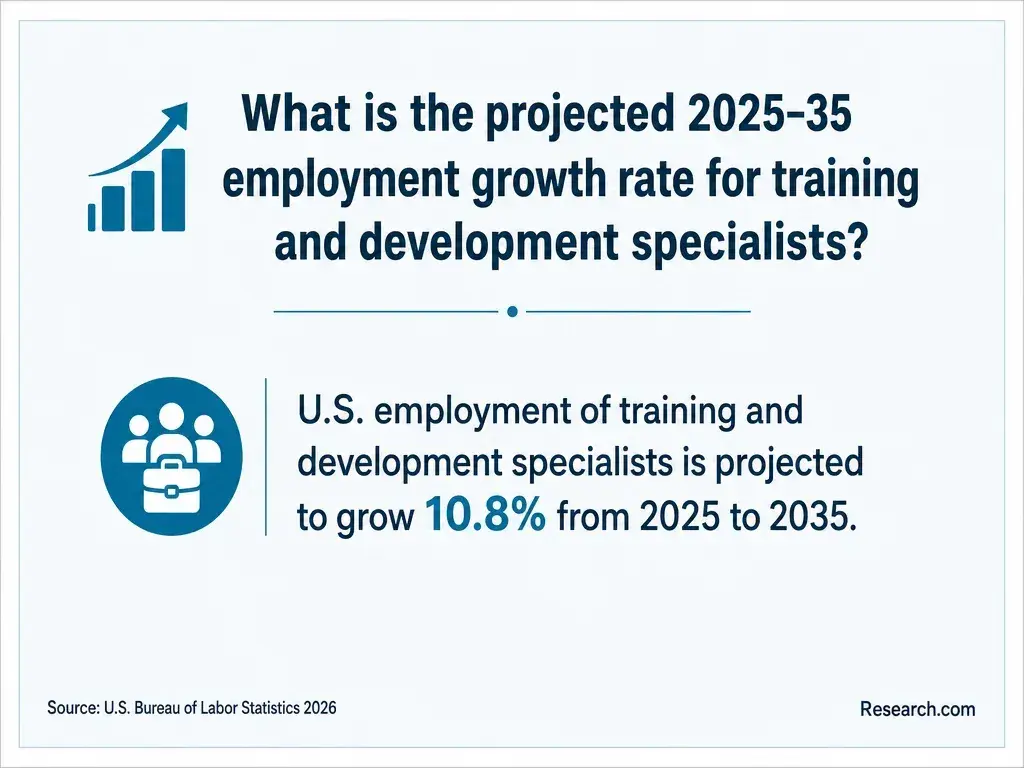
The U.S. Bureau of Labor Statistics reports a May 2025 median annual salary of $133,000 for training and development managers, with employment projected to grow 6.4% from 2025 to 2035. That occupation is relevant to experienced learning leaders, but its median covers workers with different credentials and backgrounds; it is not an expected Ed.D. graduate salary or a return-on-tuition estimate.
Use the occupation that matches the work you intend to do, then assess local openings, required management experience, and your current compensation. A doctorate may strengthen your ability to evaluate learning initiatives without creating a new position or promotion opportunity at your employer.
How Do You Choose a Reputable Online Ed.D. Program?
Evaluate programs against your proposed survey, not their "online" label. Request a recent project handbook, course sequence, sample assessment criteria, and a conversation with faculty who supervise survey-based work. Ask when students obtain project and ethics review, what support exists for instrument design and data analysis, and how a required redesign affects progression.
Compare total cost only after checking those research supports. leadership doctorate programs with lower tuition may be worth investigating, but a less expensive option is a poor fit if its schedule or project rules prevent an adequate pilot. If you need only to improve one workplace questionnaire, a supervised evaluation project or targeted methods training is usually a more direct starting point than enrolling in a doctorate.
Other Things You Should Know About EdD Leadership
Possibly. Check its licensing or permission terms, whether it measures your intended construct in your setting, and whether changing its wording affects how scores can be interpreted. Cite the source and discuss adaptations with your advisor.
It can help generate wording options, but its output is not a validated instrument. Check every question for relevance, bias, clarity, and disclosure risks; follow your program's AI-use rules and never enter restricted organizational data into an unauthorized tool.
No. Anonymous collection does not identify respondents; confidential collection may retain identifying information while restricting access. Small groups, free-text answers, and survey-platform settings can undermine anonymity even when names are not requested.
Follow your program's reporting requirements. Usually, a clear account of what was tested, what changed, and why helps readers judge the final instrument. Keep pilot observations distinct from findings from full data collection.
- Ethical Guidelines and the Institutional Review Board - PMC https://pmc.ncbi.nlm.nih.gov/articles/PMC10885741/
- TEN21-07a1.pdf | dol.gov https://www.dol.gov/node/159499
- Designing an Assessment Strategy | U.S. Office of Personnel Management https://www.opm.gov/policy-data-oversight/assessment-and-selection/assessment-strategy/
- ED Guidance on Engagement of Institutions in Research http://www.ed.gov/grants-and-programs/manage-your-grant/protection-of-human-subjects-research/ed-guidance-engagement-of-institutions-research
- 4 Collaborating with the Institutional Review Board (IRB) | mit.edu https://admindatahandbook.mit.edu/book/v1.0-rc6/irb.html
- Guarding Data Integrity - Tackling Challenges in Online Surveys | jhu.edu https://publichealth.jhu.edu/center-for-global-digital-health-innovation/guarding-data-integrity-tackling-challenges-in-online-surveys
- IRB Frequently Asked Questions | College of Charleston https://charleston.edu/research-grants-admin/human-research-protections/irb-faq.php
- When Do External Organizations Need IRB Approval? | Human & Animal Research Compliance https://irb.stanford.edu/for-researchers/when-do-external-organizations-need-irb-approval