2027 Online Ed.D. in Leadership and Learning in Organizations: Evaluating Research Preparation for Choosing Between Qualitative and Quantitative Evidence
Audited and Verified:
Our Editorial and Data Verification Process
Research.com uses government datasets, official education statistics and primary institutional information to support its career and degree guides. Our review process checks factual accuracy, occupational definitions, source dates and the requirements associated with the credentials discussed.
How This Article Was Fact-Checked
Our editorial team verifies salary estimates, employment projections, education requirements and program information against original data providers and official organizations. Salary figures are checked against the relevant occupational definitions and reporting periods. Information about licensure, accreditation and required in-person training is reviewed separately.
Fact-checked and verified on:

Co-Founder and Chief Data Scientist
A leadership team may know that a training initiative is underperforming without knowing whether to interview employees, analyze performance data, or do both. For working leaders and learning professionals considering an online Ed.D., that choice reveals more about research preparation than a course title does. This article explains how qualitative and quantitative evidence answer different organizational questions, what doctoral training should enable you to do, and how to assess a program's methods curriculum before committing time and money.
Key Things You Should Know
- Choose qualitative evidence to understand experiences and processes; choose quantitative evidence to estimate patterns or changes. Use both when the decision requires both explanations and measurement.
- Strong Ed.D. preparation includes research design, measurement, interpretation, ethics, and supervised application - not merely exposure to statistics or interviews.
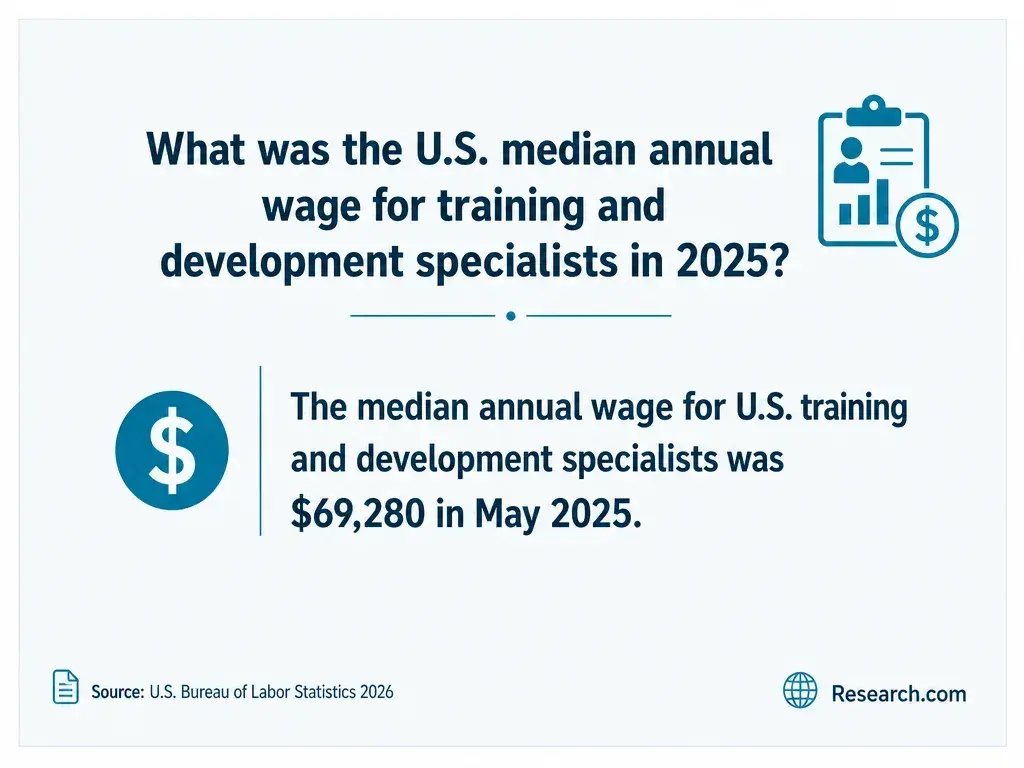
- Career value depends on experience as well as research skill: the US Bureau of Labor Statistics reports a $133,000 median annual salary for training and development managers, not an expected salary for Ed.D. graduates.
What is an online Ed.D. in Leadership and Learning in Organizations?
An online Doctor of Education focused on leadership and learning in organizations is generally a practice-oriented doctorate. It connects leadership, adult learning, organizational change, and applied inquiry so professionals can investigate problems in settings such as employers, nonprofits, universities, and public agencies. The exact degree name, curriculum, and final research requirement depend on the institution.
For this topic, the degree's value is not simply that it teaches leaders to collect more data. It should help them decide which evidence would change a decision. A leader investigating low participation in professional development, for example, may need interviews to understand scheduling barriers before a survey can measure how widespread those barriers are. Readers comparing this focus with other types of Ed.D. programs and concentrations should check the required methods sequence, not just the concentration label.
An Ed.D. is not automatically a school-administrator licensure program. It also differs from a research-focused PhD, which may better fit someone aiming to produce disciplinary scholarship, and from a short evaluation course, which may be sufficient for a narrowly defined workplace project.
How does an Ed.D. in Leadership and Learning prepare students for research?
Useful preparation moves from defining an organizational decision to designing a feasible inquiry, obtaining appropriate access, analyzing evidence, and communicating limitations. Students should learn to distinguish a needs assessment or internal program evaluation from a study intended to support broader research claims. A capstone, dissertation in practice, or dissertation can provide supervised application, but those deliverables are not interchangeable; confirm what each program actually requires.
Consider an illustrative question: Why do employees complete a leadership course but rarely use its practices at work? Interviews could surface obstacles such as unclear expectations. Participation records and a carefully defined measure of workplace use could show where a pattern occurs. Neither source alone establishes that the course caused - or failed to cause - a performance change.
Before relying on workplace information, a student must establish who may authorize access and how identifiable records will be protected. Employer permission, a data-use agreement, consent procedures, and institutional research review may apply. An internal improvement activity is not automatically exempt from review, and access to data does not itself authorize publication. Effective faculty guidance helps students make these distinctions before collection begins.
What is the difference between qualitative and quantitative research in education?
Qualitative research examines meanings, experiences, and processes, often through interviews, observations, or documents. Quantitative research uses defined numerical measures to examine frequencies, differences, or associations. Mixed methods deliberately combines the two and explains how their findings inform one another; collecting a survey and a few quotations without an integration plan is not enough.
The comparison below shows how each approach would serve the same hypothetical workplace-learning decision. It describes possible designs, not results from an actual organization.
| Approach | Useful question | Possible evidence | Main caution |
| Qualitative | How do employees experience barriers to using new practices? | Purposefully selected interviews and observations | Participants' accounts need careful interpretation and may not represent everyone. |
| Quantitative | How common is reported use, and how does it vary across groups or time? | Defined survey measures or appropriately authorized records | Missing responses, weak measures, and group differences can distort conclusions. |
| Mixed methods | Where is use low, and what helps explain the pattern? | Numerical measures connected to follow-up interviews | Both strands require sufficient time, skill, access, and an explicit integration plan. |
The decision should start with the claim you need to support. If leaders need to redesign a confusing process, credible accounts from affected employees may be more useful than a large satisfaction survey. If they must estimate the reach of a problem, a well-designed quantitative measure matters more than a handful of interviews. If they want to claim an intervention caused improvement, a simple before-and-after comparison is usually inadequate: selection, other organizational changes, and missing data may offer alternative explanations.
In either approach, specify who is included, when evidence is gathered, and what counts as an outcome. Keep learning analytics proportionate to the decision rather than turning routine employee monitoring into unexamined surveillance.
Course titles vary, but a research-ready curriculum should build a connected sequence: organizational problem framing; qualitative inquiry; quantitative reasoning and measurement; evaluation or mixed-methods design; research ethics; and guided work on the final project. Leadership, adult learning, and change courses provide context for interpreting findings rather than treating every performance issue as a training deficit.
Examine syllabi and sequencing, not only the catalog. A single introductory statistics course may support data literacy without preparing a student for a complex causal analysis. Likewise, an interview assignment does not establish competence in sampling, protocol design, reflexivity, or credible thematic interpretation. Ask whether students receive feedback on a research question and analysis plan before they seek organizational data, and whether appropriate electives will actually be available during their enrollment.
If your goal is to conduct advanced technical analysis rather than lead and evaluate organizational improvement, compare the methods depth with a research-focused doctorate or targeted graduate training.
Requirements vary by institution. Programs may request prior graduate study, transcripts, professional experience, recommendations, a statement of purpose, and evidence that an applicant can handle doctoral inquiry. Do not assume a master's in education, a publication, a particular statistics course, or a fixed leadership title is universally required.
For a methods-focused applicant, the strongest preparation is often a clear account of a real organizational decision: what evidence is available, what remains unknown, and why the question matters. Prior evaluation, research, analytics, or improvement work can demonstrate readiness even if it did not produce publishable findings. Applicants with an education specialist degree should separately verify admission eligibility and any possible degree credit; Ed.S. credit considerations for Ed.D. study do not imply automatic transfer.
Completion time depends on required coursework, enrollment pace, cohort scheduling, and the final project. Research can take longer than a course calendar suggests when permissions, recruitment, data availability, or faculty review delay the proposed design. Ask for the program's published completion expectations and recent completion information, including how it defines the starting and ending points.
Plan for a design that can survive changes in employment or organizational access. If you are continuing an education doctorate after unfinished research, ask the new institution to evaluate prior work in writing; a previous proposal or completed courses do not necessarily shorten its research sequence.
Without a named institution and entry term, there is no reliable single price. Compare the school's published tuition basis - per credit, term, or program - with required credits, fees, and any charges that continue during research or final-project enrollment. Add required travel and lodging, software or materials, and time away from paid work where applicable.
Methods preparation affects value: a less expensive program may cost more in time if the student cannot get timely design and analysis support. Employer reimbursement may lower personal cost, but eligibility, annual limits, grade conditions, and repayment obligations require written confirmation. When choosing a lower-cost online Ed.D., compare the total likely expense alongside research supervision and the feasibility of completing the required project.
Delivery mode changes access and scheduling, not the standards of good evidence. An online program may let a working leader investigate a problem near home, while a campus-based program may make in-person research collaboration easier. Either format can offer strong or weak faculty guidance. Online also does not necessarily mean asynchronous: live sessions, group meetings, and campus convenings may be required.
Ask each program how students practice interviewing, receive feedback on measures and analysis, meet advisors, and access research software and library support. For a workplace project, compare whether meeting times leave room for participants' schedules and whether required travel conflicts with data collection. The better format is the one in which you can consistently obtain guidance and complete an ethical, feasible study - not simply the one with the most convenient course location.
Research preparation can strengthen work in learning and development, program evaluation, organizational development, consulting, and education administration. The role determines which evidence skills matter: a training manager may need credible measures of learning transfer, while a consultant may need to diagnose stakeholder concerns and assess implementation. Employers also look for relevant leadership and functional experience; the doctorate alone does not confer a senior role.
The US Bureau of Labor Statistics reports a median annual salary of $133,000 for training and development managers in May 2025. That is an occupation-wide figure, not a forecast for an Ed.D. applicant or graduate. Readers interested specifically in university roles can examine organizational leadership doctorates for university leadership work, while checking each position's experience and sector-specific requirements.
How can you choose an accredited online Ed.D. program?
First, verify the institution's current accreditation status and the exact doctoral degree it awards. Accreditation establishes an important institutional baseline; it does not prove a particular methods curriculum, guarantee career outcomes, or grant educator licensure. Use the institution's current catalog and admissions office to confirm requirements for your intended entry term.
Then test research fit against a decision you might actually face at work. The following questions expose differences that a course list can conceal:
- Which required courses teach qualitative design, quantitative measurement, and the choice between them, and what prior skills do they assume?
- What is the required final deliverable, and when do students receive faculty feedback on design, ethics, and analysis?
- What approvals and data access would a workplace-based project require, and what happens if a partner or employer withdraws?
- Are live meetings, group research, campus visits, or specialized resources required to complete the methods sequence?
Choose a program only after its answers show that you can investigate a consequential question with the access, time, supervision, and methods training available to you. If you need one evaluation skill rather than a doctoral-level leadership pathway, a focused course or supervised workplace project may be the more proportionate choice.
Other Things You Should Know About EdD Leadership
Possibly, but check who owns the responses, what respondents were told about their use, and whether the measures answer your research question. Existing access does not replace organizational permission or required institutional review.
No. More responses cannot fix an unclear question, biased participation, or a measure that does not capture the intended outcome.
Only if the organization and institution permit the tool and its data-handling terms protect participants. Verify where recordings and transcripts are stored, who can access them, and whether consent covers the process.
Report the result and its limitations accurately. A well-executed project can still help leaders revise an intervention, improve measurement, or avoid an unsupported claim of success.
- Collecting and Analyzing Qualitative Data | Field Epi Manual https://www.cdc.gov/field-epi-manual/php/chapters/qualitative-data.html
- Qualitative Methods in Implementation Research - PMC - NIH https://pmc.ncbi.nlm.nih.gov/articles/PMC7023962/
- What Is Ethics in Research & Why Is It Important? | National Institute of Environmental Health Sciences https://www.niehs.nih.gov/research/resources/bioethics/whatis
- Evidence-based teaching practices - Department of Education https://www.education.gov.au/download/17487/commissioned-research/35503/aero-evidence-based-teaching-practices/pdf
- Guidance on Secondary Analysis of Existing Data Sets | University of Connecticut https://ovpr.uconn.edu/services/rics/irb/researcher-guide/secondary-analysis-of-data-sets/
- 2026 UNC Online EdD in Organizational Learning & Leadership https://online.unc.edu/online-doctoral-programs/online-edd-organizational-learning-and-leadership/
- The importance of ethical considerations in research and clinical trials | Penn LPS Online https://lpsonline.sas.upenn.edu/features/importance-ethical-considerations-research-and-clinical-trials
- Doctor of Education in Organizational Leadership, Culture and Change | Thomas Edison State University https://www.tesu.edu/degrees-programs/doctoral/edd.php
- Primary & Secondary Data Definitions - Research Guides https://researchguides.ben.edu/c.php
- Faculty Guide to Advising Research Degree Students | cornell.edu https://gradschool.cornell.edu/resources/faculty-guide-to-advising-research-degree-students/