2027 Online Ed.D. in Leadership and Learning in Organizations: Degree Fit for Leaders Tackling A Learning Team Expected to Prove ROI Without Baseline Data
Audited and Verified:
Our Editorial and Data Verification Process
Research.com uses government datasets, official education statistics and primary institutional information to support its career and degree guides. Our review process checks factual accuracy, occupational definitions, source dates and the requirements associated with the credentials discussed.
How This Article Was Fact-Checked
Our editorial team verifies salary estimates, employment projections, education requirements and program information against original data providers and official organizations. Salary figures are checked against the relevant occupational definitions and reporting periods. Information about licensure, accreditation and required in-person training is reviewed separately.
Fact-checked and verified on:

Co-Founder and Chief Data Scientist
Your learning team has been asked to prove return on investment, but nobody measured performance before the training began. That is a leadership problem as well as an evaluation problem: stakeholders need a credible decision, while the evidence may not support a precise financial claim.
For learning and development professionals considering an online Ed.D. in leadership and learning in organizations, this article explains what can be measured now, what doctoral study could add, and when a shorter route would be more useful. The goal is to help you choose a defensible response to the ROI request - and decide whether the degree fits your longer-term work.
Key Things You Should Know
- Without credible baseline or comparison data, a precise claim that training caused a financial return is usually not defensible; report what the available evidence does and does not show.
- An Ed.D. is most useful if you expect to lead recurring, organization-wide learning and evaluation decisions - not solely to resolve one urgent reporting request.
- The U.S. Bureau of Labor Statistics reports a $133,000 median annual salary for training and development managers in May 2025; that occupational figure is not an Ed.D. graduate salary or proof that the degree will pay for itself.
What Is an Online Ed.D. in Leadership and Learning in Organizations?
An online Ed.D. in leadership and learning in organizations is a practice-oriented doctorate focused on how people learn, how organizations change, and how leaders use evidence to improve practice. Program names and requirements vary. Online describes where much of the instruction occurs; it does not establish that attendance is self-paced or that applied research can be completed without organizational access.
For the team facing an ROI demand, the distinction is between training activity, performance change, and financial return. Attendance and satisfaction show participation and reaction. They do not establish that employees applied a skill, that organizational performance improved, or that training caused a financial benefit. ROI requires a credible estimate of attributable benefits alongside the full intervention cost. Missing baseline data makes that estimate harder, but it does not make every form of evaluation impossible.
The immediate objective is therefore not to manufacture a pre-training figure. It is to identify the decision leadership must make - continue, change, or stop the program - and assemble evidence proportionate to that decision.
Who Should Pursue an Online Ed.D. in Leadership and Learning?
The degree may fit an experienced learning and development manager or emerging organizational leader who has authority to negotiate measures with business partners, improve how programs are designed, and establish evaluation practices across multiple initiatives. It is a stronger fit when you want sustained preparation in organizational diagnosis, applied inquiry, and change leadership - and can use those capabilities beyond this one ROI dispute.
It is a weaker fit if the immediate need is a defensible briefing for an existing program. A supervised evaluation project, focused course in program evaluation or analytics, and help from a finance or operations partner may get you further sooner. The answer also changes if your team cannot obtain permission to access performance or cost data: a doctorate does not override an employer's data restrictions or grant decision-making authority.
Before applying, distinguish a learning problem from a process, incentive, staffing, or technology problem. Training may be part of the response, but measuring it more carefully cannot make an ineffective or unrelated intervention valuable.
What Careers Can an Online Ed.D. in Leadership and Learning Lead To?
Relevant paths include training and development management, organizational development, internal evaluation, and consulting. A training manager may set learning strategy and negotiate performance measures; an organizational consultant may diagnose why a process is underperforming. Both need experience working with stakeholders and operational evidence, not just doctoral coursework.
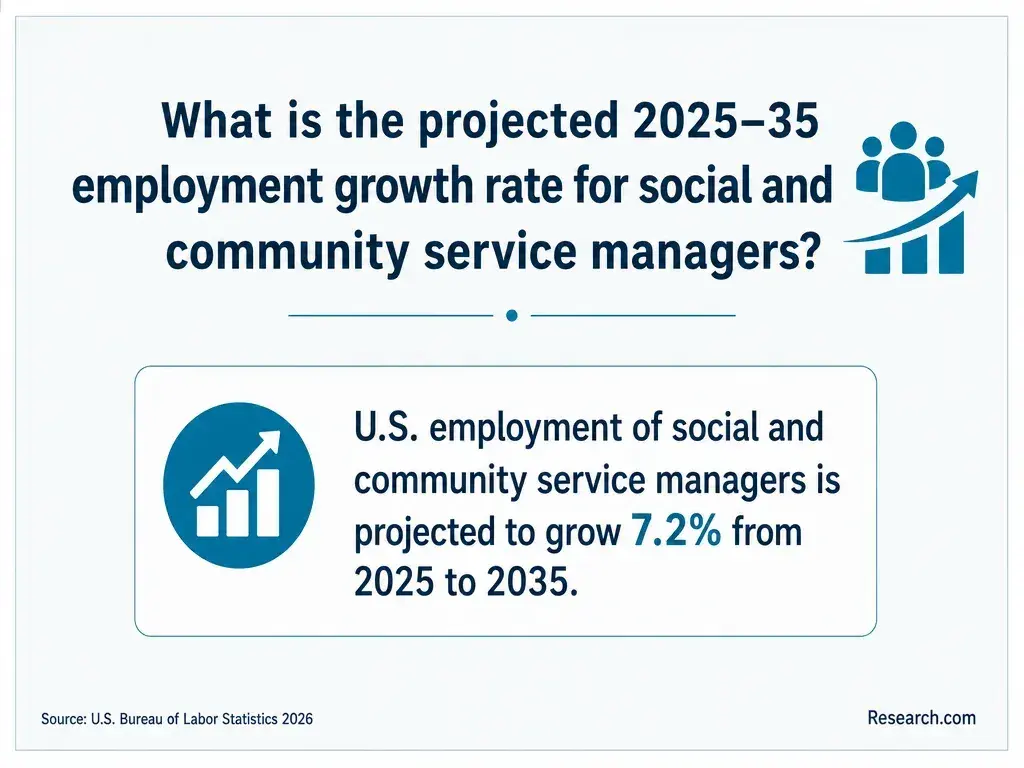
The Bureau of Labor Statistics projects 6.4% employment growth for training and development managers from 2025 to 2035. That suggests continued demand for the occupation, but it does not predict openings for Ed.D. graduates or advancement at your employer. For a move into a university learning or administrative role, evaluating an organizational leadership Ed.D. for higher education work can help frame sector-specific questions; university hiring criteria still vary by position.
A credible portfolio for these roles might show an approved measurement plan, a clearly documented needs assessment, and an executive briefing that states limitations plainly. Do not share restricted employee records or represent a proposed evaluation as a completed finding.
The most relevant curriculum combines adult learning and transfer, organizational diagnosis, leadership and change, program evaluation, research methods, and data ethics. Look for opportunities to practice defining measures before an intervention, interpreting imperfect evidence, and explaining findings to leaders who must allocate resources. A course title alone does not establish depth of preparation.
For the current ROI request, use a short evaluation sequence. It separates what the team can establish now from what it should design for future programs:
- Define the decision, the intended performance outcome, the affected group, and the time period.
- Inventory permitted records, including training costs, participation, operational measures, and any usable pre-training records; document gaps and changes in how measures were collected.
- Check alternative explanations, such as staffing, policy, workload, or technology changes, before attributing observed differences to learning.
- Report costs, observed outcomes, uncertainty, and a plan to collect baseline and follow-up measures for the next initiative.
Historical records may sometimes provide a partial baseline, but only if their definitions and coverage are comparable. Even a pre/post difference does not, by itself, isolate training's effect. An applied doctoral project could examine how an organization builds a better evaluation process; its academic requirements, access permissions, and ethical review must be confirmed with the program and organization.
Completion time depends on required credits, cohort sequencing, enrollment pace, and the dissertation or other culminating project. Ask each program for its published course sequence and completion policies rather than assuming that an online or accelerated option will fit a full-time job.
The ROI challenge creates a scheduling issue of its own: stakeholders may need an answer this quarter, while doctoral study and an approved applied project follow academic timelines. If speed is central to your choice, accelerated education doctorate completion planning offers a starting point for comparing formats. Verify live sessions, group work, campus visits, and what happens if access to your workplace project disappears. Do not delay a needed organizational decision while waiting to enroll.
There is no reliable single price for an online Ed.D. in this field. Compare each school's required credits and published tuition with mandatory fees, travel for convenings, materials, and the cost of time away from work. If an employer offers reimbursement, obtain its eligibility, grade, continued-employment, and repayment terms in writing.
For this reader, the financial comparison should include the alternative: targeted evaluation training or specialist support for the current problem versus a doctorate intended to change your long-term responsibilities. Affordable online organizational leadership doctorates can help identify programs to investigate, but calculate costs from each institution's applicable published charges. Do not use a broad managerial salary median as an assumed post-degree raise or as the numerator in a personal degree-ROI calculation.
Programs commonly ask applicants to document prior graduate study, professional experience, recommendations, and a reason for pursuing applied doctoral work, but exact requirements belong to the institution. An applicant from learning and development should describe decisions they actually influenced: for example, how they scoped a performance problem, worked with stakeholders, or recognized weaknesses in an evaluation. The missing-baseline case is a legitimate problem of practice; it is not necessary to invent a successful ROI result.
Ask admissions staff whether your prior degree and coursework meet entry conditions and, separately, whether any credits can apply toward the doctorate. Those are different decisions. Applicants considering education specialist coursework and doctoral progression should request a written program-specific assessment rather than assume previous graduate credits will shorten completion.
An online Ed.D. may let you remain employed and investigate problems in your own organization. A campus-based program may make scheduled in-person collaboration easier. Neither format automatically provides better access to finance partners, employee data, or a suitable project site; those depend largely on your organization and the program's supervision model.
Compare actual obligations rather than labels. Ask for live-class times, attendance rules, campus-convening dates, group-project expectations, faculty advising arrangements, and procedures for changing project sites. For this ROI problem, access to skilled methods guidance and a workable organizational partnership matters more than whether lectures are delivered on campus.
A teaching license is not generally the purpose of an organizational leadership and learning Ed.D. Applicants working in corporate, nonprofit, healthcare, government, or university learning functions should check the specific program's admission rules rather than assume educator certification is required.
The reverse also matters: completing a broadly focused Ed.D. does not itself qualify someone for teacher, principal, or superintendent licensure. If your intended job is regulated, confirm the program's licensure disclosures and the relevant state authority's requirements before enrolling.
How Can You Choose an Accredited Online Ed.D. Program?
Start by confirming the institution's accreditation and the exact degree awarded, then examine the curriculum against the work you want to perform. Accreditation establishes an important institutional credential; it does not prove that a particular program teaches rigorous evaluation or prepares graduates for a regulated role.
For the missing-baseline challenge, request examples of permitted culminating-project formats and ask whether faculty guide students through measure selection, comparison strategies, uncertainty, and data governance. Compare a dissertation in practice with other applied-project requirements rather than treating them as interchangeable. A resource on professional education doctorates with applied projects can help generate questions, but the institution must confirm its current requirements.
Before committing, ask a prospective program how students obtain project approval, what happens when an employer denies data access, and whether an evaluation focused on improving future measurement could satisfy its academic standards. A good fit gives you a feasible route to responsible inquiry - not a promise that a doctoral credential will turn incomplete records into a causal ROI estimate.
Other Things You Should Know About EdD Leadership
No. Label estimates, explain their sources and assumptions, and show how conclusions change under plausible alternatives.
They can document reach, but not financial return. Keep them separate from evidence about work performance and costs.
Agree in advance on an organizational owner, documentation, access permissions, and a handoff process. Academic project arrangements may need separate program approval.
Report the finding and its limitations. It may support revising the intervention, improving measurement, or reallocating resources; it should not be converted into a positive ROI claim.
- Practical recommendations for the evaluation of improvement initiatives - PMC https://pmc.ncbi.nlm.nih.gov/articles/PMC5909656/
- Rapid Evaluation Approaches for Complex Initiatives | ASPE https://aspe.hhs.gov/reports/rapid-evaluation-approaches-complex-initiatives-0
- CDC Approach to Program Evaluation https://www.cdc.gov/evaluation/php/about/index.html
- Training Needs Assessment - Planning & Evaluating | U.S. Office of Personnel Management https://www.opm.gov/policy-data-oversight/training-and-development/planning-evaluating/
- the bottom line on roi | CalHR Website https://www.calhr.ca.gov/how-to-calculate-roi-in-government-training-programs
- Online Ed.D. in Higher Education | Rockhurst University https://onlinedegrees.rockhurst.edu/programs/online-edd-education-leadership/higher-ed
- Chapter 36., Section 1. A Framework for Program Evaluation | ku.edu https://ctb.ku.edu/en/table-of-contents/evaluate/evaluation/framework-for-evaluation/main
- EdD vs. PhD in Education: Choosing the Right Program | Goodwin College of Professional Studies https://drexel.edu/soe/resources/career-path/edd-vs-phd/
- EdD Organizational Leadership Online | Saint Leo University https://onlinedegrees.saintleo.edu/programs/edd-organizational-leadership-online
- How to Measure the Impact of Your Leadership Development Programs - UPCEA https://upcea.edu/how-to-measure-the-impact-of-your-leadership-development-programs/