2027 Online Ed.D. in Leadership and Learning in Organizations: Comparing Coursework in Organizational Learning Capacity
Audited and Verified:
Our Editorial and Data Verification Process
Research.com uses government datasets, official education statistics and primary institutional information to support its career and degree guides. Our review process checks factual accuracy, occupational definitions, source dates and the requirements associated with the credentials discussed.
How This Article Was Fact-Checked
Our editorial team verifies salary estimates, employment projections, education requirements and program information against original data providers and official organizations. Salary figures are checked against the relevant occupational definitions and reporting periods. Information about licensure, accreditation and required in-person training is reviewed separately.
Fact-checked and verified on:

Co-Founder and Chief Data Scientist
Two Ed.D. programs can both advertise organizational learning while preparing students for different work. One may emphasize designing professional development; another may focus on diagnosing why an organization struggles to share knowledge, adapt, and use evidence.
That distinction matters if you already lead training, change, or improvement efforts and want coursework that strengthens your organization's ability to learn - not just its course catalog.
This guide shows how to compare curricula, applied projects, and practical constraints so you can decide whether an online leadership and learning Ed.D. offers the depth you need.
Key Things You Should Know
- Compare learning systems, not course titles: Strong preparation for organizational learning capacity connects adult learning with culture, knowledge sharing, implementation, and credible evaluation.
- Check the required sequence: An elective on organizational change is less useful to this goal if methods courses and the doctoral project never require students to study learning across an organization.
- Match the degree to the role: The US median for training and development managers was $133,000 in May 2025, but that occupational figure is not a predicted salary or promotion for Ed.D. graduates.
What Is an Online Ed.D. in Leadership and Learning in Organizations?
An online Ed.D. in leadership and learning in organizations is a practice-oriented doctorate that uses leadership, adult learning, organizational change, and applied inquiry to address problems in workplaces and other institutions.
Program names and degree requirements vary. "Online" describes where much instruction occurs; it does not establish that classes are self-paced or that campus visits are optional.
Organizational learning capacity means an organization's ability to acquire useful information, share it across roles, change practices in response, and retain what it learns. A successful training session may improve individual knowledge without changing that wider capacity.
This distinction makes the degree most relevant to learning and development professionals and emerging leaders whose responsibilities extend beyond delivering instruction to improving how teams learn and adapt.
A practice-focused Ed.D. can suit leaders who want to investigate and improve an organizational problem. Someone primarily seeking to produce generalizable academic research may prefer a research-oriented PhD; someone who needs a narrower design or evaluation skill may benefit more from targeted study.
The award's exact name matters less than what its required coursework and final project actually develop.
How Does Organizational Learning Capacity Shape Ed.D. Coursework?
Coursework addresses capacity when it moves beyond teaching people new skills to examining whether an organization can notice problems, exchange knowledge, act on evidence, and sustain improvements.
For example, low use of a new process might reflect inadequate instruction, but it could also reflect conflicting incentives, limited supervisor support, or a process that does not fit the work. A useful Ed.D. sequence teaches students to investigate those possibilities before prescribing training.
The comparison below separates dimensions of organizational learning that can sound similar in a course catalog. Use it to judge curricular depth, not as a claim that every program offers each subject:
| Capacity dimension | Relevant coursework | Sign of substantive coverage |
| Developing and transferring learning | Adult learning, instructional design, performance support | Students examine whether new skills are used on the job, not only whether learners liked instruction. |
| Sharing and retaining knowledge | Organizational learning, knowledge management, systems thinking | Assignments consider how information moves between teams and survives turnover. |
| Changing organizational practice | Culture, organizational development, change implementation | Students analyze authority, incentives, stakeholder concerns, and implementation barriers. |
| Learning from evidence | Research methods, needs assessment, program evaluation | Students assess measures and limitations before interpreting an apparent improvement. |
The strongest combination depends on your starting point. An instructional designer may already know how to build learning experiences but need deeper preparation in organizational diagnosis and change.
An operations leader may understand implementation constraints yet need adult learning theory and evaluation methods. In either case, an applied project should let you connect these areas; a disconnected collection of courses is less persuasive evidence of capacity-building preparation.
What Courses Are Included in an Online Leadership and Learning Ed.D.?
Typical course categories include leadership theory and ethics, adult and organizational learning, organizational change, qualitative and quantitative methods, and applied inquiry.
Some programs add instructional design, talent development, knowledge management, or learning analytics. None of those subjects should be assumed to be a required course or a formal concentration without checking the curriculum for the intended entry term.
Sequence matters as much as coverage. An introductory learning course can establish how adults develop and transfer skills. Organizational diagnosis can then test whether the problem calls for training, changes to workflows, or both.
Methods and evaluation courses should prepare students to select defensible measures before an approved capstone, dissertation in practice, or other final project begins. A catalog with all four topics but little opportunity to integrate them may be a weaker fit than a more focused sequence.
Compare the actual final deliverable, too. Some programs culminate in a dissertation; others use a different approved applied format. Readers weighing Ed.D. study with dissertation alternatives should confirm what replaces the dissertation, how it is supervised, and whether it permits an organizational learning question. A shorter-looking project is not necessarily a lighter research or approval obligation.
For organizational learning study, the important difference is not simply screen time versus classroom time. It is how each format supports discussion of complex workplace problems, collaboration, faculty feedback, and access to a suitable project setting.
Online students may be able to investigate their current organization while employed; campus-based students may find in-person collaboration easier. Neither format guarantees permission to use workplace data.
Ask for the weekly live-session schedule, attendance rules, group-project expectations, required campus convenings, and the timing of major research milestones.
An asynchronous lecture can still sit alongside fixed evening meetings and extensive team coordination. Likewise, a campus program may offer scheduling options that fit a local student better than a rigid online cohort.
Compare the published course sequence and project calendar rather than equating online delivery with faster completion. Guides to fast-track online education doctorate programs can help frame the pacing question, but verify whether a proposed schedule leaves enough time for organizational access, approvals, data collection, and revision.
Confirm that the degree-granting institution holds recognized institutional accreditation and that its status covers the period in which you plan to enroll. Check the accreditor and status through the accreditor's official directory or the US Department of Education's accreditation database.
Then verify that the Ed.D. itself is an authorized degree offered by that institution; a course list on a marketing page is not a substitute for the academic catalog.
Institutional accreditation does not mean a leadership doctorate has specialized accreditation, qualifies you for educator licensure, or meets an employer's hiring rules. If your goal is a regulated school role, ask the institution whether this specific program is approved for the relevant credential and confirm the answer with the state licensing authority.
For a cross-sector organizational learning role, curriculum, project supervision, and employer relevance may matter more than a programmatic label that does not apply to the degree.
Requirements vary by institution. Programs may request a completed graduate degree, transcripts, evidence of relevant professional experience, recommendations, a statement of purpose, and an interview or writing sample.
An education master's, a senior title, and a publication record are not universal prerequisites. Admissions offices decide how a particular applicant's academic and professional background meets their rules.
For this curricular focus, an application is stronger when it describes a real responsibility, such as improving onboarding across teams or evaluating leadership development, and explains what the applicant does not yet know. Evidence of stakeholder coordination, thoughtful use of data, and realistic decision-making is more informative than a claim to have "transformed culture" without support.
Before applying, check whether the program expects access to an organization for coursework or the final project. Admission eligibility and project-site approval are separate decisions. Prior graduate credits may support admission without transferring into the Ed.D. or reducing its length; request a written evaluation if credit recognition affects your choice.
Completion time depends on required credits, course availability, enrollment pace, and the final project's approval and revision process. Published schedules are useful comparisons, not promises: a project dependent on workplace data or an external partner can take longer than its course sequence suggests.
Compare costs using the school's published charge basis, per credit, term, or program, alongside required fees, books or technology, travel for any convenings, and possible continuation charges during project work.
For planning tuition for an online Ed.D., distinguish a low advertised rate from the amount payable to complete the actual curriculum. Also check whether employer reimbursement depends on grades, continued employment, or repayment after departure.
If your goal is one capability, such as evaluating training transfer, compare the full doctoral commitment with a focused course or employer-sponsored development program. The Ed.D. is more defensible when its integrated coursework and supervised inquiry serve responsibilities you expect to exercise over time.
The coursework can support advancement in learning and development, talent development, organizational development, consulting, and education-adjacent administration.
A training and development manager, for example, may set strategy, manage people and resources, and evaluate workforce programs; an organizational consultant may diagnose processes and recommend changes. Both can use organizational learning concepts, but their hiring requirements and day-to-day authority differ.
Career value depends on experience alongside the degree. Employers evaluating a director or consulting candidate may look for implemented projects, budget responsibility, stakeholder influence, and evidence of sound evaluation, not simply doctoral coursework.
A learner seeking practice-focused Ed.D. study for higher education organizational work should also compare the program with the institution's specific administrative roles; a broad leadership degree does not automatically meet faculty or licensed educator requirements.
If you are moving from instructional design into organization-wide leadership, seek opportunities to lead cross-functional initiatives while studying. The doctorate can deepen your approach to diagnosis and evidence use, but it does not replace experience managing change.
There is no single reliable salary for graduates of this degree: pay follows the occupation, sector, location, and scope of responsibility more closely than the degree title.
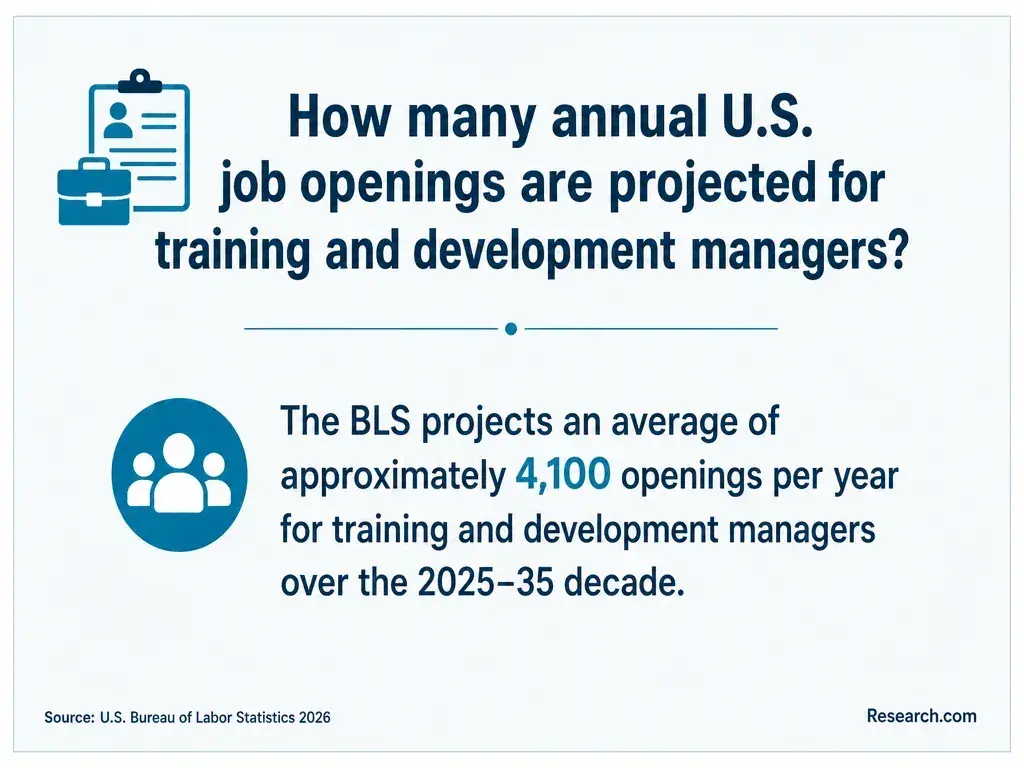
The US Bureau of Labor Statistics reports a May 2025 median annual salary of $133,000 for training and development managers, with employment projected to grow 6.4% from 2025 to 2035. This describes an occupation, not Ed.D. graduates or the pay a new manager can expect.
Use the target job, not the highest-paying adjacent role, as the basis for a financial decision. A specialist pursuing management may face a substantial experience gap, while a current manager may find the doctorate valuable for more complex work without receiving an immediate raise.
Ask employers what qualifications and demonstrated responsibilities govern advancement before treating potential earnings as a return on tuition.
How Can You Choose a Reputable Online Ed.D. Program?
Start with the organizational learning problem you want to become better equipped to address. Then compare required courses and assessments against that objective: a compelling course description is less useful if it is an elective offered infrequently or if the final project cannot examine your type of organization.
Use the following checks to move from marketing claims to a defensible shortlist:
- Request the current catalog, course sequence, syllabi where available, and final-project handbook; identify which organizational learning and evaluation courses are required.
- Ask how students receive methods guidance and project supervision, including who approves an external organization or workplace project.
- Confirm live attendance, convenings, time to completion, institutional accreditation, and the total charges under your intended pace.
- Ask for clearly defined completion or career-outcome information if published, and check whether it reflects the same degree and student population you are considering.
Compare organizational leadership doctorate cost and program value only after confirming curricular fit. The least expensive option is not necessarily good value if it lacks the methods preparation, feedback, or applied-project structure your goal requires.
Conversely, an expensive doctorate is difficult to justify when targeted training and a supervised workplace initiative would meet the same need.
Other Things You Should Know About EdD Leadership
No. Completion shows participation. Organizational learning capacity also concerns whether people apply and share knowledge, revise practices, and retain improvements. Those questions need measures suited to the work being studied.
Only under the applicable employer and university rules. Ask what permission, deidentification, data security, and research review are required before collecting or sharing employee, learner, or customer information.
Not by itself. AI may speed content production, but the stronger test is whether the material addresses a verified need and whether people can use what they learn responsibly in their work.
Access and permission may change. Ask the program in advance whether a new site, revised question, or alternative data source could be approved, and do not assume you can retain confidential information from your former employer.
- How to design, implement and evaluate organizational... - PMC https://pmc.ncbi.nlm.nih.gov/articles/PMC8432268/
- Assess Training Needs: Conducting Needs Analysis | cdc.gov https://www.cdc.gov/training-development/php/about/assess-training-needs-conducting-needs-analysis.html
- Aligning Courses | Portland State University https://www.pdx.edu/institutional-assessment-council/aligning-courses
- Asynchronous Courses Still Need Human Connection | harvard.edu https://hbsp.harvard.edu/inspiring-minds/asynchronous-online-courses-human-connection-strategies
- Practicum and Capstone: COPHP MPH | Health Systems and Population Health https://hspop.uw.edu/cophpmph/program-experience/practicum-capstone/
- Asynchronous Engagement - CNDLS @ Georgetown https://cndls.georgetown.edu/resources/asynchronous-engagement/