2027 Online Ed.D. in Leadership and Learning in Organizations: Comparing Coursework in Experiential Learning
Audited and Verified:
Our Editorial and Data Verification Process
Research.com uses government datasets, official education statistics and primary institutional information to support its career and degree guides. Our review process checks factual accuracy, occupational definitions, source dates and the requirements associated with the credentials discussed.
How This Article Was Fact-Checked
Our editorial team verifies salary estimates, employment projections, education requirements and program information against original data providers and official organizations. Salary figures are checked against the relevant occupational definitions and reporting periods. Information about licensure, accreditation and required in-person training is reviewed separately.
Fact-checked and verified on:

Co-Founder and Chief Data Scientist
Two online Ed.D. programs can list similar leadership and learning courses yet offer very different opportunities to practice those skills. One may center on case discussions; another may require sustained work with an organization and evidence of what changed. For learning and development professionals and emerging leaders, that difference can determine whether doctoral study advances an existing practice or mostly adds a credential.
This guide compares coursework through an experiential-learning lens, then explains the format, cost, and career questions to resolve before enrolling.
Key Things You Should Know
- Compare what students do in each course - not just its title: look for organizational diagnosis, supervised application, feedback, and evaluation.
- A workplace project, team assignment, and dissertation in practice are not interchangeable; confirm which deliverables are required and whether you can obtain organizational access.
- The $133,000 BLS median for training and development managers describes an occupation, not the expected earnings or return on investment from an Ed.D.
What Is an Online Ed.D. in Leadership and Learning in Organizations?
An Ed.D. in leadership and learning in organizations is a practice-oriented doctorate concerned with how people learn, how organizations change, and how leaders use evidence to improve performance. The exact degree name and curriculum vary by institution. "Online" describes where instruction occurs; it does not establish that attendance is self-paced or that applied work can be completed entirely from home.
For an established learning professional, the degree may extend existing skills in facilitation or instructional design toward organizational diagnosis, change leadership, and evaluation. Someone seeking primarily original scholarship may prefer a research-oriented PhD. Someone who needs a narrower skill - such as designing an evaluation plan - may be better served by a focused course and a supervised workplace project. For help distinguishing academic emphases, see selecting a professional focus for an Ed.D.
What Coursework Does an Ed.D. in Leadership and Learning Include?
Course titles alone reveal little about experiential depth. The comparison below shows how common subject areas can move from conceptual study to applied work; these are evaluation criteria, not a promise that every program offers each activity.
| Coursework area | Conceptual learning | Stronger experiential evidence to look for |
| Adult learning and learning design | Motivation, learning transfer, and instructional choices | Design a response to a documented learning need, test it where permitted, and revise it using feedback |
| Leadership and organizational change | Influence, culture, systems, and implementation | Diagnose a change barrier with stakeholders and develop a feasible implementation plan |
| Research and evaluation | Qualitative and quantitative reasoning, measurement, and ethics | Build a defensible evaluation plan using accessible data and explain its limitations |
| Doctoral project preparation | Problem framing and scholarly literature | Refine an approved organizational problem with faculty guidance and a workable evidence plan |
A useful sequence moves from learning theory and leadership concepts to methods, application, and a culminating project. Ask which courses are required, which electives actually run during your enrollment, and whether methods instruction arrives before students must commit to a project design. Exposure to analytics in one course is not the same as preparation to conduct an independent evaluation.
How Does Experiential Learning Shape the Ed.D. Curriculum?
Experiential learning means applying ideas in a setting, examining what happened, and revising the approach - not merely describing professional experience in a discussion post. For a learning and development manager, a meaningful assignment might begin with a documented performance concern, distinguish training needs from workflow problems, propose a response, and specify how the organization could evaluate it.
Programs can offer that cycle through simulations, peer consulting, team projects, workplace inquiry, or a culminating capstone or dissertation in practice. These activities differ in duration, supervision, and authority to act. A team case using public information may be valuable, but it does not demonstrate that a student implemented change. Likewise, an employer project does not automatically meet doctoral requirements.
Before treating a project requirement as a benefit, confirm the faculty's role, who approves the site and topic, what happens if your employer changes, and whether an external partner is permitted. Access to employee or learner information may require organizational permission, privacy safeguards, and institutional review. A feasible project can still be rigorous when its claims are appropriately limited: evidence that participants found training useful, for example, does not by itself establish improved organizational performance.
Online study can let working professionals apply coursework without relocating. Its practical value depends on live-class times, attendance rules, group meetings, faculty access, and any required campus convenings. Campus-based study may make recurring in-person collaboration easier, but commuting or relocation can constrain employment and project-site choices. Neither format is inherently more experiential.
Compare the same academic obligation across formats: how teams meet, how faculty critique project designs, where applied work occurs, and what support is available when an organizational partner withdraws. Request a sample term schedule and the convening calendar, then check whether participation fits your work responsibilities. Travel and lodging also belong in cost-conscious education doctoral degree planning; an online tuition figure alone cannot establish the less expensive option.
Verify that the degree-granting institution holds recognized institutional accreditation and that the accreditation applies to the institution offering the program. Use the institution's disclosures and the accreditor's directory to check its status; do not assume a familiar university name verifies a particular online offering or partner arrangement.
Institutional accreditation is not proof that an organizational leadership Ed.D. prepares graduates for teacher, principal, or superintendent licensure. If a regulated education role is your goal, ask the program which credential, if any, its curriculum is designed to support and confirm eligibility with the relevant state authority. For an organizational learning role, examine the actual coursework and applied-project expectations rather than treating accreditation as a measure of experiential quality.
Requirements vary by program but may include prior graduate study, transcripts, professional experience, recommendations, a statement of purpose, and evidence of readiness for doctoral work. A master's in education, a particular job title, or prior publication should not be assumed to be universal requirements. For this curriculum, a persuasive application connects an actual leadership or learning responsibility to a problem the applicant wants to investigate without claiming access to data or authority they do not have.
Applicants with previous specialist-level study should distinguish credits considered during admission from credits that can replace Ed.D. requirements. The program must make that determination after reviewing transcripts and its doctoral policies. Ed.S. credit considerations for Ed.D. study can help frame questions, but only a written evaluation from the institution can establish whether prior work changes a particular student's course plan.
Completion time depends on the required courses, enrollment pace, course availability, and the time needed to secure approvals and finish the doctoral project. A published schedule may describe an intended cohort pathway rather than a guarantee for students who pause enrollment, change jobs, or need a new project site.
For an accurate comparison, request a degree plan and a written cost estimate for your proposed entry term. Check the full obligation, not just the advertised tuition rate: required credits, fees, travel, lodging, project expenses, and any additional terms needed to finish. If an employer offers assistance, verify reimbursement limits and continued-employment conditions before subtracting it from your expected cost. Online Doctor of Education tuition planning can help organize the comparison, but published prices and aid terms must be checked with each school.
Experiential value matters to this calculation. If you mainly need one method or a portfolio project, targeted training and a supported assignment may cost less and produce usable evidence sooner than a doctorate.
Potential paths include learning and development management, organizational development, talent development, consulting, and leadership roles in colleges or other institutions. The strongest fit usually builds on responsibilities the student already holds. A training specialist who has designed learning programs may use applied doctoral work to demonstrate broader evaluation and change skills; the degree alone does not establish readiness to manage a department.
Match the program's projects to the work you want to do. A future consultant benefits from defensible diagnosis and client communication; a prospective training manager also needs experience with budgets, staff, and implementation. Professionals focused on colleges can examine Ed.D. options for organizational improvement in colleges while checking each role's specific hiring requirements. A general leadership doctorate does not substitute for a required professional license.
The U.S. Bureau of Labor Statistics reports a May 2025 median annual salary of $133,000 for training and development managers. That figure describes workers in the occupation across educational backgrounds; it is neither a starting salary nor an Ed.D. graduate outcome. It is most relevant if you already have a credible path into management, not if the degree would be your first substantial learning and development experience.
When assessing financial value, compare roles you could realistically pursue with and without the doctorate. Factor in your current pay, local employers, advancement rules, and the cost of studying. Ask programs for clearly defined graduate outcomes if available, but do not treat an occupational median as evidence that tuition will pay for itself.
What Job Outlook and Certifications Apply to Ed.D. Leadership Careers?
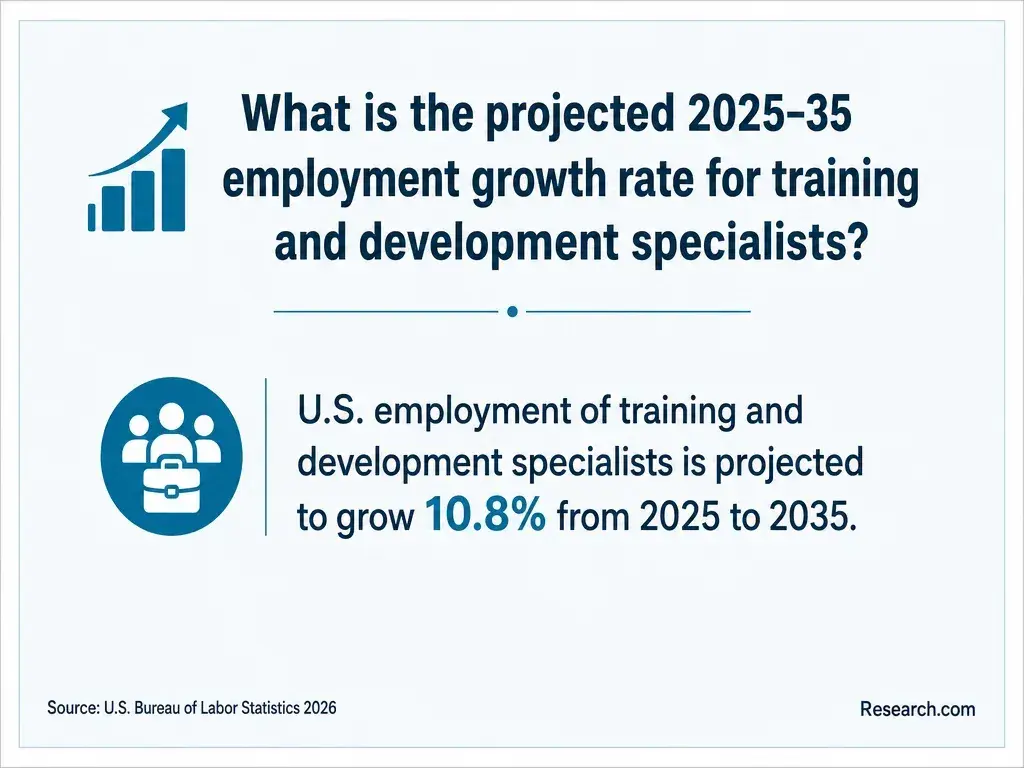
BLS projects 10.8% U.S. employment growth for training and development specialists from 2025 to 2035. That outlook concerns the occupation, not demand for doctorate holders. Moving from specialist work into leadership still depends on demonstrated responsibility for programs, people, resources, and results.
Professional certifications in learning, coaching, change, or project management may be useful when a target employer values a specific competency. They are separate from an Ed.D. and have their own eligibility and renewal rules. Review postings for the roles you want: if they consistently emphasize a technical skill you lack rather than doctoral study, focused training and a documented project may be the more direct next step.
Other Things You Should Know About EdD Leadership
Usually only to the extent your program and project partner allow. Obtain permission, remove confidential details, and explain your own contribution, methods, and limitations without presenting a proposal as a completed result.
Ask whether the course permits a simulation, approved external partner, needs assessment, or evaluation plan instead. Do not assume an unimplemented proposal will satisfy a required applied project.
Not on that basis alone. Examine whether students critically evaluate tools, protect organizational data, and measure learning or performance rather than simply generate training materials.
Not necessarily. Other changes may affect the outcome. A sound project identifies what was measured, what comparison was possible, and which conclusions the evidence cannot support.
- Distance Learning Instruction Planning Guidance | ca.gov https://www.cde.ca.gov/ls/he/hn/guidanceplanning.asp
- Partnering with Students to Develop a Capstone for a... - PMC https://pmc.ncbi.nlm.nih.gov/articles/PMC11732519/
- Using Simulation Technology to Teach Complex Problem-Solving | IES https://ies.ed.gov/learn/blog/using-simulation-technology-teach-complex-problem-solving
- EdD in Educational Leadership - The University of Alabama | UA Online https://online.ua.edu/degrees/edd-in-educational-leadership/
- What's the Difference Between Asynchronous and Synchronous Learning? | Ohio State Online https://online.osu.edu/content-hub/blogs/whats-the-difference-between-asynchronous-and-synchronous-learning/
- Online Doctor of Education in Leadership and Innovation | Purdue Global https://www.purdueglobal.edu/degree-programs/education/doctor-education-leadership-innovation/
- What Is a Capstone Project? | Florida National University (FNU) https://www.fnu.edu/what-is-a-capstone-project/
- What Is a Capstone Project? - Boston University Questrom https://www.bu.edu/questrom/blog/what-is-a-capstone-project/
- Doctorate of Education in Leadership and Adult Learning in Organizations (EdD) - William Woods University https://www.williamwoods.edu/academics-programs/leadership-and-adult-learning-in-organizations-edd-online/
- Experiential Learning | Center for Innovative Teaching and Learning | Northern Illinois University https://www.niu.edu/citl/resources/guides/instructional-guide/experiential-learning.shtml