2027 Is an Online Ed.D. in Leadership and Learning in Organizations a Good Fit for Clinical Education Leaders?
Audited and Verified:
Our Editorial and Data Verification Process
Research.com uses government datasets, official education statistics and primary institutional information to support its career and degree guides. Our review process checks factual accuracy, occupational definitions, source dates and the requirements associated with the credentials discussed.
How This Article Was Fact-Checked
Our editorial team verifies salary estimates, employment projections, education requirements and program information against original data providers and official organizations. Salary figures are checked against the relevant occupational definitions and reporting periods. Information about licensure, accreditation and required in-person training is reviewed separately.
Fact-checked and verified on:

Co-Founder and Chief Data Scientist
Clinical education leaders often need to improve learning across professions, sites, and systems - not simply teach another course. An online Ed.D. in Leadership and Learning in Organizations may help, but its value depends on the authority you already have, the work you want to lead, and the time and money you can commit.
This guide examines what the degree can add to clinical education practice, where it falls short, and which program details to verify before enrolling.
Key Things You Should Know
- Best fit: An Ed.D. is most useful for experienced clinical educators who want to lead organization-wide learning, change, or evaluation - not obtain a clinical credential.
- Career context: The U.S. median annual pay for training and development managers was $133,000 in 2025, but that occupational figure is not an expected Ed.D. graduate salary.
- Before applying: Confirm live-class and travel requirements, total cost, the doctoral project format, and whether your employer will permit the needed work and data access.
Is an online Ed.D. in Leadership and Learning in Organizations right for clinical education leaders?
It can be a strong fit when your goal is to lead learning across a healthcare organization. A clinical educator who already designs training or leads teams may use a practice-oriented Ed.D. to strengthen organizational diagnosis, adult learning, change implementation, and evaluation. Those capabilities matter when a problem spans nursing, medicine, allied health, operations, and multiple care sites.
Start with the decision you want to influence. Low participation in a training program might reflect scheduling, supervision, workflow, or incentives rather than poor instruction. An Ed.D. can help you investigate that distinction and lead a response; it cannot give you authority over budgets, staffing, or clinical policy that your role does not have.
These pathways serve different goals. The comparison is about the work each route is designed to support, not the prestige of its credential.
| Goal | Potentially better route | Key limitation to consider |
| Lead cross-functional clinical learning and improvement | Practice-oriented leadership and learning Ed.D. | Requires substantial time and organizational access; does not confer clinical authority |
| Produce original research as a primary career activity | Relevant research-focused PhD | Research preparation may be less directly focused on operational leadership |
| Advance in healthcare operations or administration | MHA, MBA, or employer leadership development | May offer less depth in adult learning and applied educational inquiry |
| Improve one course or training process | Targeted instructional-design, evaluation, or quality-improvement training | May not develop broader organizational leadership capacity |
An Ed.D. is a weaker investment if your immediate goal is a required clinical certification, a promotion governed mainly by clinical experience, or a narrow training improvement you can address through mentorship and a shorter course. Employer support and a realistic opportunity to lead change can shift the calculation in the degree's favor.
What does an Ed.D. in Leadership and Learning in Organizations prepare graduates to do?
A practice-oriented Ed.D. prepares students to use evidence to address organizational learning and leadership problems. For a clinical education leader, that could mean assessing why new practices do not transfer from training into care, coordinating interprofessional development, evaluating an education initiative, or guiding a change across departments.
The degree is not a substitute for clinical expertise. Its distinctive contribution is the ability to connect learning design with organizational conditions: who must change a practice, what support they need, which leaders control implementation, and how to assess progress without overstating the evidence. The exact preparation depends on the program's curriculum and doctoral project, not its title alone.
What careers can clinical education leaders pursue with an online Ed.D.?
Experienced clinical educators may pursue broader responsibilities in health-system education, professional development, workforce learning, simulation-program leadership, or organizational improvement. Some move into learning and development management or consulting. Hiring criteria differ: a hospital education director may need substantial clinical and supervisory experience, while a consultant must also demonstrate client-facing diagnosis and implementation work.
The most credible advancement evidence combines the degree with work you can explain: the learning problem, your decision-making authority, stakeholder involvement, implementation constraints, and appropriately measured results. A doctorate alone does not establish readiness to manage a department or lead clinical practice.
Higher-education teaching or administration is another possible direction, but positions may require discipline-specific qualifications, teaching experience, or a research record. Clinical faculty requirements are not interchangeable with requirements for organizational learning roles.
Online delivery can let a working clinical educator remain employed and avoid routine commuting. It does not necessarily mean self-paced study: live seminars, cohort meetings, team projects, campus convenings, and deadlines may still conflict with shifts or on-call responsibilities. A campus-based program may offer easier in-person access to faculty and research activities, but usually demands more geographic or schedule flexibility.
Compare the required academic work, not just the delivery label. Programs may require a dissertation, dissertation in practice, or another approved doctoral project; none should be assumed easier or available remotely without checking the actual rules. A guide to comparing Ed.D. dissertation alternatives can help you frame questions, but the program must confirm its own completion requirements.
For either format, ask how students obtain faculty guidance and what happens if shift changes, a clinical surge, or a change of employer disrupts attendance or project access.
Relevant study may include adult learning, leadership and organizational culture, change implementation, research methods, and program evaluation. Clinical educators should look beyond course titles: a useful assignment might require examining learning transfer in a real workplace, while another course may focus chiefly on theory. Verify which courses are required, which electives will actually be offered, and how the program supervises applied work.
Match the curriculum to your gap. If you already teach effectively but struggle to evaluate system-wide results, methods and implementation study may matter more than additional instructional-design coursework. If you aim to run professional development, look for opportunities to practice needs assessment, stakeholder engagement, and responsible measurement. Guides to different education doctorate specialization pathways can clarify terminology; a course on healthcare learning does not, by itself, establish a formally awarded healthcare concentration.
Requirements vary by institution. Programs may review graduate study, professional experience, transcripts, recommendations, a statement of purpose, and evidence that applicants can undertake doctoral-level inquiry. A clinical education applicant can make a stronger case by documenting actual responsibility for learning or change - not relying only on a senior job title or clinical credential.
Describe a genuine problem you have encountered, the decisions you could influence, and what you still need to learn. Do not claim access to patient or employee records, employer sponsorship, or project approval that has not been granted. If you hold an education specialist degree, guidance on online doctoral program choices after an Ed.S. may help you identify questions about eligibility. Credits considered for admission are not automatically credits applied toward the doctorate; obtain a written evaluation from each institution.
There is no reliable universal completion time or price. Required credits, enrollment pace, course sequencing, campus visits, and the doctoral project all affect duration and expense. Request the program's published tuition and fees for your intended entry term, then ask how charges change if the project takes longer than planned.
Compare the full commitment: tuition, required travel and lodging, technology or materials, time away from clinical duties, and any employer reimbursement conditions. A lower advertised tuition rate may not mean a lower total cost. Resources on cost-conscious routes to a leadership doctorate can help you build a shortlist, but use each school's current written cost estimate for your decision.
If your employer offers assistance, confirm whether doctoral study qualifies, when reimbursement is paid, whether grades or continued employment affect it, and whether work time or project access is included. Financial support is not the same as permission to conduct workplace research.
Generally, a leadership and learning Ed.D. does not grant clinical licensure or a professional certification. A nurse, physician, therapist, or other clinician must continue to meet the requirements of the relevant licensing board and certifying body. An organizational leadership doctorate also should not be assumed to qualify someone for school-administrator licensure.
If you need a specific credential for your next role, obtain its eligibility rules directly from the responsible board or certifying organization and ask the Ed.D. program whether its coursework satisfies any stated requirement. Institutional accreditation establishes a different kind of recognition; it does not establish occupation-specific eligibility.
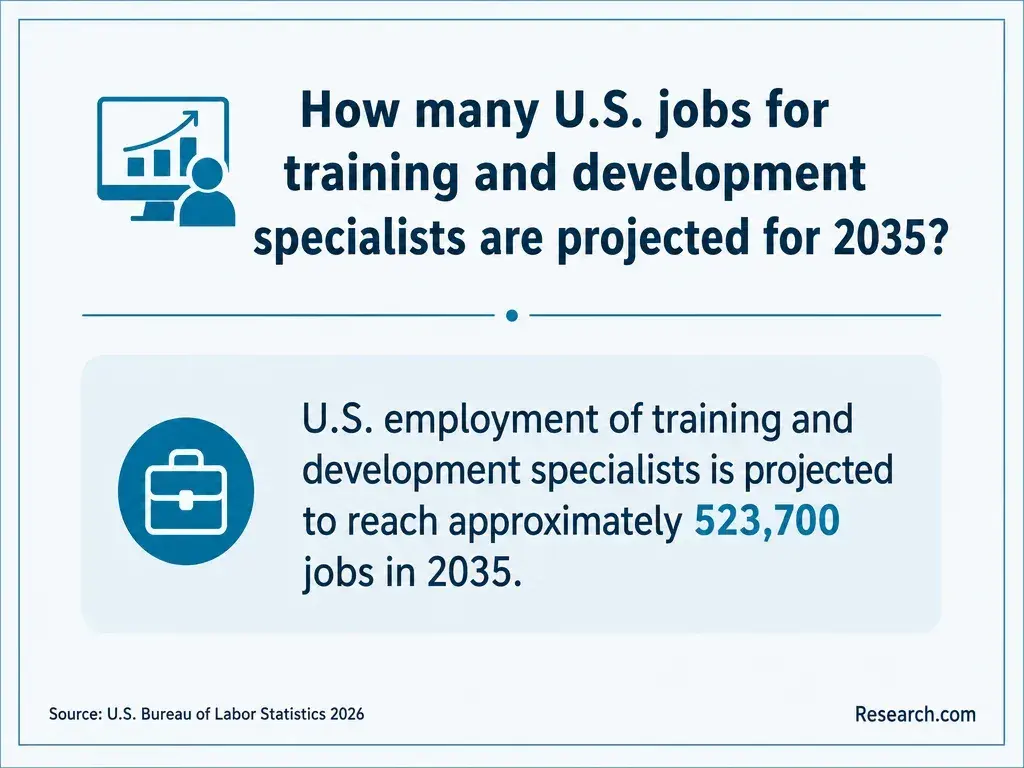
There is no single salary or employment projection for clinical education leaders with an Ed.D. Pay depends on the actual occupation, employer, location, clinical background, and scope of responsibility. As one reference point, U.S. Bureau of Labor Statistics figures put the 2025 median annual pay for training and development managers at $133,000, with employment projected to grow 6.4% from 2025 to 2035. That category spans industries and experience levels; it is not an estimate of what a hospital education leader - or a new Ed.D. graduate - will earn.
For a practical comparison, examine openings for your intended role and compare their required experience and compensation with your current position. Include the possibility that advancement depends more on managing people, budgets, and cross-functional initiatives than on adding a degree.
How can clinical education leaders choose an accredited online Ed.D. program?
First, verify the institution's accreditation with its recognized accreditor and confirm the exact degree offered. Then test the program against the clinical education work you want to do. A broad leadership curriculum can be valuable, but it may offer little direct attention to healthcare settings; an advertised online format may still require travel or fixed-time attendance.
Before committing, ask the program to provide its current curriculum, attendance and convening rules, doctoral project requirements, total-cost estimate, and available completion information. Discuss whether an approved project could involve your healthcare organization, who supervises it, and what alternatives exist if employer access changes. Employer permission, academic approval, privacy obligations, and any required research review are separate matters.
If your target is higher-education leadership rather than health-system education, compare that distinct career pathway and its funding options. Information on higher education leadership doctoral grants and aid may help identify questions to ask; confirm award eligibility and terms with each institution. Choose an Ed.D. only when its learning, project structure, and realistic career use justify its full cost and workload.
Other Things You Should Know About EdD Leadership
Possibly. The initiative must fit the program's project rules and have a manageable question, appropriate supervision, and organizational approval. Running a simulation course alone does not make it an approved doctoral project.
Do not assume so. Ask who owns the data, what use is authorized, and whether institutional review or a data-use agreement is required. Remove identifiable patient or employee information unless its use is explicitly permitted and appropriately protected.
Tell your advisor promptly. Ask whether the project can continue with permission, move to a new site, or be redesigned; the answer depends on program rules and the approvals already in place.
No. Flexible scheduling, protected time, tuition support, and permission to use workplace resources are separate arrangements. Get any commitment in writing before relying on it.
- Reforming Accreditation to Strengthen Higher Education | The White House https://www.whitehouse.gov/presidential-actions/2025/04/reforming-accreditation-to-strengthen-higher-education/
- Types of Financial Aid: Grants, Work-Study, and Loans | studentaid.gov https://studentaid.gov/understand-aid/types
- A scoping review of interprofessional education in healthcare | nih.gov https://pmc.ncbi.nlm.nih.gov/articles/PMC11924666/
- Interprofessional Education in a Simulation Setting - NCBI - NIH https://www.ncbi.nlm.nih.gov/books/NBK557471/
- Cost of Attendance (Budget) | 2025-2026 Federal Student Aid Handbook https://fsapartners.ed.gov/knowledge-center/fsa-handbook/2025-2026/vol3/ch2-cost-attendance-budget
- Doctoral dissertation or capstone: how to choose the right program | PhD/Doctorate | Capella University Blog https://www.capella.edu/blog/phd-doctorate/the-difference-between-a-dissertation-and-doctoral-capstone/
- Careers Leaders Can Pursue with an Ed.D. | Peabody Online | VU-EDU https://peabodyonline.vanderbilt.edu/edd-in-organizational-learning/edd-careers/
- EdD vs. PhD in Education: Choosing the Right Program | Goodwin College of Professional Studies https://drexel.edu/soe/resources/career-path/edd-vs-phd/