2027 Is an Online Ed.D. in Leadership and Learning in Organizations a Good Fit for Professional Learning Design Specialists?
Audited and Verified:
Our Editorial and Data Verification Process
Research.com uses government datasets, official education statistics and primary institutional information to support its career and degree guides. Our review process checks factual accuracy, occupational definitions, source dates and the requirements associated with the credentials discussed.
How This Article Was Fact-Checked
Our editorial team verifies salary estimates, employment projections, education requirements and program information against original data providers and official organizations. Salary figures are checked against the relevant occupational definitions and reporting periods. Information about licensure, accreditation and required in-person training is reviewed separately.
Fact-checked and verified on:

Co-Founder and Chief Data Scientist
Professional learning design specialists often know how to build effective instruction but have less authority over the systems that determine whether learning changes workplace performance. An online Ed.D. in leadership and learning in organizations may help bridge that gap, but it is a substantial commitment, not a standard requirement for advancement.
This article examines the degree through the lens of a working designer: the responsibilities it could support, the experience it cannot replace, and the program features and costs to check before applying.
Key Things You Should Know
- An online Ed.D. is most useful if you want to lead organizational learning strategy, evaluate initiatives, and implement change, not simply become a more proficient course designer.
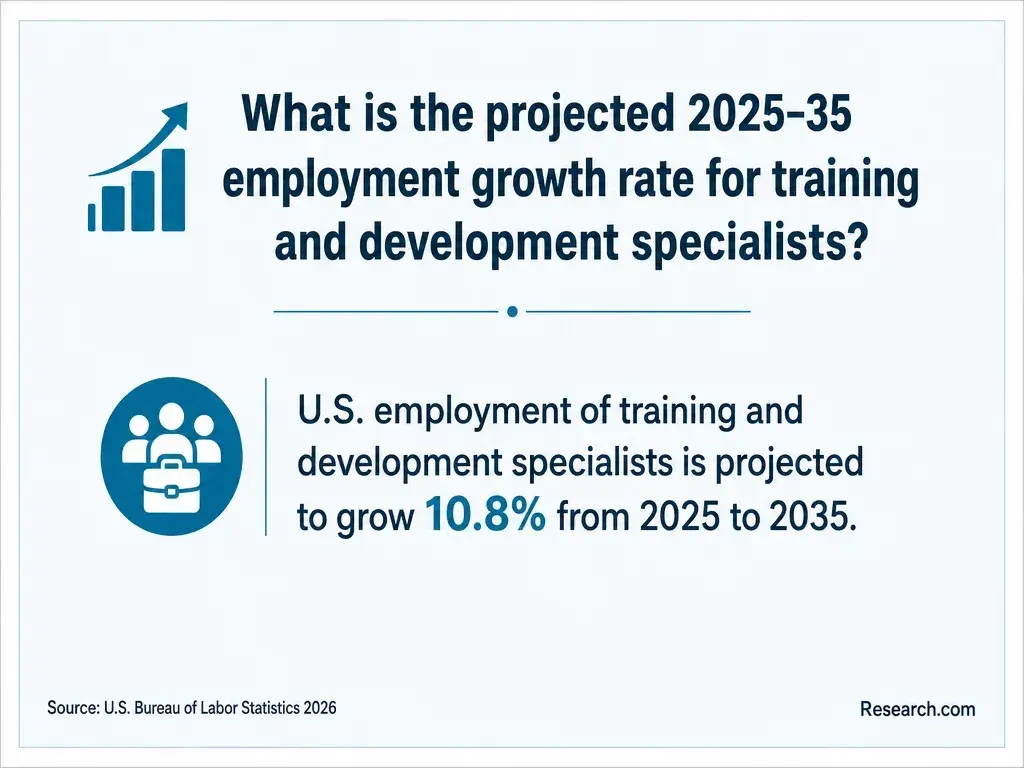
- The U.S. Bureau of Labor Statistics projects 10.8% employment growth for training and development specialists from 2025 to 2035; that outlook describes an occupation, not demand for Ed.D. graduates.
- Before enrolling, compare the full cost and schedule with a smaller leadership project, targeted graduate study, or employer-sponsored development; the doctorate alone does not confer a promotion or professional license.
Is an Online Ed.D. in Leadership and Learning in Organizations a Good Fit for Professional Learning Design Specialists?
It can be a good fit if your next role requires you to shape learning across an organization, not just design individual programs. A specialist who already conducts needs assessments, works with leaders, and tests whether learning transfers to the job has a practical foundation for doctoral study.
The degree is less compelling if the immediate goal is to master a new authoring tool, build a stronger design portfolio, or qualify for a first supervisory assignment.
Use the responsibility you want next, not the appeal of a doctoral title, to compare routes. The distinctions below show when the extra scope of an Ed.D. is likely to matter:
| Primary goal | Likely better starting point | Why |
| Improve course design or learning technology skills | Focused training, a certificate, or a design portfolio project | These address technical gaps more directly than a broad leadership doctorate. |
| Lead learning strategy and evaluate organization-wide change | Applied Ed.D. plus substantial workplace leadership practice | Doctoral inquiry can complement responsibility for decisions, stakeholders, and implementation. |
| Build a research career centered on generating new theory | Research-oriented PhD | A PhD may offer a stronger match for sustained scholarly research and publication. |
If you already direct cross-functional initiatives, an Ed.D. may help you investigate why training succeeds in one setting but fails in another. If you have not yet led such work, seek ownership of a needs assessment, evaluation, or change initiative first.
That experience will clarify both your degree choice and your eventual application. Comparing programs by choosing the right Doctor of Education study emphasis can help you avoid mistaking a broad leadership curriculum for advanced instructional design training.
What Is an Online Ed.D. in Leadership and Learning in Organizations?
An Ed.D., or Doctor of Education, is a doctoral degree commonly oriented toward using research and leadership practice to address problems in organizations. A leadership and learning program may examine adult learning, organizational culture, change, and evidence-based improvement across workplaces, not only schools.
"Online" describes where much instruction occurs; it does not establish that classes are self-paced or that campus visits are unnecessary.
Program names do not guarantee identical curricula. One university may require an individual dissertation in practice, another a different applied project.
A concentration is formal only if the institution awards or records it as such. Check the degree designation, required courses, and final project rather than inferring them from a program's marketing language.
What Careers Can This Ed.D. Prepare Professional Learning Design Specialists For?
The most direct progression is from designing professional learning to taking responsibility for its strategy, delivery, measurement, and improvement.
Possible roles include learning and development manager, leadership development lead, organizational development practitioner, and consultant. In each case, employers may value the doctorate, but they will also look for evidence that you have managed stakeholders, resources, and implementation.
The roles below differ in what they ask you to deliver. Identify which work you want before judging whether a program's projects are relevant:
| Potential role | Work beyond instructional design | Experience to demonstrate |
| Training and development manager | Sets priorities, oversees staff or vendors, and accounts for learning investments | Budgeting, people leadership, and program decisions |
| Leadership development lead | Builds development systems with executives and talent teams | Stakeholder influence and evaluation of development initiatives |
| Organizational development consultant | Diagnoses performance or change problems and advises clients | Organizational diagnosis, facilitation, and implementation |
The U.S. Bureau of Labor Statistics reports a May 2025 median annual salary of $133,000 for training and development managers. That is an occupational median across workers with varied education and experience, not an expected salary for Ed.D. graduates.
A designer pursuing university learning leadership should also check institution-specific hiring expectations; organizational leadership Ed.D. programs for university professionals may serve a different career target than corporate learning programs.
The valuable shift is from asking "Does this learning experience work?" to asking "What organizational problem are we addressing, and what evidence would show improvement?"
Relevant doctoral work may deepen adult-learning theory, systems thinking, organizational diagnosis, change leadership, and program evaluation. It can also strengthen your ability to explain findings to executives without overstating what the evidence proves.
For example, low completion rates in a manager-development program do not automatically mean the course needs redesign. Scheduling, incentives, supervisor support, or an unclear business objective may be involved.
A strong Ed.D. experience helps you test plausible explanations and collaborate on a feasible response. Coursework alone, however, cannot establish that you can manage a team or secure organizational buy-in; look for opportunities to practice those responsibilities at work.
Course titles and requirements vary, but a relevant curriculum may combine leadership and organizational learning with qualitative or quantitative inquiry, research ethics, and evaluation. Some programs also address instructional design, learning technologies, talent development, or change management.
For an experienced designer, the most important question is often whether the curriculum extends your capabilities rather than repeating material you already use professionally.
Review course descriptions and the sequence of research preparation. Ask whether you can investigate a real organizational learning problem, what faculty supervision is available, and whether the required final deliverable suits your goal.
Do not assume that an elective will be offered when you need it, or that exposure to analytics constitutes advanced technical training.
Requirements are institution-specific. Programs may ask for a completed graduate degree, transcripts, professional experience, recommendations, a statement of purpose, and evidence of readiness for applied inquiry.
Some may use interviews or specify academic thresholds. A master's in education, a particular job title, and a publication record are not universal prerequisites.
As a learning design specialist, describe decisions you actually influenced: the problem you identified, stakeholders you worked with, evidence you considered, and limits of your authority. If a program expects a workplace-based project, ask how it handles applicants without access to an appropriate site.
Also distinguish graduate coursework that helps establish admission eligibility from credits formally approved to reduce doctoral requirements; only the institution can make that evaluation.
Completion time depends on required credits, enrollment pace, course availability, and the final project. Request the published degree plan and ask how long students on your intended schedule actually take to finish. A fast coursework sequence may still leave substantial time for project approval, data collection, analysis, and revision.
For a usable budget, obtain the institution's current tuition basis and required-credit total, then add mandatory fees, technology expenses, any convening travel, and the cost of extending enrollment. Check employer reimbursement limits and conditions in writing.
Avoid estimating a return from a presumed promotion; compare the expense with the concrete responsibilities you could pursue now. Guides to affordable practice-focused education doctoral study can provide comparison candidates, but confirm each school's current charges directly.
An online program can remove a regular commute and widen your choice of institutions, which matters if you plan to remain employed. It may still require live meetings, group work, or campus convenings.
A campus-based program may make in-person faculty and peer interaction easier, but travel and fixed meeting times can be harder to reconcile with a full-time design role.
Compare the actual weekly timetable, attendance rules, faculty access, project supervision, and required travel, not just the delivery label.
If speed matters, descriptions of fast-track online education doctorate programs are a starting point, not proof that the workload or final project will fit your schedule. Ask what happens if your employer, work hours, or project site changes during enrollment.
Professional learning design and most organizational learning leadership roles do not have a single, universal state license. An Ed.D. also does not automatically award an industry certification. Employers can set their own preferences for experience, education, or credentials.
If your intended move is into a regulated education role, the answer changes: a general leadership and learning doctorate should not be assumed to qualify you for teacher or school-administrator licensure.
Ask the program whether its exact degree is approved for your target credential, then confirm eligibility with the relevant state authority before enrolling for that purpose.
How Can You Choose an Accredited Online Ed.D. Program?
Start by confirming the institution's accreditation through the accreditor and the U.S. Department of Education's recognized-accreditor information. Then assess the specific degree. Institution-level accreditation establishes neither a learning design specialization nor eligibility for a regulated position.
A useful comparison should test whether the program will help you do work you cannot yet do. Before applying, ask admissions staff and faculty for the following details and request written confirmation of consequential policies:
- The required courses, available electives, and exact final-project format.
- Live-session, group-work, attendance, and campus-convening requirements.
- Faculty guidance and rules for using workplace data or an external project site.
- Total required credits, current charges, continuation costs, and available employer-benefit arrangements.
Compare those answers against your target role and a realistic work schedule. If cost is decisive, choosing an education doctorate with a manageable tuition budget is more useful than choosing the lowest advertised per-credit price without calculating the full degree cost.
The best fit is the program whose verified requirements support your next responsibility at a cost and pace you can sustain.
Other Things You Should Know About EdD Leadership
Possibly, but check your employer's confidentiality and intellectual-property rules and your program's publication requirements. Obtain permission before sharing internal materials, and use an approved, redacted account when appropriate.
Tell your advisor promptly. Access to a former employer's people or data may end, and a replacement project site may need new academic and organizational approvals.
They may assist with permitted tasks, but follow program and employer policies. Do not enter confidential employee or learner information into an unapproved tool, and verify any AI-generated analysis or citations.
Not necessarily. Cross-functional project leadership can demonstrate relevant responsibility. Check how each program defines qualifying experience and be precise about what you led versus what you supported.
- Accreditation in the U.S. | ed.gov http://www.ed.gov/laws-and-policy/higher-education-laws-and-policy/college-accreditation/accreditation-in-the-us
- Cost of Attendance (Budget) | 2025-2026 Federal Student Aid Handbook https://fsapartners.ed.gov/knowledge-center/fsa-handbook/2025-2026/vol3/ch2-cost-attendance-budget
- How Instructional Design Is Operationalized in Various... - PMC https://pmc.ncbi.nlm.nih.gov/articles/PMC8320718/
- EdD vs. PhD in Education: What's the Difference? | Northeastern University Graduate Programs https://graduate.northeastern.edu/knowledge-hub/edd-vs-phd-in-education/
- Synchronous vs. Asynchronous Classes | Hopkins EP https://ep.jhu.edu/news/asynchronous-vs-synchronous-classes/
- Doctoral dissertation or capstone: how to choose the right program | PhD/Doctorate | Capella University Blog https://www.capella.edu/blog/phd-doctorate/the-difference-between-a-dissertation-and-doctoral-capstone/
- EdD vs PhD: What's the Difference in Education Fields | usa.edu https://www.usa.edu/blog/phd-vs-edd/
- Walden University's Guide to Doctoral Capstone Projects https://www.waldenu.edu/online-doctoral-programs/resource/guide-to-doctoral-capstone-projects
- Careers Leaders Can Pursue with an Ed.D. | Peabody Online | VU-EDU https://peabodyonline.vanderbilt.edu/edd-in-organizational-learning/edd-careers/
- What Topics Do EdD Students Research in the EdD Program? | Fairfield University https://www.fairfield.edu/news/insights/education-human-development/what-topics-do-edd-students-research.html