2027 Is an Online Ed.D. in Leadership and Learning in Organizations a Good Fit for College Academic Advisors Moving into Leadership?
Audited and Verified:
Our Editorial and Data Verification Process
Research.com uses government datasets, official education statistics and primary institutional information to support its career and degree guides. Our review process checks factual accuracy, occupational definitions, source dates and the requirements associated with the credentials discussed.
How This Article Was Fact-Checked
Our editorial team verifies salary estimates, employment projections, education requirements and program information against original data providers and official organizations. Salary figures are checked against the relevant occupational definitions and reporting periods. Information about licensure, accreditation and required in-person training is reviewed separately.
Fact-checked and verified on:

Co-Founder and Chief Data Scientist
Academic advisors often understand student barriers better than anyone, but moving from advising students to leading an advising operation requires different skills. An online Ed.D. in leadership and learning may help you evaluate student-support initiatives, lead organizational change, and make evidence-informed decisions.
It is also a substantial commitment that many advising leadership jobs do not require. This guide is for college advisors weighing that trade-off. It explains what the degree can add, where experience matters more, and what to verify before enrolling.
Key Things You Should Know
- An online Ed.D. can fit advisors seeking responsibility for advising strategy, staff development, and student-success initiatives, not simply a higher credential for their current advising work.
- Advising leadership roles do not universally require a doctorate. Supervisory experience, institutional knowledge, and evidence of improving services may be more immediately valuable.
- The U.S. Bureau of Labor Statistics reports a $104,590 median annual salary for postsecondary education administrators in May 2025. That occupational median is not an expected salary for Ed.D. graduates or advising directors.
Is an Online Ed.D. in Leadership and Learning a Good Fit for Academic Advisors?
It can be a good fit if you already want to lead beyond an individual advising caseload. A practice-oriented Ed.D. combines leadership, learning, and applied inquiry: using evidence to understand a problem and improve how an organization works.
For an advisor, the relevant problem might involve inconsistent advising practices across departments or difficulty implementing a new student-support process. The degree is less compelling if your main goal is to become a senior advisor without managing people, programs, or change.
Look first at the work you do now. Training new advisors, coordinating faculty partnerships, managing an advising initiative, or interpreting service data gives you a foundation on which doctoral study can build.
If you have not yet held those responsibilities, seek a project lead or supervisory assignment before assuming a doctorate will make you competitive for a director role. Advisors considering online Ed.D. study connecting organizations and higher education should check whether the actual curriculum addresses university governance and student services, rather than organizational leadership only in general terms.
The strongest reason to enroll is a specific leadership problem you want to learn to address. If your employer needs a better advising workflow now, a mentored improvement project or targeted management training may produce useful experience sooner and at lower cost.
What Can Academic Advisors Do With an Ed.D. in Leadership and Learning?
The degree may support advancement into advising management, student-success administration, or professional learning for campus staff. These are experience-dependent paths: an Ed.D. does not substitute for hiring, budgeting, supervision, or campus collaboration. The table separates plausible roles from the work an applicant would still need to demonstrate.
| Possible role | Typical responsibility | Experience that strengthens candidacy |
| Advising director | Set advising standards, supervise staff, and coordinate services across units | Staff supervision, service redesign, and resource planning |
| Student-success administrator | Coordinate retention or completion initiatives across campus | Cross-functional leadership and careful interpretation of student-outcome data |
| Advisor development leader | Design onboarding and continuing learning for advisors | Facilitation, learning design, and evaluation of staff development |
Moving from advising into these roles is often an internal progression. Document what you led, who made decisions, and how you assessed the work; do not present a change in student outcomes as your personal impact without adequate evidence. A doctoral project can help demonstrate analytical judgment, but promotion still depends on the position's requirements and your record of responsibility.
What Does an Online Ed.D. in Leadership and Learning Teach?
A well-matched program should help an advisor connect organizational leadership, how people, resources, and decisions are coordinated, with adult learning, how staff develop and apply new practices. Applied research or evaluation can then help you judge whether an advising change is working, for whom, and under what conditions.
That combination matters because an advising problem is not always a training problem. If advisors receive conflicting policies from different offices, a workshop alone may not fix the underlying coordination failure. Look for opportunities to study implementation, stakeholder engagement, and responsible use of student data.
When comparing Doctor of Education program types, distinguish a broad leadership curriculum from a higher-education concentration with substantial student-affairs content.
Programs vary in their culminating work. A capstone, dissertation in practice, and research dissertation can differ in scope and approval requirements. If you hope to investigate your own advising office, confirm the program's rules and your institution's permissions before treating workplace records or student information as available research data.
Online delivery can let an employed advisor remain on campus during the workday, but it does not necessarily mean self-paced study. Live evening classes, cohort meetings, group assignments, and required campus convenings can compete with registration peaks, orientation, and other advising-cycle demands. Campus-based study may offer easier in-person interaction but could require commuting or a less compatible work schedule.
Compare the actual calendar, not the format label. Ask each program when live meetings occur, how attendance works during peak advising periods, whether travel is required, and how much flexibility exists during the final project. These questions matter even when evaluating fast-track education doctoral programs: a shorter advertised schedule may leave less room for a demanding advising term or a delayed workplace approval.
Course titles vary, but relevant study often includes leadership theory, organizational change, adult learning, qualitative and quantitative methods, and program evaluation. For an advisor targeting a director role, the value lies in applying those subjects to decisions: developing staff, coordinating departments, assessing an initiative, and explaining findings without overstating them.
Inspect the required sequence rather than relying on an appealing elective list. A higher-education policy or student-success course may be optional, infrequently offered, or absent. Also check whether budgeting, supervision, and institutional governance receive enough attention for your goal. Coursework introduces frameworks; it does not by itself establish competence in managing an advising unit.
Requirements are set by each university. Programs may ask for a completed master's degree, transcripts, recommendations, a statement of purpose, and evidence of relevant professional experience; test, grade, interview, and experience rules vary. An academic advisor should describe actual responsibility, such as leading training or coordinating a service change, rather than relying on a job title alone.
Before applying, ask admissions whether your graduate degree meets its eligibility rules and whether your proposed career goals fit the program. Graduate credits used to establish admission eligibility are not necessarily credits that transfer into the doctorate.
If you want to study a workplace advising problem, ask separately whether the program expects access to an approved project site; admission does not grant permission to use institutional data.
Time and total cost depend on required credits, course pacing, tuition structure, fees, and the length of the culminating project. An advisor should request a program-specific completion plan and a written estimate covering required coursework through graduation. Published tuition per credit alone may omit fees, travel for convenings, additional terms, and research-related expenses.
Compare the estimated total with your likely career benefit, not a presumed doctoral salary premium. If you are reviewing low-cost Doctor of Education programs online, verify the price for your enrollment status and whether the schedule permits you to keep working. Ask your employer about tuition assistance, annual limits, required grades, and repayment obligations if you leave; support should not be counted until its terms are confirmed.
No universal Ed.D. requirement applies to advising leadership. Individual colleges set their own qualifications, and a director posting may emphasize a master's degree, advising experience, supervision, or knowledge of student services. Read postings for the positions you wan, especially at your institution, before deciding that a doctorate is the missing qualification.
If your gap is managing staff or budgets, seek a deputy role, a supervised campus project, or employer leadership development. If your goal is specialized higher-education administration, a relevant master's or graduate certificate may be more direct.
An Ed.D. becomes more persuasive when the roles you seek call for institution-wide change, advanced evaluation, or sustained leadership of complex initiatives, and when you can use the degree's applied work in that setting.
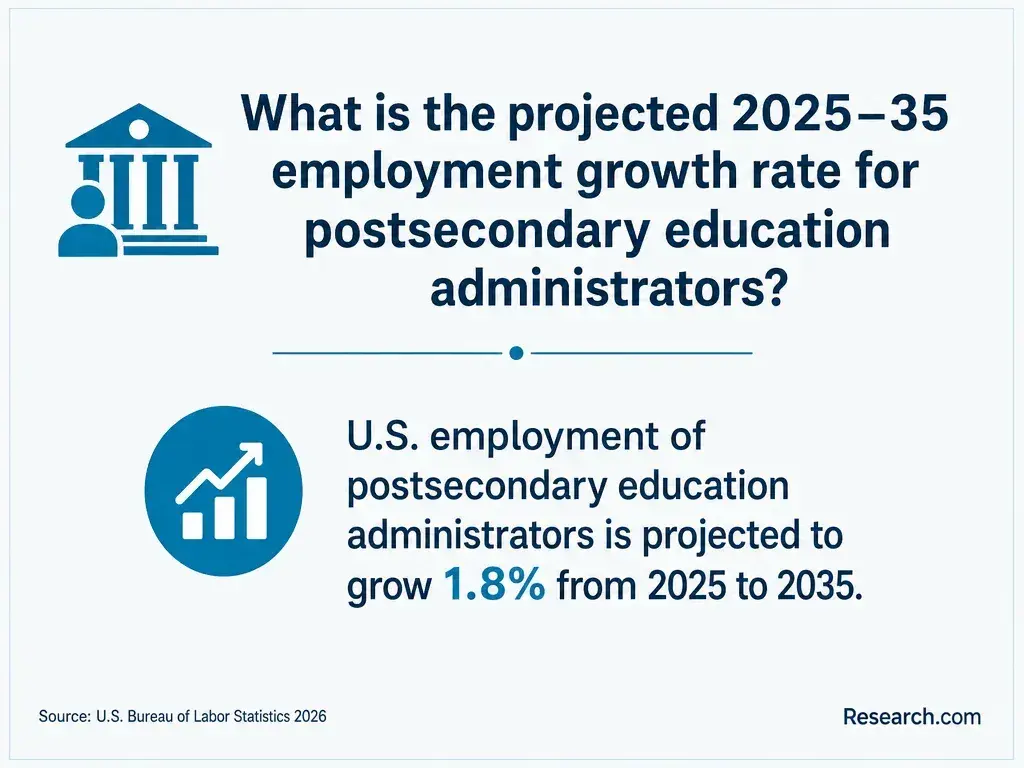
The U.S. Bureau of Labor Statistics reports a $104,590 median annual salary for postsecondary education administrators in May 2025 and projects 1.8% employment growth for that occupation from 2025 to 2035. The category covers a range of administrative jobs, not just advising leadership; neither figure measures Ed.D. graduates' pay or the degree's effect on earnings.
For a useful financial comparison, examine salary ranges in actual advising-manager and director postings, along with your institution's pay structure. Public institutions may have defined bands that limit an immediate increase even when a doctorate strengthens your candidacy. Weigh any plausible change in responsibility and compensation against the full cost and time of study.
How Can You Choose an Accredited Online Ed.D. Program?
Start by confirming the university's institutional accreditation through the accreditor or U.S. Department of Education, then verify the exact Ed.D. awarded. Accreditation establishes an institutional quality-assurance baseline; it does not mean a program specializes in advising leadership or meets a particular employer's hiring criteria.
Next, compare required higher-education content, faculty expertise, attendance rules, the culminating project, and support for working professionals. Ask where graduates have applied their learning, but assess any reported outcomes by how they were collected and whom they include.
If employer support is important, use information on employer-sponsored higher education leadership doctoral education as a starting point, then obtain your own employer's written policy.
Before committing, compare a few target job postings with each program's required curriculum and your existing experience. Choose the Ed.D. only if it addresses a real skills gap, fits your work schedule and finances, and offers an applied project you can complete with the necessary academic and workplace approvals.
Other Things You Should Know About EdD Leadership Programs
Not without appropriate authorization. Ask your university and Ed.D. program about FERPA, data access, confidentiality, and any required research review before collecting or analyzing records.
A move could affect access to a project site or data. Ask the program how project changes are approved and what alternatives exist before relying on continued access to your current workplace.
It may meet a credential requirement for some courses, but departments decide hiring qualifications based on subject expertise, teaching experience, and the specific position. It does not guarantee a faculty appointment.
No. A doctorate and any employer-recognized certification serve different purposes. Check the qualifications in your target job postings before pursuing either credential.
- How Do Online Classes Work? - NMSU Global Campus https://global.nmsu.edu/blog/general/how-do-online-classes-work/
- Frequently Asked Questions for Applicants | The Harry S. Truman Scholarship Foundation https://www.truman.gov/apply/advice-guidance/frequently-asked-questions-applicants
- Types of Financial Aid: Grants, Work-Study, and Loans | studentaid.gov https://studentaid.gov/understand-aid/types
- Qualified Ed expenses | Internal Revenue Service https://www.irs.gov/credits-deductions/individuals/qualified-ed-expenses
- Rule 3341-3-06 - Ohio Administrative Code https://codes.ohio.gov/ohio-administrative-code/rule-3341-3-06
- Cost of Attendance (Budget) | 2025-2026 Federal Student Aid Handbook https://fsapartners.ed.gov/knowledge-center/fsa-handbook/2025-2026/vol3/ch2-cost-attendance-budget
- A View toward the Position of Director of Academic Advising | psu.edu https://journals.psu.edu/mentor/article/view/61536/61188
- What Is an EdD in Educational Leadership and Who Is It For? | Neumann https://learn.neumann.edu/neuperspectives/what-is-an-educational-leadership-degree
- How Can Employer Tuition Assistance Help Pay for Graduate School? - The University of Olivet https://www.uolivet.edu/how-can-employer-tuition-assistance-help-pay-for-graduate-school/