2027 Online Ed.D. in Leadership and Learning in Organizations Admissions: Planning an English-Language Waiver Request
Audited and Verified:
Our Editorial and Data Verification Process
Research.com uses government datasets, official education statistics and primary institutional information to support its career and degree guides. Our review process checks factual accuracy, occupational definitions, source dates and the requirements associated with the credentials discussed.
How This Article Was Fact-Checked
Our editorial team verifies salary estimates, employment projections, education requirements and program information against original data providers and official organizations. Salary figures are checked against the relevant occupational definitions and reporting periods. Information about licensure, accreditation and required in-person training is reviewed separately.
Fact-checked and verified on:

Co-Founder and Chief Data Scientist
An English-language proficiency waiver can remove a testing requirement from an online Ed.D. application, but it is not automatic, even if you have worked or studied in English for years. For international applicants, the crucial decision is whether the program's written policy covers your circumstances and whether you can document them before the admissions deadline.
This guide explains how to check eligibility, request a decision, assemble persuasive evidence, and keep a testing backup plan. It also puts the waiver in context so you can judge whether the degree itself fits your professional goals.
Key Things You Should Know
- A waiver excuses a specified English-proficiency test only if the university approves it; an English-medium degree or English-speaking job does not automatically qualify.
- Ask which office decides, what evidence it accepts, and whether approval must arrive before the application deadline; retain time to test if the request is denied.
- Keep waiver approval separate from admission, overseas enrollment eligibility, and US immigration rules, each is a different decision.
What Is an Online Ed.D. in Leadership and Learning in Organizations?
An Ed.D. in leadership and learning in organizations is a practice-oriented doctorate concerned with how people learn, how organizations change, and how leaders use evidence to improve practice. Depending on the program, students may study adult learning, organizational development, evaluation, and applied research. "Online" describes delivery, not a promise of self-paced study or freedom from campus visits.
The exact degree title and curriculum matter. A program focused on organizational learning across sectors may differ substantially from one preparing school administrators. If your goal is a particular specialization, use guidance on comparing academic focuses within Ed.D. programs, then confirm what the institution formally awards. Neither the degree title nor an English-language waiver establishes eligibility for educator licensure.
What Are the Admission Requirements for an Online Ed.D. in Leadership and Learning?
Requirements vary by university and entry term. An applicant may need a recognized prior degree, transcripts, recommendations, a statement of purpose, and evidence of relevant professional experience. International transcripts may require a university-approved credential evaluation. A school may assess academic readiness separately from its English-language proficiency requirement.
Read the program and graduate-school admissions rules together. Identify whether a master's degree is required, how the school defines qualifying experience, and whether it accepts waiver requests from applicants whose earlier degree was taught in English. Credits considered for admission should not be assumed to transfer into the doctorate. A waiver, even when granted, changes only the requirement named in the decision; it does not promise admission.
How Can You Request an English-Language Proficiency Waiver?
Start with the university's policy for your proposed entry term. Waiver criteria may depend on the language of instruction for a completed degree, the institution or country where it was earned, or another expressly permitted basis. Do not substitute your own interpretation of "English-speaking" for the school's wording.
Use this sequence to obtain a decision without losing your chance to meet the standard testing requirement:
- Locate the applicable policy and note the application, waiver, and test-score deadlines.
- Ask the designated admissions office whether your specific education and employment history fits a published criterion and whether a separate form is required.
- Submit the request through the required channel with evidence that matches that criterion; request confirmation that the file is complete.
- Keep the written decision and, if timing permits, reserve an acceptable test date as a backup until approval is confirmed.
Ask whether the university permits an application to be reviewed while a waiver decision is pending. Only the responsible office can confirm that procedure or approve an exception.
The strongest documents establish the precise fact the policy asks you to prove. For example, a transcript can establish degree completion but may say nothing about the language used to teach it. Use the school's document rules, including any requirements for official records or translations.
The table distinguishes commonly useful evidence from what it cannot establish on its own; it is not a substitute for the university's accepted-document list.
| Document | What it may establish | Important limitation |
| Official transcript or degree certificate | Institution, credential, and completion | May not identify the language of instruction |
| Registrar's or authorized university letter | Language of instruction for the completed program | Must address the school's stated criterion, not merely describe some courses |
| Employer letter | English-language responsibilities at work | May be irrelevant if the policy recognizes only academic study |
| Credential evaluation, if required | How an international credential compares with US study | Does not itself grant a language waiver |
Keep your request brief and factual. A suitable opening is: "I request review for an English-language proficiency waiver under the policy for applicants with qualifying English-medium study. I completed [degree] at [institution], and the attached authorized letter confirms the language of instruction. Please let me know whether further documentation is required." Use this wording only if it accurately matches the policy and your records.
For an applicant living outside the United States, online delivery may eliminate a regular commute, but it can introduce live-class time-zone conflicts. Either format may require group work, scheduled meetings, or in-person convenings. Compare the published attendance requirements, not the delivery label, before applying.
A language waiver does not determine where you may enroll. Ask the university whether it can enroll a student located in your country and whether any required visit is feasible. Admission to an online program is also distinct from permission to enter, remain in, or work in the United States; do not assume the program provides visa sponsorship or employment authorization.
Coursework commonly addresses leadership, adult learning, organizational change, and research or evaluation methods, but required courses and depth differ. For waiver planning, look beyond whether classes are delivered in English: doctoral work may demand discussion of complex organizational problems, collaborative writing, and a substantial applied project.
Compare the published curriculum with your preparation. An applicant experienced in leading training may still need support in research methods; an experienced analyst may need more exposure to learning theory. Ask how the program develops academic writing and provides feedback. A test waiver does not waive course-level communication expectations.
Completion time depends on the required course sequence, enrollment pace, and the program's final project or dissertation rules. A delayed waiver decision can affect whether an application is complete for the intended cohort, so work backward from the admissions deadline rather than from the first class.
If a shorter timeline is essential, resources for evaluating fast-track education doctoral programs can help frame the comparison. Confirm the actual schedule, project requirements, and any leave policy with each school. Neither prior graduate study nor a language waiver should be assumed to shorten the degree.
Request a written estimate based on the required credits or terms, mandatory fees, expected enrollment pace, and any campus travel. For an overseas applicant, also check payment methods and whether a quoted aid option is available to students outside the United States. Employer reimbursement, if offered, may depend on continued employment or satisfactory progress.
Compare the total expected commitment, not a headline tuition figure. Lists of tuition-focused education doctorate program choices can be a starting point, but obtain each institution's current charges and aid terms before making a financial decision. If your objective is a specific leadership skill rather than a doctorate, targeted professional development may cost less.
The degree can support work in learning and development, organizational improvement, consulting, or education administration when paired with relevant experience.
It does not by itself confer a managerial appointment, a US work permit, or occupation-specific licensure. If your aim is university administration, consider how college leadership development through organizational leadership doctoral study matches the actual positions you seek.
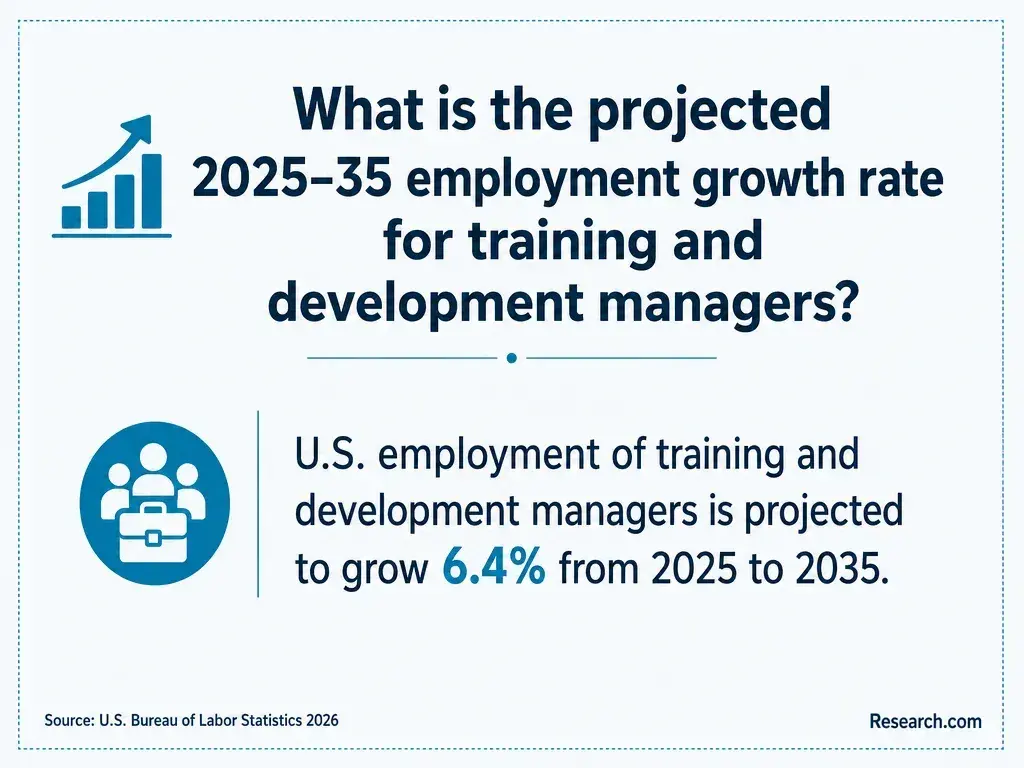
As US labor-market context, the Bureau of Labor Statistics reports a May 2025 median annual salary of $133,000 for training and development managers. That occupational median describes employed workers across backgrounds, not the expected pay of Ed.D. graduates. Your existing leadership record, location, sector, and authorization to work will matter more to an individual hiring decision than a waiver or degree title alone.
How Should You Choose an Accredited Online Ed.D. Program?
Confirm the institution's recognized accreditation, the exact degree awarded, its online attendance and travel rules, and its final-project requirements. Then compare the graduate school's English-proficiency policy with the program's application instructions. If they appear inconsistent, ask which office has final authority and obtain its answer in writing.
For applicants weighing aid alongside these requirements, guidance on financial support for online higher education leadership doctorates can help identify questions to raise with financial aid staff. Verify your own eligibility directly. The best choice is a program you can attend from your location, finance responsibly, and use for a defined professional goal, even if another school offers an easier waiver.
Other Things You Should Know About EdD Leadership Programs
Possibly. Ask whether an approved test score can still arrive by the applicable deadline and whether the school permits review of an incomplete file. Do not assume either option is available.
No. Each institution applies its own admissions policy. Submit a separate request wherever a waiver is needed.
Not necessarily. Schools may base eligibility on specified education or other criteria rather than citizenship alone. Check the exact policy, including how it treats applicants with multiple citizenships.
Follow the university's application-integrity rules. Tools may help you proofread if permitted, but the facts must be yours, and any required statement must meet the school's authorship expectations.
- English and Civics Testing https://www.uscis.gov/policy-manual/volume-12-part-e-chapter-2
- Waiver Requests Guidebook | ca.gov https://docs.ctc.ca.gov/Document/Download/30264
- English Language Proficiency | Texas Education Agency https://tea.texas.gov/educators/certification/out-state-certification/english-language-proficiency
- Eligibility Designations for Higher Education Programs | ed.gov http://www.ed.gov/grants-and-programs/grants-higher-education/eligibility-designations-higher-education-programs
- do I need to submit additional proof of English proficiency? | Graduate Education https://grad.gatech.edu/faq/knowledgebase.php
- English Language Proficiency test exemptions | mit.edu https://oge.mit.edu/graduate-admissions/admissions-policies/elp-test-requirement/elp-exemptions/
- English language proficiency - UC Admissions https://admission.universityofcalifornia.edu/admission-requirements/international-applicants/english-language-proficiency-toefl-ielts.html
- Admission Requirements | Ed.D. Educational Leadership https://edd.sfsu.edu/content/admission-requirements