2027 Online Ed.D. in Leadership and Learning in Organizations: Comparing Coursework in Assessment Design
Audited and Verified:
Our Editorial and Data Verification Process
Research.com uses government datasets, official education statistics and primary institutional information to support its career and degree guides. Our review process checks factual accuracy, occupational definitions, source dates and the requirements associated with the credentials discussed.
How This Article Was Fact-Checked
Our editorial team verifies salary estimates, employment projections, education requirements and program information against original data providers and official organizations. Salary figures are checked against the relevant occupational definitions and reporting periods. Information about licensure, accreditation and required in-person training is reviewed separately.
Fact-checked and verified on:

Co-Founder and Chief Data Scientist
Two online Ed.D. programs can both promise expertise in organizational learning while teaching very different approaches to assessment. One may emphasize designing tests and feedback for learners; another may focus on evaluating whether a leadership program changes workplace practice. For learning and development professionals and emerging organizational leaders, that difference affects which skills they can use on the job.
This guide explains how to compare coursework, assignments, research preparation, and program requirements so you can choose a degree - or a shorter course - that fits the assessments you need to design.
Key Things You Should Know
- Compare what students design and test, not just whether a catalog lists "assessment": learner feedback, program evaluation, and workforce analytics are different capabilities.
- Look for assignments that connect a defined learning goal to appropriate measures, examine validity and fairness, and explain what the results can - and cannot - show.
- An Ed.D. makes the strongest case when you need to lead and evaluate organizational learning initiatives; a focused assessment or evaluation course may be enough for a narrower skill gap.
What is an online Ed.D. in Leadership and Learning in Organizations?
An online Ed.D. in leadership and learning in organizations is a practice-oriented doctorate concerned with how people learn, how organizations change, and how leaders use evidence to improve practice. Programs with similar names can differ substantially: some center workplace learning, while others emphasize education administration or organizational change. The exact degree title and curriculum belong to the awarding institution.
In this context, assessment design means choosing what to measure, developing an appropriate way to gather evidence, and interpreting it for a decision. Assessing whether employees understood a new procedure is different from evaluating whether a training initiative improved performance. An Ed.D. can help an experienced practitioner connect those decisions to leadership and applied inquiry; someone seeking only test-writing techniques may not need a doctorate. Compare Ed.D. specialization choices for professional goals before treating a course title as evidence of a formal concentration.
How does assessment design coursework differ across online Ed.D. programs?
The most useful comparison is the unit of assessment: an individual learner, a learning program, or an organizational outcome. The table shows common curricular emphases, not a claim that every program offers each one.
| Coursework emphasis | Likely design work | Best fit | Limitation to check |
| Learning assessment | Learning objectives, questions or performance tasks, rubrics, and feedback | Designing instruction and checking learner progress | A good test score alone does not establish workplace transfer |
| Program evaluation | Evaluation questions, implementation measures, outcome indicators, and reporting plans | Deciding whether to continue or revise a learning initiative | Pre/post change alone rarely establishes that the program caused it |
| Measurement and analytics | Survey or instrument review, data-quality checks, analysis, and interpretation | Working with larger-scale learning evidence | Analytics coverage may be introductory rather than technical |
| Applied organizational inquiry | Stakeholder-informed measures within a capstone or dissertation in practice | Investigating a specific organizational problem | Project access, faculty approval, and ethical review may constrain the design |
To compare programs, request recent syllabi or assignment descriptions. Look for an opportunity to build, critique, revise, and explain an assessment - not merely read about one. Ask whether students examine alignment with learning objectives, validity for the intended use, accessibility, fairness, sampling, and uncertainty. Also check whether quantitative and qualitative methods courses prepare students to interpret the evidence their designs produce.
For example, a workplace-learning assignment might ask students to design a demonstration of a new procedure, then propose how supervisors would observe its use later. A learner quiz and an observation measure answer different questions. Neither should be described as proof that training caused an organizational improvement without a suitable evaluation design.
What accreditation should an online Ed.D. program in organizational leadership have?
Confirm that the degree-awarding institution holds recognized institutional accreditation and that the accreditation covers the institution offering the online doctorate. Check the accreditor's directory and the institution's degree listing rather than relying on a marketing statement. Ask separately whether any programmatic accreditation is relevant to the specific degree; institutional accreditation does not mean every leadership program has specialized accreditation.
Accreditation also does not establish the depth of assessment design coursework or confer permission to hold a regulated education position. If your goal requires educator or school-administrator licensure, verify the program's licensure disclosures and the applicable state authority's requirements. A broadly focused organizational leadership Ed.D. should not be assumed to qualify.
Course names and requirements vary, but programs commonly bring together leadership and organizational change, adult learning, research methods, and an applied doctoral project. For assessment design, the sequence matters more than the presence of one promising elective: learning theory helps define the intended outcome, design coursework develops a measure, and methods coursework supports defensible interpretation.
Review the required course map for instructional design or performance improvement, assessment or measurement, qualitative and quantitative inquiry, and program evaluation. Then check which electives actually run for online students and whether the capstone or dissertation allows an assessment-focused question. An elective that is rarely offered - or a project that requires unavailable workplace data - may not deliver the preparation you expect.
Delivery mode does not determine assessment-design rigor. Both online and campus-based students can critique instruments, receive faculty feedback, and conduct applied inquiry. What differs is how they collaborate, obtain feedback, and manage access to a suitable project setting.
For an online program, verify live-class attendance, group-meeting expectations, required campus convenings, and whether assessment assignments can use a setting you can access ethically. For a campus-based program, weigh travel and scheduling against the value of in-person collaboration. In either format, ask to see how faculty review students' proposed measures before data collection. Online access is not the same as self-paced study, especially during group projects and doctoral research.
Requirements are program-specific. Schools may ask for prior graduate study, transcripts, recommendations, a statement of purpose, a résumé, or evidence of relevant professional experience. Do not assume that every applicant needs an education master's, a particular job title, a test score, or previous publications.
For an assessment-focused application, explain a real learning or evaluation decision you have faced: what the organization needed to know, what evidence was available, and what you could not conclude. That demonstrates research judgment without inventing results. Ask admissions which requirements are mandatory and ask program faculty whether your professional setting could support the work you hope to do. If you previously left a doctorate before completing its dissertation, investigate returning to Ed.D. study after reaching ABD status; readmission and applicable prior credits require an individual institutional decision.
There is no reliable universal timeline or price. Required credits, enrollment pace, course availability, and the capstone or dissertation determine completion time. Compare a school's published tuition basis - per credit, term, or program - with required fees, convening travel, and the cost of continuing if the project takes longer than planned.
Assessment-focused projects can add practical constraints: obtaining permission to use organizational data, refining an instrument, and securing academic review may take time even when classes are online. Request a degree plan and a written estimate for your intended enrollment pattern, then compare them with your employer's actual reimbursement rules. For a broader cost comparison, use organizational leadership doctoral tuition planning as a starting point, not a substitute for the university's current charges.
Assessment design can strengthen work in learning and development, leadership development, program evaluation, organizational development, and consulting. The tasks differ: an instructional designer may build learning checks, while a training manager may decide which evidence justifies changing a program. Consultants may need to explain both findings and their limitations to clients.
The degree is most useful when it builds on experience leading projects and gives you credible examples of decisions informed by evidence. It does not substitute for management responsibility, sector knowledge, or access to meaningful projects. University professionals considering an internal advancement path can compare organizational leadership Ed.D. programs for university professionals, while checking each role's actual hiring and licensure requirements.
There is no dependable salary attributable to this degree alone. The U.S. Bureau of Labor Statistics reports a $133,000 median annual salary for training and development managers in May 2025. That is an occupational median, not an Ed.D. graduate outcome or an entry-level expectation; pay depends on responsibilities, experience, employer, and location.
Before using a potential promotion to justify doctoral tuition, compare the requirements and pay range of roles you could realistically pursue with your current experience. Higher-education employees should also examine tuition support routes for higher education leadership doctorates and confirm eligibility and repayment conditions with their employer.
What job outlook and certifications apply to Ed.D. leadership graduates?
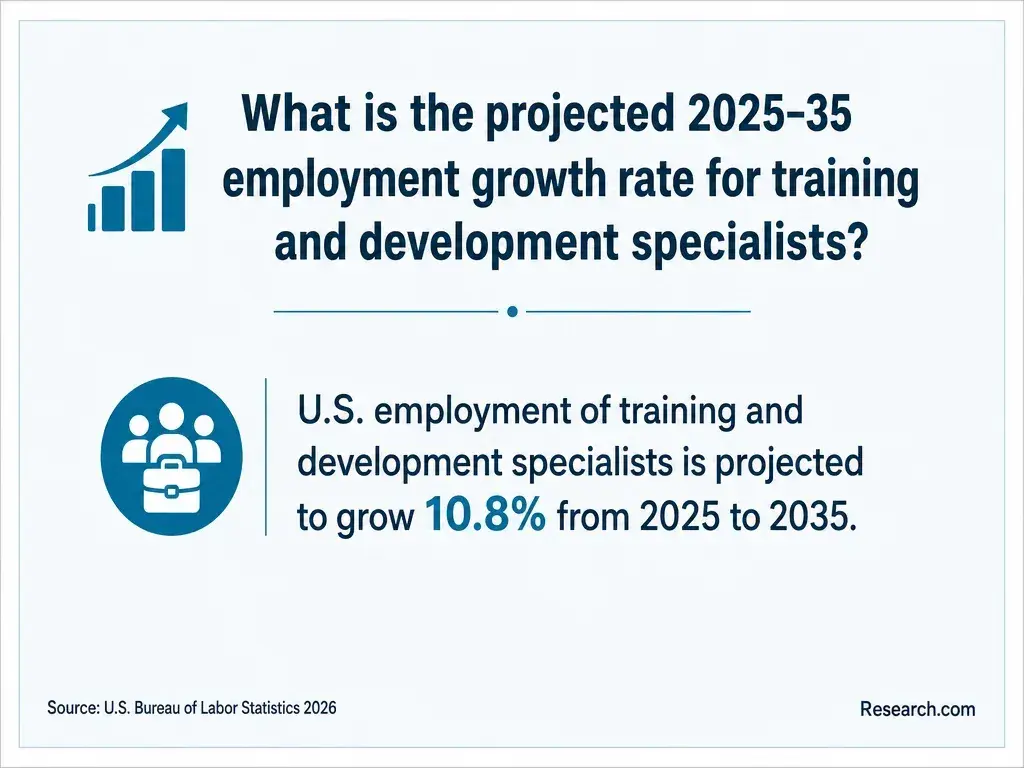
The U.S. Bureau of Labor Statistics projects 10.8% employment growth for training and development specialists from 2025 to 2035. That indicates demand for an occupation related to workplace learning, not demand specifically for Ed.D. graduates or assessment designers.
An organizational leadership Ed.D. does not automatically award a professional certification. If a target job calls for a particular evaluation, instructional design, human resources, or change-management credential, check the issuing organization's eligibility rules and the employer's job posting. If your immediate goal is to improve assessment practice in your current role, a targeted course, supervised project, or portfolio may be more direct than a doctorate.
Other Things You Should Know About EdD Leadership
Yes. You can develop objectives, draft measures, critique existing instruments, and practice analysis with permitted or synthetic data. Confirm whether the program's final project requires access to an actual organization.
That depends on the course's AI policy. If permitted, treat generated questions as drafts: check their accuracy, alignment, accessibility, and bias, and disclose AI use as required.
No. Exposure to measurement concepts is not professional authorization. Check the instrument publisher's qualifications and any applicable state rules before administering a restricted test.
Only if you have permission to share them. Remove confidential information and use a clearly labeled sample or approved, redacted excerpt when the original work cannot be disclosed.
- Writing and Using Learning Objectives - PMC - NIH https://pmc.ncbi.nlm.nih.gov/articles/PMC9582829/
- Reporting & Use of Assessment Results | JMU https://www.jmu.edu/assessment/sass/ac-step-seven.shtml
- Design Assessment Methods - opair - Penn State https://opair.psu.edu/assessment/loa-handbook/choose-and-design-assessment-methods/
- Align Assessments, Objectives, Instructional Strategies | Carnegie Mellon University https://www.cmu.edu/teaching/assessment/basics/alignment.html
- Creating assessments - Teaching@UW https://teaching.washington.edu/course-design/assessment/creating-assessments/
- Designing Assessments of Student Learning | Teaching and Learning Resource Center https://teaching.resources.osu.edu/teaching-topics/designing-assessments-student
- Online Master of Education in Measurement, Evaluation, Statistics & Assessment | Online MESA https://mesaonline.ec.uic.edu/programs/master-education-measurement-evaluation-statistics-assessment/
- Design effective assessments | Portland State University | OAI+ Faculty Teaching Resources https://oaiplus.pdx.edu/design-effective-assessments/
- Qualitative Methods in Evaluation | NYU SPS https://www.sps.nyu.edu/courses/GLOB1-CE9024-qualitative-methods-in-evaluation.html
- MEASRES: Measurement and Research - UNI Catalog https://catalog.uni.edu/courses/measres/