2027 Online Ed.D. in Leadership and Learning in Organizations: Degree Fit for Leaders Tackling Employees Unclear About Internal Career Paths
Audited and Verified:
Our Editorial and Data Verification Process
Research.com uses government datasets, official education statistics and primary institutional information to support its career and degree guides. Our review process checks factual accuracy, occupational definitions, source dates and the requirements associated with the credentials discussed.
How This Article Was Fact-Checked
Our editorial team verifies salary estimates, employment projections, education requirements and program information against original data providers and official organizations. Salary figures are checked against the relevant occupational definitions and reporting periods. Information about licensure, accreditation and required in-person training is reviewed separately.
Fact-checked and verified on:

Co-Founder and Chief Data Scientist
When employees cannot see a path to their next role, another training catalog may not solve the problem. The obstacle could be unclear promotion criteria, limited openings, inconsistent manager guidance, or skills that are difficult to demonstrate. For leaders responsible for talent development or organizational change, an online Ed.D. in Leadership and Learning in Organizations may offer a way to investigate and address those issues. This guide explains what the degree could add, what it cannot fix by itself, and how to decide whether doctoral study is more useful than a focused workplace initiative.
Key Things You Should Know
- An Ed.D. is most relevant when unclear career paths are a recurring, organization-wide problem that you have the authority and time to investigate, not simply a missing career-page document.
- Start by separating employee awareness from access: publishing role requirements will not create openings or change inconsistent promotion decisions.
- The U.S. Bureau of Labor Statistics reports a $133,000 median annual salary for training and development managers in May 2025; that occupational figure is not an expected salary for Ed.D. graduates.
What is an online Ed.D. in Leadership and Learning in Organizations?
An Ed.D., or Doctor of Education, in leadership and learning is a practice-oriented doctorate concerned with how people develop and how organizations change. Programs with similar names can differ substantially, so the exact degree title, curriculum, and culminating project must be checked with each university. Online describes where much of the instruction occurs; it does not necessarily mean self-paced study or no campus visits.
For a leader facing unclear internal career paths, the useful connection is between organizational systems and adult learning. Employees may need better information about roles and development opportunities, while the organization may need clearer job architecture, fairer selection practices, or managers who can discuss growth credibly. Doctoral study can help a leader diagnose those connected problems and evaluate a response. It cannot give that leader authority over hiring rules, budgets, or promotions.
Is an online Ed.D. in Leadership and Learning right for organizational leaders?
Possibly - but first establish what "unclear career paths" means in your organization. Employees might be unable to find opportunities, understand qualifications but lack access to projects, or see criteria applied differently across departments. Those are different problems. An employee survey alone cannot establish which one causes stalled movement; compare its responses with job descriptions, vacancy practices, development access, and appropriately governed aggregate mobility data.
The degree is a stronger fit if you already lead cross-functional talent or learning work, can influence decisions beyond training, and want to develop sustained skill in organizational diagnosis and applied evaluation. It is a weaker fit if the immediate task is to publish existing job levels or train managers on a policy the organization has already agreed to use. Leaders comparing education options should distinguish an Ed.D. from affordable online organizational leadership doctorates: similar titles do not establish the same emphasis on adult learning, research, or talent systems.
Before considering a doctoral project, work through the following sequence with HR, managers, and employee representatives where appropriate:
- Define the decision: for example, whether employees need clearer role criteria, better access to development, or changes to internal selection.
- Review existing policies and permitted aggregate evidence; ask employees about their experiences without promising confidentiality you cannot provide.
- Choose an intervention your organization can authorize, such as clearer competency descriptions or a consistent process for discussing readiness.
- Set a baseline and review measures such as employees' understanding of criteria, access to development, and internal applications - not promotion counts alone.
That sequence also tests degree fit. If leaders cannot obtain approval to examine or change the relevant processes, an Ed.D. will not remove the constraint. A focused HR project, organizational-development support, or manager coaching may produce a faster answer.
What careers can you pursue with an Ed.D. in Leadership and Learning?
For someone already working in talent development or organizational leadership, the most plausible benefit is deeper responsibility in an existing field. Training and development managers oversee learning strategy and teams; organizational-development consultants diagnose and advise on change; HR or talent leaders may own career frameworks and succession processes. Postsecondary administrators can also work on staff development, but institutional hiring rules and experience requirements differ.
An Ed.D. can provide evidence of applied inquiry and leadership learning, especially when paired with an authorized project you can describe without disclosing employee information. Employers still assess your record of managing people, budgets, implementation, and stakeholder relationships. If your goal is specifically a higher-education leadership role, compare that role's requirements and the cost of paying for a doctorate in higher education leadership before choosing a broader organizational program.
Relevant study may combine adult learning, organizational change, leadership, research methods, and program evaluation. For the career-path problem, adult learning helps distinguish knowing a role's requirements from having opportunities to practice its skills. Organizational analysis helps examine job structures, manager incentives, and selection processes. Evaluation methods help determine whether a change improved employees' understanding or access without mistaking a favorable survey response for proof that promotions became fairer.
Check the actual course sequence rather than assuming every program teaches job architecture, workforce analytics, or instructional design in depth. Ask whether you can examine a workplace problem through coursework or a capstone, what faculty guidance is available, and whether an employer must approve the project. Access to identifiable employee records, interviews, or internal hiring decisions may require employer permission, privacy safeguards, and institutional research review; a routine workplace evaluation is not automatically an approved doctoral study.
Requirements vary by institution. Programs may request a qualifying prior degree, transcripts, professional experience, recommendations, a statement of purpose, and evidence that applicants can undertake doctoral work. Some have additional graduate-study or research-preparation requirements. A leadership title, education master's degree, or fixed number of years is not a universal condition.
For this topic, a persuasive application would accurately describe decisions you have made about talent, learning, or organizational change; the career-path issue you hope to understand; and the limits of your authority and data access. Applicants with specialist-level education study can investigate Ed.D. pathways building on education specialist study, but credits that support admission do not necessarily transfer into doctoral requirements. Request a written eligibility and credit evaluation from the institution.
Completion time depends on required credits, course scheduling, enrollment pace, and the final project. An applied study of internal mobility can take longer than expected if approvals, employee-data access, or organizational priorities change. Ask a program for its published plan of study and completion policies rather than relying on an advertised fastest possible timeline.
If speed matters, compare the required attendance, research milestones, and project expectations behind choosing an accelerated Ed.D. study route. A shorter schedule may reduce elapsed time while increasing the weekly burden on a working leader and the colleagues needed for an organizational project.
There is no responsible single price for this degree type: tuition structures, required credits, fees, and aid differ by program. Compare each school's published charges for your proposed entry term, then include technology costs, any required travel and lodging, and the effect of reduced work hours. Employer assistance may depend on continued employment, grades, or repayment terms; obtain the policy before counting reimbursement.
Use the same full-cost method when examining affordable distance learning Ed.D. degrees. A lower advertised tuition figure may not be the lowest total cost for a leader who must travel or extend enrollment. Because a doctorate does not guarantee a promotion, base the financial decision on benefits you would value even if your job title stays the same.
The central distinction is access, not academic purpose. Online delivery may let you remain employed and investigate a workplace issue locally. Campus-based study may make in-person faculty and peer contact easier, but it can require commuting or relocation. Either format can include scheduled classes, collaborative work, and research deadlines.
For a career-path project, ask both types of program whether the culminating work can be conducted at your employer, what happens if you change jobs, and how faculty supervise applied research. Confirm live-session times and required campus convenings for online programs. Choose the format whose obligations you can meet through the project stage, not merely through the first term.
Verify that the institution holds accreditation recognized by the U.S. Department of Education and confirm that the Ed.D. is an officially awarded doctoral degree. Check the institution's own program listing for its exact name and requirements. Do not infer that institutional accreditation gives a general leadership Ed.D. specialized professional recognition or eligibility for educator licensure.
If a target job requires a license or particular credential, ask the university for its applicable disclosures and confirm requirements with the relevant state authority. For a workplace talent-leadership goal, the more immediate academic checks are curriculum fit, faculty support, project rules, and whether the degree is credible to your employer.
What salary and job outlook can Ed.D. graduates expect?
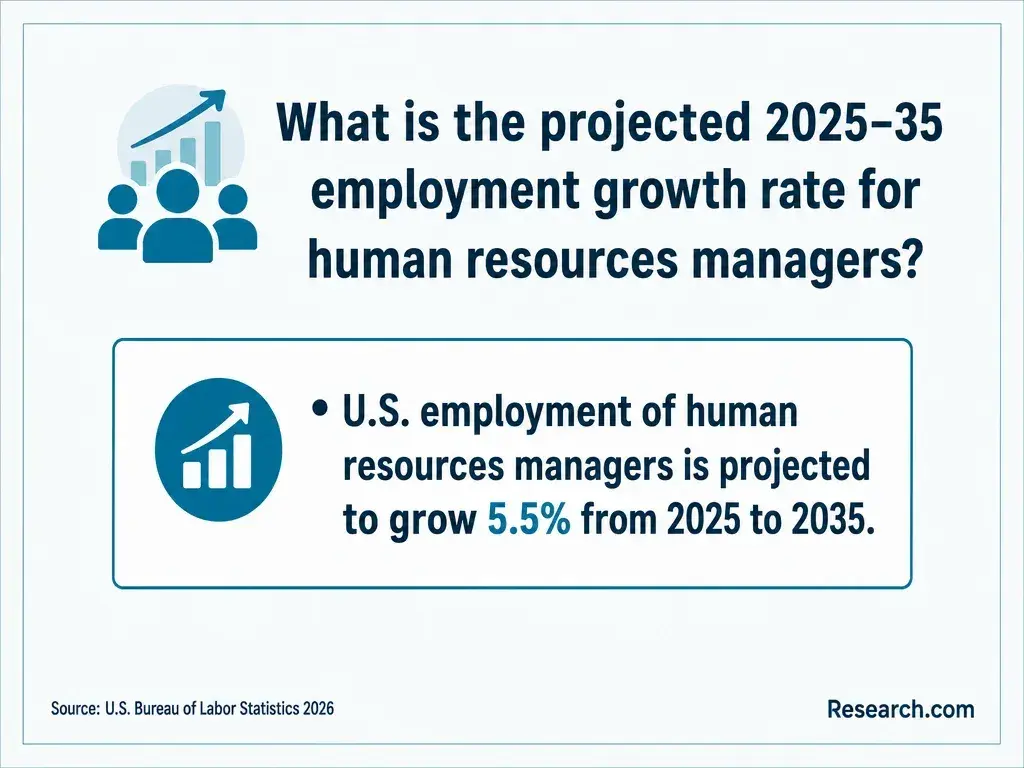
There is no single Ed.D. salary: pay follows the occupation, sector, location, and responsibilities rather than the degree title. The U.S. Bureau of Labor Statistics reports a May 2025 median annual salary of $133,000 for training and development managers and projects 6.4% employment growth from 2025 to 2035. These figures describe an occupation, not graduates of a particular program or an Ed.D. earnings premium.
If your aim is to lead an internal career-path initiative, examine openings for the role you actually want and note their requirements for management experience, HR knowledge, analytics, and implementation. A doctorate may strengthen your approach to a complex problem, but it does not substitute for those qualifications or establish a financial return on its own.
Other Things You Should Know About EdD Leadership
Visibility helps, but a vacancy list is not a career path. Employees also need understandable qualifications and a consistent way to learn about opportunities; employers should apply their own hiring rules and obligations.
It can help people explore options, but recommendations may reflect incomplete skills records or past inequities. Review data quality, privacy, and potential bias, and keep consequential employment decisions under appropriate human oversight.
Make the tension visible to leadership. A development initiative is unlikely to change mobility if managers are rewarded for retaining talent but not for developing people across the organization.
Track whether employees understand role criteria and can access useful projects, mentoring, or lateral moves. Report those measures honestly rather than presenting them as equivalent to promotion or higher pay.
- To keep employees, focus on career advancement | MIT Sloan https://mitsloan.mit.edu/ideas-made-to-matter/to-keep-employees-focus-career-advancement
- Walden University's Guide to Doctoral Capstone Projects https://www.waldenu.edu/online-doctoral-programs/resource/guide-to-doctoral-capstone-projects
- What Is a Problem of Practice? | spalding.edu https://online.spalding.edu/blog/what-is-problem-practice
- Online Ed.D. in Organizational Leadership | UMass Global https://www.umassglobal.edu/academic-programs/doctor-education-organizational-leadership
- Choosing a learning format that works for you | Gary W. Rollins College of Business https://blog.utc.edu/business/2025/06/09/choosing-a-learning-format-that-works-for-you/
- Career Navigation Q&A for Leaders and Policymakers | Project on Workforce https://pw.hks.harvard.edu/post/career-navigation-q-a-for-leaders-and-policymakers
- Tuition and Financial Aid - UNC-Chapel Hill Online https://online.unc.edu/online-doctoral-programs/online-edd-organizational-learning-and-leadership/admissions/tuition-financial-aid/
- Careers Leaders Can Pursue with an Ed.D. | Peabody Online | VU-EDU https://peabodyonline.vanderbilt.edu/edd-in-organizational-learning/edd-careers/