2027 Online Ed.D. in Leadership and Learning in Organizations: Comparing Coursework in Communities of Practice
Audited and Verified:
Our Editorial and Data Verification Process
Research.com uses government datasets, official education statistics and primary institutional information to support its career and degree guides. Our review process checks factual accuracy, occupational definitions, source dates and the requirements associated with the credentials discussed.
How This Article Was Fact-Checked
Our editorial team verifies salary estimates, employment projections, education requirements and program information against original data providers and official organizations. Salary figures are checked against the relevant occupational definitions and reporting periods. Information about licensure, accreditation and required in-person training is reviewed separately.
Fact-checked and verified on:

Co-Founder and Chief Data Scientist
A course can teach the theory of communities of practice without giving students a chance to participate in one. That distinction matters if you want an online Ed.D. to strengthen how colleagues share expertise, solve problems, and improve their work.
This guide is for learning and development professionals and organizational leaders comparing doctoral curricula. It explains what to look for in courses, cohort activities, and applied research - and how to tell whether the experience fits your workplace and career goals.
Key Things You Should Know
- A community of practice is more than a discussion board: members share a field of work, interact repeatedly, and develop useful practices together.
- Compare syllabi and project rules for sustained collaboration, organizational learning theory, and ways to evaluate whether knowledge changes practice - not just course titles mentioning "community."
- Career value depends on experience as well as coursework: the U.S. Bureau of Labor Statistics reports a 2025 median salary of $133,000 for training and development managers, not for Ed.D. graduates as a group.
What Is an Online Ed.D. in Leadership and Learning in Organizations?
An online Doctor of Education in leadership and learning in organizations is a practice-oriented doctorate concerned with how people learn, lead, and improve work within institutions. Depending on the program, students may study adult learning, organizational change, leadership, and applied research while continuing to work. The degree's exact name and required curriculum vary by university.
A community of practice is a group whose members share a domain of work, interact over time, and develop ways of doing that work better. A network of training managers exchanging tested approaches to onboarding could become one. A one-time class discussion, by itself, would not. Coursework may examine how such communities form, whose knowledge is included, what helps members participate, and whether shared learning reaches everyday practice.
This focus suits professionals who can connect study to an organizational learning challenge. If your goal is principally academic theory-building, compare research-oriented PhD programs; if you need a narrower skill, a short course or employer-supported development project may be enough. The range of Doctor of Education study areas to compare can help clarify whether organizational learning, rather than school administration or another focus, matches your aim.
How Do Online Ed.D. Programs Compare With Campus-Based Programs?
Online and campus-based programs can teach the same concepts, but their structures create different opportunities to practice community-based learning. Online delivery widens access to peers across workplaces and locations; it does not necessarily provide flexible attendance or sustained collaboration. Campus meetings can make informal exchange easier, but proximity alone does not create a community of practice.
Look past the delivery label. In either format, ask whether students work with the same peers over multiple courses, receive faculty feedback on collaborative inquiry, and have a way to carry ideas into their organizations.
For an online option, confirm live-session times, group-meeting expectations, required campus visits, and how participation is assessed. A working professional may gain more from a well-supported online cohort than from occasional campus contact - but only if its schedule is feasible.
What Coursework Is Included in Leadership and Learning in Organizations Programs?
The most useful curriculum comparison is not the number of courses labeled "leadership." It is whether required courses connect theories of shared learning to facilitation, organizational conditions, and credible evidence of change. Course titles differ, and an elective or single assignment should not be mistaken for a formal specialization.
The table shows what each curricular area could contribute to work with communities of practice. Use it to compare published requirements and syllabi, not as a claim that every Ed.D. includes every area.
| Coursework area | Relevant learning | What to examine in the syllabus |
| Adult and organizational learning | How expertise is shared, adapted, and applied at work | Attention to informal learning, learning transfer, and participation - not only formal training |
| Leadership and organizational change | How leaders support participation across roles and teams | Work on power, incentives, culture, and barriers to sharing knowledge |
| Facilitation or learning design | How to support purposeful peer interaction | Opportunities to design or facilitate recurring exchanges and obtain feedback |
| Research methods and evaluation | How to investigate a learning problem and interpret evidence | Appropriate qualitative or quantitative methods, limitations, and ethical data practices |
| Applied doctoral work | How to connect inquiry with an organizational decision | The actual project format, approval process, faculty guidance, and permissible work setting |
A strong sequence moves from understanding how practitioners learn together, to diagnosing barriers, to designing support, to evaluating what changed. For example, counting meeting attendance may establish participation, but it cannot show whether members adopted a useful practice. Interviews, work products, or carefully chosen performance indicators may provide a fuller picture, subject to access and privacy limits.
Before enrolling, request recent syllabi and the program handbook. Ask which relevant courses are required, whether electives run often enough to take, and whether an applied project may examine a community of practice. Also ask how faculty distinguish a collaborative course assignment from sustained inquiry in an organization. That distinction is especially important if your workplace cannot grant access to colleagues or records.
Confirm that the university holds institutional accreditation recognized by the U.S. Department of Education or the Council for Higher Education Accreditation, and that the accreditation covers the institution awarding the doctorate. Check the university's own degree listing as well: accreditation does not verify that a particular course, concentration, or project format exists.
Specialized recognition, where applicable, has its own scope; do not assume institutional accreditation means an organizational leadership Ed.D. is approved for educator licensure. If your employer requires a particular credential or type of institution, get its acceptance criteria in writing before applying.
Requirements vary, but applications may ask for prior graduate study, transcripts, recommendations, a statement of purpose, and evidence of relevant professional experience. Some programs may also assess research preparation or interview applicants. An education master's, a senior title, or a publication record is not a universal prerequisite.
For a communities-of-practice focus, describe a real learning challenge you have observed and the decisions you have been responsible for - not an unverified claim that your organization already has an effective community.
Ask admissions staff separately whether prior graduate credits establish eligibility and whether any could apply to doctoral requirements; those are different decisions. Applicants holding an education specialist degree can also investigate Ed.S. progression into an online Ed.D., but should obtain a program-specific credit evaluation.
Completion depends on required credits, course sequencing, enrollment pace, and the doctoral project or dissertation. A community-based project can take additional time if recruiting participants, securing organizational permission, or gathering usable evidence proves difficult. "Online" does not mean self-paced, and an accelerated course schedule does not automatically accelerate project approval.
Ask for a term-by-term plan that shows live classes, cohort work, research milestones, and any campus convenings. If speed is important, compare fast-track doctoral study in education against the time you can actually devote to collaboration and applied inquiry. Confirm leave and reentry policies before relying on an optimistic completion date.
There is no defensible single price for this degree category. Compare each school's published tuition basis - per credit, term, or program - with required credits, mandatory fees, and any travel or lodging for convenings. Then account for continued enrollment during the doctoral project, reduced work hours if necessary, and employer reimbursement conditions. Do not assume an online program eliminates travel or that prior graduate credits will reduce the bill.
For a cost comparison, request an estimate based on your intended pace and ask what charges continue if project work extends beyond coursework. Low-cost Doctor of Education programs online may be worth examining, but compare total expected expenses and project support rather than advertised tuition alone. A targeted facilitation or evaluation course could be a better financial choice if you do not need doctoral-level study.
Relevant paths include learning and development management, organizational development, workforce training, consulting, and some higher-education or nonprofit leadership roles. The connection is strongest when the doctorate builds on experience leading people, programs, or change. Employers may value evidence that you facilitated cross-functional learning and evaluated its usefulness more than a course title alone.
If you work in higher education, organizational leadership doctoral options for college administrators may offer a more relevant comparison than corporate training programs. Whatever the sector, check the target job's management, budgeting, technical, and hiring requirements. An Ed.D. does not substitute for experience or guarantee promotion.
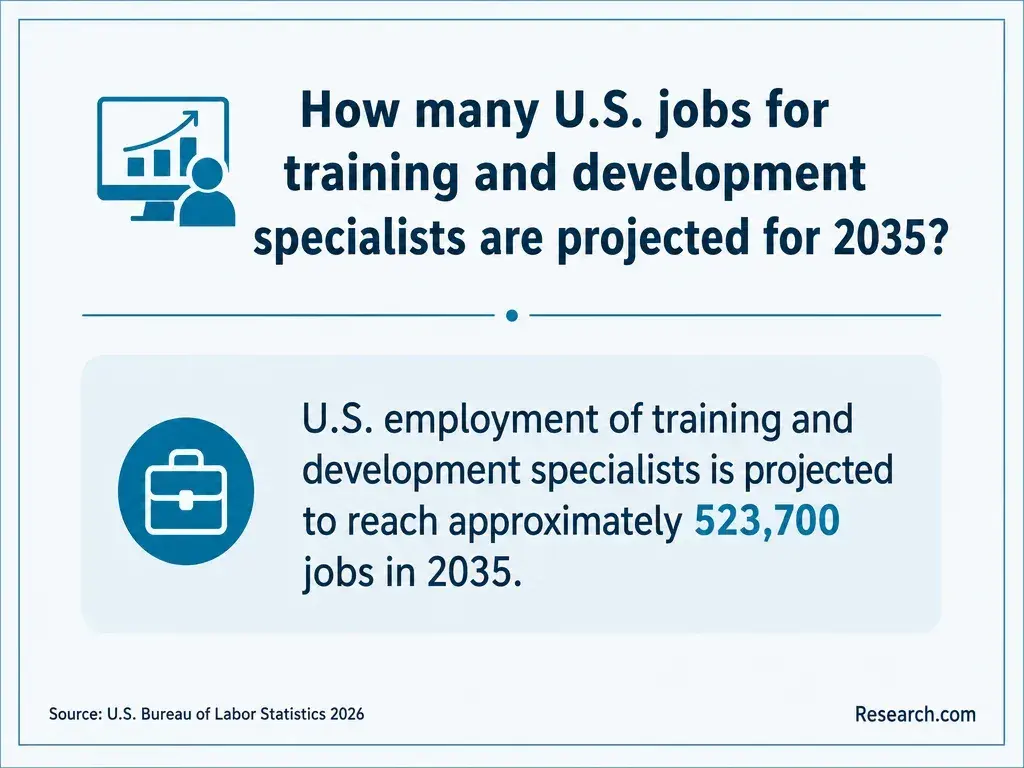
There is no reliable salary that applies to all graduates. Pay depends on the occupation, sector, location, and level of responsibility. The U.S. Bureau of Labor Statistics reports a 2025 median annual salary of $133,000 for training and development managers, with projected employment growth of 6.4% from 2025 to 2035. These are occupation-wide figures, not outcomes for Ed.D. holders or a forecast of what an individual will earn.
Use the job you realistically qualify for - not the highest-paying role associated with leadership - as the basis for a financial decision. Compare its requirements and likely compensation with the full cost of study and the advancement opportunities available through experience alone.
Do Ed.D. Graduates Need Licensure or Professional Certification?
Organizational learning, training, and many consulting roles generally do not require a license merely because the professional holds an Ed.D. Particular employers may prefer certifications or specialized experience. School leadership and other regulated education roles are different: a broadly focused organizational leadership doctorate does not, by itself, establish eligibility for principal, superintendent, teacher, or counseling licensure.
If licensure is your goal, obtain the program's written licensure disclosure and check requirements with the relevant state authority before enrolling. If your goal is to facilitate communities of practice at work, judge optional certifications by the skills and credibility your specific role requires, rather than treating them as automatic additions to the doctorate.
Other Things You Should Know About EdD Leadership
Yes. Members can share a professional domain without sharing an employer. For doctoral work, confirm that the program permits the proposed setting and that each organization authorizes any data access or participation it controls.
Not without observing employer rules and course requirements. Remove identifying details where appropriate, and obtain permission before sharing restricted documents, employee information, or records.
Start with its purpose and look for evidence members can use: changes in shared resources, decisions, or work practices. Attendance and satisfaction alone do not establish improved performance or causation.
Discuss the change promptly with your faculty advisor and organizational contact. You may need to revise recruitment, scope, or timing; do not assume replacement participants or a new site will be approved automatically.
- Partnering with Students to Develop a Capstone for a... - PMC https://pmc.ncbi.nlm.nih.gov/articles/PMC11732519/
- EDA Communities of Practice https://www.eda.gov/strategic-initiatives/communities-of-practice
- Cost of Attendance (Budget) | 2025-2026 Federal Student Aid Handbook https://fsapartners.ed.gov/knowledge-center/fsa-handbook/2025-2026/vol3/ch2-cost-attendance-budget
- Walden University's Guide to Doctoral Capstone Projects https://www.waldenu.edu/online-doctoral-programs/resource/guide-to-doctoral-capstone-projects
- Online Doctorate in Education and Leadership (Ed.D.) | Rockhurst University https://onlinedegrees.rockhurst.edu/online-edd-programs
- What Is a Capstone Project? - Boston University Questrom https://www.bu.edu/questrom/blog/what-is-a-capstone-project/
- UNC EdD Online: Organizational Learning and Leadership https://online.unc.edu/online-doctoral-programs/online-edd-organizational-learning-and-leadership/
- Asynchronous Engagement - CNDLS @ Georgetown https://cndls.georgetown.edu/resources/asynchronous-engagement/
- Communities of Practice | Office of Academic Faculty Excellence | Oregon State University https://academicaffairs.oregonstate.edu/faculty-excellence/faculty-development/communities-practice