2027 Is an Online Ed.D. in Leadership and Learning in Organizations a Good Fit for District Human Resources Directors?
Audited and Verified:
Our Editorial and Data Verification Process
Research.com uses government datasets, official education statistics and primary institutional information to support its career and degree guides. Our review process checks factual accuracy, occupational definitions, source dates and the requirements associated with the credentials discussed.
How This Article Was Fact-Checked
Our editorial team verifies salary estimates, employment projections, education requirements and program information against original data providers and official organizations. Salary figures are checked against the relevant occupational definitions and reporting periods. Information about licensure, accreditation and required in-person training is reviewed separately.
Fact-checked and verified on:

Co-Founder and Chief Data Scientist
District human resources directors already lead consequential work: recruiting educators, developing leaders, retaining staff, and navigating labor and budget constraints. An online Ed.D. in Leadership and Learning in Organizations may strengthen that work, but its value depends on the role you want next - not on the doctorate alone.
This guide examines what the degree can add to district HR practice, where it falls short, and how to compare programs, costs, and alternatives before committing.
Key Things You Should Know
- An organizational leadership Ed.D. is a strong fit when you want to lead districtwide workforce development or evaluate change initiatives; it is less direct preparation for licensure-based school administration.
- The U.S. Bureau of Labor Statistics reports a $133,000 median annual wage for training and development managers in May 2025, but that occupational figure does not predict a district HR director's pay after an Ed.D.
- Before enrolling, verify the program's live attendance, applied-project rules, full cost, accreditation, and your district's advancement and tuition-support policies.
Is an online Ed.D. in Leadership and Learning in Organizations right for district human resources directors?
It can be a good fit if your next responsibility is improving how a district develops, supports, and retains its workforce. A practice-oriented Ed.D. studies leadership and organizational learning through problems that working leaders can investigate and address. For an HR director, those problems might include a weak principal onboarding process, inconsistent supervisor development, or difficulty determining whether professional learning transfers into practice.
The fit is weaker if your immediate goal is a superintendent credential, expertise in employment law, or a promotion governed mainly by a salary schedule or board hiring criteria. An Ed.D. cannot replace legal advice, labor-relations experience, or a state-approved administrator preparation pathway. If you need a narrower skill - such as workforce analytics or collective-bargaining practice - a targeted course, mentorship, or employer-sponsored development may be faster and less expensive.
Start with the decision you hope to make better at work. Then ask whether doctoral study will give you access to useful methods, faculty feedback, and a feasible applied project. Also ask whether your district offers tuition assistance and whether its repayment terms would still make sense if you change jobs. Resources on reducing higher education leadership doctoral study costs can suggest funding questions, but a district HR director should confirm which options actually apply to their program and employer.
What does an online Ed.D. in Leadership and Learning in Organizations prepare graduates to do?
The degree is intended to help experienced professionals diagnose organizational problems, design learning or change initiatives, and evaluate results. In a school district, that could mean distinguishing a training gap from a staffing, scheduling, supervision, or incentive problem before commissioning another workshop.
Relevant capabilities include adult learning, leadership development, organizational change, stakeholder engagement, and applied research. An HR director could use them to assess whether new-teacher onboarding is implemented consistently or whether a supervisor-development program reaches the employees it was designed to serve. Coursework alone, however, does not establish that an intervention works or confer authority to change district policy.
Applied projects require particular care in HR. Access to personnel files, employee surveys, and student-linked records depends on district permission and applicable privacy rules. The university must determine its own academic and research-review requirements; district authorization does not substitute for them. A useful project needs a question the district can act on, appropriate data, and a scope that remains manageable alongside the director's job.
What career outcomes can district HR directors pursue with this Ed.D.?
The most plausible outcome is greater effectiveness or broader responsibility in work you already know: district HR strategy, talent development, leadership development, or organizational improvement. A doctorate may also support a move into consulting or another education organization, but employers will assess your record of leading teams, budgets, and change - not just the degree.
The distinctions below help separate adjacent roles that often share the word "leadership" but demand different evidence of readiness.
| Possible direction | What carries over from district HR | What else to establish |
| District talent or HR executive | Workforce planning, hiring systems, labor relations | Executive decision-making and the district's position requirements |
| Leadership development director | Supervisor support, onboarding, professional learning | Program design and credible evidence of learning transfer |
| Organizational consultant | District operations and stakeholder management | Client development, project delivery, and demonstrable results |
If you seek a chief-level district role, compare actual postings and board expectations before enrolling. Where advancement depends chiefly on demonstrated executive experience, a cross-functional district assignment may be more valuable than another credential.
An online format can let a district HR director remain employed without relocating. It does not necessarily mean self-paced study: programs may require live evening classes, team meetings, fixed cohort schedules, or campus convenings. Those commitments can collide with bargaining periods, hiring season, and board meetings.
A campus-based program may make regular in-person collaboration easier, while an online program may provide more geographic choice. Neither delivery mode establishes the degree's quality or its relevance to district HR. Compare faculty access, research support, required travel, and the final project rather than relying on the label "online." The distinction between an organizational learning doctorate and a K-12 administration doctorate matters more than delivery mode; comparing Doctor of Education program types can help frame that choice.
Curricula vary, but relevant study commonly spans leadership theory, adult learning, organizational change, and quantitative or qualitative inquiry. For district HR work, look beyond course titles: determine whether assignments address workforce development, program evaluation, implementation, and the practical limits of organizational data.
Ask how the required sequence prepares students for the final academic deliverable. A dissertation in practice, capstone, team project, and conventional dissertation can differ substantially in scope and approval requirements. Reviewing practice-focused Ed.D. final project options may help you identify questions to ask, but the school's current handbook controls what its students must complete.
Requirements are program-specific. Schools may request a completed graduate degree, transcripts, a statement of purpose, recommendations, and evidence of professional leadership; some also use interviews or set academic thresholds. A district HR title is useful context, not automatic proof of eligibility or readiness.
Show what decisions you have actually led: for example, how you coordinated a hiring-system change, worked across departments, or assessed a development initiative. Describe a real organizational question you would like to investigate without claiming results you have not measured. If you have prior graduate coursework, ask separately whether it meets admission requirements and whether any credits can apply to the doctorate; one decision does not establish the other.
There is no reliable universal timeline or price for this degree. Required credits, course sequencing, enrollment pace, and the final project determine how long a particular program takes. A faster advertised path may still require fixed live sessions or an approved project that cannot be rushed; use faster routes through an education doctorate as a starting point for checking the actual completion rules.
Request a written estimate covering tuition for all required credits, mandatory fees, travel and lodging for convenings, and likely continuation charges if the project runs long. Compare that estimate with your district's reimbursement cap, grade and employment conditions, and any repayment obligation. Include the value of time away from work or family; an online program can save relocation costs without eliminating those commitments.
Do not assume it does. A broadly focused Ed.D. in leadership and learning may develop useful district leadership skills without being a state-approved superintendent or school-administrator preparation program. Holding a doctorate and qualifying for a regulated administrator credential are separate matters.
If licensure is your goal, give the university the state and credential you seek and request its written licensure disclosure for your entry term. Confirm the answer with the relevant state licensing authority, including any prerequisite credentials or supervised experience. If the program does not meet that pathway, compare a state-approved administrator program before committing to the Ed.D.
No occupational median identifies what district HR directors earn because they completed this Ed.D. Compensation may depend on district size, location, contract terms, position classification, and whether the employer recognizes the doctorate in its pay structure.
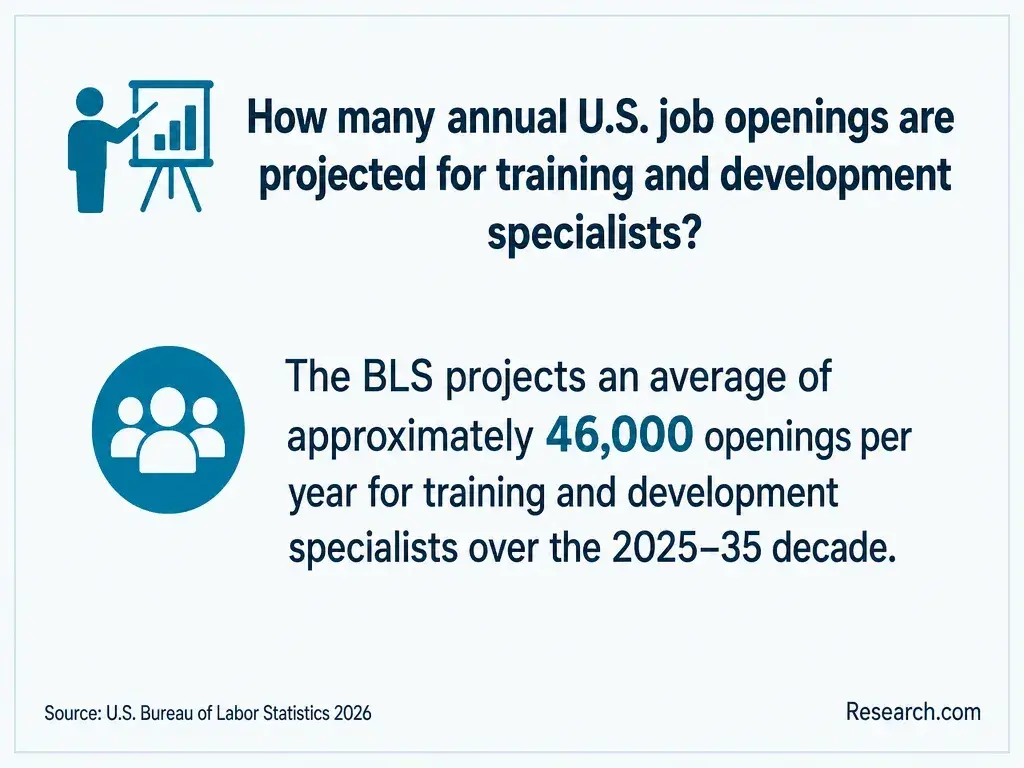
For an adjacent occupation, the U.S. Bureau of Labor Statistics reports a May 2025 median annual wage of $133,000 for training and development managers and projects 6.4% employment growth for that occupation from 2025 to 2035. Those figures describe a national occupation, not school-district HR directors, Ed.D. graduates, or a likely raise. For a useful personal estimate, examine the salary range of specific positions you could realistically obtain and ask your district whether this degree changes your placement or eligibility.
How can district HR directors choose an accredited online Ed.D. program?
Begin by confirming the institution's recognized accreditation and the exact degree it awards. Accreditation is a baseline check, not evidence that the program meets a state licensure requirement or fits district workforce work. Compare the curriculum and final project against the responsibilities you want, then request program-specific answers before applying.
These questions expose differences that a program overview may not show:
- Which classes require live attendance, group work, or campus travel, and when do those obligations occur?
- Can an approved project address district workforce development, and what faculty, district, data-access, and ethics approvals would it need?
- What is the full expected charge through completion, including fees and possible continuation costs?
- What completion, career-support, and licensure information can the school document for this exact program?
Compare written answers on equivalent terms. A lower advertised tuition rate is not necessarily a lower total cost; comparing online leadership doctorate program prices is most useful when you also check credits, fees, and travel. Choose the program only if its obligations and applied work fit both your district role and your intended next step.
Other Things You Should Know About EdD Leadership
No. An Ed.D. is an academic degree; an HR certification has its own eligibility, assessment, and renewal rules. Check which credential the positions you want actually value.
Leadership and organizational-change study may improve how you analyze and communicate decisions, but it does not replace knowledge of your state's labor rules, negotiated agreements, or district counsel's advice.
Yes, an earned Ed.D. is a doctoral degree. In district communications, identify your degree or role when context could otherwise make the title ambiguous.
Reassess the benefit against the full cost and your career goal. A smaller employer-funded project, targeted training, or a later enrollment date may be a better decision than financing a doctorate without a clear use for it.
- General Schedule Qualification Policies | U.S. Office of Personnel Management https://www.opm.gov/policy-data-oversight/classification-qualifications/general-schedule-qualification-policies/
- Maximizing the Impact and ROI of Leadership Development | nih.gov https://pmc.ncbi.nlm.nih.gov/articles/PMC11505461/
- Cost of Attendance (Budget) | 2026-2027 Federal Student Aid Handbook https://fsapartners.ed.gov/knowledge-center/fsa-handbook/2026-2027/vol3/ch2-cost-attendance-budget
- What Can You Do With a Doctor of Education (Ed.D.)? - TXWes https://doctorofeducation.txwes.edu/articles/what-can-you-do-with-an-edd/
- Leadership, Change, and Organizational Impact | MIT Management Executive Education https://executive.mit.edu/blog/leadership-change-and-orgamizational-impact.html
- Synchronous Online Courses - Academic Affairs | Coles College of Business https://campus.kennesaw.edu/faculty-staff/academic-affairs/curriculum-instruction-assessment/digital-learning-innovations/faculty-learning-scientists/course-facilitation/synchronous-online-courses.php
- Walden University's Guide to Doctoral Capstone Projects https://www.waldenu.edu/online-doctoral-programs/resource/guide-to-doctoral-capstone-projects
- What's the Difference Between Asynchronous and Synchronous Learning? | Ohio State Online https://online.osu.edu/content-hub/blogs/whats-the-difference-between-asynchronous-and-synchronous-learning/
- Why data-driven decision-making is defining modern leadership - IENYC - The Blueprint https://www.ienyc.edu/the-blueprint/data-driven-leadership-modern-management/
- Trinity Policies for Online Teaching and Learning | trinitydc.edu https://discover.trinitydc.edu/catalog-25-26/online-teaching-and-learning-policy/