2027 Is an Online Ed.D. in Leadership and Learning in Organizations a Good Fit for University Registrar Office Leaders?
Audited and Verified:
Our Editorial and Data Verification Process
Research.com uses government datasets, official education statistics and primary institutional information to support its career and degree guides. Our review process checks factual accuracy, occupational definitions, source dates and the requirements associated with the credentials discussed.
How This Article Was Fact-Checked
Our editorial team verifies salary estimates, employment projections, education requirements and program information against original data providers and official organizations. Salary figures are checked against the relevant occupational definitions and reporting periods. Information about licensure, accreditation and required in-person training is reviewed separately.
Fact-checked and verified on:

Co-Founder and Chief Data Scientist
Registrar leaders increasingly manage more than records: they coordinate academic policy, student information systems, staff development, and changes that affect the entire institution. An online Ed.D. in Leadership and Learning in Organizations may strengthen that work, but it is a substantial investment - not a standard requirement for promotion. This guide helps experienced registrar professionals assess what the degree teaches, where it could support advancement, what it cannot replace, and which program and workplace conditions to verify before enrolling.
Key Things You Should Know
- Best fit: A registrar leader who wants to lead institution-wide change, develop teams, and evaluate improvements - not simply acquire a credential for a registrar job.
- Career reality: The U.S. median annual salary for postsecondary education administrators was $104,590 in May 2025; that occupational figure is not an Ed.D. graduate salary or a forecast of a raise.
- Before applying: Confirm the program's schedule, total cost, applied-project rules, and whether a doctorate matters for the specific roles you want.
Is an online Ed.D. in Leadership and Learning in Organizations a good fit for university registrar leaders?
Yes, potentially - if your goal is broader leadership rather than a faster route to a registrar title. A practice-oriented Ed.D. in leadership and learning examines how organizations develop people, use evidence, and implement change. Those capabilities can matter when a registrar is coordinating policy across colleges, improving service delivery, or guiding staff through a student information system transition.
The fit is strongest for leaders who already influence decisions beyond their own unit and can identify a consequential problem to investigate. For example, inconsistent degree-audit practices may involve training, system configuration, policy interpretation, and governance. A doctorate could help a leader diagnose those interacting causes and evaluate a response; training alone may not fix them.
The case is weaker if the immediate goal is proficiency with a records platform, a first supervisory appointment, or a promotion for which the institution values operational experience over doctoral study. Targeted systems training, a cross-functional project, mentorship, or an employer leadership program may be more direct. Compare the proposed role and the full investment - not the prestige of the credential - when assessing organizational leadership doctorate cost and program value.
What does an Ed.D. in Leadership and Learning in Organizations prepare graduates to do?
Such programs generally prepare experienced professionals to examine organizational problems, lead collaborative change, design learning initiatives, and assess whether an intervention worked. For a registrar, that might mean testing a staff-development approach to policy interpretation or evaluating how an advising-process change affects the consistency of information students receive.
The degree does not, by itself, confer authority over academic policy, qualify someone for every senior administration post, or establish expertise in a particular student information system. Those responsibilities depend on institutional governance, demonstrated work, and the job description. A research-focused PhD is usually a better match for someone whose primary aim is sustained scholarly research; an Ed.D. is more directly aligned with improving professional practice.
How can an online Ed.D. advance a university registrar's career?
An Ed.D. can help a registrar present evidence of readiness for broader responsibilities: leading teams across academic affairs, explaining complex decisions to campus stakeholders, and evaluating whether changes improve services. Its strongest career value comes when coursework connects to visible, authorized work - not when the degree is treated as a substitute for management experience.
Consider the position you want next. A registrar seeking an associate vice provost role may need budget responsibility, faculty relationships, and a record of institution-wide implementation. The doctorate might strengthen their change and evaluation skills, but it will not supply those experiences automatically. Ask a supervisor or trusted senior administrator which qualifications actually distinguish candidates for the target role, then compare that answer with the program's learning outcomes.
Relevant coursework may cover leadership and organizational change, adult learning, research methods, and program evaluation. A registrar can use adult-learning concepts to improve staff onboarding, for instance, while evaluation methods can help distinguish whether a revised process is being followed from whether it improves the intended outcome. Check the required course sequence rather than assuming every similarly named Ed.D. offers the same depth in analytics, higher education policy, or technology.
Applied work deserves particular scrutiny. Programs may require a dissertation in practice, another dissertation format, or a different culminating project; the name alone does not establish its scope. If you prefer an applied deliverable to a conventional dissertation, investigate online Ed.D. programs without a traditional dissertation, then confirm each school's actual completion requirements.
A proposed registrar-office project also needs more than an interesting question. Permission to access records, faculty approval, institutional review requirements, and rules governing student information may affect what can be studied or shared. Access for your job does not automatically authorize use of the same data for doctoral work.
Online study can reduce routine travel, but it does not necessarily allow attendance whenever work permits. The comparison below highlights obligations that matter when registration cycles, graduation processing, and other peak periods limit a registrar leader's availability.
| Consideration | Online Ed.D. | Campus-based Ed.D. |
| Class participation | May combine live meetings, independent work, and group collaboration | Typically requires travel to scheduled campus classes |
| In-person requirements | May still include required convenings; verify dates and attendance rules | Regular campus presence is part of the format |
| Workplace project | May permit an approved local site, subject to program rules | Project-site and supervision rules still require confirmation |
| Best scheduling test | Compare live sessions and group meetings with office peak periods | Compare commute and class times with office peak periods |
Ask for a sample term calendar, including live-session times, team meetings, convenings, and project milestones. A program marketed as accelerated may concentrate obligations rather than eliminate them; planning a shorter education doctorate timeline requires checking whether that pace remains workable during your busiest terms.
Requirements vary by institution. Programs may request prior graduate study, professional experience, transcripts, recommendations, a statement of purpose, and evidence that the applicant can undertake doctoral work. A master's in education, a particular registrar title, or prior publication should not be assumed to be universal requirements.
Registrar applicants can make their experience concrete by describing decisions they influenced, people or processes they led, and a genuine organizational problem they want to examine. They should also ask admissions staff to distinguish graduate coursework considered for eligibility from credits, if any, that would actually count toward the doctorate. Applicants who already hold an education specialist degree can explore schools offering online Ed.S.-to-Ed.D. routes, while requesting a written evaluation of their own credits and remaining requirements.
There is no reliable universal timeline or price: required credits, enrollment pace, project progress, tuition policies, and any campus visits differ by program. A registrar comparing offers should request the published credit requirements and a term-by-term cost estimate for the intended entry term. Include fees, travel and lodging, books or technology, and the cost of continuing enrollment if the final project takes longer than planned.
Employer assistance can change the calculation, particularly at a public university, but reimbursement may depend on continued employment, approved coursework, grades, or annual funding limits. Check the written policy before counting it as support. Resources on online Ed.D. affordability and degree planning can help identify comparison points; the decisive figure is your own documented net cost and the responsibilities you expect the degree to help you assume.
The most plausible next roles build on existing higher education experience. The table separates those paths from moves that require substantial additional functional preparation.
| Potential direction | Registrar experience that transfers | What else to demonstrate |
| Senior registrar or enrollment operations leader | Records governance, policy implementation, systems coordination | Broader strategy, budgets, and sustained team leadership |
| Academic affairs or student-success administration | Cross-campus relationships and knowledge of academic processes | Results tied to the specific unit's goals and governance |
| Institutional process or change leadership | Workflow improvement and stakeholder coordination | Evidence of implementation and credible evaluation |
| Organizational learning or consulting | Staff development and complex operational problem-solving | Direct experience designing learning or advising clients |
An Ed.D. may strengthen a candidacy, especially alongside a documented institutional improvement project. It does not replace the specialized experience an employer expects in enrollment strategy, institutional research, human resources, or consulting. For a narrow move - such as becoming the office's systems expert - technical training and project leadership may have a clearer payoff.
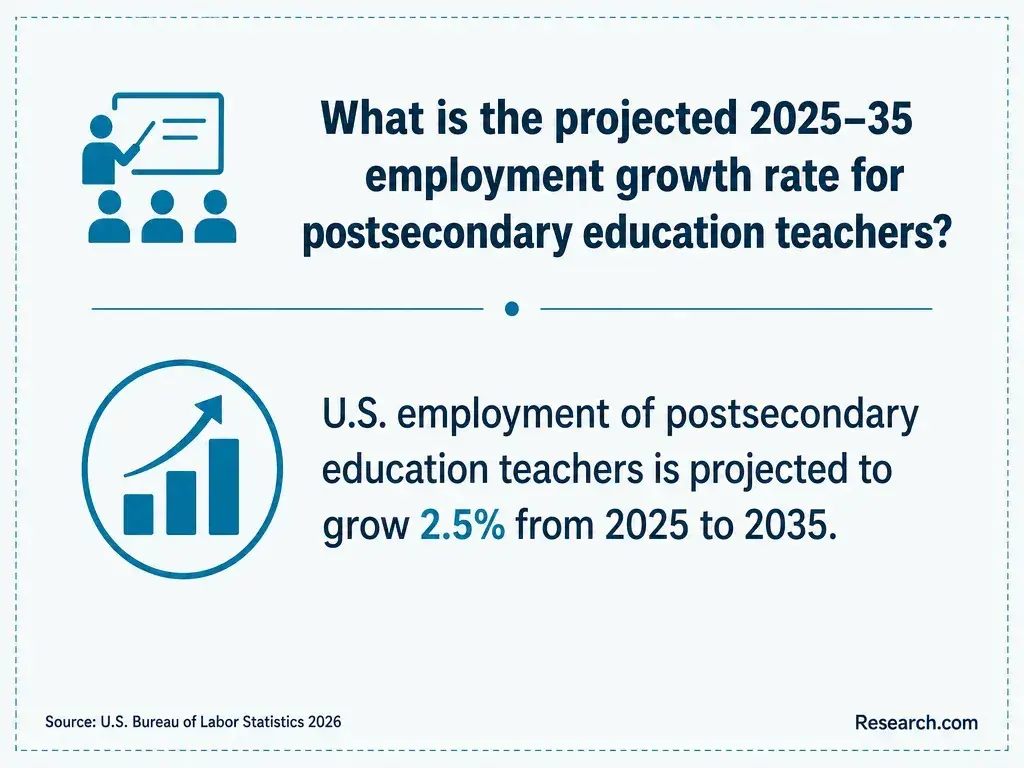
The U.S. Bureau of Labor Statistics reports a $104,590 median annual salary for postsecondary education administrators in May 2025 and projects 1.8% employment growth for that occupation from 2025 to 2035. This broad category offers context for higher education administration; it does not isolate registrars, distinguish doctoral degree holders, or predict an individual offer.
Pay and advancement also depend on institution type, location, scope of responsibility, and internal compensation rules. Before using a prospective salary increase to justify tuition, review actual postings and pay ranges for the roles you would seek, and ask whether those roles require, prefer, or merely accept an Ed.D.
How can registrar professionals choose an accredited and reputable online Ed.D. program?
Start by confirming the institution's recognized accreditation and the exact degree it awards. Then read the curriculum and completion requirements against your target work: a strong fit should offer meaningful study of leadership, organizational learning, and applied inquiry without claiming to provide registrar-specific expertise it does not teach. Institutional accreditation alone does not establish specialized certification or eligibility for a regulated role.
Request direct answers from the program about live attendance, campus convenings, faculty advising, approved project sites, data access, published completion information, and total charges for your entry term. If the school reports outcomes, check which students were counted and over what period. Finally, discuss a possible project with your employer before relying on office data or access. A reputable program should make its requirements clear enough to test against your schedule, budget, and authority at work.
Other Things You Should Know About EdD Leadership
Possibly, but job access is not research permission. Obtain the institution's required approvals and check FERPA, data-use, confidentiality, and doctoral research-review rules before collecting or sharing information.
No. Doctoral leadership study and platform-specific proficiency serve different purposes. System training is usually the more direct choice for a technical skills gap.
Ask the program in advance whether the project can change sites, what approvals would need to be renewed, and how a transition could affect progress. Do not assume access or permission transfers with you.
It may satisfy a degree expectation for some positions, but departments set subject-matter and teaching requirements. Check actual postings and the institution's faculty qualification policies.
- Accreditation in the U.S. | ed.gov http://www.ed.gov/laws-and-policy/higher-education-laws-and-policy/college-accreditation/accreditation-in-the-us
- Cost of Attendance (Budget) | 2025-2026 Federal Student Aid Handbook https://fsapartners.ed.gov/knowledge-center/fsa-handbook/2025-2026/vol3/ch2-cost-attendance-budget
- Types of Financial Aid: Grants, Work-Study, and Loans | studentaid.gov https://studentaid.gov/understand-aid/types
- What Is a Capstone Project? Types, Examples, and Tips | SCU https://www.scu.edu/business/blog/business-concepts/what-is-a-capstone-project/
- What Topics Do EdD Students Research in the EdD Program? | Fairfield University https://www.fairfield.edu/news/insights/education-human-development/what-topics-do-edd-students-research.html
- synchronous Archives | Ohio State Online https://online.osu.edu/tag/synchronous/
- Office of the Registrar Projects | University of Arizona Office of the Registrar https://registrar.arizona.edu/about/office-registrar-projects
- UNC EdD Online: Organizational Learning and Leadership https://online.unc.edu/online-doctoral-programs/online-edd-organizational-learning-and-leadership/
- Ed.D. in Organizational Improvement for Educational Leaders | University of Delaware https://www.education.udel.edu/doctoral/edd/
- EdD in Organizational Change and Leadership | USC Rossier https://rossier.usc.edu/programs/doctoral/organizational-leadership/