2027 Online Ed.D. in Leadership and Learning in Organizations Admissions: Explaining Entrepreneurial Leadership Without Employees
Audited and Verified:
Our Editorial and Data Verification Process
Research.com uses government datasets, official education statistics and primary institutional information to support its career and degree guides. Our review process checks factual accuracy, occupational definitions, source dates and the requirements associated with the credentials discussed.
How This Article Was Fact-Checked
Our editorial team verifies salary estimates, employment projections, education requirements and program information against original data providers and official organizations. Salary figures are checked against the relevant occupational definitions and reporting periods. Information about licensure, accreditation and required in-person training is reviewed separately.
Fact-checked and verified on:

Co-Founder and Chief Data Scientist
Running a business alone can involve substantial leadership, but an Ed.D. admissions committee may not see it in a résumé that lists no direct reports. If you are a founder, independent consultant, or sole proprietor considering an online Ed.D. in leadership and learning, your task is to show whom you influenced, what decisions you owned, and what organizational learning problem you want to investigate.
This guide explains how to document that experience honestly, assess program requirements, and decide whether a practice-oriented doctorate fits your goals.
Key Things You Should Know
- Having no employees does not automatically rule out entrepreneurial leadership. Show decisions, influence over clients or collaborators, and responsibility for outcomes rather than claiming people-management experience you do not have.
- Admissions rules vary: a program may require a graduate degree or particular professional experience, while treating entrepreneurial work as competitive evidence only after reviewing its scope and documentation.
- Before applying, identify a feasible organizational learning problem and ask whether the program permits inquiry with clients or external partners; business ownership alone does not secure project approval or data access.
What Is Entrepreneurial Leadership Without Employees in an Ed.D. Program?
For an applicant, entrepreneurial leadership without employees means directing an initiative and influencing people or systems without supervising a payroll team.
A solo consultant might coordinate a client's managers, design a training process, negotiate with a vendor, and revise the work after evaluation. The leadership claim rests on decisions and influence - not on calling every customer a team member.
Distinguish three things in your application: ownership of a business, leadership of work involving other people, and learning or organizational change that the experience helps you understand.
Owning a business establishes neither the second nor the third by itself. Conversely, a founder who led a cross-organizational initiative may have compelling evidence despite never hiring an employee.
What Are the Admission Requirements for an Online Ed.D. in Leadership and Learning?
Requirements belong to the individual university and entry term. Programs may request a completed master's degree, transcripts, professional history, recommendations, a statement of purpose, and an interview; minimum grades, tests, and experience rules vary.
An admissions office, not an applicant's job title, decides whether self-employment meets a stated experience requirement. Graduate credits used to establish eligibility are not necessarily transferable into the doctorate.
The distinction below helps you describe solo-founder experience without treating all business activity as equivalent leadership evidence:
| Experience | Leadership signal | Limit to acknowledge |
| Owning a solo business | Accountability for strategy, resources, and delivery | Ownership alone does not demonstrate influence over others |
| Coordinating client or partner work | Stakeholder alignment, decisions, and implementation | Client authority and the founder's role may differ |
| Designing and evaluating learning | Diagnosis, feedback use, and improvement | Participant satisfaction is not proof of performance impact |
Build your statement around one bounded example: the problem, your decision authority, the stakeholders involved, what you did, and what the available evidence does, and does not, show.
Name a doctoral question that grows from the experience, such as how small organizations support learning when they lack a dedicated training function. A portfolio, project brief, or appropriately redacted deliverable can substantiate your role; do not disclose client information without permission or present proposed work as completed research.
Ask admissions whether founders without direct reports satisfy its professional-experience rule and whether client or partner references are acceptable.
Choose recommenders who observed your judgment and collaboration, rather than people who can attest only to your sales or personal ambition. If a program explicitly requires supervising employees, request a written interpretation before paying an application fee; do not assume an exception.
Is an Online Ed.D. in Leadership and Learning Accredited?
Online delivery does not determine accreditation. Check the institution's current accreditation status with its recognized institutional accreditor, then confirm the exact Ed.D. award and program in the university catalog.
Do not infer a separate programmatic accreditation or a formal specialization from a leadership course or marketing description.
Accreditation also does not make a general leadership doctorate a teacher, principal, or superintendent licensure program. If a regulated education role is your goal, obtain the university's licensure disclosure and check the relevant state authority.
For a solo founder seeking organizational learning expertise, the more immediate question is whether the degree's actual curriculum and applied work fit the problem you intend to address.
Entrepreneurial leadership is useful beyond launching a company. A founder may help a nonprofit coordinate volunteer learning, help a small business improve onboarding, or work with a college unit on a new service. In each setting, influence depends on understanding stakeholders, budgets, incentives, and authority, not merely proposing training.
That distinction can strengthen an admissions narrative. Suppose clients repeatedly request workshops after a process change. The defensible observation is that a learning need may exist; the cause could instead be unclear responsibilities or a poorly designed process.
An Ed.D. may help you investigate such problems through organizational diagnosis and evaluation. If your immediate need is better facilitation or sales execution, targeted training and supervised practice may be more direct than doctoral study.
Depending on the program, study may connect adult learning, organizational change, leadership, research methods, and evaluation. For a founder, the academic value lies in testing assumptions: Did an intervention address a genuine learning gap? Did participants apply what they learned? What alternative explanations fit the evidence? Course titles alone cannot establish how deeply a program teaches these skills.
Review required courses, available electives, faculty expertise, and the actual culminating project. If you need to compare a broad leadership curriculum with a narrower education-focused route, education doctorate specialization comparisons can help frame that choice; confirm the credential and offerings in each university's catalog.
Completion time depends on required credits, course sequencing, enrollment pace, and the dissertation or other culminating work. An online format may remove a commute while retaining scheduled classes, group meetings, campus convenings, and fixed project deadlines. A founder should also plan for periods when client work and doctoral milestones peak at the same time.
Ask for the program's published course sequence and completion rules, including what happens if you pause enrollment or lose access to a project partner. When reviewing nontraditional Ed.D. completion requirements, verify the actual capstone or dissertation expectations; a different deliverable is not necessarily a shorter or easier path.
There is no reliable single price for an online Ed.D. Tuition may be charged by credit or term, and the full commitment can include fees, books, technology, travel for required convenings, and additional enrollment while finishing a project.
For a self-employed applicant, reduced billable time can matter as much as the university bill. Request an entry-term cost schedule and calculate a range using the school's published requirements rather than an advertised starting price.
Compare that estimate with the work you want to do. A founder seeking stronger evaluation skills may benefit first from a focused course, mentor, or supervised project.
If a doctorate remains appropriate, affordable online doctorates in education can provide options to investigate, but verify each program's total requirements and current charges directly. Do not assume doctoral funding, reimbursement, or higher future revenue.
A founder might continue consulting with stronger organizational diagnosis and evaluation skills, pursue learning and development work, or seek an organizational leadership role.
These are different transitions. An employer hiring a training manager may expect experience leading a learning function; a college leadership position may require substantial higher-education experience. The doctorate can support a candidacy but cannot replace those qualifications.
If college administration is your specific target, assess your experience against the responsibilities of those jobs before exploring online Ed.D. pathways for college organizational leadership. If your goal is to improve your existing practice rather than change occupations, weigh the degree against client-facing projects and shorter professional development.
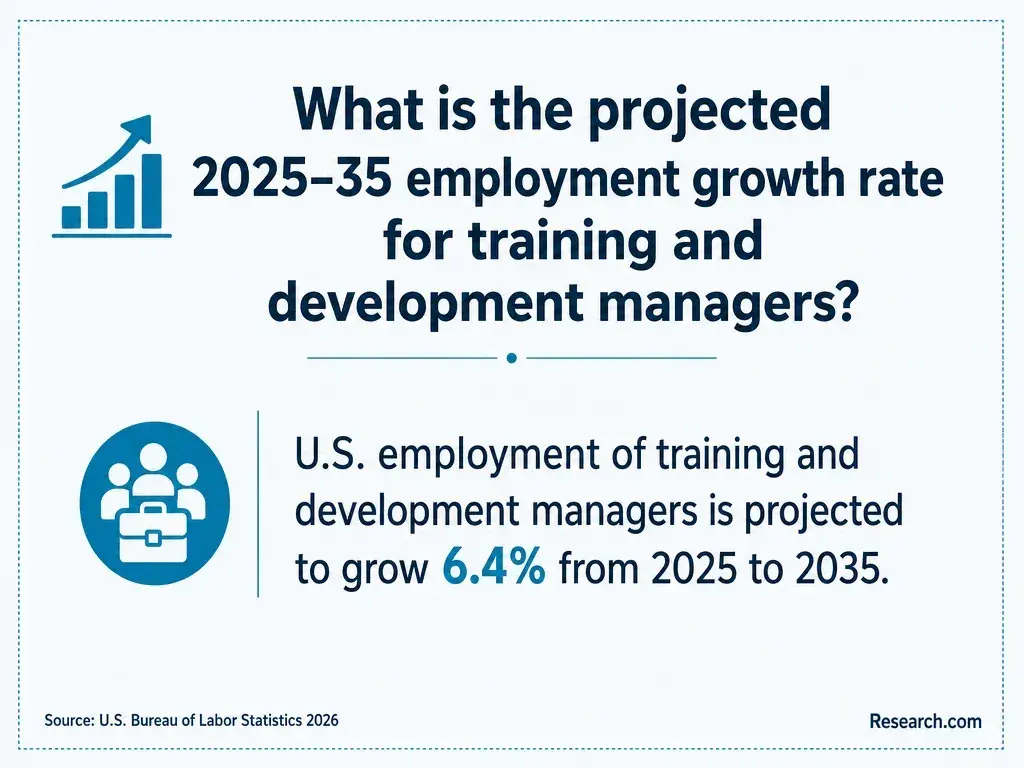
There is no defensible salary figure for Ed.D. graduates as a group - or for founders who earn the degree. The U.S. Bureau of Labor Statistics reports a $133,000 median annual salary for training and development managers in May 2025, with projected employment growth of 6.4% from 2025 to 2035.
That occupation-wide figure reflects many career paths and experience levels; it is not a forecast of what an applicant will earn after graduation.
For a solo founder, the financial comparison is especially personal: potential access to different work versus tuition and time away from paying clients. Evaluate actual job postings or the needs of your client market, not an occupational median, before treating the degree as an investment.
How Do You Choose a Reputable Online Ed.D. Leadership Program?
Start with your intended applied question, then compare programs on admission eligibility, curriculum, faculty guidance, online attendance rules, project-site requirements, accreditation, and full cost.
A low advertised tuition figure is less useful if the project model requires access to employees you do not have. Leadership doctorate programs with lower tuition can serve as a comparison starting point, not a substitute for checking each university's current policies.
Before applying, request answers to these founder-specific questions:
- Does documented leadership of clients, contractors, or cross-organizational work meet the professional-experience requirement without direct reports?
- Can a dissertation or applied project use an external organization, and who approves the site, scope, and data access?
- What live sessions, campus visits, and collaborative obligations are required?
- What are the required credits, fees, project continuation charges, and rules if a partner withdraws?
Get consequential answers in writing from the admissions or program office. A promising application explains your real leadership responsibility; a suitable program also gives you an ethical, feasible way to study the organizational problem that motivates you.
Other Things You Should Know About EdD Leadership
Usually, the business's legal form is less informative than your responsibilities, but the program decides what documentation it accepts. Describe your work accurately whether you operate through an LLC or as a sole proprietor.
Yes, if you explain the decisions you made, what evidence challenged your assumptions, and what you learned. Avoid turning an unverified claim about the venture's impact into an achievement.
It may demonstrate leadership, but whether it satisfies a formal experience rule depends on the program's wording and review. Document the scope, stakeholders, dates, and your actual authority.
Use a generalized description that preserves the substance of your role without revealing protected details. Obtain permission before sharing documents, identifying the client, or proposing to use its data in doctoral work.
- Letters of Recommendation | The Harry S. Truman Scholarship Foundation https://www.truman.gov/apply/advice-guidance/letters-recommendation
- FAQs for master's applicants | Gerald R. Ford School of Public Policy https://fordschool.umich.edu/mpp-mpa/admissions/faqs
- EdD in Organizational Leadership Admission Requirements | Pepperdine University https://gsep.pepperdine.edu/doctorate-organizational-leadership/admission-requirements/
- Writing Your Academic Statement of Purpose - Graduate School https://gradschool.cornell.edu/inclusion/recruitment/prospective-students/writing-your-statement-of-purpose/
- Leadership and Learning in Organizations Online Ed.D. | Peabody College of Education and Human Development https://peabody.vanderbilt.edu/academics/edd-programs/online-leadership-learning-organizations/
- Advanced Online Ed.D. Programs at Illinois https://education.illinois.edu/online/eddonline
- Letters of Recommendation - The Writing Center https://writingcenter.unc.edu/tips-and-tools/letters-of-recommendation/
- Online Doctorate in Education Leadership and Innovation | NYU https://leadershipinnovation.steinhardt.nyu.edu/
- Doctoral Application Requirements | Crown Family School of Social Work, Policy, and Practice https://crownschool.uchicago.edu/admissions/doctoral-admissions/application-procedures
- Admissions and Application Requirements - UNC Online https://online.unc.edu/online-doctoral-programs/online-edd-organizational-learning-and-leadership/admissions/