2027 Online Ed.D. in Leadership and Learning in Organizations: Comparing Coursework in Responsible Leadership
Audited and Verified:
Our Editorial and Data Verification Process
Research.com uses government datasets, official education statistics and primary institutional information to support its career and degree guides. Our review process checks factual accuracy, occupational definitions, source dates and the requirements associated with the credentials discussed.
How This Article Was Fact-Checked
Our editorial team verifies salary estimates, employment projections, education requirements and program information against original data providers and official organizations. Salary figures are checked against the relevant occupational definitions and reporting periods. Information about licensure, accreditation and required in-person training is reviewed separately.
Fact-checked and verified on:

Co-Founder and Chief Data Scientist
Two online Ed.D. programs can both promise "responsible leadership" while teaching very different skills. One may emphasize ethical decision-making; another may require students to examine power, evaluate workplace learning, and protect employee data during applied research.
For learning and development professionals and emerging organizational leaders, that difference matters more than the phrase on a program page. This guide shows how to compare coursework and assignments, then checks the format, cost, and career implications that could change your choice.
Key Things You Should Know
- Compare required courses and assessed projects, not course titles alone, for evidence that students practice ethical judgment, stakeholder engagement, organizational diagnosis, and responsible use of data.
- Look for a sequence that connects leadership theory and adult learning to research methods, implementation, and evaluation; an isolated ethics elective cannot establish that the whole curriculum does so.
- Use career figures as context, not a promised return: the U.S. Bureau of Labor Statistics reports a $133,000 median annual salary for training and development managers in May 2025, across workers with varied credentials and experience.
What is an online Ed.D. in Leadership and Learning in Organizations?
It is a practice-oriented education doctorate focused on how people lead, learn, and change within organizations. Programs with similar names may serve corporate, nonprofit, government, healthcare, or education professionals, but their required courses and final projects can differ substantially. "Online" describes where much instruction occurs; it does not necessarily mean self-paced study or no campus visits.
For a learning and development professional, the value is the opportunity to connect training decisions to organizational systems: who defines a performance problem, whose interests an intervention serves, and what evidence would show whether it helped.
A research-focused PhD may fit someone seeking deeper preparation to produce generalizable scholarship. A shorter certificate or employer leadership program may fit someone who needs a specific skill rather than a doctorate.
What coursework defines responsible leadership in an online Ed.D. program?
Responsible leadership means making consequential organizational decisions with attention to evidence, affected stakeholders, power, fairness, and accountability. No single course title proves that a program develops it. The stronger comparison is what students must do across the curriculum, and how faculty assess their decisions.
The table identifies coursework to look for in published degree plans and syllabi. These are comparison criteria, not claims that every Ed.D. requires each subject:
| Coursework to compare | Evidence of responsible leadership | Limitation to check |
| Leadership ethics and governance | Students justify decisions involving competing stakeholder interests, authority, and accountability. | Does assessment go beyond discussing leadership theories? |
| Adult learning and organizational learning | Students distinguish a learning need from a process, incentive, or management problem. | Does the course examine learning transfer, not just training design? |
| Organizational diagnosis and change | Students examine culture, resistance, implementation constraints, and unintended effects. | Are affected employees or communities represented in the analysis? |
| Research methods and evaluation | Students choose defensible measures, acknowledge uncertainty, and distinguish improvement from proof of causation. | Is there enough methods preparation for the required final project? |
| Data ethics and applied inquiry | Students address permission, confidentiality, appropriate data use, and reporting limitations. | Does the program explain its review and project-approval process? |
Sequence matters. A program might introduce ethical frameworks early, then require students to use them when designing an intervention, analyzing evidence, and presenting recommendations.
Ask for a sample syllabus or assignment rubric to see whether students must defend those choices. An elective that is rarely offered is less useful than required coursework with repeated, assessed application.
Match depth to your starting point. An experienced instructional designer may benefit most from organizational diagnosis and evaluation; a manager with change experience but limited research preparation may need stronger methods teaching. Neither course exposure nor a completed doctorate, by itself, demonstrates executive judgment.
How do online and campus-based Ed.D. programs compare?
Delivery format changes how students practice responsible leadership together, but it does not determine academic quality. Online cohorts may use live discussions, simulations, group projects, and workplace-based inquiry; campus programs may offer more in-person contact but require commuting or relocation.
In either format, examine how faculty give feedback on difficult decisions rather than assuming discussion alone develops sound judgment.
Request the actual meeting schedule, attendance policy, group-work expectations, and required campus-convening dates. If your intended project involves a university or public institution, scheduling and travel should be considered alongside budget planning for higher education leadership doctoral study.
Online access removes a commute to routine classes, not necessarily travel expenses or fixed evening commitments.
Confirm that the university holds recognized institutional accreditation and that the accreditation covers the institution awarding the degree.
Check the accreditor's directory and the university's disclosures rather than relying only on marketing language. Then verify the exact Ed.D. title and whether any advertised concentration is formally awarded or merely a set of electives.
Institutional accreditation does not establish that responsible leadership is taught well, nor does it make a general organizational leadership Ed.D. a state-approved school-administrator licensure program.
If licensure is your goal, obtain written confirmation of the program's intended eligibility and check the relevant state authority separately.
Requirements vary by institution and entry term. Programs may review prior graduate study, professional experience, recommendations, a statement of purpose, and evidence that an applicant can undertake applied inquiry.
Some specify a completed master's degree or particular graduate credits; others set different conditions. An education major, senior job title, publication record, or particular entrance test is not a universal requirement.
Use the application to describe a real leadership or learning decision you have helped make, what evidence was available, and what you still need to learn.
If you previously began a doctorate, ask whether doctoral completion options for ABD education students apply to your situation. Credits that support admission are not automatically transferred into a new degree; obtain a written evaluation before assuming they reduce coursework.
Completion time depends on required credits, enrollment pace, course sequencing, and the final project. Published timelines may assume uninterrupted progress and timely access to an approved project setting.
Compare schools using a written degree plan, including what happens if a required course is unavailable or a workplace project changes.
For cost, request an estimate that separates tuition, mandatory fees, materials, technology, required travel and lodging, and any continuing-enrollment charges. Ask when tuition may change and whether employer reimbursement requires particular grades or continued employment.
Cost-conscious online Ed.D. study options can help form a shortlist, but compare the total cost of completing the curriculum you want - not an advertised tuition figure alone. If you only need training in ethical evaluation or change leadership, a targeted course may cost less time and money.
The coursework can support professionals pursuing broader responsibility in learning and development, organizational development, leadership development, workforce training, consulting, or education administration.
The fit depends on prior experience: a training specialist may need evidence of managing programs and budgets before competing for manager roles, while an established manager may use doctoral inquiry to improve how a cross-functional change is evaluated.
For higher education roles, compare the degree's organizational focus with the position's actual requirements; doctoral study in organizational leadership for higher education careers is a distinct choice from school-administrator licensure preparation.
A portfolio showing how you framed a problem, consulted stakeholders, and interpreted evidence, without disclosing restricted information, may be more persuasive to an employer than a course list. The doctorate does not replace relevant management experience or guarantee promotion.
There is no reliable single salary for graduates of this degree. Pay follows the occupation, sector, location, responsibility, and experience more closely than the degree title.
As one benchmark, the U.S. Bureau of Labor Statistics reports a May 2025 median annual salary of $101,860 for management analysts, an occupation that includes organizational consulting work. That is the median for the occupation, not an Ed.D. graduate salary or an estimate of a doctoral pay increase.
Before treating tuition as a career investment, compare openings in your target role with your present qualifications and ask whether employers value doctoral study, demonstrated project results, or both. Public-sector pay scales and internal promotion rules can make the calculation particularly different from private-sector consulting.
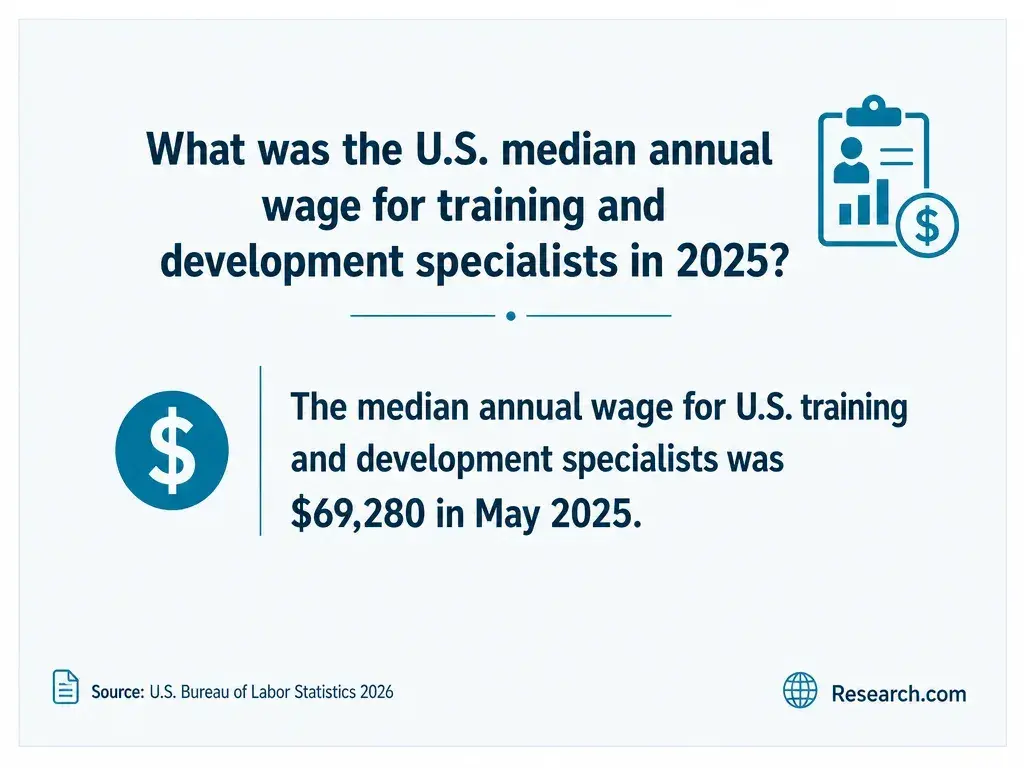
Outlook varies across roles that share leadership and learning vocabulary. The Bureau of Labor Statistics projects 10.8% U.S. employment growth for training and development specialists from 2025 to 2035.
That indicates demand for the occupation, not that employers will require an Ed.D. or that every applicant will find a leadership position.
Read postings for your target role to identify the work behind the title: needs assessment, facilitation, evaluation, staff supervision, budgeting, or change implementation.
If postings emphasize hands-on experience you do not yet have, leading a supervised workplace initiative may be a more direct next step than enrolling immediately.
How can you choose a reputable online Ed.D. program?
Begin with the responsible-leadership capability you need, then compare only programs whose required curriculum gives you repeated opportunities to practice it. A practical sequence keeps attractive marketing claims separate from verifiable academic requirements:
- Obtain the current degree plan and identify required ethics, learning, change, methods, and evaluation coursework; confirm when relevant electives are offered.
- Request sample syllabi or rubrics showing how students are assessed on stakeholder reasoning, evidence quality, and responsible data use.
- Confirm the final project's format, faculty supervision, organizational access requirements, and applicable research-review procedures.
- Verify accreditation, live attendance, campus visits, completion rules, and a written estimate of total charges for your expected pace.
- Ask which career outcomes the school actually tracks, for which graduates and over what period; do not infer outcomes from testimonials.
If organizational leadership is your main focus, planning the cost of an organizational leadership doctorate can complement a curriculum comparison.
Choose the Ed.D. when its assessed coursework and applied inquiry address a capability you cannot reasonably build through experience, mentorship, or shorter study, and when its schedule and full cost are workable.
Other Things You Should Know About EdD Leadership
Possibly, but academic approval is not publication permission. Check employer agreements, data rights, confidentiality obligations, and the program's review requirements before sharing the case publicly.
Yes. Tell your faculty advisor and relevant organizational decision-makers about your role. You may need another person to collect feedback or assess results so staff do not feel pressured.
Do not do so without authorization under your organization's data rules and the program's policies. Removing names alone may not prevent identification.
Describe the decision, your responsibilities, the methods you used, and the limitations you recognized. Share findings only at an aggregation level your organization permits.
- Prerequisites for ethical leadership in health and social care | nih.gov https://pmc.ncbi.nlm.nih.gov/articles/PMC12907462/
- Educational Leadership and Policy Studies (ELPS) | luc.edu https://catalog.luc.edu/course-descriptions/elps/
- UNC EdD Online: Organizational Learning and Leadership https://online.unc.edu/online-doctoral-programs/online-edd-organizational-learning-and-leadership/
- What Is Ethical Leadership and Why Is It Important? | Harvard DCE https://professional.dce.harvard.edu/blog/what-is-ethical-leadership-and-why-is-it-important/
- A Pathway to Sharing Leadership With Student Teams | sagepub.com https://journals.sagepub.com/doi/10.1177/10525629241264548
- What Is a Problem of Practice? | spalding.edu https://online.spalding.edu/blog/what-is-problem-practice
- Teaching the Essence of Responsible Leadership | AACSB https://www.aacsb.edu/insights/articles/2022/06/teaching-the-essence-of-responsible-leadership