2027 Online Ed.D. in Leadership and Learning in Organizations: Moving from Manager Development to Succession Planning
Audited and Verified:
Our Editorial and Data Verification Process
Research.com uses government datasets, official education statistics and primary institutional information to support its career and degree guides. Our review process checks factual accuracy, occupational definitions, source dates and the requirements associated with the credentials discussed.
How This Article Was Fact-Checked
Our editorial team verifies salary estimates, employment projections, education requirements and program information against original data providers and official organizations. Salary figures are checked against the relevant occupational definitions and reporting periods. Information about licensure, accreditation and required in-person training is reviewed separately.
Fact-checked and verified on:

Co-Founder and Chief Data Scientist
Running manager-development workshops is different from building a reliable succession pipeline. The latter requires leaders to identify critical roles, assess readiness fairly, create development opportunities, and test whether those efforts strengthen the organization. For learning and development professionals and emerging organizational leaders, an online Ed.D. in Leadership and Learning in Organizations may offer a way to study that larger challenge while working. This guide explains what the degree can contribute, where experience matters more, and how to judge whether doctoral study is the right next step.
Key Things You Should Know
- An Ed.D. can help you evaluate leadership development and organizational change, but it does not replace experience making talent decisions with senior leaders.
- Succession planning concerns readiness for specific critical roles - not simply completion of manager training - and requires fair criteria, development opportunities, and evidence of progress.
- The U.S. median annual pay for training and development managers was $133,000 in May 2025; that occupational figure is not a salary prediction for Ed.D. graduates.
What is an online Ed.D. in Leadership and Learning in Organizations?
An Ed.D. is a practice-oriented doctorate. Programs with a leadership-and-learning focus examine how adults develop, how organizations change, and how leaders use evidence to improve practice. The exact degree title, courses, research requirements, and online format vary by institution.
For succession planning, the distinction between manager development and organizational readiness matters. A manager may improve coaching or delegation skills without becoming ready for a particular executive, technical, or operational role. Succession planning connects role requirements to talent assessment, stretch assignments, mentoring, and future staffing decisions. An Ed.D. may help a practitioner diagnose and evaluate that system; it does not confer authority over an employer's personnel decisions.
The table shows where the work changes as a learning professional moves toward succession responsibility.
| Decision | Manager development | Succession planning |
| Who is included? | Managers with identified learning needs | Potential successors for defined critical roles, using defensible criteria |
| What is developed? | Current-role leadership skills | Capabilities and experience needed for future-role readiness |
| What counts as evidence? | Skill application and performance improvement | Readiness evidence, development progress, and coverage of critical roles |
What careers can an online Ed.D. in Leadership and Learning prepare you for?
The strongest fit is usually someone already working in learning and development, talent management, organizational development, human resources, or organizational leadership who wants greater responsibility for leadership pipelines. Relevant work may include defining competencies with executives, coordinating talent reviews, designing developmental assignments, and evaluating whether successors gain the experience required for critical roles.
A training and development manager may oversee leadership programs but have limited authority over promotions. A talent or organizational development leader may work more directly with workforce planning and succession processes. A consultant can help clients design those processes, although credibility depends on implementation experience and client access as well as a degree. Higher education is another possible setting, but its governance and hiring requirements differ; readers considering that sector can examine higher education leadership through an organizational leadership Ed.D.
If your next goal is to facilitate better manager workshops, a targeted certificate, mentorship, or a project evaluating an existing program may be more direct. An Ed.D. becomes more compelling when you need sustained preparation to investigate a complex leadership-development system and can apply that work in an organization.
How do you choose an accredited online Ed.D. program?
Start by confirming the institution's accreditation with a recognized accreditor and checking that the advertised doctorate is the degree you will actually earn. Institutional accreditation does not, by itself, establish a succession-planning specialization, professional certification, or school-administrator licensure eligibility.
Next, compare published curriculum and project rules against your intended work. Look for substantive study of adult learning, talent development, organizational change, evaluation, and research methods - not just a leadership course title. If you need a formally designated concentration, verify how it appears on institutional records; guidance on selecting a professional focus for an Ed.D. can help you separate a concentration from electives.
Ask the program whether a succession-related workplace project would meet its applied-research requirements, who approves the site, and what happens if your employer or role changes. Also confirm live attendance, campus visits, faculty supervision, completion requirements, and the rules that will apply to your entry term. Those answers are more useful than an unverified promise that a program is entirely flexible or career-transforming.
Relevant study may combine adult learning, leadership theory, organizational diagnosis, change implementation, and qualitative or quantitative inquiry. For succession work, the valuable question is whether students learn to connect these subjects: how to identify a capability gap, choose a development approach, and evaluate progress without mistaking course completion for job readiness.
A feasible applied project might examine how an organization defines readiness for a critical role and whether its development opportunities match those requirements. The student would need faculty approval and organizational permission before using personnel information. Employee assessments and succession lists may be sensitive; access, consent, confidentiality, and any required institutional review must be settled before data collection.
Course exposure alone does not make someone an expert in workforce analytics or talent decisions. Ask to see the course sequence and the required capstone or dissertation format, then identify where you would gain hands-on experience interpreting evidence with the people who own the succession process.
Requirements vary. Programs may request prior graduate study, transcripts, professional experience, recommendations, a statement of purpose, and evidence of readiness for doctoral-level writing and inquiry. Some specify a master's degree or experience threshold; others evaluate preparation differently. A management title or an education degree is not a universal prerequisite.
For this goal, a strong application describes what you have actually led: perhaps a manager-development initiative, a needs assessment, or collaboration on talent processes. Explain the organizational problem you hope to investigate without claiming access to confidential succession data or results you have not obtained. If your background is primarily facilitation, identify how you plan to gain exposure to workforce planning and senior-level decisions. Admissions staff can clarify eligibility; faculty or project staff should clarify whether your proposed setting can support the required doctoral work.
Online study can let an employed professional remain close to a real organizational challenge while completing coursework. It does not necessarily mean self-paced study: live seminars, cohort meetings, group work, and campus convenings may still be required. A campus-based program may offer more routine in-person interaction but demand relocation or regular commuting. Compare actual schedules and supervision rather than treating delivery mode as a proxy for quality.
Remaining employed may also preserve access to mentors and potential project partners, though access to personnel records is never automatic. Before enrolling, confirm whether your employer will permit an appropriately scoped project and how study time fits your responsibilities. If financial support affects that decision, review the terms of any employer tuition support for higher education leadership study; reimbursement, continued-employment conditions, and project permission are separate matters.
Completion time depends on required credits, course availability, enrollment pace, and the scope of the final project or dissertation. A succession-planning inquiry can slow down if a sponsor changes, approvals take time, or confidential data cannot be used. Ask each program for its published sequence and completion policies, including what happens when a project site becomes unavailable.
Shorter advertised pathways deserve particular scrutiny: compare what is included in the stated timeline and whether its pace is realistic alongside your job. Information about fast-track doctoral study in education can help frame that comparison, but only the institution can confirm the requirements and schedule for its program.
There is no reliable single price for this degree category. Build a program-specific estimate from published tuition and required credits or terms, then add mandatory fees, books or technology, campus-convening travel, and any expenses associated with extending enrollment. Compare the estimate with available aid and the written terms of employer reimbursement. A useful starting point for comparing Ed.D. program costs for prospective doctoral students is to check each school's current charges directly before making a commitment.
For a succession-planning goal, also consider opportunity cost. If a shorter talent-management assignment or employer-sponsored development program would give you the decision-making experience you lack, it may offer more immediate value than doctoral tuition. Do not assume a promotion or salary increase will offset the cost.
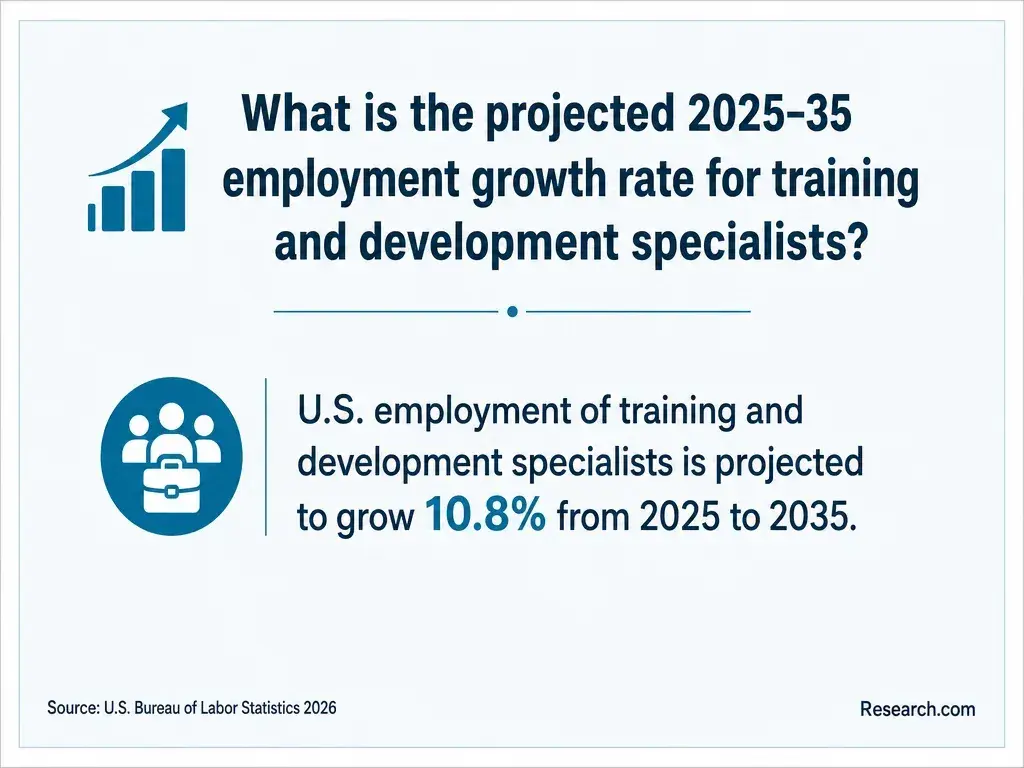
The U.S. Bureau of Labor Statistics reports a May 2025 median annual salary of $133,000 for training and development managers and projects 6.4% employment growth for that occupation from 2025 to 2035. This is a useful market reference for an experienced professional pursuing management responsibilities, not an Ed.D. graduate salary or a forecast of succession-planning openings.
Compensation depends on the role, sector, location, and responsibilities. A position that owns enterprise succession decisions may require substantial talent-management and executive-partnership experience; completing a doctorate alone does not establish that readiness. Compare actual job postings and internal promotion criteria with your current experience before estimating a financial return.
Do Ed.D. graduates need licenses or professional certifications?
Succession planning and most corporate learning-and-development work do not have a general state license conferred by an Ed.D. Employers may value particular HR, coaching, or change-management credentials, but those are separate qualifications with their own requirements. Choose one only if it addresses a skill gap or appears in roles you are targeting.
School leadership is different. A broadly focused organizational leadership doctorate does not automatically qualify someone for principal or superintendent licensure. If your target job is regulated, ask the program about its licensure disclosures and confirm eligibility with the relevant state authority before enrolling.
Other Things You Should Know About EdD Leadership
Possibly. A project could focus on role requirements, development processes, or appropriately aggregated information. Confirm the scope with your faculty advisor and obtain organizational approval before collecting or sharing data.
Yes, but it may focus on a few essential roles and continuity risks rather than a large leadership pipeline. The process should fit the organization's size and decision-making capacity.
Do not treat an automated score as a substitute for accountable human judgment. Any proposed tool needs scrutiny for data quality, privacy, fairness, and whether its criteria genuinely reflect the role.
Tell your faculty advisor promptly and check whether another authorized sponsor can support the approved scope. Have a feasible alternative site or question in mind, but do not assume a project change will be approved automatically.
- Cost of Attendance (Budget) | 2025-2026 Federal Student Aid Handbook https://fsapartners.ed.gov/knowledge-center/fsa-handbook/2025-2026/vol3/ch2-cost-attendance-budget
- Types of Financial Aid: Grants, Work-Study, and Loans | studentaid.gov https://studentaid.gov/understand-aid/types
- Selection Process | U.S. Office of Personnel Management https://www.opm.gov/policy-data-oversight/senior-executive-service/selection-process/
- Maximizing the Impact and ROI of Leadership Development | nih.gov https://pmc.ncbi.nlm.nih.gov/articles/PMC11505461/
- Succession Planning Desk Guide | usgs.gov https://www.usgs.gov/human-capital/succession-planning-desk-guide-0
- Estimate your college cost | usa.gov https://www.usa.gov/estimate-college-cost
- Leadership and Learning in Organizations Online Ed.D. | Peabody College of Education and Human Development https://peabody.vanderbilt.edu/academics/edd-programs/online-leadership-learning-organizations/
- 5 Steps for Building an Effective Succession Plan | UNC Executive Development https://execdev.unc.edu/5-steps-building-effective-succession-plan/
- Online Ed.D. in Leadership and Learning in Organizations | VU-EDU https://peabodyonline.vanderbilt.edu/edd-in-organizational-learning/
- 2026 UNC Online EdD in Organizational Learning & Leadership https://online.unc.edu/online-doctoral-programs/online-edd-organizational-learning-and-leadership/