2027 Online Ed.D. in Leadership and Learning in Organizations: How to Evaluate a Required Research Proposal
Audited and Verified:
Our Editorial and Data Verification Process
Research.com uses government datasets, official education statistics and primary institutional information to support its career and degree guides. Our review process checks factual accuracy, occupational definitions, source dates and the requirements associated with the credentials discussed.
How This Article Was Fact-Checked
Our editorial team verifies salary estimates, employment projections, education requirements and program information against original data providers and official organizations. Salary figures are checked against the relevant occupational definitions and reporting periods. Information about licensure, accreditation and required in-person training is reviewed separately.
Fact-checked and verified on:

Co-Founder and Chief Data Scientist
A required research proposal can reveal more about an online Ed.D. than its course list does. For experienced leaders and learning professionals, the crucial distinction is whether the school expects a preliminary idea for admission or a feasible, approved study later in the degree.
That difference affects how much evidence, organizational access, and methodological preparation you need before applying. This guide explains what a strong proposal requirement asks you to demonstrate, how to assess the support behind it, and when the requirement may signal that a different program or preparation route is a better fit.
Key Things You Should Know
- Confirm when the proposal is due and what it does. An admissions concept, a course assignment, and an approved doctoral research plan are different requirements.
- Evaluate the proposed question against three practical constraints: a decision the organization needs to make, evidence you can reasonably obtain, and the school's ethics and approval rules.
- A strong program publishes the proposal criteria and explains who guides revisions; a required proposal should not depend on applicants already possessing restricted workplace data or guaranteed project approval.
What Is an Online Ed.D. in Leadership and Learning in Organizations?
An Ed.D. in leadership and learning in organizations is a practice-oriented doctorate concerned with how people learn, lead, and implement change at work. Students may examine leadership development, workforce learning, organizational culture, or program effectiveness across business, education, healthcare, government, and nonprofit settings. "Online" describes where much instruction occurs; it does not establish that classes are self-paced or that meetings, teamwork, or campus visits are optional.
Program names and final projects vary. One school may require a dissertation in practice, another a capstone or research dissertation. Check the actual award and curriculum rather than inferring a formal specialty from a course title. Choosing between Ed.D. academic concentrations is useful when the proposed research problem fits organizational learning better than school administration or another leadership focus.
What Does a Required Ed.D. Research Proposal Include?
A proposal explains a problem worth investigating, the evidence needed to examine it, and what the inquiry could help an organization decide. At admission, it may be a brief demonstration of research reasoning rather than a binding dissertation plan. At the doctoral approval stage, the institution may require substantially more detail.
The usual components connect the practical problem to a feasible study. The exact length and format belong to the program's instructions.
- Problem and setting: Identify the organizational learning or leadership challenge, who is affected, and why it merits inquiry without claiming an unverified cause.
- Purpose and question: State a question narrow enough to investigate and a decision the findings could inform.
- Relevant evidence: Summarize existing scholarship or organizational information, distinguish what is known from what is assumed, and acknowledge important gaps.
- Proposed design: Explain potential participants or units, measures or interview topics, timing, and why qualitative, quantitative, or mixed methods suit the question.
- Feasibility and safeguards: Identify possible data sources, access dependencies, confidentiality risks, approvals, limitations, and a realistic scope.
For example, a leader could propose studying whether a new supervisor-development process helps participants apply specific coaching practices. That is a proposed question, not evidence that coaching improved. A survey of participant satisfaction alone would not establish workplace behavior change, much less prove that the program caused it.
How Do You Evaluate an Ed.D. Research Proposal Requirement?
Start by locating the requirement in the student journey. A school asking applicants to describe an area of interest is testing fit differently from one requiring a defended research design before students can advance. The distinction is especially important if your organization has not yet authorized a project.
This comparison shows what each type of requirement can reasonably tell you about readiness and program support.
| Requirement | What it generally evaluates | What to verify |
| Admissions proposal or concept statement | Problem framing, alignment with the degree, and potential for applied inquiry | Length, scoring criteria, whether a project site is required, and whether the topic can change |
| Course-based proposal | Developing methods and incorporating faculty feedback | Which courses provide preparation and how revisions are assessed |
| Formal project or dissertation proposal | Readiness to undertake the approved doctoral study | Advisor and committee roles, review stages, site permissions, and research-ethics procedures |
Then request the prompt and rubric, a sample schedule of proposal milestones, and the policy for changing topics or project sites. Ask who provides methods guidance and what happens if an employer withdraws access. Separate academic approval from an employer's permission to use records: neither automatically supplies the other. The institution must determine whether research review is required; employee records, student information, and interviews may also trigger privacy, consent, or data-use obligations.
If you previously completed doctoral coursework elsewhere, ask whether the program evaluates that work before assuming you must start a new proposal. Education doctorate ABD program options may warrant comparison, but prior doctoral standing does not guarantee admission, transferred credits, or acceptance of an earlier study plan.
Verify that the degree-granting institution holds recognized institutional accreditation and that the accreditation covers the institution awarding the doctorate. Confirm its status through the accreditor and the U.S. Department of Education's accreditation information, not through an advertisement alone. Ask the university whether any additional programmatic recognition applies to this particular Ed.D.; do not assume a similarly named education program shares it.
Accreditation is a baseline institutional check, not a substitute for reviewing the proposal process. An accredited university can still have a project model, faculty capacity, or site-access requirement that does not fit your circumstances. Nor does institutional accreditation establish eligibility for a regulated school-leadership credential.
Look for a sequence that helps students move from an organizational problem to a defensible design: research-question development, literature review, qualitative and quantitative methods, measurement, program evaluation, and research ethics. Adult learning and organizational change courses can provide context, but they do not replace instruction in sampling, data interpretation, or the limits of causal claims.
Compare the course sequence with the proposal deadline. If a detailed design is due before methods training, ask what preparation applicants are expected to bring and what feedback is available. If your intended project uses employee interviews or learning analytics, ask whether faculty can advise on those methods and on confidential data handling. A course appearing in the catalog does not establish that it will be offered before your proposal milestone.
Requirements differ by institution and entry term. Schools may assess prior degrees, transcripts, professional experience, recommendations, a statement of purpose, and a proposal or description of an organizational problem. Some may specify graduate coursework or an interview. Distinguish a formal eligibility rule from evidence that makes an application stronger: a senior title or prior publication is not a universal prerequisite.
For a proposal-focused application, document decisions you have actually influenced, the learning or change problem you have observed, and what remains uncertain. Do not present employer cooperation, access to confidential records, or project outcomes as secured when they are not. Ask admissions whether a provisional topic is acceptable and whether the program permits research at an external organization.
Applicants with an education specialist degree should also distinguish eligibility from credit transfer. Comparing Ed.S.-to-Ed.D. program options can help frame the inquiry, but only the receiving institution can determine whether prior credits apply to its doctoral requirements.
Completion time depends on required credits, enrollment pace, course availability, proposal review, data collection, and final-project revisions. Request a term-by-term plan that shows when methods courses and proposal approvals occur, plus the school's policy if organizational access or employment changes delay the project. An advertised completion schedule may not account for those contingencies.
For cost, calculate required credits against the published tuition schedule, then add mandatory fees, books or technology, any campus travel, and possible continuation charges during research. Confirm whether employer reimbursement depends on grades, continued employment, or payment after each term. Affordable distance learning education doctorates can be a starting point for comparison, but obtain a current, program-specific cost estimate before committing.
The strongest fit is often an experienced learning-and-development professional, organizational leader, or program manager who wants to investigate and improve a problem within their existing field. Depending on prior experience, relevant work may include training leadership, organizational development, consulting, workforce initiatives, or education administration. The proposal can become evidence of how you frame decisions, but an uncompleted study is not proof of results.
Match the degree to the responsibilities you want, not just the title you hope to hold. If your goal is cross-sector management rather than organizational learning research, compare the curriculum with affordable online organizational leadership doctorates and with shorter employer-sponsored leadership development. Neither doctorate substitutes for the managerial experience a particular employer requires.
There is no single Ed.D. graduate salary: employers pay for specific roles, responsibilities, sectors, and experience. U.S. Bureau of Labor Statistics data place the median annual pay for training and development managers at $133,000 in May 2025. That occupational median is not an entry salary or a forecast of what earning the doctorate will add to your pay.
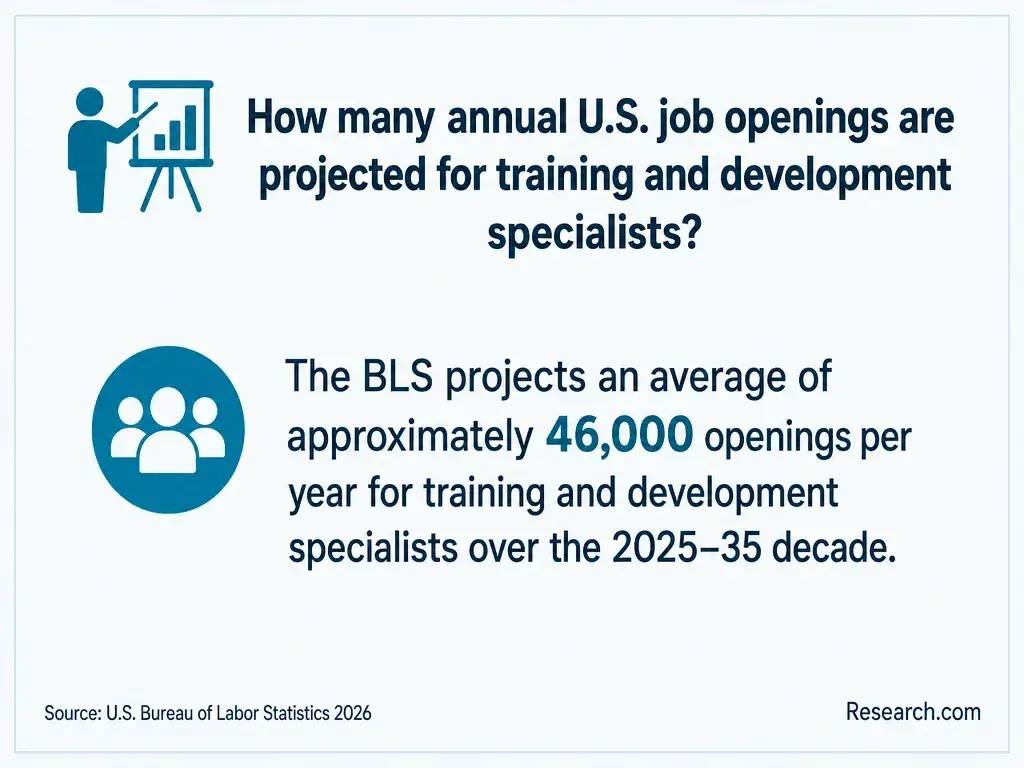
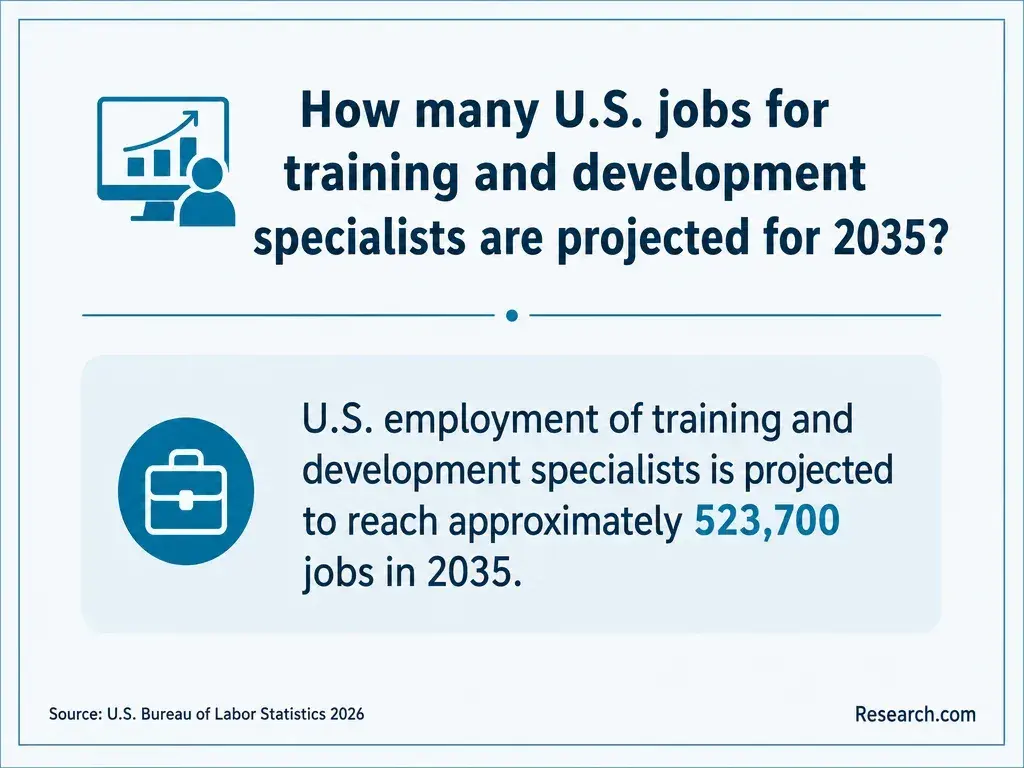
For an adjacent but different role, BLS projects 10.8% employment growth for training and development specialists from 2025 to 2035. Growth indicates demand for that occupation, not a guaranteed opening for Ed.D. holders. Use the responsibilities and qualifications in your target employers' postings - not a broad salary figure - to judge the degree's career value.
Do Ed.D. Graduates Need Licensure or Professional Certification?
Organizational learning and development roles generally do not have a universal doctorate-specific license. An employer may value a professional certification, but its requirements are separate from Ed.D. admission and graduation. For K-12 principal, superintendent, teaching, counseling, or other regulated roles, check the applicable state authority and the university's licensure disclosures before enrolling.
A research proposal about schools does not turn a general leadership-and-learning Ed.D. into a state-approved administrator preparation program. If licensure is the career objective, verify the exact program's approval and your individual eligibility in the state where you intend to practice.
Other Things You Should Know About EdD Leadership
Usually, provided each submission follows that school's prompt and honestly explains its program fit. Check each institution's rules on previously submitted work.
No. A credible proposal identifies what remains unknown and how evidence could inform a decision; it should not promise favorable findings.
Check the program's applicant-integrity policy. Verify every citation and claim yourself, disclose AI use if required, and do not enter confidential workplace information into an unapproved tool.
Only if you are authorized to use and describe it. Ask about confidentiality, cite it according to the application's instructions, and use a public or appropriately generalized description when permission is unavailable.
- Back to the basics: guidance for formulating good research questions - PMC https://pmc.ncbi.nlm.nih.gov/articles/PMC11129835/
- Advance Your Leadership With an Online Ed.D | SUNY Empire https://sunyempire.edu/academics/graduate-academics/doctorate/educational-leadership-change.html
- 2026 UNC Online EdD in Organizational Learning & Leadership https://online.unc.edu/online-doctoral-programs/online-edd-organizational-learning-and-leadership/
- Ethical considerations when collecting, using, or sharing primary data - UK Data Service https://ukdataservice.ac.uk/learning-hub/data-producer-support/legal-and-ethical-responsibilities/ethical-responsibilities/ethical-considerations-when-collecting-using-or-sharing-primary-data/
- Project Proposal Requirements | umn.edu https://ugresearch.umn.edu/project-proposal-tips
- Leadership Development and Organizational Change | The ILR School https://www.ilr.cornell.edu/programs/professional-education/topic/leadership-development-and-organizational-change
- Educational Leadership, Evaluation & Organizational Development | UofL | Information Technology Services https://education.louisville.edu/academic-programs/academic-departments/department-leadership-evaluation-and-development
- Advance Your Leadership Career with an Online Ed.D. | UMass Global https://www.umassglobal.edu/blog-news/advance-your-leadership-career-online-edd
- How to Choose a Global Leadership Dissertation Topic | Pepperdine University https://gsep.pepperdine.edu/blog/posts/how-to-choose-global-leadership-dissertation-topic.htm
- Comprehensive Admissions Review Criteria - Graduate School https://graduateschool.colostate.edu/comprehensive-admissions-review-criteria/