2027 Online Ed.D. in Leadership and Learning in Organizations: Comparing Coursework in Leadership Succession
Audited and Verified:
Our Editorial and Data Verification Process
Research.com uses government datasets, official education statistics and primary institutional information to support its career and degree guides. Our review process checks factual accuracy, occupational definitions, source dates and the requirements associated with the credentials discussed.
How This Article Was Fact-Checked
Our editorial team verifies salary estimates, employment projections, education requirements and program information against original data providers and official organizations. Salary figures are checked against the relevant occupational definitions and reporting periods. Information about licensure, accreditation and required in-person training is reviewed separately.
Fact-checked and verified on:

Co-Founder and Chief Data Scientist
Leadership succession takes more than naming someone to fill a vacancy. Organizations need ways to identify future leadership needs, develop people for those responsibilities, and test whether the plan works. If you are considering an online Ed.D. in Leadership and Learning in Organizations, the useful comparison is not whether a catalog mentions "succession," but whether its courses let you practice those decisions. This guide shows experienced leaders and learning professionals what to look for in coursework, applied projects, and program requirements - and when a shorter development route may be enough.
Key Things You Should Know
- Strong succession preparation connects organizational strategy, talent assessment, adult learning, and evaluation; a course title alone does not establish that depth.
- Compare what you can actually produce - such as a leadership-role analysis, development plan, and evaluation design - not just whether a program offers leadership electives.
- The US median annual salary for training and development managers was $133,000 in May 2025, but that occupational figure is not a predicted salary or promotion for Ed.D. graduates.
What is an online Ed.D. in Leadership and Learning in Organizations?
An online Ed.D. in leadership and organizational learning is a practice-oriented doctorate concerned with how people lead, learn, and implement change at work. Programs with similar names can differ substantially: one may emphasize adult learning and workforce development, while another concentrates on education administration or organizational change. The precise degree title, required courses, and final project must be checked at each institution.
For succession work, the Ed.D. is most useful when a leader must investigate a recurring organizational problem: for example, why promising managers are not prepared to assume critical roles. A research-oriented PhD may better fit someone seeking to build generalizable theory; an employer leadership program or focused talent-development course may be more direct if the goal is simply to improve an existing succession process. Applicants who have already completed doctoral coursework should ask how that work would be evaluated rather than assuming an accelerated route; prior doctoral credit considerations in Ed.D. completion programs are a separate issue from the relevance of prior learning.
How does leadership succession coursework prepare organizational leaders?
Leadership succession is the continuing process of preparing people and organizational systems for changes in key roles. It differs from replacement planning, which focuses primarily on who could step in when a position opens. Useful coursework connects future-role requirements to development opportunities and tests assumptions about readiness instead of treating a manager's nomination as proof.
The comparison below shows what to look for in syllabi and assignments. A program need not use these exact course names, but it should provide a credible way to develop the capabilities your role requires.
| Coursework focus | Useful succession application | Limitation to check |
| Strategy and organizational diagnosis | Identify critical roles and capabilities needed for the organization's direction. | Does the work examine systems and role requirements, not just individual leadership styles? |
| Talent development and adult learning | Design coaching, stretch assignments, or learning experiences for potential successors. | Are development choices tied to observable responsibilities and opportunities to practice? |
| Leadership assessment and ethics | Examine how readiness judgments are made and who may be overlooked. | Are evidence quality, confidentiality, and fair access addressed? |
| Research methods and evaluation | Assess whether development activities improve readiness using appropriate measures. | Does the program teach the limits of small samples and self-reported gains? |
A meaningful applied assignment might ask you to define a role's future demands, propose a development pathway, and specify how readiness would be assessed. It should not require you to disclose confidential personnel ratings without permission. Even strong coursework cannot substitute for actual authority to make staffing decisions or experience coaching people over time.
Is an online Ed.D. in Leadership and Learning accredited?
Accreditation applies to a specific institution or, where applicable, a program - not to the phrase "online Ed.D." Check the institution's current accreditation status with its recognized accreditor and confirm that the institution awards the advertised doctoral degree. If a school claims specialized recognition, verify its scope separately rather than assuming institutional accreditation covers every professional purpose.
Accreditation alone does not show that a curriculum covers succession planning, qualify a graduate for a professional certification, or confer teacher or school-administrator licensure. Ask for the current catalog and licensure disclosures if a regulated education role is part of your plan.
Course catalogs often combine leadership theory, organizational change, adult learning, and research methods. For a succession-focused comparison, examine the required sequence first: can you move from diagnosing leadership needs to designing development and evaluating results? Then check whether electives in talent management, coaching, assessment, or workforce learning are offered during your enrollment, rather than merely appearing in a catalog.
Methods coursework matters because succession decisions often rely on incomplete evidence. Interviews may reveal how leaders define readiness; organizational records may show access to development opportunities; evaluation courses can help you distinguish participation in training from demonstrated capability. Ask whether these methods can be applied to a faculty-approved workplace project and what supervision is available. A course mentioning talent management does not, by itself, constitute a formal succession concentration or advanced assessment qualification.
Requirements vary by institution and entry term. Programs may evaluate prior degrees and graduate work, academic performance, recommendations, a statement of purpose, and relevant professional experience. Some may request an interview or evidence that an applicant can pursue applied inquiry. An education master's degree, a particular job title, and a fixed number of leadership years should not be assumed to be universal requirements.
For a succession-focused application, describe decisions you have actually influenced: perhaps designing manager development, evaluating workforce needs, or leading a cross-functional change. Explain a problem you want to investigate without claiming access to confidential talent data you have not been authorized to use. If you hold an education specialist degree, ask admissions which credits establish eligibility and which, if any, apply to the doctorate; doctoral progression after an education specialist degree depends on the receiving institution's written evaluation.
Completion time depends on the school's required credits, course sequence, enrollment pace, and final-project rules. Online delivery does not necessarily mean self-paced study: live sessions, cohort courses, group assignments, campus convenings, and project approvals can affect your schedule.
Ask for a term-by-term plan that identifies when research courses and the final project begin. If you hope to study faster, compare the actual sequencing and project milestones - not just the advertised minimum duration. Guidance on choosing an accelerated Ed.D. study route can help frame that comparison, but your institution must confirm the schedule available to your entering cohort.
Without a named institution and entry term, there is no defensible single price. Request a written estimate covering the required credits or terms, tuition, mandatory fees, technology charges, any campus travel, and likely costs if the final project extends beyond the planned schedule. Compare online Ed.D. fees and cost comparisons against each school's own current charges.
For a succession project, also consider the time spent securing organizational approvals and conducting an evaluation. Employer reimbursement may help, but confirm eligibility, annual limits, grade requirements, and any obligation to remain employed. If a shorter leadership-development course would solve your immediate problem, compare its total cost with the doctorate before committing.
Succession expertise can support advancement in learning and development, talent management, organizational development, workforce planning, and consulting. Training and development managers may oversee leadership programs; organizational consultants may help clients diagnose pipeline gaps; senior talent leaders may coordinate assessment and development across departments. These roles differ in their expectations for managerial experience, analytics, facilitation, and industry knowledge.
An Ed.D. can strengthen an experienced professional's ability to investigate and communicate an organizational problem. It does not itself confer hiring authority, qualify someone for an executive post, or replace evidence that they have implemented development initiatives. If you are entering talent development from another function, a supervised internal project and mentorship may build more immediate credibility than doctoral enrollment alone.
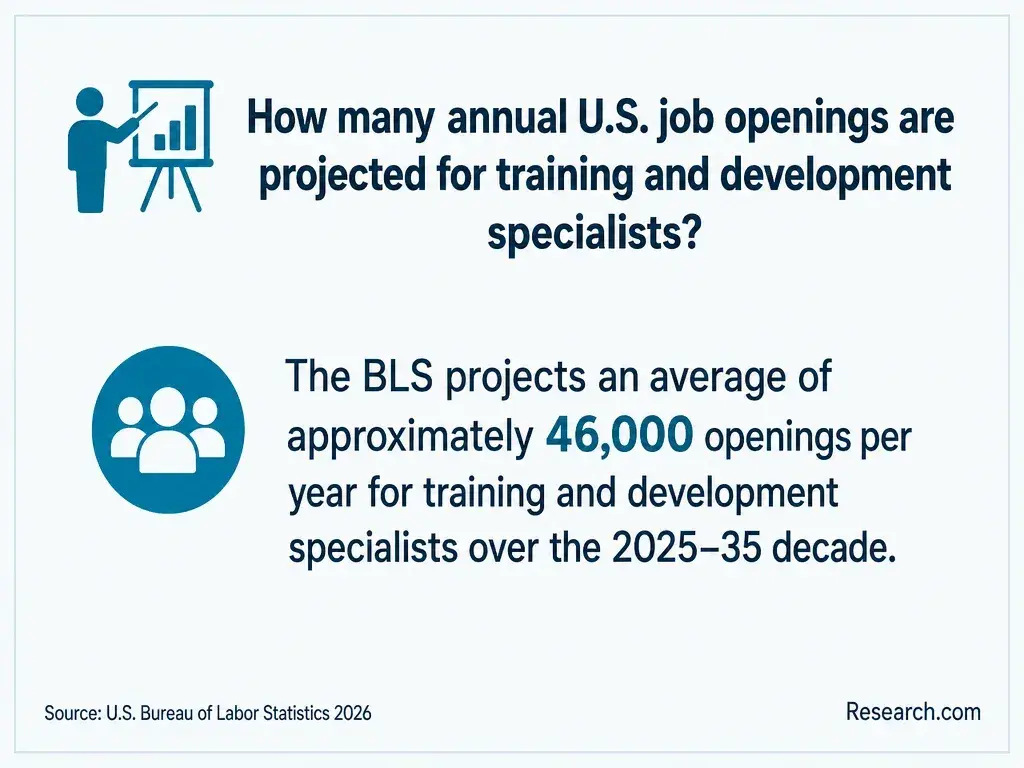
The US Bureau of Labor Statistics reports a May 2025 median annual salary of $133,000 for training and development managers and projects 6.4% employment growth for that occupation from 2025 to 2035. The figures describe an occupation, not Ed.D. alumni: compensation depends on responsibilities, employer, location, sector, and prior experience.
Use occupational data to test whether a target role is plausible, then examine actual job postings and your employer's promotion criteria. A succession-focused doctorate may be professionally valuable without producing a measurable salary increase, particularly when your organization can support the same work through existing leadership development.
How should you choose an online Ed.D. in Leadership and Learning program?
Start with the succession decision you want to become better equipped to make. A leader designing an organization-wide pipeline needs different coursework from a learning professional evaluating one manager-development program. Before applying, compare programs using evidence you can obtain from catalogs, sample syllabi, and program staff:
- Identify the required courses and available electives that address role analysis, leadership development, assessment ethics, and evaluation.
- Request examples of permitted final-project formats and ask whether a succession-related topic would be feasible under faculty supervision.
- Confirm live attendance, group work, convenings, and the project timeline against your work responsibilities.
- Ask who approves organizational access, what data may be used, and how a project can proceed if your employer cannot share personnel records.
- Compare the full written cost and likely professional benefit with an employer program, targeted coursework, or mentored project.
Use evaluating the cost of an online education doctorate to broaden the financial comparison, but make your final choice on verified program requirements and the work you expect to do. If a program cannot show how its curriculum supports your succession objective, its degree title is not enough reason to enroll.
Other Things You Should Know About EdD Leadership
Yes. An assignment can begin with identifying critical roles and development needs. Present it as a proposal, not an approved organizational plan, unless leaders have authorized the work.
It can. Emergency coverage identifies who can maintain essential operations now; long-term succession develops people for future responsibilities. A useful course distinguishes the two.
Follow your organization's policies and the program's ethical requirements. Do not use identifiable assessments or interview employees for an academic project without checking permission, privacy protections, and any required review.
They should not be treated as independent decision-makers. Any proposed use needs scrutiny for data quality, bias, confidentiality, explainability, and applicable employment rules, with accountable human oversight.
- Succession Planning Desk Guide | usgs.gov https://www.usgs.gov/human-capital/succession-planning-desk-guide-0
- Curriculum development: a how to primer - PMC - NIH https://pmc.ncbi.nlm.nih.gov/articles/PMC6910735/
- Succession Planning Essentials | U.S. Office of Personnel Management https://www.opm.gov/agency-services/training-and-development/for-individuals/skill-building-courses/succession-planning-essentials/
- 5 Steps for Building an Effective Succession Plan | UNC Executive Development https://execdev.unc.edu/5-steps-building-effective-succession-plan/
- Online Doctor of Education in Leadership and Innovation | Purdue Global https://www.purdueglobal.edu/degree-programs/education/doctor-education-leadership-innovation/
- Online Ed.D. in Leadership and Learning in Organizations | VU-EDU https://peabodyonline.vanderbilt.edu/edd-in-organizational-learning/
- UNC EdD Online: Organizational Learning and Leadership https://online.unc.edu/online-doctoral-programs/online-edd-organizational-learning-and-leadership/
- Components of Curriculum - Adult and Community Learning Services (ACLS) https://www.doe.mass.edu/acls/frameworks/components.html