2027 Online Ed.D. in Leadership and Learning in Organizations: Choosing a Public Sector Capstone Partner
Audited and Verified:
Our Editorial and Data Verification Process
Research.com uses government datasets, official education statistics and primary institutional information to support its career and degree guides. Our review process checks factual accuracy, occupational definitions, source dates and the requirements associated with the credentials discussed.
How This Article Was Fact-Checked
Our editorial team verifies salary estimates, employment projections, education requirements and program information against original data providers and official organizations. Salary figures are checked against the relevant occupational definitions and reporting periods. Information about licensure, accreditation and required in-person training is reviewed separately.
Fact-checked and verified on:

Co-Founder and Chief Data Scientist
A public agency may have a compelling workforce or learning problem but still be the wrong capstone partner if it cannot authorize data access, support the project timeline, or approve a useful deliverable.
This guide is for public sector and education professionals considering an online Ed.D. in leadership and learning in organizations. It explains how to assess potential partners, separate organizational permission from academic approval, and plan for privacy and leadership changes. The goal is to help you select a project setting that serves a public need and can support doctoral work.
Key Things You Should Know
- Choose a partner with a specific learning or organizational problem, an authorized sponsor, feasible evidence, and time to participate - not simply a prestigious agency name.
- Before committing, confirm the program's capstone rules and separately obtain organizational permission, data authorization, and any required ethics review.
- Public sector salary upside is not assured: the Bureau of Labor Statistics reports a $133,000 median annual salary for training and development managers in 2025, but that occupational figure is not an Ed.D. graduate outcome.
What Is an Online Ed.D. in Leadership and Learning in Organizations?
An Ed.D. in leadership and learning in organizations is a practice-oriented doctorate focused on how people learn, how organizations change, and how leaders use evidence to improve practice. "Online" describes the delivery of coursework; it does not establish that classes are self-paced or that a capstone can be completed remotely without meetings, site access, or faculty supervision. Program names and final-project requirements vary.
A capstone or dissertation in practice generally applies inquiry to a defined organizational problem. It is not automatically the same as a consulting contract or a conventional research dissertation. For a public sector project, the distinction matters: a useful agency report may not meet doctoral assessment standards, while an academically strong study may require permissions the agency cannot grant.
If your goal is targeted leadership training rather than a doctoral project, compare the commitment with lower-cost distance learning in doctoral leadership study and shorter professional-development options before enrolling.
How Does an Online Ed.D. Prepare Students for Public Sector Leadership?
Relevant preparation combines organizational diagnosis, adult learning, change leadership, and applied evaluation. A student might examine why staff are not using a new case-management process, then distinguish a training gap from a software, staffing, or policy problem. That reasoning is more useful than assuming another workshop will fix implementation.
Public agencies operate under appropriations, procurement rules, records obligations, collective-bargaining arrangements, and multiple lines of accountability. An Ed.D. project can help a leader work within those constraints, but coursework cannot confer decision authority. The strongest partner is often a unit where the student can reach both operational staff and a sponsor empowered to consider the findings.
For an agency with limited education assistance, compare the proposed degree against online doctorates in education with affordable study routes and employer-sponsored training. A smaller credential or a supervised improvement project may be sufficient if the immediate need is a specific management skill.
How Do You Choose a Public Sector Capstone Partner?
The best partner is the organization that can support a bounded, approved inquiry - not necessarily the largest agency or the one with the most urgent problem. Start with a question the organization needs answered, such as whether a revised supervisor onboarding process is being implemented as intended. Avoid promising to prove that the process caused better employee retention when the available design cannot support that conclusion.
Partner settings offer different opportunities and constraints. This comparison helps you recognize likely access issues before developing a proposal.
| Potential setting | Potential project fit | Common constraint to investigate |
| Current government employer | Existing knowledge of workflows and stakeholders | Whether job access also permits student research or publication |
| School district or public college | Professional learning or service-delivery evaluation | Student-record protections, calendars, and separate research approvals |
| External public agency | A problem beyond the student's own unit | Time needed to establish sponsorship and authorized access |
| Multiagency initiative | A shared workforce or coordination problem | Different authorities, data rules, and decision timelines |
Use the following sequence to test a prospective partnership before either side invests heavily in project design:
- Check academic fit first. Ask the faculty advisor or program coordinator what final deliverable, site approval, methods, team arrangements, and project milestones the program requires. Do not assume an external placement is permitted.
- Identify an accountable sponsor. Ask who owns the problem, can authorize staff participation, and will review findings. Also identify a day-to-day contact; a senior endorsement alone may not keep the work moving.
- Bound the question and evidence. Agree on the population, process, available baseline information, feasible measures, and what the project will not establish. Test whether the data can be obtained within the academic timetable.
- Separate permissions. Document organizational approval, data-use terms, any employee or learner consent requirements, and the university's determination about institutional review. FERPA may apply to education records; personnel and other restricted records have their own rules. An agency's willingness to collaborate does not replace any required review.
- Set deliverables and contingencies. Clarify who receives a briefing or report, what may be shared academically or in a portfolio, how confidential information will be protected, and what happens if a sponsor leaves or access is withdrawn.
Before agreeing, ask the agency contact: "Who can approve access and review the final product, and can those decisions be made before my program's proposal deadline?" Ask the faculty advisor: "Would the proposed setting and evidence meet our capstone requirements if access is limited to aggregated records?" If either answer is uncertain, narrow the project, seek another data source, or identify a backup partner. No agreement should promise findings or benefits before the inquiry is complete.
Confirm that the university holds recognized institutional accreditation and that it covers the institution awarding the Ed.D. Then verify the exact degree, delivery format, and capstone requirements with the program. Accreditation establishes institutional oversight; it does not certify that a proposed public agency will be approved as a project site.
A broadly focused leadership Ed.D. also does not automatically qualify a graduate for teacher, principal, or superintendent licensure. If a regulated education role is your goal, check the program's licensure disclosures and the relevant state authority's rules before treating the degree as a pathway to that position.
Coursework may address adult learning, organizational culture, leadership, research methods, and program evaluation. For partner selection, the most important question is whether the program teaches you to turn a public-service concern into a feasible inquiry: define the problem, select credible measures, interpret limitations, and communicate findings to people who can act on them.
Examine the actual curriculum and faculty guidance rather than assuming every program provides advanced training in public administration, statistical analysis, or data security. A student planning to evaluate agency training, for example, needs enough methods preparation to distinguish participation and satisfaction from learning transfer or operational improvement. The partner must also be willing to examine possible nontraining causes of the problem.
Requirements vary by program. Schools may review prior graduate study, professional responsibilities, academic records, recommendations, and a statement of purpose. A public sector applicant can strengthen a proposed project by documenting decisions they have helped make, stakeholders they have worked with, and a problem they can investigate without claiming access or approvals they do not yet have.
Ask admissions staff whether an external partner is needed at application, before capstone proposal approval, or later. Also distinguish graduate coursework that supports admission from credits the school will actually apply to the doctorate. Applicants returning after an education specialist degree can explore advanced study options after an Ed.S., but only the admitting institution can determine credit applicability.
Completion time depends on required credits, course sequencing, enrollment pace, and the final project. A public agency's approval calendar can extend a capstone even when coursework is on schedule. Confirm live-class attendance, any campus convenings, and the deadline by which a project site must be secured; online delivery does not eliminate those commitments.
Request a written estimate covering tuition and mandatory fees, travel if required, and continuation charges if the project takes longer than planned. Include any unpaid work time or project travel in your own budget.
Employer reimbursement may depend on continued employment or course completion, so treat it as conditional until you have the policy in writing. If timing is decisive, compare faster routes through an education doctorate while checking whether their capstone schedule is realistic for your prospective agency.
Depending on experience, graduates may pursue public workforce-development leadership, agency training management, organizational improvement, higher education administration, or evaluation and consulting roles. The capstone can provide evidence of how you framed a problem and worked across stakeholders, but it does not replace required sector experience, civil-service hiring procedures, or role-specific credentials.
Choose a partner with your intended work in mind. A workforce-training project may be more relevant to a learning and development role than a broadly framed strategy report. If your goal is an internal promotion, ask whether your employer values the degree, demonstrated project leadership, or both; that answer is more useful than assuming the doctorate alone changes your eligibility.
Pay depends on the occupation, employer, location, and experience - not on the degree title alone. The Bureau of Labor Statistics reports a 2025 median annual salary of $104,590 for postsecondary education administrators. That is a national occupational median, not a starting salary or a forecast for Ed.D. graduates; a public institution's pay schedule may be more relevant to your decision.
Compare the cost of doctoral study with the positions you could realistically seek and your employer's advancement rules. Prospective higher education administrators should consider higher education leadership doctoral costs after financial aid alongside verified local job requirements and compensation.
What Is the Job Outlook for Education and Organizational Leaders?
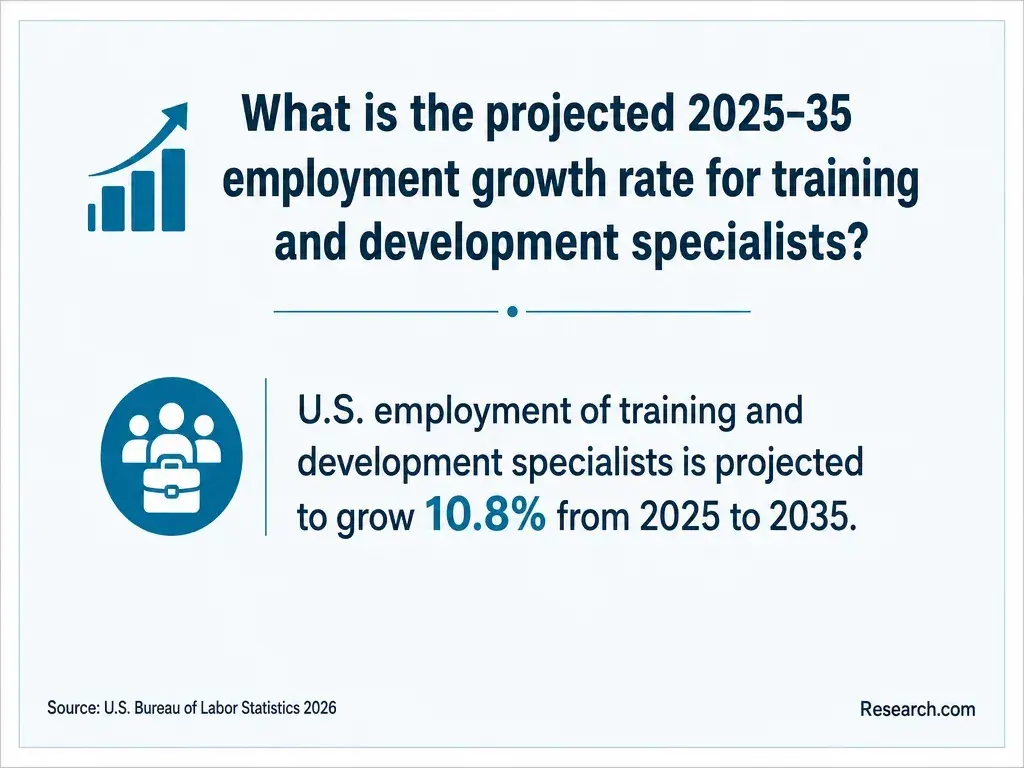
The Bureau of Labor Statistics projects 10.8% employment growth for training and development specialists from 2025 to 2035. That points to demand for the occupation, not specifically for doctorate holders or public agency capstone experience. Managerial and education-administration opportunities follow different labor markets.
For a more useful outlook, examine vacancies in your target agency type and identify whether they require public budgeting, labor relations, evaluation, staff supervision, or particular credentials. A well-chosen capstone can demonstrate some of those capabilities, but hiring decisions still depend on the full job specification and your record of responsibility.
Other Things You Should Know About EdD Leadership
Potentially, but an elected official's support may not provide operational or data-access authority. Identify the agency official who can make the necessary approvals and keep the project viable through a leadership change.
Possibly, if the program accepts that project design. Check the data's terms of use, whether the information is sufficiently detailed for the question, and what academic review is required. Public availability does not by itself establish capstone approval.
Not necessarily. Clarify whether the arrangement involves payment, expenses, a formal agreement, or procurement review under agency policy. Do not assume an unpaid student project is exempt from every agency approval process.
Only if the shared question requires multiple agencies and each can meet the project timeline. Otherwise, a single-agency project with a clearly defined decision-maker is usually easier to scope and complete.
- Frequently Asked Questions | Protecting Student Privacy https://studentprivacy.ed.gov/frequently-asked-questions
- Ethical Guidelines and the Institutional Review Board - PMC https://pmc.ncbi.nlm.nih.gov/articles/PMC10885741/
- The Organizational Risks Of Cross-Sector Partnerships | PubMed https://pubmed.ncbi.nlm.nih.gov/32250681/
- Types of IRB Review | Thomas Edison State University https://www.tesu.edu/about/leadership-departments/institutional-review-board/types-of-irb-review.php
- Privacy and Confidentiality for Research Participants | University of Pittsburgh https://www.hrpo.pitt.edu/privacy-and-confidentiality-research-participants
- Capstone Partnerships | Virginia Commonwealth University https://soe.vcu.edu/academics/leadership/leadership-edd/capstone-partnerships/
- Public Service & Administration Capstone Projects | The Bush School of Government & Public Service https://bush.tamu.edu/research/capstone-projects/psa/
- Human Subjects Protection and Institutional Review Board (IRB) | NBER https://www.nber.org/programs-projects/projects-and-centers/human-subjects-protection-and-institutional-review-board-irb
- Sponsored Project Handbook - Office of Research Services | University of Pennsylvania https://researchservices.upenn.edu/resources/sponsored-project-handbook/
- Online Ed.D. in Higher Education | Rockhurst University https://onlinedegrees.rockhurst.edu/programs/online-edd-education-leadership/higher-ed