2027 Choosing an Online Ed.D. in Leadership and Learning in Organizations Around a Remote Job with Evening Meetings
Audited and Verified:
Our Editorial and Data Verification Process
Research.com uses government datasets, official education statistics and primary institutional information to support its career and degree guides. Our review process checks factual accuracy, occupational definitions, source dates and the requirements associated with the credentials discussed.
How This Article Was Fact-Checked
Our editorial team verifies salary estimates, employment projections, education requirements and program information against original data providers and official organizations. Salary figures are checked against the relevant occupational definitions and reporting periods. Information about licensure, accreditation and required in-person training is reviewed separately.
Fact-checked and verified on:

Co-Founder and Chief Data Scientist
A remote job gives you a place to study, but it does not necessarily free your evenings. If meetings regularly run late, an online Ed.D. with mandatory live classes could be harder to complete than its marketing suggests.
This guide is for working leaders and learning professionals weighing doctoral study alongside an unpredictable calendar. It explains which scheduling rules to verify, how coursework and applied research affect your week, and when a more flexible program, or a shorter credential, may be the better choice.
Key Things You Should Know
- Online does not mean self-paced: Required live classes, group meetings, and campus convenings may conflict with evening work calls.
- Check the conflict before applying: Obtain the actual meeting schedule, attendance policy, time zone, and project expectations for your entry cohort.
- Compare total commitments, not just tuition: Protect time for reading, collaboration, and applied research, especially if work meetings can move without notice.
What is an online Ed.D. in Leadership and Learning in Organizations?
An Ed.D. is a professional doctorate. A program focused on leadership and learning in organizations examines how adults learn, how organizations change, and how leaders use evidence to improve practice.
Depending on the school, students may study workplace learning, leadership development, organizational culture, and program evaluation, then complete a dissertation in practice, capstone, or another approved culminating project.
The exact degree title and requirements vary. This is not automatically a K-12 administrator preparation program, nor is it interchangeable with a research-focused PhD. For a remote professional, its value depends partly on whether the program's learning and research activities can fit around actual work obligations, not merely whether lectures are delivered online.
Is an online Ed.D. compatible with a remote job and evening meetings?
Yes, conditionally. Compatibility depends on which commitments are fixed and whether your employer can protect them. A recurring evening meeting is manageable in a program with genuinely asynchronous coursework; it may be disqualifying when a required seminar meets at the same time and absences are restricted.
The distinctions below help you compare delivery formats. They describe scheduling implications, not promises about any particular school:
| Program feature | What an evening-meeting employee should check |
| Asynchronous coursework | Whether discussions and assignments still have fixed weekday deadlines or scheduled group work |
| Live online seminars | Meeting days, time zone, attendance rules, and whether recordings count as attendance |
| Cohort and team projects | How often peers must meet outside class and who controls those meeting times |
| Campus convenings | Required dates, travel time, and whether missing a convening delays progression |
| Applied research | When interviews, approvals, data collection, and advisor meetings must occur |
A workable plan reserves separate blocks for independent study, live participation, and collaboration. Test that plan against a busy work week, not an unusually quiet one. If meetings shift between time zones, ask whether the program publishes a stable class calendar and how it handles a missed session.
Ask your manager for protected class time only if the organization can realistically honor it; an informal expression of support is not an attendance-policy exception.
Faster completion can make these conflicts more concentrated. If speed matters, use accelerated education doctorate completion planning to frame questions about course load and pacing, then confirm the actual calendar with each program. A less intensive pace may be safer than an accelerated cohort when work evenings are unpredictable.
How do you choose an accredited online Ed.D. program?
First, verify the institution's accreditation through the accreditor and the U.S. Department of Education's recognized-accreditor information. Then confirm the exact Ed.D. title, the school awarding it, and whether any claimed program-specific recognition applies to that degree. Institutional accreditation does not, by itself, establish eligibility for an educator license.
For this decision, scheduling evidence matters as much as the credential label. Compare the published course sequence and attendance policy for your intended entry term, not a general description of "flexible online learning."
Ask whether live sessions rotate, whether courses are available when you need them, and what happens if work forces a pause. If the program reports completion outcomes, request the cohort size and time period so you can interpret the figures fairly.
Common areas include adult learning, leadership theory, organizational change, research methods, and evaluation. Some programs add instructional design, talent development, or learning analytics.
Course names alone reveal little about workload: a methods course requiring interviews with organizational participants creates different scheduling demands from one centered on independent reading and analysis.
Examine the sequence as well as the catalog. Ask when group assignments begin, whether field-based work can use an approved organization other than your employer, and how often faculty meetings occur.
Programs also differ in their culminating requirements; Ed.D. programs emphasizing applied culminating work can provide comparison points, but a capstone is not necessarily lighter or more schedule-flexible than a dissertation. Verify the required deliverable and approvals directly.
Requirements vary by institution. Programs may request a completed graduate degree, transcripts, professional experience, recommendations, a statement of purpose, and evidence that the applicant can pursue an organizational problem.
Some require interviews or particular academic preparation; do not assume that an education master's, a test score, or a fixed number of management years is universal.
If your remote role provides relevant leadership or learning experience, describe decisions you have made and problems you have investigated rather than relying on your job title. Be candid about whether you can obtain permission and data for workplace-based inquiry.
Prior graduate coursework may support admission without transferring into the doctorate. Applicants with an education specialist degree can consult planning the transition from Ed.S. to Ed.D., then request a written program-specific credit evaluation.
Completion time depends on required credits, course availability, enrollment pace, and progress on the culminating project. For someone with evening meetings, the advertised fastest path is less useful than the pace you can sustain when work is busy. Ask how a missed course, leave of absence, or change in project site affects the sequence.
Request a written cost estimate covering tuition, mandatory fees, books or technology, required travel, and additional enrollment if a project takes longer than planned.
Confirm whether charges are per credit or term. Employer reimbursement may depend on continued employment, grades, or repayment conditions, so treat it as conditional until you have the policy in writing.
Readers considering an education-sector route can use reducing higher education leadership doctoral study costs to identify funding questions; compare its options with the organizational-learning curriculum you actually want.
The degree may support advancement in learning and development, organizational development, talent development, consulting, or education administration. The credible next step depends on your existing responsibilities.
A training specialist who has led evaluations and cross-functional projects may be positioned differently from a remote employee whose experience is primarily individual-contributor work.
Match programs to the work you want to perform: designing learning systems, leading organizational change, evaluating initiatives, or managing teams.
Seek opportunities to lead and document an approved project while studying. If your immediate goal is a first supervisory role or a specific technical skill, employer-sponsored leadership development or targeted training may be more direct and less costly than a doctorate.
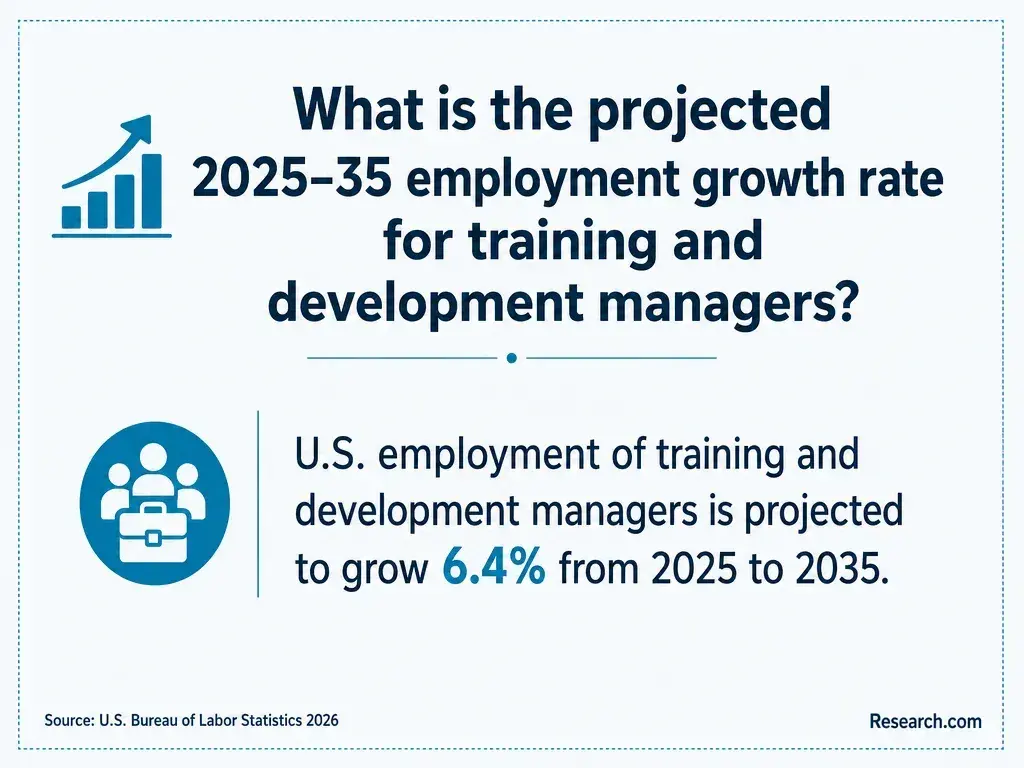
There is no reliable single salary for graduates of this degree: pay depends on the occupation, sector, location, and prior experience. The U.S. Bureau of Labor Statistics reports a May 2025 median annual salary of $133,000 for training and development managers, with employment projected to grow 6.4% from 2025 to 2035. That is an occupational benchmark, not an expected Ed.D. graduate salary or evidence that the degree causes a promotion.
Before using salary to justify enrollment, compare roles you could realistically qualify for now with roles requiring experience you still need to gain.
For a remote worker, also consider whether a proposed promotion would change meeting hours or management demands; higher pay does not necessarily make doctoral study easier to schedule.
Most general organizational learning and development roles do not have a universal license attached to this Ed.D. Employers may value relevant certifications, but requirements depend on the position.
A leadership and learning doctorate does not automatically qualify someone for teacher, principal, superintendent, or counseling licensure.
If your target job is regulated, check the relevant state authority and the program's licensure disclosure before enrolling. If it is not regulated, review actual job postings: demonstrated management, facilitation, evaluation, or sector experience may matter more than an additional credential.
How can you evaluate an online Ed.D. before enrolling?
Ask for answers tied to your intended cohort and keep them alongside your work calendar. These checks turn a broad claim of flexibility into a decision you can test:
- Request the next cohort's live-class days, time zone, convening dates, and written attendance policy.
- Map required sessions against recurring work meetings and identify conflicts you cannot move.
- Ask a program advisor how team meetings, faculty supervision, and project milestones are scheduled.
- Confirm leave, course-reentry, and project-site-change rules in case your remote job changes.
- Compare written total-cost estimates and employer-benefit conditions at a pace you can sustain.
If two programs remain viable, favor the one whose verified requirements fit your least flexible work commitments, not the one with the strongest claim of convenience.
For another cost comparison, review tuition-focused choices for a leadership doctorate, while checking that each option offers the learning focus and schedule you need. If neither program protects enough time for participation and research, postponing the Ed.D. or pursuing focused professional development is a sound decision.
Other Things You Should Know About EdD Leadership
Possibly. Ask the institution whether it can enroll students in your state and whether any required activities have location restrictions. Do not infer eligibility from the word "online."
Only within your employer's rules and the program's guidance. Describe a problem without identifying protected people or disclosing restricted records, and obtain permission before using organizational data for a project.
Often a topic can be refined, but changes may require advisor approval and can affect project milestones. Ask when the program formally approves a proposal and what happens if the original problem or site becomes unavailable.
Ask each institution about remote database access, research consultations, and document delivery. Those services can matter when you are developing a project outside normal campus hours.
- Plan and Pay for Higher Education - State Controller's Office https://www.sco.ca.gov/eo_higher_education.html
- Academic Years, Academic Calendars, Payment Periods, and Disbursements | 2025-2026 Federal Student Aid Handbook https://fsapartners.ed.gov/knowledge-center/fsa-handbook/2025-2026/vol3/ch1-academic-years-academic-calendars-payment-periods-and-disbursements
- Online Doctorate in Education and Leadership (Ed.D.) | Rockhurst University https://onlinedegrees.rockhurst.edu/online-edd-programs
- Advanced Online Ed.D. Programs at Illinois https://education.illinois.edu/online/eddonline
- EdD in Educational Leadership - The University of Alabama | UA Online https://online.ua.edu/degrees/edd-in-educational-leadership/
- What's the Difference Between Asynchronous and Synchronous Learning? | Ohio State Online https://online.osu.edu/content-hub/blogs/whats-the-difference-between-asynchronous-and-synchronous-learning/
- 2026 UNC Online EdD in Organizational Learning & Leadership https://online.unc.edu/online-doctoral-programs/online-edd-organizational-learning-and-leadership/
- What Does Asynchronous Mean? A Simple Guide to Online Learning Formats - Professional Development at Charlotte https://professional.charlotte.edu/what-does-asynchronous-mean-a-simple-guide-to-online-learning-formats/
- Online Doctor of Education in Leadership and Innovation | Purdue Global https://www.purdueglobal.edu/degree-programs/education/doctor-education-leadership-innovation/
- Online EdD in Organizational Leadership | Pepperdine University https://gsep.pepperdine.edu/doctorate-organizational-leadership/