2027 Online Ed.D. in Leadership and Learning in Organizations: Degree Fit for Leaders Tackling Professional Development That Excludes Part-Time Staff
Audited and Verified:
Our Editorial and Data Verification Process
Research.com uses government datasets, official education statistics and primary institutional information to support its career and degree guides. Our review process checks factual accuracy, occupational definitions, source dates and the requirements associated with the credentials discussed.
How This Article Was Fact-Checked
Our editorial team verifies salary estimates, employment projections, education requirements and program information against original data providers and official organizations. Salary figures are checked against the relevant occupational definitions and reporting periods. Information about licensure, accreditation and required in-person training is reviewed separately.
Fact-checked and verified on:

Co-Founder and Chief Data Scientist
Part-time staff may be eligible for professional development on paper yet unable to attend sessions scheduled outside their paid hours. For leaders responsible for workforce learning, that gap calls for more than another training course: it calls for a careful look at scheduling, compensation, access, and whose needs shape the program.
This article examines whether an online Ed.D. in leadership and learning in organizations would help you investigate and change that system - or whether a smaller intervention would serve staff sooner. It also covers the degree's practical demands, costs, and career relevance.
Key Things You Should Know
- An Ed.D. is a strong fit if you have authority to redesign professional development across teams and want advanced preparation in organizational change and applied evaluation. It is not necessary to start fixing access barriers.
- Compare participation by employment status using eligible staff - not just attendees - as the denominator, then examine paid time, shift coverage, technology access, and promotion-related training requirements before assuming the content is the problem.
- The U.S. Bureau of Labor Statistics projects 10.8% employment growth for training and development specialists from 2025 to 2035. That outlook describes an occupation, not demand for Ed.D. graduates or a return on the degree.
What is an online Ed.D. in leadership and learning in organizations?
An Ed.D. is a practice-oriented education doctorate. Programs focused on leadership and learning in organizations typically connect adult learning, organizational change, and applied inquiry to problems in workplaces or other institutions. The exact degree name, courses, and final project vary by university; "online" describes delivery, not a common curriculum or a promise of self-paced study.
For the part-time-staff problem, the useful distinction is between training design and organizational access. A leader might improve a workshop, but attendance may still depend on paid release time, supervisor approval, shift coverage, accessible materials, or eligibility rules. Doctoral study is most relevant when you need to diagnose and influence those connected systems, not simply create another course.
Is an online Ed.D. in leadership and learning worth it for working professionals?
It may be worth it if inclusive learning is a sustained leadership responsibility, rather than a single training assignment. A learning-and-development manager, nonprofit director, or public-sector workforce leader could use doctoral study to develop stronger evaluation and change-leadership skills while addressing an ongoing organizational problem. The value depends on whether the program provides relevant methods, faculty guidance, and a feasible applied-project route - and whether your employer will let you act on what you learn.
Do not wait for a doctorate to test an immediate improvement. First, establish who is eligible, who participates, and whether staff can attend during paid hours. Ask part-time employees about barriers without making them responsible for fixing management's scheduling decisions. If the main obstacle is unpaid attendance or unavailable shift coverage, a budget and policy decision may accomplish more than a new credential.
A shorter course in evaluation or adult learning, mentorship, or a supervised cross-functional project may be the better investment if your goal is to improve one program. If you do need doctoral-level preparation, compare the full commitment with affordable practice-focused education doctoral study; a lower advertised tuition figure alone does not establish that a program fits your work or budget.
What careers can an online Ed.D. in leadership and learning lead to?
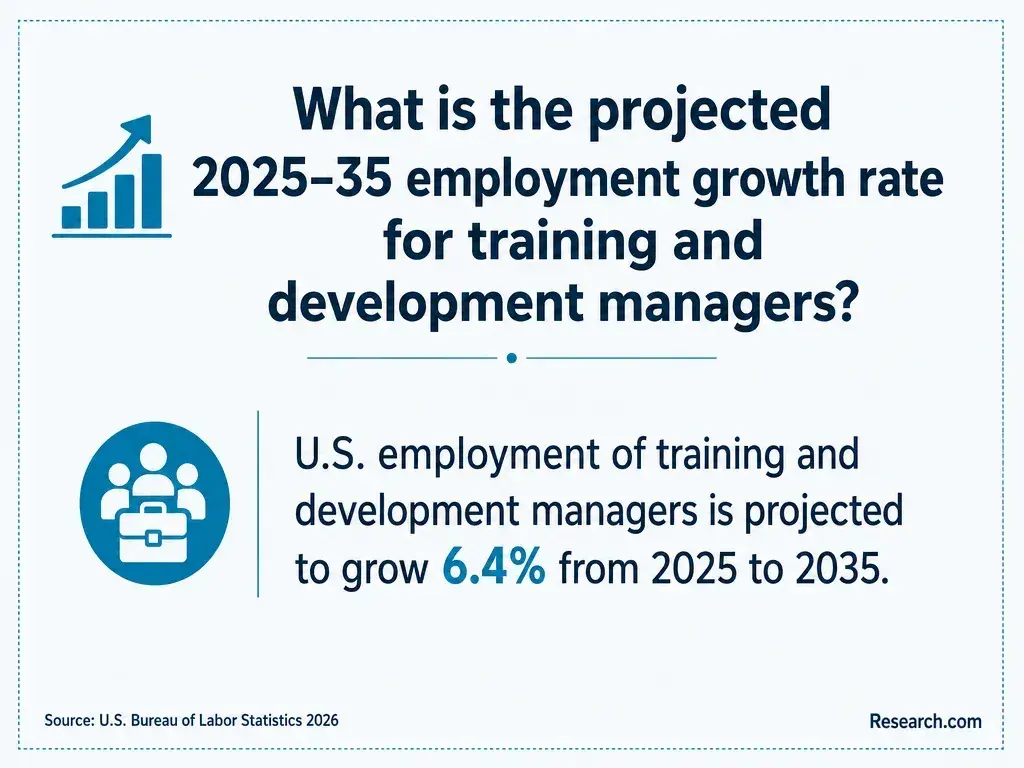
The degree can support advancement in learning and development, talent development, organizational development, workforce programs, or consulting. It does not replace the experience employers expect. A training and development specialist may design and evaluate learning; a training manager may also control strategy, staff, vendors, and budgets; an organizational consultant may diagnose performance problems and advise clients. Those are different responsibilities, even when all involve learning.
For a leader addressing part-time access, credible career evidence would include a documented eligibility review, stakeholder collaboration, an approved redesign, and a candid evaluation of participation - not a claim that the doctorate alone produced a promotion. The Bureau of Labor Statistics projects 10.8% growth for training and development specialists from 2025 to 2035, but that projection neither identifies doctorate-required jobs nor predicts openings at your employer.
Online study can let a working leader remain employed and investigate a problem in their own organization. Campus-based study may make in-person collaboration easier. Neither format is inherently more rigorous or more compatible with shift-based work: compare the actual faculty access, research support, required meetings, and final-project expectations.
Before choosing an online program, obtain its live-class schedule, attendance rules, group-work expectations, and any campus-convening dates. Ask whether project work requires access to an employer or approved external partner. Compare tuition and required travel separately; comparing online leadership doctorate program prices can help frame the price check, but program names and academic requirements must still be verified individually.
Relevant curricula may include adult learning, organizational leadership, change implementation, research methods, and program evaluation. For this particular challenge, look past course titles: can students study learning transfer, access barriers, and the difference between low attendance and low interest? Can they evaluate whether a redesign reaches part-time staff without treating a small before-and-after comparison as proof of causation?
Programs differ in electives and final requirements. Some require a dissertation in practice or another applied project; others use a different doctoral deliverable. Compare the published requirements with professional education doctorates with applied projects, and ask whether your proposed workplace question, project site, and available data could satisfy the specific program's rules. An employer's willingness to participate does not substitute for academic approval.
Requirements vary. Programs may review prior graduate education, transcripts, professional experience, recommendations, and a statement explaining the applicant's goals; some also use interviews or other requirements. An education master's degree, a senior job title, or a fixed number of leadership years should not be assumed necessary at every school.
Present your part-time-staff challenge as a problem you can investigate, not a solution you have already proved. Describe decisions you have actually influenced, what remains unknown, and whether you can seek permission to examine workplace processes. If you have unfinished doctoral study, ask admissions and the doctoral program separately about eligibility and credit applicability; reviewing Ed.D. completion programs for ABD applicants is relevant only if that is your situation. Prior credits considered during admission do not automatically shorten the new degree.
Duration and total cost depend on required credits, enrollment pace, tuition structure, fees, and the time needed to complete the doctoral project. Without a specific program's published requirements, a reliable total cannot be given. A faster advertised pathway is useful only if its live sessions, project milestones, and workload fit alongside your job; education doctorate duration comparisons are a starting point, not an individual completion estimate.
Request a written estimate covering tuition, mandatory fees, any campus travel, and likely continuation charges if the project takes longer. Check employer reimbursement limits and whether support depends on grades, continued employment, or repayment conditions. Also account for time away from paid work: solving an access problem for part-time colleagues should not require overlooking the financial and scheduling constraints of your own study.
Verify that the university holds institutional accreditation recognized by the U.S. Department of Education or the Council for Higher Education Accreditation, and confirm that the credential awarded is the Ed.D. described in the program materials. Then review the university's disclosures for your intended location and career goal. Institutional accreditation speaks to the institution; it does not establish that an organizational leadership degree qualifies graduates for a regulated education role.
For this decision, accreditation is a threshold check, not proof of practical fit. Ask to see the curriculum, project requirements, faculty guidance, and available support for ethical workplace inquiry before deciding that the program can help you address unequal development access.
There is no single Ed.D.-graduate salary. Pay depends on the occupation, sector, location, responsibility, and prior experience. The U.S. Bureau of Labor Statistics reports a May 2025 median annual salary of $133,000 for training and development managers. That is the median for people in the occupation - not the expected pay for a new Ed.D. graduate or a promised increase for an existing employee.
For a personal financial decision, compare roles you could realistically pursue with and without the degree. If your employer uses fixed public-sector pay bands or promotion requirements, its written policies may be more informative than a national occupational median.
Do Ed.D. graduates need licenses or certifications for leadership careers?
Many organizational learning and development roles do not require a state professional license, although employers may value relevant experience or specific certifications. Requirements change with the role: school principal and other regulated education positions can require state-approved preparation and licensure. A broadly focused leadership and learning Ed.D. should not be treated as a licensure pathway unless the institution and relevant state authority confirm it.
Before enrolling for a particular job, check the employer's qualifications and, if the position is regulated, the applicable licensing authority's requirements. That check matters more than the degree's leadership-focused title.
Other Things You Should Know About EdD Leadership
Offer input opportunities during paid shifts where possible, provide accessible ways to respond, and obtain management approval for the time involved. Participation should be voluntary and should not affect access to future development.
Examine access by shift as well as employment status. A single alternative session may still exclude staff; scheduling, recorded materials, and paid time to complete learning may need separate consideration.
Not automatically. Check employer permission, confidentiality rules, the doctoral program's oversight requirements, and any restrictions on sharing employee information before collecting data or presenting results outside the organization.
Identify who controls eligibility, compensation, and staffing decisions. A supervisor can help document barriers, but a redesign that depends on those decisions needs authorization from the people empowered to make them.
- Program Eligibility, Written Arrangements, and Distance Education | 2024-2025 Federal Student Aid Handbook https://fsapartners.ed.gov/knowledge-center/fsa-handbook/2024-2025/vol2/ch2-program-eligibility-written-arrangements-and-distance-education
- Part-Time & Job Sharing | U.S. Office of Personnel Management https://www.opm.gov/policy-data-oversight/hiring-information/part-time-and-job-sharing/
- Careers Leaders Can Pursue with an Ed.D. | Peabody Online | VU-EDU https://peabodyonline.vanderbilt.edu/edd-in-organizational-learning/edd-careers/
- EdD vs. PhD in Education: Choosing the Right Program | Goodwin College of Professional Studies https://drexel.edu/soe/resources/career-path/edd-vs-phd/
- Adult Learning, Training and Organizational Development | temple.edu https://education.temple.edu/altod
- How Long Does It Take to Get an EdD? Full Online Timeline Guide | Alverno College https://edd.alverno.edu/articles/how-many-years-is-a-doctorate-in-education/
- About | Adult Learning and Leadership | Organization and Leadership | Teachers College, Columbia University https://www.tc.columbia.edu/organization-and-leadership/adult-learning-and-leadership/about/
- Doctor of Education in Educational Leadership - USC Online https://online.usc.edu/programs/educational-leadership/
- EdD in Learning, Leadership, and Organization Development | Mary Frances Early College of Education https://coe.uga.edu/academics/degrees/edd-learning-leadership-organization-development/