2027 Online Ed.D. in Leadership and Learning in Organizations: Designing a Project About Service Improvement
Audited and Verified:
Our Editorial and Data Verification Process
Research.com uses government datasets, official education statistics and primary institutional information to support its career and degree guides. Our review process checks factual accuracy, occupational definitions, source dates and the requirements associated with the credentials discussed.
How This Article Was Fact-Checked
Our editorial team verifies salary estimates, employment projections, education requirements and program information against original data providers and official organizations. Salary figures are checked against the relevant occupational definitions and reporting periods. Information about licensure, accreditation and required in-person training is reviewed separately.
Fact-checked and verified on:

Co-Founder and Chief Data Scientist
A service improvement idea becomes a viable Ed.D. project only when an organization needs the work, a doctoral program accepts its design, and the student can obtain appropriate evidence and approvals. This guide is for working leaders and learning professionals considering an online Ed.D. It shows how to turn a service problem into a manageable applied project, evaluate programs against that goal, and decide whether doctoral study - or a smaller improvement effort - is the better next step.
Key Things You Should Know
- Scope the project around one service decision, an authorized sponsor, accessible baseline evidence, and measures that capture both improvement and unintended effects.
- Confirm the program's required deliverable and review process before promising an employer that a workplace improvement effort will count as a doctoral project.
- The $133,000 median annual salary for training and development managers is an occupational benchmark, not an expected salary or return on investment for Ed.D. graduates.
What Is an Online Ed.D. in Leadership and Learning in Organizations?
An online Ed.D. in leadership and learning in organizations is a practice-oriented doctorate focused on how people learn, lead change, and improve performance in workplaces and other institutions. Its exact name and curriculum vary by school. Unlike a research-oriented PhD, it generally emphasizes applying inquiry to professional problems, though both degrees require rigorous evidence and each program defines its own final project.
For a service improvement project, the fit is strongest when the problem involves more than teaching staff a new procedure. A public agency's slow response to requests, for example, might reflect workflow, decision authority, staffing, communication, or learning needs. Compare Ed.D. specialization choices for professional goals against the work you actually intend to do; a broadly named leadership degree may not offer the evaluation guidance your project needs.
How Can a Service Improvement Project Strengthen Organizational Leadership?
A strong project helps an organization make a defensible decision about a specific service process. It also gives the student practice securing stakeholder support, distinguishing symptoms from causes, managing a change, and explaining what the evidence can - and cannot - show. Improving staff training alone may accomplish little if approval delays or conflicting policies are the primary obstacle.
Use the following sequence as a proposal framework, not as a completed assessment or a promise that a program will approve the project:
- Define the decision: Identify the service, its users, the responsible leader, and the decision the findings should inform - for example, whether to revise a request-intake process.
- Check feasibility: Ask a sponsor who controls the process, what staff time is available, which records can lawfully be accessed, and whether the proposed project fits the academic term and final deliverable.
- Document a baseline: Specify existing evidence, such as response-time records or service-user feedback, and examine how consistently those records were collected before choosing an intervention.
- Design the change: State what will change, who will implement it, and why it addresses a plausible cause. Include a way to notice burdens shifted to another team or reduced service quality.
- Evaluate and report: Define an outcome measure, a process measure, and a balancing measure; document implementation and missing data; then report limitations and a practical recommendation without claiming causation from a simple before-and-after comparison.
Academic approval, employer sponsorship, permission to use data, and permission to share findings are separate decisions. Before collecting employee, learner, or customer information, ask the faculty advisor and organization what ethical review, consent, confidentiality safeguards, and data-use terms apply.
In education settings, protected student records may also trigger FERPA obligations. Compare the school's stated requirements with capstone-based education doctorate pathways; "capstone" does not establish that a proposed workplace project will qualify.
What Do Online Leadership and Learning Ed.D. Programs Teach?
Relevant study may combine organizational diagnosis, adult learning, change leadership, research methods, and program evaluation. For a service project, the useful question is whether required courses prepare you to investigate a process, work with stakeholders, choose credible measures, and revise an intervention - not merely whether a catalog mentions leadership or analytics.
Review the sequence as well as course titles. A methods course taken before project approval may help you test data access and measurement quality early; a late introduction to evaluation may leave little time to adjust scope. Ask whether faculty guide service-process projects and whether a team capstone, individual dissertation in practice, or another deliverable is required. Course exposure by itself does not establish advanced research or operational expertise.
Online delivery can make continued employment and a local service project more feasible, but it does not make the project self-paced. Live classes, group meetings, campus convenings, and faculty checkpoints can still constrain the schedule. Campus-based study may make in-person collaboration easier while adding commuting or relocation demands.
Compare formats against the actual project work: when can you meet the sponsor, collect permitted evidence, consult faculty, and coordinate any team members? Obtain the attendance and residency rules in writing, including what happens if your employer or project site changes. The better format is the one that supports sustained oversight and realistic access to the organization, not necessarily the one with fewer campus visits.
Programs set their own requirements for prior degrees, graduate coursework, professional experience, recommendations, statements, and research preparation. A service improvement proposal can demonstrate readiness when it explains your responsibility for a real problem, the stakeholders affected, and the limits of your authority. It should not claim access, sponsor support, or findings you do not yet have.
Ask admissions staff to separate eligibility from project feasibility: being admitted does not approve a site or research plan. If you previously completed doctoral coursework, ask separately whether it supports admission and whether any credits could apply to degree requirements. Online Ed.D. options for all-but-dissertation applicants may help identify questions to raise, but only the institution can evaluate your transcript and remaining requirements.
Completion time depends on required credits, course availability, enrollment pace, and the time needed for project approval, implementation, analysis, and revision. A service partner that delays access can affect the schedule even when coursework stays on track. Ask programs for their published curriculum and progression rules rather than relying on a general completion estimate.
For a useful cost comparison, request the required credits and tuition basis, mandatory fees, convening travel, and charges that may continue during the final project.
Check employer reimbursement limits and what happens if you change jobs or pause enrollment. Faster routes through an education doctorate are worth examining only if their pace leaves enough time for ethical review and meaningful organizational work. If the goal is to improve one service process rather than earn a doctorate, employer-supported improvement training or supervised project experience may cost less and deliver a decision sooner.
Confirm the institution's recognized accreditation and the exact degree it awards. Then evaluate project-specific quality: Who approves the topic and site? How often does an advisor provide feedback? Are service improvement projects acceptable? What happens if organizational permission changes? Institution-level accreditation alone answers none of those project questions or establishes professional licensure eligibility.
Ask for the current handbook, a description of acceptable final deliverables, review procedures, and applicable costs before committing. Published completion or career claims are more useful when the program explains which students were counted and over what period. If affordability is decisive, investigate low-cost higher education leadership doctoral funding options, while checking whether their program focus and any aid terms fit your service project.
A well-executed service project can provide evidence of change leadership, evaluation, and cross-functional collaboration for experienced learning and development professionals, nonprofit leaders, public-service managers, or organizational consultants. The career value depends on the role you seek: a training manager may emphasize learning transfer, while a service operations leader may emphasize workflow redesign and stakeholder governance.
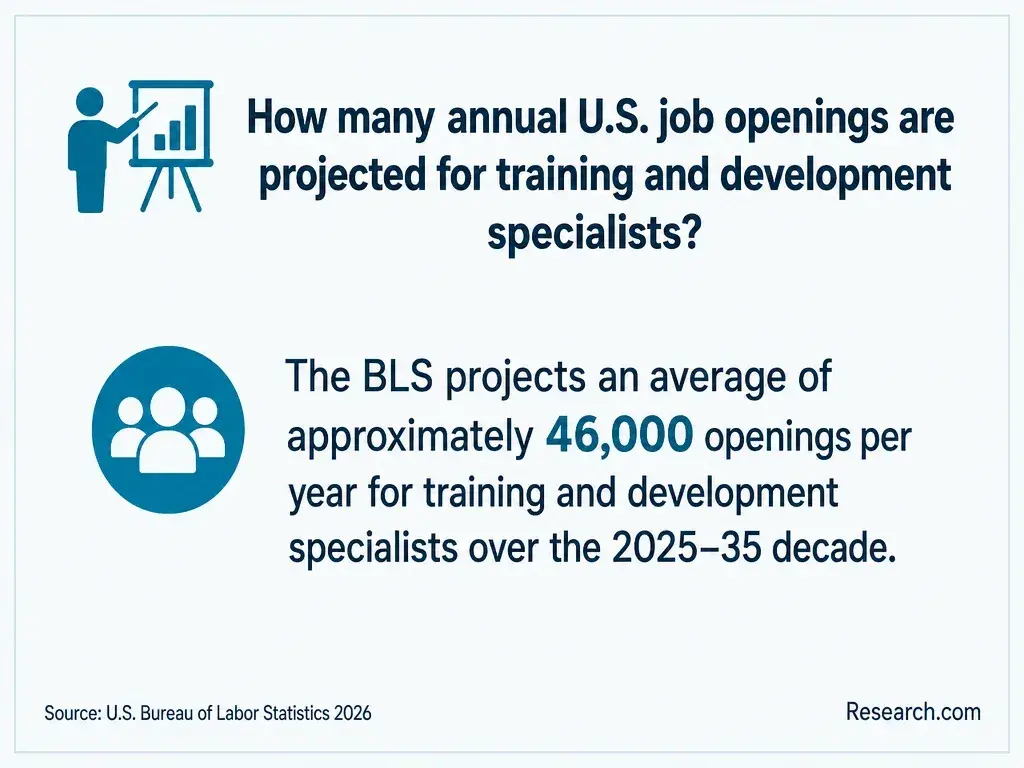
The degree does not substitute for sector knowledge or management experience. The U.S. Bureau of Labor Statistics projects 10.8% employment growth for training and development specialists from 2025 to 2035, but that occupation does not generally require an Ed.D. If your target role primarily calls for hands-on evaluation or project leadership, building that experience may be a more direct step than doctoral enrollment.
There is no reliable single salary for graduates of a broadly defined leadership and learning Ed.D. Pay depends on occupation, sector, location, and prior responsibility. The U.S. Bureau of Labor Statistics reports a May 2025 median annual salary of $133,000 for training and development managers. That figure describes workers in an occupation - not new Ed.D. graduates, not a doctoral wage premium, and not a forecast of your earnings.
Use the compensation range for your target job and employer as the financial comparison. A project may strengthen an advancement case by demonstrating relevant responsibility, but a promotion or salary increase remains an employer decision.
Does This Ed.D. Require a Professional License or Certification?
A general organizational leadership and learning Ed.D. does not itself confer a professional license or certification for service improvement work. Some target jobs - particularly regulated school leadership positions - have separate state requirements. Verify the program's licensure disclosures and the relevant licensing authority's rules if such a role is your goal.
Likewise, a course in coaching, evaluation, or change management is not the same as an independently awarded certification. Choose any additional credential because a target employer or role values it, not because it is assumed to come with the doctorate.
Other Things You Should Know About EdD Leadership
Potentially. Confirm that the program accepts the setting and that the organization can authorize the work. Volunteer participation does not remove privacy, consent, or oversight considerations.
Tell the advisor promptly. Ask whether the scope, data source, or site can change under program rules, and document what information you may retain or must delete.
Only within the organization's sharing and intellectual-property rules. Seek permission, remove confidential material, and describe your own contribution and the findings' limitations accurately.
Check organizational data rules and program policy first; do not upload restricted feedback to an unapproved tool. Review any permitted output against the original evidence and avoid presenting generated summaries as participant statements.
- Ways to Approach the Quality Improvement Process | Agency for Healthcare Research and Quality https://www.ahrq.gov/cahps/quality-improvement/improvement-guide/4-approach-qi-process/index.html
- Quality Measures: Types, Selection, and Application in Health Care Quality Improvement Projects - PMC https://pmc.ncbi.nlm.nih.gov/articles/PMC10229016/
- Privacy and Data Sharing | Protecting Student Privacy https://studentprivacy.ed.gov/privacy-and-data-sharing
- Building Evidence for a New Intervention or Program Takes Time | The Administration for Children and Families https://acf.gov/opre/report/building-evidence-new-intervention-or-program-takes-time
- Quality Improvement Activities FAQs | hhs.gov https://www.hhs.gov/ohrp/regulations-and-policy/guidance/faq/quality-improvement-activities/index.html
- When Do They Require IRB Review? | bu.edu https://wwwapp.bumc.bu.edu/ocr/ClinicalResearchNewsletter/article.aspx
- The IHI Model for Improvement - QPSi Knowledgebase https://knowledge.qpsi.med.ufl.edu/qi-foundations/improvement-models/ihi-model-for-improvement/
- What Is a Problem of Practice? Definition, Examples, and Writing Tips - JHU School of Education https://education.jhu.edu/news/what-is-a-problem-of-practice-definition-examples-and-writing-tips/
- What Is an Applied Doctoral Project? ADP vs Dissertation | UAGC https://www.uagc.edu/blog/what-applied-doctoral-project-adp-vs-dissertation