2027 Paying for an Online Ed.D. in Leadership and Learning in Organizations: A Foundation Grant for Leadership Development
Audited and Verified:
Our Editorial and Data Verification Process
Research.com uses government datasets, official education statistics and primary institutional information to support its career and degree guides. Our review process checks factual accuracy, occupational definitions, source dates and the requirements associated with the credentials discussed.
How This Article Was Fact-Checked
Our editorial team verifies salary estimates, employment projections, education requirements and program information against original data providers and official organizations. Salary figures are checked against the relevant occupational definitions and reporting periods. Information about licensure, accreditation and required in-person training is reviewed separately.
Fact-checked and verified on:

Co-Founder and Chief Data Scientist
A foundation grant could make an online Ed.D. in leadership and learning more affordable - but only if the award can actually be used for your tuition and the remaining cost fits your budget. This guide is for working leaders and learning professionals considering doctoral study for organizational improvement or career development. It explains how to verify grant eligibility, compare the full cost of attendance, and judge whether the degree is worth pursuing even if funding falls short.
Key Things You Should Know
- A foundation grant is not automatically available to an Ed.D. student: confirm the eligible recipient, permitted expenses, award period, and payment process before counting it toward tuition.
- Compare the grant with the entire degree budget - not just tuition - including fees, required travel, and any amount you must pay before reimbursement.
- Do not assume a grant makes the doctorate financially worthwhile; compare the remaining cost with your leadership goals, employer support, and shorter development options.
What Is an Online Ed.D. in Leadership and Learning in Organizations?
An Ed.D. in leadership and learning in organizations is a practice-oriented doctorate concerned with how people learn, lead, and implement change at work. Depending on the program, students may study adult learning, organizational development, leadership, and applied research, then complete a dissertation in practice or another approved doctoral project. "Online" describes the primary delivery method; it does not establish that every class is asynchronous or that campus visits are unnecessary.
The degree can fit an experienced training manager, nonprofit leader, or public-sector professional who needs to evaluate and improve a real organizational practice. It is less direct than a focused certificate or employer leadership program if the immediate goal is one skill, such as facilitation. Program titles do not guarantee identical curricula, so use guidance on reviewing Ed.D. specializations and degree fit to identify the courses and applied work that matter to your goal.
How Can a Foundation Grant Help Pay for an Online Ed.D.?
A foundation grant is funding awarded under a foundation's stated purpose and conditions. An award to an individual for graduate education may help pay an Ed.D. bill. A grant to a nonprofit or university for leadership development, however, is not automatically a scholarship its employees or students can use. The grant agreement - not the appealing title of the initiative - controls who receives the funds and how they may be spent.
Before treating a prospective award as part of your financing plan, ask the foundation or administering organization for written answers to these questions:
- Is an individual pursuing an online professional doctorate eligible, or is the award restricted to an institution or organization?
- Which expenses are allowed: tuition, mandatory fees, books, travel, research costs, or living expenses?
- Is payment made to the student, the university, or an employer, and when will it arrive relative to the tuition deadline?
- Does the award require a particular field, employer, project, enrollment level, academic standing, or continued service?
- Can it be combined with university aid and employer assistance, and what happens if enrollment or employment changes?
For a community-serving organization, a foundation might instead support a defined leadership-development project involving staff learning or program evaluation. That possibility should not be recast as personal tuition funding without the funder's authorization. Obtain any required organizational, university, and project approvals separately. If no confirmed grant exists, build the enrollment decision around verified resources rather than a hoped-for award.
How Much Does an Online Ed.D. in Leadership and Learning Cost?
There is no reliable single price for this degree. Universities may charge per credit, per term, or by program, and the advertised tuition figure may omit required expenses. The table separates costs a grant might cover from costs a working student may still need to finance.
| Cost | What to verify | Why it matters to a grant-funded student |
| Tuition and mandatory fees | Published rate, required credits or terms, fee schedule, and possible rate changes | A tuition-only award may leave fees unpaid. |
| Online study and campus convenings | Technology requirements, required visits, travel, and lodging | Location flexibility does not eliminate travel costs. |
| Time away from work or caregiving | Workload, leave arrangements, and household support needs | These costs may be substantial even when they are not billed by the university. |
| Applied project | Approved project expenses and available university support | Data collection or project-related travel may not be grant-eligible. |
| Extended enrollment | Continuation fees and charges beyond the planned schedule | An award may end before the degree does. |
Request an individualized, term-by-term estimate from each university and a written award budget from the grant administrator. Subtract only confirmed, usable funding from the expenses it actually covers; separately check when payments are due. Programs listed among affordable distance learning education doctorates can be a starting point, but compare current program-specific charges and required travel before deciding which is affordable for you.
Verify that the degree-granting university holds recognized institutional accreditation and that the Ed.D. is an authorized degree offering. Check the accreditor's status and the university's program listing directly; an accredited university's marketing description alone does not establish what a particular Ed.D. prepares graduates to do.
If your grant names eligible institutions or accreditors, ask its administrator whether the program qualifies before accepting an award or enrolling. Likewise, a general organizational leadership Ed.D. should not be assumed to satisfy teacher, principal, or superintendent licensure requirements. Anyone pursuing a regulated role should confirm the specific program and state requirements with the university and relevant licensing authority.
Requirements vary by university. Programs may ask for a completed graduate degree, transcripts, a statement of purpose, recommendations, a résumé documenting professional responsibilities, and evidence that the applicant can pursue an applied organizational problem. Some use interviews or specify professional-experience thresholds. A leadership title, education master's degree, or test score is not universally required.
If you have prior advanced study, distinguish credits considered for admission from credits accepted toward the Ed.D.; only the institution can evaluate the latter. Applicants with an education specialist degree can investigate Ed.S.-to-Ed.D. admission and study options, then request a written program-specific credit assessment. When considering a foundation award, also check whether admission and grant deadlines align: eligibility for one does not secure the other.
Relevant programs commonly combine leadership and organizational learning with research or evaluation methods. Useful coursework might address adult learning and learning transfer, organizational diagnosis, change implementation, stakeholder engagement, and interpreting evidence about an intervention. The depth of each topic - and whether it is required or elective - must be checked in the actual curriculum.
For a grant tied to leadership development, look beyond a course title. Ask whether students can evaluate a leadership-development initiative, receive faculty guidance on feasible measures, and report limitations responsibly. An applied project may demonstrate how a leader frames a problem and uses evidence, but it does not by itself prove that a training intervention caused better organizational outcomes.
Online study may let an employed leader remain in their community or organization while completing doctoral work. Campus study may offer more in-person access to peers and facilities. Neither format is inherently cheaper or easier: the consequential differences are attendance rules, travel, faculty access, project support, and the schedule you can sustain.
Ask each program for its live-class timetable, required campus dates, group-work expectations, accessibility arrangements, and rules for missed sessions. Then test those obligations against your job and any grant conditions. A foundation that funds online tuition but excludes travel, for example, may make an otherwise attractive hybrid program difficult to afford.
Completion time depends on the program's course sequence, enrollment rules, and doctoral-project requirements. A published schedule is a planning scenario, not a guarantee: project approval, organizational data access, or a leave of absence can change both the finish date and the amount owed.
Ask the program for its required sequence, maximum time to completion, continuation charges, and policies if a workplace project becomes unavailable. Ask the grant administrator whether funding continues during delayed or reduced enrollment. Returning doctoral students considering unfinished education doctorate study and completion choices should obtain a written evaluation rather than assuming previous work will shorten this degree.
Potential directions include learning and development management, organizational development, workforce training leadership, consulting, nonprofit program leadership, and some education-administration roles. Fit depends heavily on prior experience: an established learning professional might use doctoral study to strengthen evaluation and change leadership, while a career changer may still need direct experience in the target function.
Before committing personal funds or pursuing a restricted grant, compare the degree with actual job descriptions and speak with people who hire for your intended role. For a college-sector goal, online organizational leadership Ed.D. choices for college leaders can help frame a more focused program search. A shorter credential, mentorship, or an employer-sponsored project may be the better investment if a doctorate is not needed for the responsibilities you seek.
What Salaries and Job Outlook Can Ed.D. Graduates Expect?
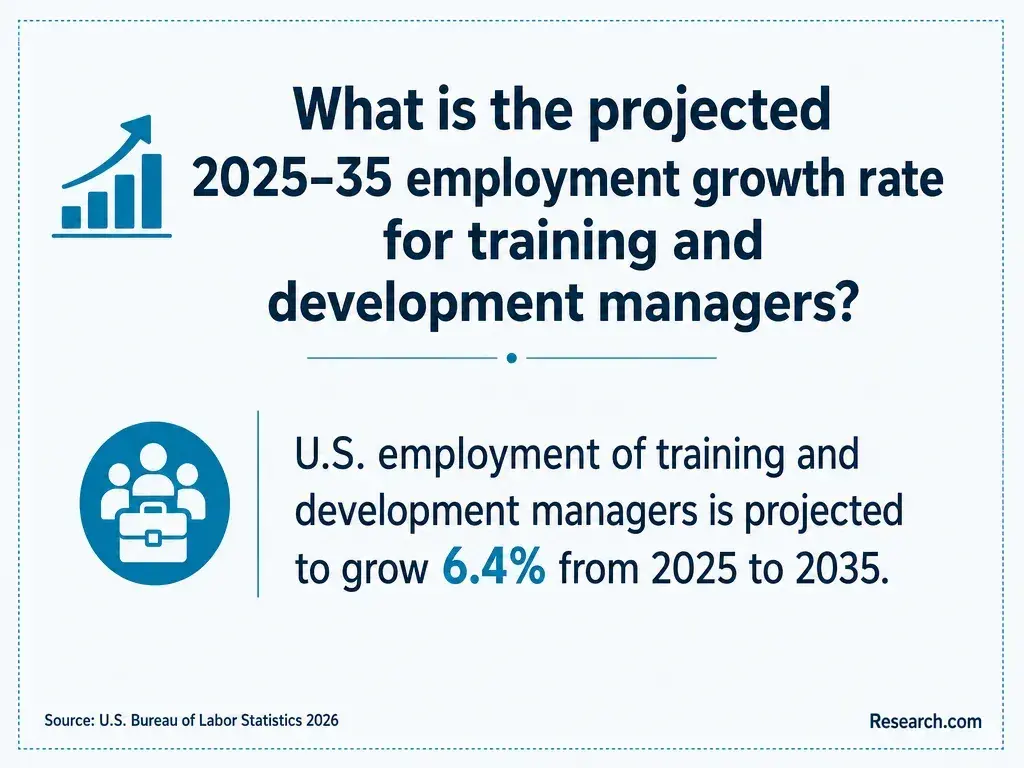
There is no single Ed.D. graduate salary: employers pay for an occupation, responsibilities, experience, and location - not the degree title alone. The U.S. Bureau of Labor Statistics reports a median annual salary of $133,000 for training and development managers in May 2025 and projects 6.4% employment growth for that occupation from 2025 to 2035. Those figures describe the occupation as a whole, not new Ed.D. graduates or a likely raise after enrollment.
Use the occupation closest to your target job when assessing the investment, then compare its requirements with your existing experience. A grant lowers the price you pay, but it does not establish that a promotion will follow. If the degree's remaining cost depends on an unconfirmed salary increase to be manageable, reconsider the financing plan or a lower-cost development route.
Other Things You Should Know About EdD Leadership
Only if its application rules allow it. Some foundations accept applications from individuals; others fund invited organizations or institutions. Check the published eligibility and application process before preparing a proposal.
It may, if the award permits those expenses and the university and project site approve the work. Funding does not replace permission to access organizational data or any required ethics review.
Tax treatment depends on who receives the award and how the funds are used. Review the award documentation and applicable IRS guidance or consult a qualified tax professional rather than assuming the entire grant is tax-free.
Ask the university's financial aid and billing offices how it posts outside awards and whether a credit or refund is possible. Do not assume a later award will reimburse an earlier payment; the foundation's terms and university procedures both matter.
- Packaging Aid | 2025-2026 Federal Student Aid Handbook https://fsapartners.ed.gov/knowledge-center/fsa-handbook/2025-2026/vol3/ch3-packaging-aid
- Overview of Grant Process | cdc.gov https://www.cdc.gov/grants/life-cycle-overview/index.html
- Types of Financial Aid: Grants, Work-Study, and Loans | studentaid.gov https://studentaid.gov/understand-aid/types
- Qualified Ed expenses | Internal Revenue Service https://www.irs.gov/credits-deductions/individuals/qualified-ed-expenses
- Tuition | NYU Steinhardt EdD in Leadership & Innovation https://leadershipinnovation.steinhardt.nyu.edu/tuition/
- EdD in Educational Leadership | How to Apply | USC Rossier https://rossier.usc.edu/programs/doctoral/educational-leadership/educational-leadership-application-instructions/
- Tuition and Financial Aid - UNC-Chapel Hill Online https://online.unc.edu/online-doctoral-programs/online-edd-organizational-learning-and-leadership/admissions/tuition-financial-aid/
- EDLPS: EDD Program | Florida International University Catalog https://catalog.fiu.edu/programs/EDLPS:EDD/requirements-uz47h
- EdD in Educational Leadership - The University of Alabama | UA Online https://online.ua.edu/degrees/edd-in-educational-leadership/
- Frequently Asked Questions | University of Arizona Office of Scholarships & Financial Aid https://financialaid.arizona.edu/faqs