2027 Online Ed.D. in Leadership and Learning in Organizations: Designing a Project About Change Readiness
Audited and Verified:
Our Editorial and Data Verification Process
Research.com uses government datasets, official education statistics and primary institutional information to support its career and degree guides. Our review process checks factual accuracy, occupational definitions, source dates and the requirements associated with the credentials discussed.
How This Article Was Fact-Checked
Our editorial team verifies salary estimates, employment projections, education requirements and program information against original data providers and official organizations. Salary figures are checked against the relevant occupational definitions and reporting periods. Information about licensure, accreditation and required in-person training is reviewed separately.
Fact-checked and verified on:

Co-Founder and Chief Data Scientist
A change-readiness project can help an organization decide whether it can implement a proposed change - and what must happen first. For an online Ed.D. student, the challenge is to turn that practical question into a feasible academic project without mistaking employee enthusiasm for proof that a change will succeed.
This guide is for leaders and learning professionals considering such a project. It explains how to define the decision, gather credible evidence, protect participants, and choose an Ed.D. program whose project requirements fit the work.
Key Things You Should Know
- Assess readiness for a specific proposed change, among defined groups and at a defined point in time - not an organization's general attitude toward change.
- Examine both willingness and ability: stakeholder trust, leadership support, workload, skills, systems, and decision authority can point to different implementation needs.
- Before collecting employee or learner information, obtain the required organizational permissions and ask the Ed.D. program what academic and ethics review applies.
What is an online Ed.D. in Leadership and Learning in Organizations?
An Ed.D. in Leadership and Learning in Organizations is a practice-oriented doctorate concerned with how people learn, lead, and improve organizations. Programs with similar names can differ substantially: one may emphasize workplace learning and organizational change, while another centers on education administration. "Online" describes where much instruction occurs, not necessarily the attendance schedule or project format.
For a change-readiness project, the degree is most useful when coursework and faculty guidance connect organizational diagnosis, adult learning, applied inquiry, and implementation. Compare actual degree requirements rather than assuming a concentration from the title alone; an overview of types of Ed.D. programs and concentrations can help frame that comparison. If the goal is simply to support one upcoming rollout, a focused change-management course or employer-sponsored project may be faster and less costly than a doctorate.
How does an online Ed.D. compare with a campus-based doctoral program?
Either format can support a rigorous organizational project. The meaningful difference is access: an online student may investigate a current workplace while remaining employed, whereas a campus-based student may have more routine in-person contact with faculty and research peers. Neither format automatically supplies an organizational sponsor, data access, or permission to study employees.
Ask about required live sessions, group meetings, campus convenings, advisor availability, and whether a project may use an external partner. An online format is a poor fit if its fixed meetings or travel requirements conflict with the periods when the student must meet stakeholders and collect evidence. A campus program may be preferable when its faculty expertise or local partnerships are central to the proposed project.
What accreditation should an online Ed.D. program have?
Confirm that the institution holds recognized institutional accreditation and that the credential awarded is the Ed.D. the program advertises. Check the accreditor's scope and the university's current accreditation listing rather than inferring status from a marketing page. Accreditation does not establish that a particular change-readiness project will be approved, that the curriculum covers a preferred method, or that the degree qualifies a graduate for a regulated role.
Request the program handbook or project guidelines as well. They are more useful than an accreditation label for determining who approves the proposal, what evidence is acceptable, and whether the final deliverable is an individual dissertation in practice, a team capstone, or another form of applied work.
Relevant coursework may address leadership, organizational learning, adult learning, change, research methods, and program evaluation. Titles alone do not show whether students practice designing measures, analyzing organizational data, or reporting limitations. Ask for course descriptions and a sample sequence, including when project planning and faculty feedback begin.
For this project, methods preparation matters as much as change theory. A student should be able to distinguish a poorly understood change from weak implementation capacity, choose defensible questions, and explain why a survey, interviews, or existing operational records can answer them. If the program offers little preparation in those tasks, identify what mentoring or additional study would fill the gap before proposing employee data collection.
Change readiness is the extent to which the people and systems involved are prepared to undertake a particular change. A useful project informs a real decision, such as whether to launch a new staff-development process across an organization or pilot it in one unit first. It does not claim to predict success from a single readiness score.
For example, a nonprofit considering a new volunteer-training system could examine whether coordinators understand the proposed workflow, have time to use it, and can access the necessary technology. Those are possible questions, not findings about any organization. The following sequence turns such a proposal into a manageable academic deliverable:
- Specify the decision and boundaries. Name the proposed change, decision-maker, affected groups, project site, and decision date. State what a "proceed," "pilot," or "revise" recommendation would inform.
- Agree on sponsorship and authority. Identify who can authorize access, explain the change, protect staff from pressure to participate, and act on recommendations. Obtain faculty approval for the academic scope separately from employer support.
- Map plausible readiness factors. Examine understanding, perceived value, trust, leadership support, available time, skills, tools, and competing priorities. Do not assume that a request for training rules out a workload or systems problem.
- Choose evidence that fits the decision. Consider existing implementation plans or help-desk records, a short anonymous questionnaire, and voluntary interviews. Document who may be missed, how questions were developed, and what each source can - and cannot - show.
- Set access and ethics rules before collection. Check organizational permission, confidentiality and retention requirements, consent language, applicable employment or education-record protections, and whether institutional research review is required. Do not assume a workplace evaluation is automatically exempt from review.
- Analyze differences without exposing people. Look for patterns across authorized groups and evidence sources, but suppress or combine small groups when responses could identify individuals. Separate reported perceptions from verified resource or process constraints.
- Deliver a usable recommendation. Present the decision, methods, limitations, readiness barriers, responsible owners, and actions to test before rollout. Specify what evidence would prompt a revised decision rather than declaring the organization "ready."
The final report should give an executive sponsor a concise decision brief and give the faculty advisor enough detail to assess methods and reasoning. A confidential appendix may hold instruments or analysis details if the program and organization permit it; a public portfolio version may need substantial redaction. Compare applied-project routes through an education doctorate only after confirming that a school's actual capstone or dissertation rules allow this kind of deliverable.
Requirements vary. Programs may ask for prior graduate study, transcripts, recommendations, a statement of purpose, and evidence of professional leadership or organizational problem-solving. A proposed change-readiness project can demonstrate fit, but applicants should describe the problem and their role honestly - not promise access, participant cooperation, or results they do not yet have.
Ask admissions which academic credentials establish eligibility, then ask the program separately whether your prospective organization and project type could satisfy its applied-work requirements. Prior doctoral study may affect the conversation, but it does not automatically transfer or shorten the degree. Applicants returning to Ed.D. study after reaching ABD status should request a written evaluation of credits and completion requirements.
Both depend on the school's required credits, enrollment pace, tuition structure, and project milestones. A workplace-based project can reduce travel to a research site, but it may add time for permissions, recruitment, analysis, and revisions. Ask what happens to enrollment and charges if the organization delays access or changes its plans.
Build a personal cost estimate from published tuition and required fees, then add any campus travel, software or data costs, and time away from paid work. Check whether employer reimbursement requires continued employment or particular grades. Aid comparisons for higher education leadership doctoral costs after financial aid may suggest questions to ask, but they cannot substitute for a written estimate and aid offer for the specific program under consideration.
Experienced graduates may apply their learning in organizational development, learning and development leadership, workforce development, consulting, or education administration. In these roles, a credible change-readiness project can show how the candidate defined a decision, worked with stakeholders, interpreted imperfect evidence, and proposed feasible action. It does not replace experience leading implementation or meeting an employer's sector-specific requirements.
The target role should shape the project. A training leader might emphasize learning transfer and staff capacity; a public-sector manager may need to account for governance and procurement; a college administrator may focus on institutional stakeholders. Readers targeting that last path can explore comparing organizational leadership Ed.D. pathways for college administration while checking the experience each position actually requires.
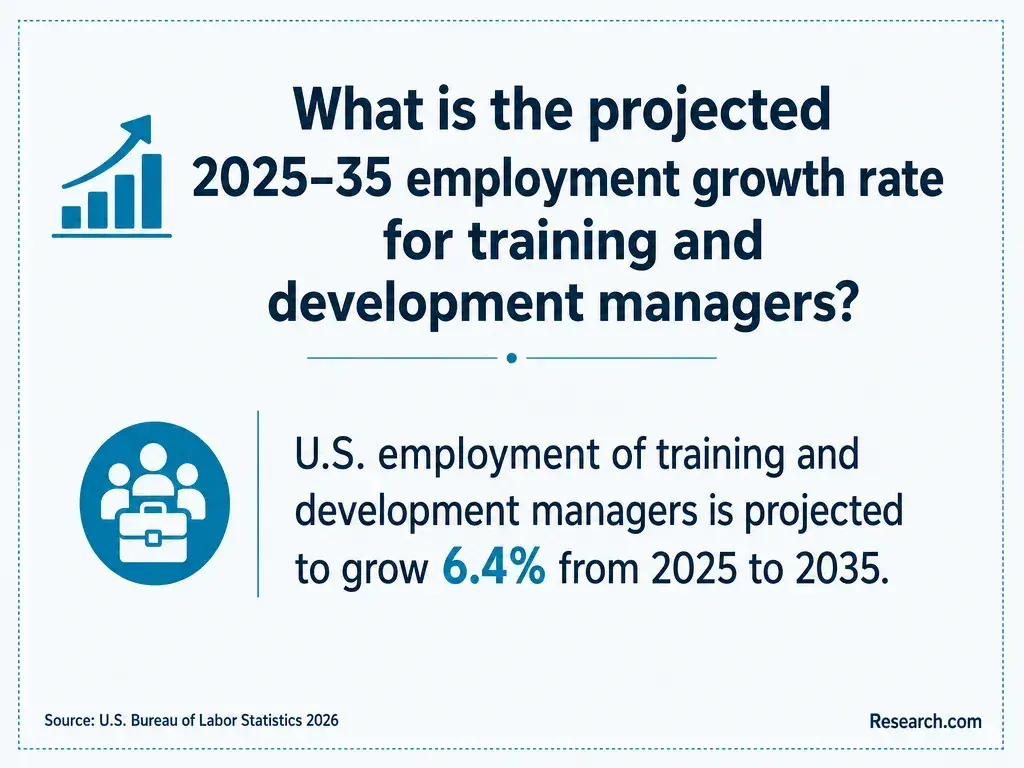
There is no reliable single salary for holders of this degree; pay depends on occupation, experience, employer, and location. The US Bureau of Labor Statistics reports a median annual salary of $133,000 for training and development managers in May 2025. That is an occupational median, not a starting salary or an expected outcome for Ed.D. graduates.
Evaluate the degree against a specific role and plausible advancement path. If an employer values demonstrated change leadership more than a doctorate for that role, completing a smaller organizational project may offer a better immediate return.
Does an online Ed.D. require a license or professional certification?
Organizational leadership and learning roles generally do not require a license merely because the degree is an Ed.D. The doctorate also does not itself award a change-management certification or authorize practice in a regulated education role. Requirements for school administration or other licensed positions depend on the state and the specific position.
If licensure is part of your career goal, obtain the program's written licensure disclosure and check the relevant state authority before enrolling. If the goal is to lead an internal change-readiness assessment, clarify organizational authority and research oversight instead; those permissions matter more to the proposed project than a professional title.
Other Things You Should Know About EdD Leadership
Tell your advisor promptly. The program may permit a revised question, a different partner, or another project, but only its academic authorities can approve the change.
Only if its questions fit the specific change and you have permission to use and report it. A branded score is not automatically more informative than a well-designed, clearly limited assessment.
That depends on the program. Confirm how individual contributions, organizational permissions, and final assessment work before committing colleagues or a partner organization.
Assign owners to the recommended actions and decide what to check before implementation. Readiness can change as staffing, resources, or the proposed change itself changes.
- CDC Program Evaluation Framework, 2024 | MMWR https://www.cdc.gov/mmwr/volumes/73/rr/rr7306a1.htm
- Qualitative Methods in Implementation Research - PMC - NIH https://pmc.ncbi.nlm.nih.gov/articles/PMC7023962/
- What Is Ethics in Research & Why Is It Important? | National Institute of Environmental Health Sciences https://www.niehs.nih.gov/research/resources/bioethics/whatis
- Evaluate the intervention | WHO FCTC https://extranet.who.int/fctcapps/fctcapps/fctc/kh/article12/evaluate-intervention
- Walden University's Guide to Doctoral Capstone Projects https://www.waldenu.edu/online-doctoral-programs/resource/guide-to-doctoral-capstone-projects
- Online Ed.D. in Leadership and Learning in Organizations | VU-EDU https://peabodyonline.vanderbilt.edu/edd-in-organizational-learning/
- What Topics Do EdD Students Research in the EdD Program? | Fairfield University https://www.fairfield.edu/news/insights/education-human-development/what-topics-do-edd-students-research.html
- Research Ethics and Informed Consent | Educational Research Basics by Del Siegle https://researchbasics.education.uconn.edu/ethics-and-informed-consent/
- Doctoral dissertation or capstone: how to choose the right program | PhD/Doctorate | Capella University Blog https://www.capella.edu/blog/phd-doctorate/the-difference-between-a-dissertation-and-doctoral-capstone/