2027 Online Ed.D. in Leadership and Learning in Organizations: Degree Fit for Leaders Tackling High-Potential Employees Leaving for External Opportunities
Audited and Verified:
Our Editorial and Data Verification Process
Research.com uses government datasets, official education statistics and primary institutional information to support its career and degree guides. Our review process checks factual accuracy, occupational definitions, source dates and the requirements associated with the credentials discussed.
How This Article Was Fact-Checked
Our editorial team verifies salary estimates, employment projections, education requirements and program information against original data providers and official organizations. Salary figures are checked against the relevant occupational definitions and reporting periods. Information about licensure, accreditation and required in-person training is reviewed separately.
Fact-checked and verified on:

Co-Founder and Chief Data Scientist
When high-potential employees leave for external opportunities, a new training program may not address the reason they went. Limited advancement, weak management, pay, and unclear career paths call for different decisions.
For talent development professionals and organizational leaders, an online Ed.D. in Leadership and Learning in Organizations may build the skills to diagnose those problems and evaluate solutions, but it is a substantial investment. This guide explains where doctoral study can help, where it cannot, and what to check before choosing a program.
Key Things You Should Know
- An Ed.D. is most useful when you can influence talent systems and investigate why valued employees leave; it cannot substitute for competitive pay, available roles, or management accountability.
- Start with authorized evidence about internal mobility, development access, and departures before choosing a retention intervention. An outside offer alone does not establish why someone left.
- The U.S. median annual pay for training and development managers was $133,000 in May 2025, according to the Bureau of Labor Statistics; that occupational figure is not an Ed.D. graduate salary or a projected return on tuition.
What is an online Ed.D. in Leadership and Learning in Organizations?
An Ed.D. is a practice-oriented Doctor of Education. Programs focused on leadership and learning in organizations typically examine how adults develop, how leaders shape organizational systems, and how to evaluate change. Online describes where much of the instruction occurs, not necessarily a self-paced schedule: programs may require live classes, group work, campus visits, or an applied doctoral project.
For a leader concerned about high-potential turnover, the relevant question is whether the curriculum connects organizational diagnosis, talent development, and evidence-based implementation. "Leadership and Learning in Organizations" is not a universal degree title or curriculum; confirm the exact award and requirements at each school. This is also distinct from an education leadership doctorate specifically designed for school-administrator preparation.
Is an online Ed.D. in Leadership and Learning worth it for advancing organizational talent?
It can be worth considering if you already lead talent, learning, or organizational change; have access to decisions and appropriate evidence; and need sustained practice in diagnosing and evaluating complex problems.
It is less compelling if the immediate obstacle is an uncompetitive pay structure, a hiring freeze that blocks promotion, or leaders who will not permit internal moves. Those constraints require organizational decisions, not another credential.
The comparison below separates the capability you need from the credential that might develop it. It describes typical emphases, not guaranteed features of any individual program.
| Pathway | Most relevant use | Principal limitation for this problem |
| Leadership and learning Ed.D. | Long-term organizational diagnosis, adult learning, change leadership, and applied evaluation | Substantial cost and time; requires authority or partners to act on findings |
| Targeted organizational development or talent training | Filling a defined gap in succession planning, coaching, or workforce analytics | May not provide the breadth or sustained inquiry of a doctorate |
| Employer-led retention initiative | Changing internal mobility rules, manager incentives, job design, or compensation | Depends on executive commitment and implementation capacity |
A PhD generally fits someone seeking a more research-intensive academic pathway; a DBA may better suit a business-research objective. Neither is inherently a better retention credential.
Before taking on doctoral costs, compare your likely access to projects and employer support with comparing affordable education doctorate pathways. The strongest case for an Ed.D. is a durable need to lead and evaluate organizational learning work, not an expectation that the letters alone will stop departures.
How can this Ed.D. help reduce high-potential employee turnover?
Doctoral study can improve how a leader defines the problem, tests assumptions, and assesses an intervention. It does not establish that development opportunities are the cause of departures. "High-potential" should also have a documented, reviewable meaning: if managers nominate employees inconsistently, a retention initiative can reinforce unequal access to opportunity.
A practical investigation starts by separating what is observed from what is inferred. With employer authorization, examine patterns in voluntary departures, internal applications, promotions, development participation, and manager changes.
Compare those records with appropriately collected employee perspectives. Exit interviews can suggest explanations, but departing employees may not disclose every reason, and a correlation between low promotion rates and exits does not prove causation.
The resulting decision sequence is more useful than launching training by default:
- Define whose departures matter to the organization and check whether the high-potential designation is applied fairly.
- Identify plausible barriers, such as scarce openings, blocked transfers, inadequate coaching, pay, or work conditions, and determine which leaders can change them.
- Choose an intervention matched to the barrier, with a baseline, implementation owner, and measures such as internal movement, development access, and voluntary exits.
- Review results and unintended effects, including whether opportunities improved for employees outside the designated group.
An Ed.D. project might help a leader evaluate part of this work, subject to faculty approval, employer permission, and applicable privacy and research-review rules.
Employee records and interview responses should not be assumed available for coursework or publication. Even a promising before-and-after result requires caution: hiring conditions and other simultaneous changes can affect turnover.
Course titles and depth vary. For this retention problem, useful study would connect adult learning and learning transfer with organizational development, leadership, talent systems, and program evaluation.
Research-methods courses should help you frame answerable questions, assess the quality of HR measures, conduct appropriate qualitative or quantitative inquiry, and communicate uncertainty to decision-makers.
Look beyond a course labeled "leadership." A program may teach coaching but offer little on internal labor markets; another may emphasize research methods without much practice implementing change.
Ask for the current course sequence and applied-project requirements, then check whether you can study career development and internal mobility without treating employees as merely a dataset. An elective or course topic is not necessarily a formal concentration.
Requirements vary by institution. Programs may request a qualifying prior degree, transcripts, a statement of purpose, recommendations, a résumé, and evidence of relevant professional work; some also use interviews or specify academic thresholds. An education degree or senior job title is not universally required.
Stronger evidence for this topic is responsibility for talent or organizational decisions, a clearly bounded problem you hope to investigate, and realistic access to support, not a claim that you already know why employees leave.
Ask admissions to distinguish credits considered when assessing eligibility from credits that would actually satisfy doctoral requirements. If you have unfinished doctoral work, Ed.D. pathways for students with prior doctoral study can help frame questions, but only the institution can determine whether prior work applies.
Also ask the program whether an employer-sponsored or external project is necessary and what happens if your workplace access changes.
Completion time depends on the program's credit requirements, course sequence, enrollment pace, and doctoral project. An online format may remove routine commuting without removing scheduled seminars, team meetings, campus convenings, or project deadlines. Those commitments matter when the retention work also depends on busy HR partners and senior leaders.
Request a term-by-term plan showing when methods courses and project approvals occur, along with the program's leave and continuation policies. Compare advertised fast-paced online Ed.D. study formats against the time you can actually reserve for coursework and authorized workplace inquiry. A shorter published schedule is not useful if the necessary data access or organizational sponsorship will not be ready.
There is no dependable single price for this degree: schools set different tuition structures, credit requirements, fees, and travel obligations. For a realistic budget, obtain the current tuition schedule and calculate required credits or terms, mandatory fees, technology charges, any campus travel, and likely continuation costs if the project extends beyond the standard sequence. Account separately for time away from paid work.
Employer assistance can change the decision, but verify reimbursement limits, grade rules, continued-employment conditions, and any repayment obligation in writing. Do not compare tuition alone with a manager's occupational median salary; that median says nothing about your likely promotion or pay change. A cost-focused selection of a Doctor of Education program is a starting point for finding options, not a substitute for a school-specific total-cost estimate.
Relevant paths include talent development leadership, organizational development, training management, and consulting. A training and development manager typically oversees learning strategy, staff, budgets, and program evaluation; a management analyst may advise organizations on performance and change.
Advancement into either role depends heavily on demonstrated responsibility and employer needs, not simply degree completion.
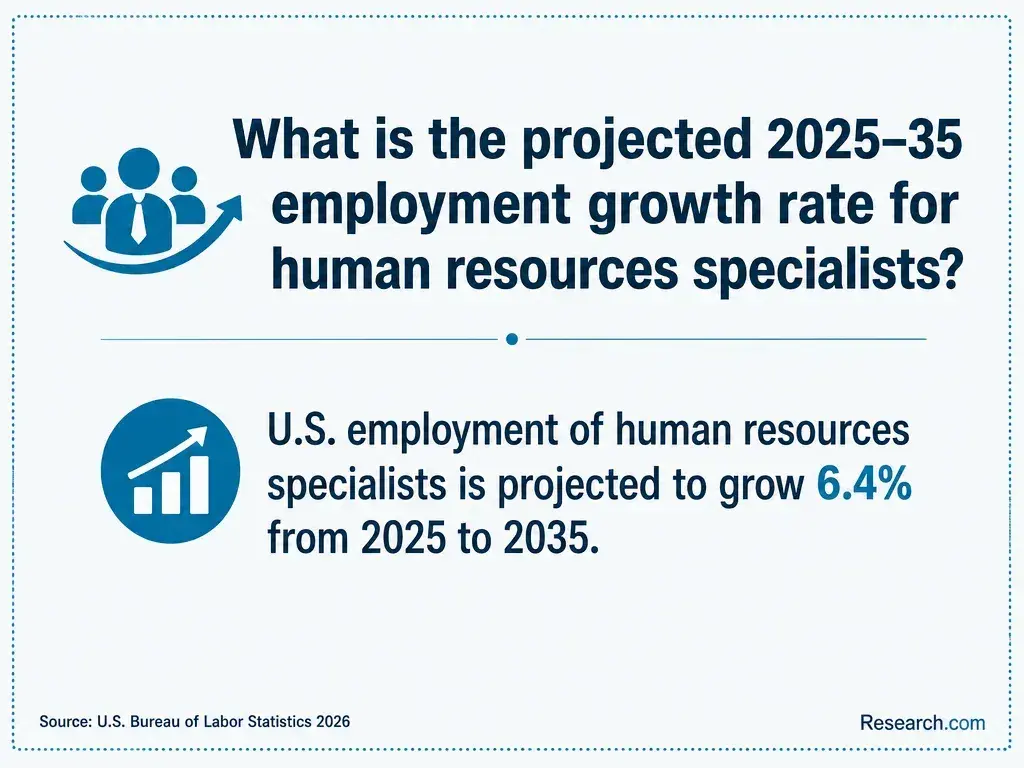
For context, the Bureau of Labor Statistics reports a May 2025 U.S. median annual salary of $133,000 for training and development managers and projects 6.4% employment growth for the occupation from 2025 to 2035. These figures describe an occupation across workers with varied backgrounds; they do not measure this degree's outcomes.
Leaders moving from campus talent work may also consider college leadership development through organizational leadership doctoral study, while checking the hiring rules and compensation structure of their target institution.
A general leadership and learning Ed.D. does not, by itself, grant an HR certification, executive appointment, or educator license. If your target job requires a particular credential, especially a regulated school leadership role, check the program's written licensure disclosures and the relevant state authority's requirements before enrolling. Do not infer eligibility from institutional accreditation or from a course on educational leadership.
How should you choose an accredited online Ed.D. program?
First, confirm the institution's accreditation and its status with a recognized accreditation authority. Then verify the exact degree, current curriculum, online attendance rules, required visits, doctoral deliverable, and published cost for your proposed entry term. Accreditation establishes an institutional quality baseline; it does not establish that a program fits a talent-retention objective.
For this particular goal, ask faculty and program staff whether students can examine organizational talent questions, what approvals a workplace project needs, and how a project proceeds if an employer changes or denies access.
Seek examples of the types of completed projects and the support available for methods and ethics, without expecting access to confidential employee findings. Choose a program only if its academic obligations fit your authority, schedule, budget, and ability to put evidence into practice.
Other Things You Should Know About EdD Leadership Programs
There is no universal rule. Decide how the designation is defined, reviewed, and communicated with HR and legal stakeholders. Be transparent about actual opportunities without promising promotion or implying that other employees cannot develop.
Possibly, but "anonymous" must be accurate. Small teams and combined demographic details can make responses identifiable. Obtain employer authorization and follow the program's instructions on privacy and research review before collecting or sharing responses.
That may be a mobility-policy and incentive issue rather than a training gap. Bring the pattern to leaders with authority over transfer rules and manager expectations; avoid attributing an individual departure to that practice without evidence.
Yes. You can review authorized workforce information, clarify internal career paths, improve coaching, and seek targeted support now. Doctoral study is an option for developing deeper inquiry and change-leadership capabilities, not a prerequisite for taking responsible action.
- Online EdD in Organizational Leadership | Pepperdine University https://gsep.pepperdine.edu/doctorate-organizational-leadership/
- EdD in Educational Leadership | USC Rossier https://rossier.usc.edu/programs/doctoral/educational-leadership/
- What Can You Do with a Doctorate in Education (Ed.D.)? | Rockhurst University https://onlinedegrees.rockhurst.edu/blog/doctorate-education-edd
- Lack of growth opportunities is a big reason why employees leave jobs. Here's how to change that | apa.org https://www.apa.org/topics/healthy-workplaces/growth-opportunities
- Explore the Cross-Sectoral Career Impact of an Online EdD | nyu.edu https://leadershipinnovation.steinhardt.nyu.edu/cross-sectoral-career-impact-of-an-online-education-doctorate/
- 5 Benefits of Corporate Employee Training & Development | Harvard Business School https://online.hbs.edu/blog/post/employee-training-development
- What Topics Do EdD Students Research in the EdD Program? | Fairfield University https://www.fairfield.edu/news/insights/education-human-development/what-topics-do-edd-students-research.html
- What Can You Do With an EdD in Leadership? Top Careers | University of the Cumberlands https://www.ucumberlands.edu/blog/what-can-you-do-with-an-edd-in-leadership
- To keep employees, focus on career advancement | MIT Sloan https://mitsloan.mit.edu/ideas-made-to-matter/to-keep-employees-focus-career-advancement