2027 Is an Online Ed.D. in Leadership and Learning in Organizations a Good Fit for Community College Partnership Managers?
Audited and Verified:
Our Editorial and Data Verification Process
Research.com uses government datasets, official education statistics and primary institutional information to support its career and degree guides. Our review process checks factual accuracy, occupational definitions, source dates and the requirements associated with the credentials discussed.
How This Article Was Fact-Checked
Our editorial team verifies salary estimates, employment projections, education requirements and program information against original data providers and official organizations. Salary figures are checked against the relevant occupational definitions and reporting periods. Information about licensure, accreditation and required in-person training is reviewed separately.
Fact-checked and verified on:

Co-Founder and Chief Data Scientist
Community college partnership managers work across employers, faculty, workforce agencies, and student services - but coordinating those relationships is not the same as leading institution-wide change. An online Ed.D. in Leadership and Learning in Organizations may help you move toward broader responsibility, especially if you want to evaluate and improve how partnerships work. It is also a substantial commitment with no automatic promotion attached. This guide helps you judge the degree against your career goal, the work you already do, and less costly ways to gain the skills you need.
Key Things You Should Know
- Best fit: An Ed.D. is most useful when you want to lead cross-institutional change and evaluate partnership outcomes - not simply qualify for another partnership manager opening.
- Career reality: The US Bureau of Labor Statistics reports a $104,590 median annual salary for postsecondary education administrators in 2025, but that occupation-wide figure is not an Ed.D. graduate salary.
- Before enrolling: Confirm the program's applied-project rules, live attendance, full cost, and whether your target roles value a doctorate more than demonstrated partnership results.
Is an online Ed.D. in Leadership and Learning in Organizations right for community college partnership managers?
Yes, potentially - if your next role requires you to lead and assess change across organizations. Partnership managers often negotiate employer relationships, coordinate noncredit or credit-bearing pathways, and reconcile different priorities among faculty, students, employers, and public agencies. A practice-oriented Ed.D. can add methods for diagnosing organizational problems, leading collaborative change, and evaluating whether an initiative works.
The distinction is between managing agreements and improving a partnership system. For example, increasing the number of employer agreements is not necessarily the same as improving student participation, completion, or access to jobs. Doctoral study may be worthwhile if you have - or are moving toward - authority to examine those outcomes and change how partners make decisions. It is less compelling if your immediate goal is better contract administration, grant compliance, or employer outreach; supervised projects, targeted training, or mentorship may address those needs faster.
Use your target job descriptions as a reality check. If they emphasize a doctorate or advanced applied research, investigate Ed.D. programs. If they emphasize workforce-sector knowledge, budget ownership, and a record of building partnerships, prioritize evidence of that work before taking on doctoral costs.
What does an online Ed.D. in Leadership and Learning in Organizations teach?
These practice-oriented doctorates typically combine leadership and organizational learning with applied inquiry. Organizational learning concerns how institutions develop, share, and use knowledge; for a partnership manager, that might mean understanding why lessons from one employer collaboration do not carry over to another. Relevant study can include adult learning, organizational change, stakeholder engagement, program evaluation, and qualitative or quantitative methods.
The value lies in connecting those subjects. A manager might investigate whether a workforce program's low participation reflects outreach, scheduling, eligibility rules, or another constraint before proposing more training or marketing. Coursework can strengthen that reasoning, but course exposure alone does not establish expertise in labor-market analysis, grant management, or college finance. Compare actual syllabi and applied assignments with the skills your next role requires.
What careers can community college partnership managers pursue with an Ed.D.?
The most plausible move is usually into a role adjacent to your existing experience, with wider responsibility. An Ed.D. may strengthen your case for advancement, but hiring committees will also examine your budgets, supervisory experience, partnership results, and knowledge of the institution.
The following distinctions can help you identify a credible next step rather than treating all higher education leadership jobs as interchangeable.
| Possible role | What the work adds to partnership management | Evidence to build alongside the degree |
| Director of workforce or employer partnerships | Program strategy, staff and budget oversight, employer relationships | Implemented partnerships and documented program decisions |
| Dean or administrator overseeing continuing education | Broader academic operations, governance, and resource allocation | Experience working with faculty, enrollment, budgets, and institutional policy |
| Regional workforce or nonprofit leader | Coordination across colleges, agencies, funders, and employers | Cross-organization implementation and evaluation experience |
| Organizational improvement consultant | Diagnosis and evaluation for multiple clients | A portfolio of authorized projects and client-facing work |
For a move into senior college administration, evaluating an organizational leadership Ed.D. for higher education work can help frame program comparisons. A broadly focused doctorate does not substitute for experience with academic governance or make someone automatically eligible for a dean or executive appointment.
Requirements vary by institution. Programs commonly assess prior graduate education, professional experience, academic transcripts, recommendations, and a statement explaining your goals. Some may request an interview or evidence of research readiness. Do not assume that an education master's degree, a particular job title, or a fixed number of management years is universally required.
As a partnership manager, describe decisions you actually influenced: which stakeholders you coordinated, what problem you addressed, what evidence you used, and where your authority ended. A proposed question about partnership effectiveness can show doctoral readiness without claiming that you already have research approval or access to student records.
If you hold an education specialist degree, ask separately whether it supports admission and whether any coursework can satisfy degree requirements; those are different decisions. Resources on Ed.S. progression into an online Ed.D. can help you identify questions, but only the admitting institution can evaluate your transcript and award applicable credit.
An online format can let you remain employed and connected to local college partners while studying. It does not necessarily make the doctorate self-paced. Live seminars, cohort meetings, group assignments, campus convenings, and intensive project stages may still compete with evening employer events or changing academic calendars.
A campus-based program may offer easier in-person access to faculty and local research networks, but commuting or relocation can make it impractical. Neither format is inherently better preparation for partnership leadership; compare faculty guidance, opportunities to study your own setting, peer collaboration, and the time you can reliably protect for coursework.
Before applying, request the published attendance and travel requirements and ask how the program handles an employer change during an applied project. When reviewing fast-paced online Ed.D. study formats, test the proposed pace against your busiest partnership cycles - not just an ordinary workweek.
Look for a combination of adult learning, organizational change, higher education or public-sector leadership, and program evaluation. Adult learning can inform workforce program design; change and systems coursework can address coordination across departments; evaluation methods can help distinguish an active partnership from one that produces useful outcomes. A course bearing the word "partnership" is less important than assignments that let you examine real cross-organization decisions.
For applied research, a feasible question might be how a college and its employers identify barriers to participation in a training pathway. That is a proposed line of inquiry, not a diagnosis or a claim of impact. Before planning interviews or using learner records, confirm faculty oversight, college and partner permission, applicable privacy rules - including FERPA where relevant - and whether institutional research review is required. Ask what the program actually requires: a dissertation in practice, another capstone format, or a different doctoral deliverable.
Both answers depend on the specific program's required credits, enrollment pace, tuition structure, and final-project rules. Published minimum completion times may not reflect the time a working manager needs to secure project access or complete revisions. Request a term-by-term plan and ask what happens to tuition and enrollment status if the project takes longer than planned.
Compare the full cost of completion, not an advertised tuition rate alone: required credits, fees, books or technology, any campus travel, and time away from paid work. Ask your college whether doctoral study qualifies for education assistance, what grades or continued employment reimbursement requires, and whether repayment obligations apply. There is no sound return-on-investment calculation without both a verified cost and a realistic career alternative.
When comparing affordable education doctorate pathways, check that each quoted figure covers the same costs and enrollment assumptions. The least expensive advertised option is not necessarily the least costly one to finish.
Community college partnership management generally does not depend on an Ed.D.-specific license. An organizational leadership doctorate is an academic degree, not a professional certification or automatic authorization to practice in a regulated role. Employers may instead prioritize experience with workforce programs, contracts, grants, or college administration.
If your goal changes to a position with state-specific licensure or other credential rules, check that position's requirements with the responsible authority and the program's disclosures. Do not infer licensure eligibility from a school's accreditation or from leadership courses in its curriculum.
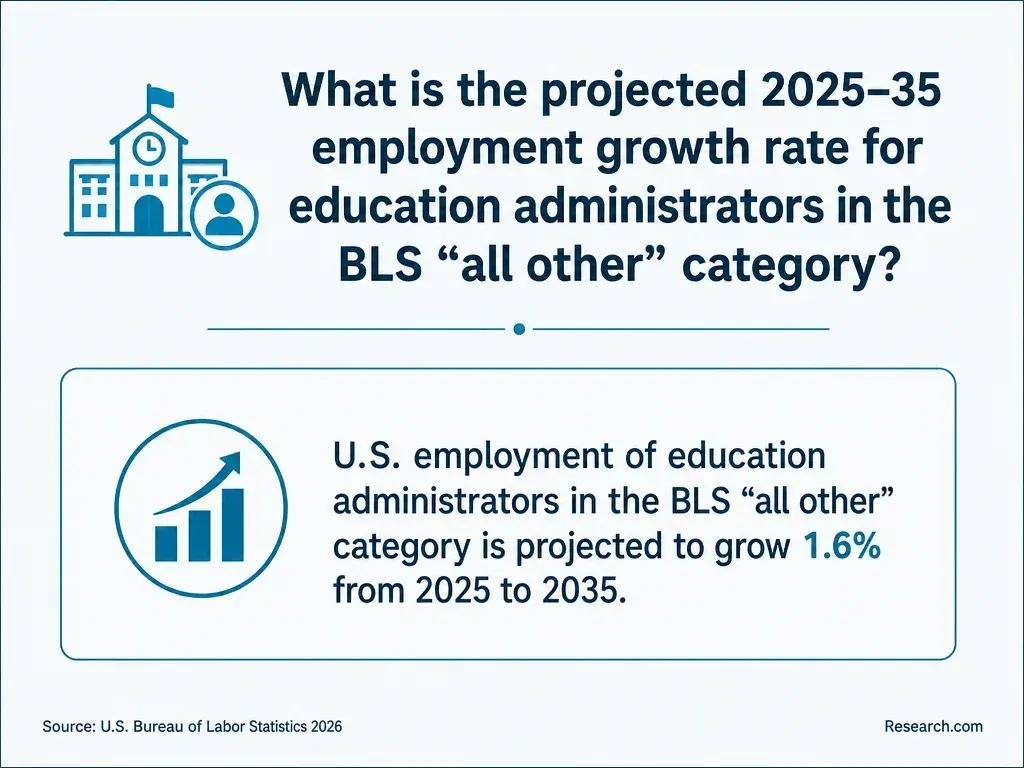
The US Bureau of Labor Statistics reports a $104,590 median annual salary for postsecondary education administrators in 2025 and projects 1.8% employment growth from 2025 to 2035. These figures describe a broad occupation - not community college partnership managers specifically, not starting offers, and not the earnings of Ed.D. graduates. The modest projected growth also makes a doctorate an unreliable substitute for a strong record of institutional leadership.
For your decision, compare actual vacancies in your region or college system: required versus preferred degrees, salary ranges, supervisory duties, and opportunities for internal advancement. Public-college pay structures and hiring procedures may limit the immediate financial benefit of earning another credential.
How can you choose an accredited online Ed.D. program?
Start by confirming the institution's accreditation through the recognized accreditor and verifying the exact degree awarded. Then judge whether the curriculum and applied-project structure serve your partnership leadership goal. Institutional accreditation matters, but it does not establish that a program offers a partnership specialization, guarantees employer recognition, or meets a separate licensure requirement.
Before committing, obtain answers from each program to the questions most likely to change your decision:
- Which required courses address organizational learning, applied evaluation, and leadership across institutions?
- What are the live-session, group-work, and campus-convening requirements for my entry term?
- What final project is required, and can it involve an approved community college or external partner?
- What is the estimated cost through completion, including fees and potential extra enrollment terms?
- What faculty guidance and career support are available to working higher education professionals?
Compare written answers with your college's tuition-assistance policy. Guidance on reducing higher education leadership doctoral study costs can help you explore funding routes, but confirm every award and reimbursement condition directly before counting on it.
Other Things You Should Know About EdD Leadership
No. Pay classification depends on your employer's position rules, applicable agreements, and the job you hold. Ask human resources whether the doctorate affects your current classification before treating a raise as part of the degree's value.
Usually you can describe your responsibilities and decisions, but avoid sharing confidential terms, identifiable student information, or an employer's documents without permission. A carefully anonymized account is often more appropriate.
It may support an application, but teaching eligibility depends on the subject, course level, institutional policy, and your disciplinary qualifications. Ask the relevant academic department what credentials it requires.
Consider a focused graduate certificate, professional development, or a stretch assignment leading a cross-department initiative. Those routes may build the experience you want without committing to a doctoral research requirement.
- Understanding College Costs | studentaid.gov https://studentaid.gov/resources/prepare-for-college/students/choosing-schools/consider-costs
- Cost of Attendance (Budget) | 2025-2026 Federal Student Aid Handbook https://fsapartners.ed.gov/knowledge-center/fsa-handbook/2025-2026/vol3/ch2-cost-attendance-budget
- Accreditation in the U.S. | ed.gov http://www.ed.gov/laws-and-policy/higher-education-laws-and-policy/college-accreditation/accreditation-in-the-us
- Careers Leaders Can Pursue with an Ed.D. | Peabody Online | VU-EDU https://peabodyonline.vanderbilt.edu/edd-in-organizational-learning/edd-careers/
- Ed.D. in Executive Leadership - Degrees & Requirements | Columbia University https://www.tc.columbia.edu/organization-and-leadership/edd-in-executive-leadership/degrees--requirements/executive-leadership-edd/
- Considering Student Workload | CITT - University of Florida https://citt.it.ufl.edu/resources/course-design-basics/develop-and-implement/considering-student-workload/
- Educational Leadership (Community College Leadership), Ed.D. | UNCW https://www.uncw.edu/academics/majors-programs/wce/educational-leadership-community-college-leadership-edd/
- Community College Leadership Doctoral Program | K-State https://coe.k-state.edu/academics/program-areas/community-college-leadership/
- UNC EdD Online: Organizational Learning and Leadership https://online.unc.edu/online-doctoral-programs/online-edd-organizational-learning-and-leadership/
- Build Community Partnerships in Higher Education With an Ed.D | YSU https://online.ysu.edu/degrees/education/edd/higher-ed-leadership-administration/build-community-partnerships/