2027 Online Ed.D. in Leadership and Learning in Organizations: Comparing Coursework in Digital Credentialing
Audited and Verified:
Our Editorial and Data Verification Process
Research.com uses government datasets, official education statistics and primary institutional information to support its career and degree guides. Our review process checks factual accuracy, occupational definitions, source dates and the requirements associated with the credentials discussed.
How This Article Was Fact-Checked
Our editorial team verifies salary estimates, employment projections, education requirements and program information against original data providers and official organizations. Salary figures are checked against the relevant occupational definitions and reporting periods. Information about licensure, accreditation and required in-person training is reviewed separately.
Fact-checked and verified on:

Co-Founder and Chief Data Scientist
A course titled "digital credentialing" can mean anything from designing badges to evaluating whether employees actually use newly learned skills. For learning and development professionals considering an online Ed.D. in Leadership and Learning in Organizations, that difference matters: the useful program is the one that supports the credentialing decisions you expect to lead. This article compares the coursework and applied experiences behind those decisions, then covers the degree, format, cost, and career considerations needed to choose a sensible path.
Key Things You Should Know
- Compare what students design and evaluate, not whether a catalog mentions badges: strong preparation connects learning objectives, assessment evidence, credential records, and organizational goals.
- A digital badge or microcredential may be a course topic, an elective project, or an institutionally issued award; none of those automatically constitutes a formal Ed.D. specialization or professional certification.
- The US median annual pay for training and development managers was $133,000 in May 2025, but that occupational figure is not an expected salary or pay increase for Ed.D. graduates.
What is an online Ed.D. in Leadership and Learning in Organizations?
An Ed.D. in Leadership and Learning in Organizations is a practice-oriented doctorate concerned with how people learn, how organizations change, and how leaders use evidence to improve practice. "Online" describes where much instruction occurs, not necessarily a self-paced program. Degree names and requirements vary; a program with similar wording may emphasize workplace learning, education administration, or organizational change.
For a professional building a workforce credentialing initiative, the degree's value lies in connecting learning design to leadership decisions: which skills matter, whose evidence counts, and whether the initiative serves employees and the organization fairly. It is a broader commitment than training on a badge platform. Applicants who already hold an education specialist degree can examine Ed.D. pathways building on education specialist study, while confirming separately whether any prior credits would apply to a particular doctorate.
What coursework does an online Ed.D. in Leadership and Learning include?
Leadership and learning curricula commonly draw on adult learning, organizational change, learning design, research methods, and evaluation. Digital credentialing may appear within those courses rather than as a course or concentration of its own. The comparison below shows what different curricular emphases contribute to credentialing work - and what each leaves unresolved.
| Coursework emphasis | Contribution to digital credentialing | Likely limitation on its own |
| Adult learning and instructional design | Aligns skill claims, learning activities, and assessments. | May give little attention to organizational adoption or credential records. |
| Leadership and organizational change | Addresses stakeholder trust, implementation, and the use of credentials in talent decisions. | May not teach assessment design in depth. |
| Research methods and program evaluation | Supports questions about participation, learning, transfer, and unintended effects. | Does not by itself establish technical badge expertise. |
| Learning technology and data governance | Examines issuing systems, accessibility, evidence access, and privacy. | Platform familiarity can become outdated without broader design principles. |
For an experienced instructional designer, evaluation and change coursework may close a larger gap than another design class. A leader new to learning and development may need the reverse. Compare required courses, available electives, assignments, and the culminating project - not just catalog keywords. A prior doctoral learner considering Ed.D. pathways for students with prior doctoral study should also confirm how much coursework and what new research or project work the receiving institution requires.
How does digital credentialing fit into Ed.D. leadership programs?
Digital credentialing is the practice of defining, assessing, issuing, and managing electronic records of achievement. A digital badge can display an accomplishment; a microcredential generally denotes a defined, assessed set of competencies. Neither label alone tells an employer how rigorous the assessment was. A useful doctoral project might examine a proposed credential for supervisor coaching, including its assessment rubric, issuance rules, and evaluation plan - not simply create an attractive badge.
The decisive coursework moves across three levels: learning - what evidence demonstrates a skill; systems - how recipients and employers can inspect and verify that evidence; and governance - who may issue, correct, expire, or revoke a credential. A course that covers only badge software may prepare someone to operate a platform, but not to justify the credential's claims or evaluate its effects.
When comparing syllabi, look for assignments that require students to defend assessment criteria, consider accessibility, and distinguish completion from demonstrated competence. If workplace data would be used, ask about employer permission, privacy safeguards, and the program's review process. An applied evaluation can investigate whether a credentialing initiative is working; it cannot establish organizational impact merely by counting badges issued.
Delivery mode affects access to coursework and collaborators more than the underlying credentialing concepts. An online cohort may let a working professional examine a live workplace initiative, yet still require scheduled classes, group meetings, or campus visits. Campus-based study may offer more in-person contact but require commuting or relocation. Neither format guarantees access to a suitable project site or a digital credentialing elective.
Before choosing a format, request the actual class schedule, residency calendar, elective rotation, and project requirements for the entry term. For a student balancing employment with study, a missed live session or an unavailable elective may matter more than the "online" label. Those weighing lower-cost distance learning in doctoral leadership study should compare required travel and time away from work alongside tuition.
Requirements depend on the institution. Programs may request graduate transcripts, evidence of professional experience, recommendations, a statement of purpose, and an interview; acceptable degrees, grades, tests, and experience definitions must be checked with the admissions office. An education master's or a job title such as "director" is not a universal prerequisite.
For a credentialing-focused application, describe a real learning or workforce problem you have encountered, the decisions you were responsible for, and what you still need to learn about assessment or evaluation. Distinguish an initiative you proposed from one you implemented. If you hope to study it during the doctorate, ask whether the program requires organizational access or sponsorship, but do not assume an employer's interest amounts to project approval.
Completion time depends on the required coursework, enrollment pace, course availability, and dissertation or applied-project milestones. Published schedules are plans, not guarantees - particularly when an employer-based project needs permissions or data access. Ask for the program's credit requirements, expected sequence, maximum time to completion, and rules for taking leave.
Compare the full financial commitment: tuition, mandatory fees, technology, required travel, and any income lost to reduced work hours. Employer reimbursement may depend on grades, continued employment, or an annual limit. Because charges and aid change by institution and entry term, obtain a written estimate rather than treating an advertised per-credit figure as a total price. A comparison of Ed.D. program costs for prospective doctoral students can help frame questions, but the institution's current charges and your funding terms should control the decision.
Confirm that the degree-granting institution holds recognized institutional accreditation and that the Ed.D. is an authorized degree at that institution. Check the accreditor and the school's current status directly through the institution and the relevant accreditation records. Accreditation applies to the institution or a stated programmatic scope; it does not establish that a particular digital credentialing course is rigorous.
For this topic, inspect the academic evidence as well: faculty expertise, current syllabi, assessment and research-methods requirements, and the rules governing the culminating project. Do not infer a formally awarded digital credentialing concentration from one elective or a badge issued for completing a course.
The closest fit is often an established learning and development, talent development, organizational development, or workforce leader seeking greater responsibility for learning strategy and evaluation. Credentialing initiatives may require collaboration with instructional designers, HR teams, technology staff, managers, and legal or privacy specialists; a doctorate does not replace their functional expertise.
A professional already leading training programs could use doctoral work to build a carefully documented assessment framework or evaluation plan. Someone seeking an initial credential-design role may get there more directly through design experience, a portfolio, and targeted training. University employees considering leadership roles can also compare organizational leadership Ed.D. programs for university professionals, while checking the hiring requirements of their target positions. The strongest career case for the Ed.D. is responsibility for complex decisions, not possession of the degree alone.
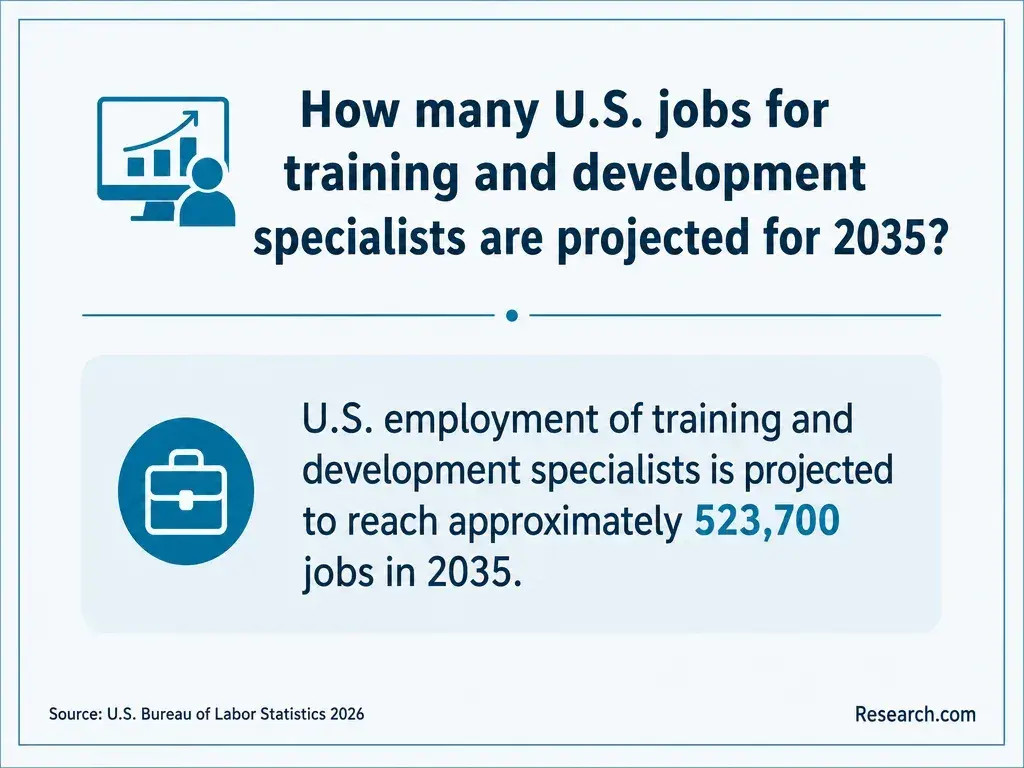
US Bureau of Labor Statistics figures place the May 2025 median annual pay for training and development managers at $133,000, with employment projected to grow 6.4% from 2025 to 2035. Those figures describe an occupation across employers and education backgrounds - not Ed.D. graduates or digital credentialing specialists. They are most relevant if you already have, or can credibly build, the management experience the role requires.
Before using a salary figure to justify tuition, compare actual openings in your sector with your experience and current compensation. A nonprofit, public agency, university, and corporation may assign different budgets and authority to similarly titled learning roles. No occupational median establishes that the doctorate will produce a raise or promotion.
Does an online Ed.D. lead to professional licensure or certification?
A general Ed.D. in organizational leadership and learning does not automatically confer teacher, principal, or superintendent licensure, nor does it award a separate professional certification in digital credentialing. An institution may issue its own course badge, but that is distinct from the doctoral degree and from an independently awarded certification.
If a regulated education role is your goal, obtain the program's licensure disclosure and confirm eligibility with the relevant state authority before enrolling. If your goal is to administer a particular credentialing platform, check the platform provider's training requirements instead. These are different decisions from choosing doctoral coursework in assessment, organizational change, and evaluation.
Other Things You Should Know About EdD Leadership
Possibly, if the program accepts it and you have permission to share the badge and supporting evidence. Redact confidential employee or organizational information; a badge alone may not demonstrate your contribution.
Ownership depends on employer policies, project agreements, and university rules. Clarify reuse and publication rights before building a doctoral assignment around proprietary rubrics, content, or data.
Make its requirements and evidence understandable without relying only on color, images, or a single interaction method. Check the issuing platform's accessibility features and the needs of intended recipients.
It can if the issuer's rules and technical system support those actions. For skills that change or require ongoing authorization, compare the issuer's renewal and revocation policies with what a recipient or verifier can actually see.
- Frequently Asked Questions | Protecting Student Privacy https://studentprivacy.ed.gov/frequently-asked-questions
- Aligning Student Learning Outcomes With Assessment | AACSB https://www.aacsb.edu/insights/articles/2022/09/aligning-student-learning-outcomes-with-assessment
- Ed.D. Admissions - Peabody | Vanderbilt University Online https://peabodyonline.vanderbilt.edu/edd-in-organizational-learning/admissions/
- Is an Online Doctor of Education, Leadership and Innovation Right For You? | nyu.edu https://leadershipinnovation.steinhardt.nyu.edu/is-an-online-doctorate-in-education-leadership-right-for-you/
- Course Accessibility Plan | Access and Disability Resources https://radr.rutgers.edu/resource/course-accessibility-plan
- Definitions - Microcredentials - UMBC https://microcredentials.umbc.edu/definitions/
- ADA Title II Update: New Requirements for Digital Course Content Accessibility | Undergraduate Education https://ue.berkeley.edu/news/ada-title-ii-update-new-requirements-digital-course-content-accessibility
- Microcredentialing and Digital Badging at Rutgers University https://academicaffairs.rutgers.edu/microcredentialing-and-digital-badging
- Digital Credentials - Rutgers Policy Library https://policies.rutgers.edu/B.aspx
- Digital Credentials | College of Lifetime Learning - Georgia Tech https://www.lifetimelearning.gatech.edu/digital-credentials